
Isaiah of Rostov
Our Father among the Saints Isaiah the Wonderworker, Bishop of Rostov
Bishop · Wonderworker · Venerable · b. early 11th century, near Kiev — d. May 15, 1090, at Rostov
Commemorated 15 May — Repose at Rostov in 1090, 23 May — Uncovering of the incorrupt relics at Rostov, 1164; kept also with the Synaxis of the Saints of Rostov and Yaroslavl
Isaiah was a monk of the Kiev Caves, tonsured by St Theodosius, who was set over the princely monastery of St Demetrius in Kiev and then, about 1077, sent as bishop of Rostov — a see that then covered an enormous and only half-converted territory in the north-east of Rus'. For thirteen years he travelled it with apostolic persistence, preaching against idolatry and sorcery, burning the idols, building churches, and adorning the cathedral of the Dormition at Rostov; the Paterikon remembers him above all as merciful to the poor and a nourisher of orphans. The Kiev Caves tradition relates that an angel bore him to Kiev for the consecration of the Great Church of the Lavra on 14 August 1089, when there had been no time to summon the bishops. He reposed on 15 May 1090, and his relics were found incorrupt in 1164 when the foundations of the new stone cathedral at Rostov were dug. He is one of the three great hierarchs of Rostov — Leontius, Isaiah and Ignatius — and is called the Wonderworker.

Origins and the Kiev Caves
Isaiah was born in the early eleventh century in the country near Kiev, of Christian parents who brought him up in the faith and had him taught his letters. As a young man he turned from the prospects open to him and came to the Monastery of the Caves, then in the first generation of its greatness, and was tonsured by St Theodosius, its igumen and the founder of the common life in Rus'. The Paterikon's praise of him is the standard praise of that house and is worth taking seriously as a description of its formation: strictness in fasting and in prayer, and beyond that humility, obedience and chastity — that is, the specifically cenobitic virtues rather than the feats of the solitary. He was of the same school and the same decade as the other founders of Russian monasticism, and his later work as a bishop is unintelligible apart from it.
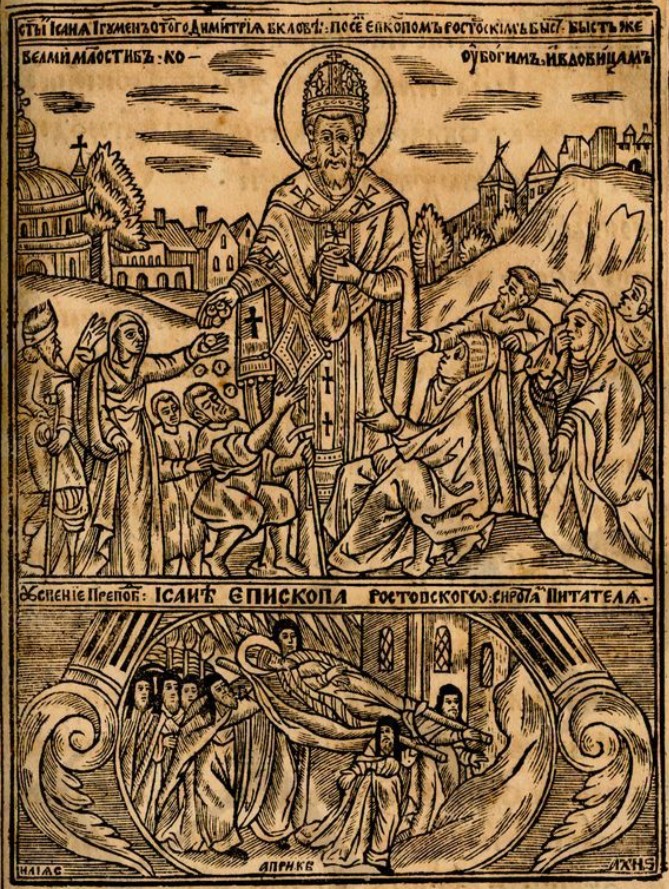
When Barlaam, the first igumen of the Caves, who had been transferred by Prince Iziaslav Yaroslavich to the new princely monastery of the Great Martyr Demetrius that the prince had built by his palace, died, Isaiah was chosen — at Iziaslav's request and by St Theodosius' appointment — to succeed him as igumen of St Demetrius'. The Caves monastery thus supplied the abbot for the prince's foundation, and Isaiah spent years in Kiev governing a house that stood at the point where the monastic and the princely worlds met. The 1661 woodcut of his life still labels him, in its upper inscription, "igumen of that monastery of Demetrius."
Bishop of Rostov
About 1077–1078 Isaiah was consecrated bishop of Rostov, in succession to St Leontius, who had been killed or driven out by the pagans of the region. The diocese was enormous — the lands that later became the principalities and provinces of Rostov, Suzdal, Yaroslavl, Vladimir, Nizhny Novgorod, Kostroma and Vologda — and it was in no sense a Christian country. The Merya and the Finnic peoples of the Volga–Kliazma watershed were still largely pagan; even in the towns the faith was thin, and sorcery, divination and the old sacrifices were normal. Leontius' fate showed what the office could cost.
Isaiah's method, as the notices describe it, was circuit and confrontation. He travelled the diocese continually, preaching Christ in villages that had never heard the Gospel coherently, arguing against the folly of the idols, gathering and instructing those who received baptism, and burning the idols where he found them — the same combination of patience and iconoclasm that marks the missionary bishops of the northern Slavonic lands. Where he made Christians he built them churches and gave them clergy.
At Rostov itself he completed and adorned the cathedral church of the Dormition of the Most Holy Theotokos, on which the see's authority rested; the work was helped by the prince Vladimir Monomakh, and the church received a wonderworking icon of the Mother of God ascribed to St Alypius of the Caves, the first named iconographer of Rus'. The Paterikon's remembered epithet for him, repeated in the inscriptions of the woodcut, is not "the missionary" or "the builder" but that he was exceedingly merciful to the poor, to widows and to orphans — a nourisher of orphans. It is a useful reminder of what the office looked like from the inside: the bishop of a frontier diocese was also its principal almoner.
The angel and the consecration of the Great Church, 1089
The most celebrated episode of his life is told by the Kiev Caves Paterikon. On the fourteenth of August 1089 the great church of the Dormition of the Caves Lavra — the church begun by Theodosius and finished after his death — was to be consecrated by Metropolitan John of Kiev. There had been no time to send for the bishops of the distant sees. Yet on the day, to the metropolitan's astonishment, the bishops arrived: Isaiah of Rostov, Luke of Belgorod and John of Chernigov all presented themselves, and Isaiah declared that an angel of God had appeared to him, commanded him to attend the consecration of the church of the Mother of God, and brought him from Rostov to Kiev. The three served the consecration with the metropolitan. Whatever judgement is made on the miracle, the notice preserves a real fact of ecclesiastical history: the Rostov see, remote as it was, belonged to the Caves and its bishop came from that house, and the Paterikon is claiming him.
Repose
Isaiah reposed on the fifteenth of May 1090, after some thirteen years as bishop, and was buried in the Dormition cathedral at Rostov. The lower register of the 1661 woodcut depicts the scene, inscribed "the repose of the venerable Isaiah, bishop of Rostov, nourisher of orphans."
Relics and later veneration
In 1164, while the foundations were being dug for the new stone cathedral raised by Prince Andrei Bogoliubsky at Rostov, two coffins came to light: those of St Leontius and of Isaiah. Isaiah's was opened on the twenty-third of May, and the vestments and the body were found incorrupt. The relics were laid in the new church, and the day of the uncovering became a second commemoration; it is also the day of the Synaxis of the Saints of Rostov and Yaroslavl, in which Isaiah stands with Leontius and Ignatius as one of the founding hierarchs of the region.
Formal ecclesiastical veneration is usually dated from 1474, when the relics were translated with honour; in 1722 they were enclosed in a silver reliquary. In 1920 the Soviet authorities opened and publicly exhibited the relics, as they did with many Russian shrines, and afterwards returned them. The honourable head of St Isaiah is today kept in the Serapion chamber of the Kiev Caves Lavra, and a portion of the relics was translated to the Dormition cathedral at Rostov on 5 June 1999 — which is the twenty-third of May by the Old Calendar, the day of the uncovering, an eight-hundred-and -thirty-five-year echo deliberately arranged.
Feast and commemoration
May 15 (church date; New Calendar civil May 15, Old Calendar civil May 28) — his repose; and May 23 (Old Calendar civil June 5) — the uncovering of the relics in 1164, kept also as the Synaxis of the Saints of Rostov and Yaroslavl. The commemoration is Russian and is carried by the Slavic calendars and by the Orthodox Church in America; it is not in the Greek or Antiochian books, where the day belongs to Pachomius the Great and Achilles of Larissa. At Rostov he is honoured with Leontius and Ignatius as one of the three founding hierarchs of the see, and at the Kiev Caves Lavra among the fathers of the house who became bishops.
Hymns
Apolytikion — Tone 4 (common of a hierarch)
O God of our fathers, who dealest with us ever according to Thy gentleness: take not Thy mercy from us, but by the prayers of Isaiah direct our life in peace.
Kontakion — Tone 2 (common of a hierarch)
Having been nurtured in the caves of Kiev, thou wast set as a lamp upon the mountain of Rostov, and thou didst cast down the idols of the darkened peoples and gather them into the fold of Christ; father of orphans and refuge of the poor, O hierarch Isaiah, intercede that our souls may be saved.
Iconography
Isaiah is painted as a Russian hierarch of the earliest period: an ascetic face, a long and pointed greying beard, the sakkos or phelonion with the omophorion, a white klobuk or bare head, blessing with the right hand and holding the Gospel in the left. His attributes are those of the office rather than of a legend; where he is distinguished, it is by the Dormition cathedral of Rostov held or set beside him as its adorner, or by the almsgiving that gave him his epithet. He appears most often not alone but in the group of the hierarchs of Rostov — Leontius, Isaiah and Ignatius standing together, a type known from Rostov icons of the late fifteenth century onward — and in the wider assemblies of the saints of Rostov with Abraham of Rostov and Sergius of Radonezh. Narrative cycles show the angel carrying him to Kiev for the consecration of the Great Church, and his repose.
The stored image is the woodcut of 1661 cut by the monk Ilya for the Kiev-Caves Paterikon printed at the Lavra, one of the great illustrated books of seventeenth-century Rus'. Its upper register shows the saint in full hierarchical vesture, mitred and nimbed, standing in the open before the towers of a city and distributing coins from his hand: on his right a woman with a child and a crippled man press forward, on his left the poor and the blind reach out to him, and the inscription above reads that "St Isaiah, igumen of that monastery of Demetrius, was afterwards bishop of Rostov, and was exceedingly merciful to the poor and to widows." The lower register, under the caption "the repose of the venerable Isaiah, bishop of Rostov, nourisher of orphans," shows the body laid out with candle-bearing monks at the head and the bier being carried. It is a good example of the Ukrainian baroque hagiographic print, and one of the very few pre-modern images that name this saint unambiguously.
Disputed questions
Chronology of the Kiev years. The dates given in the tradition do not reconcile cleanly. Isaiah is said to have been tonsured by St Theodosius, who was igumen of the Caves from about 1062 until his death in 1074; he is also said to have been made igumen of St Demetrius' on the death of Barlaam, and one widely reproduced notice dates Iziaslav's request to Theodosius to 1065, while another dates the tonsure itself to about 1074. The two cannot both stand. The likeliest reconstruction is that Isaiah entered the Caves early in Theodosius' abbacy, was made igumen of St Demetrius' on Barlaam's death — an event variously placed between 1065 and 1074 — and was raised to Rostov in 1077 or 1078. The point is worth recording because it is a good example of how the Paterikon's material, compiled generations later, preserves genuine relations of persons while its dates drift.
Isaiah of Rostov and Isaiah of the Near Caves. The calendars commemorate on this same day, May 15, a second Isaiah: the Venerable Isaiah, Wonderworker of the Kiev Near Caves, an "industrious elder" of the monastery whose repose is placed in 1115 and whose relics rest in the Near Caves. Whether this is a genuinely distinct saint or a doubling of the Rostov hierarch within the Caves' own commemorations has been asked, since the name, the day, the epithet wonderworker and the house are all shared. The Lavra's tradition and the printed calendars treat them as two, and this collection follows that; but a reader who meets "Isaiah, wonderworker of the Caves, May 15" should not assume a copying error, nor assume with confidence that two men are meant.
Not to be confused with the prophet Isaiah (May 9), nor with the several later Russian Isaiahs — among them the monk Isaiah who made the royal doors of the Avraamiev monastery at Rostov in 1562, whose name in that inscription has occasionally been read as the saint's.