
Isidore of Rostov
Blessed Isidore Tverdislov, Fool-for-Christ and Wonderworker of Rostov
Fool for Christ · Wonderworker · d. 14 May 1474, at Rostov
Commemorated 14 May — Repose at Rostov, 1474
Isidore of Rostov (†1474), surnamed Tverdislov, "firm of word," is the German-born fool-for-Christ of the Russian north: a rich man's son from the Latin West who gave away his inheritance, embraced Orthodoxy, and walked east as a beggar until he settled in Rostov, where he built himself a brushwood hut on marshy ground and lived in it "in filth and snow and rain and cold," enduring every insult the town could offer. He stood at prayer through the nights and played the fool through the days, and was granted the gift of wonderworking while he lived. He reposed unnoticed in 1474; the townspeople learned of it only when they passed his hut and smelled the fragrance coming from it. Over his grave rose the church of the Ascension, still called by his name, where his relics remain.

A westerner who came east
The Life is unusually explicit about something the Russian hagiographical tradition rarely records: Isidore was a foreigner from the Latin West. It says he was born "of the German land," of rich parents, and brought up in Roman Catholicism; from his youth, in the words of the Life, he "led an unsullied life and had a compassionate understanding." Where and when he was received into the Orthodox Church is not known — the Life, which is otherwise willing to describe his origins, is silent on the moment of his conversion, and later writers have not been able to fill the gap.
What is transmitted is what he did with his position: desiring the Kingdom of God, he left his father's house and distributed his wealth to the poor, took up a wanderer's staff, and went through many lands and cities as a pilgrim without means. At the end of that wandering he came into Russia and chose to remain at Rostov — the ancient city on Lake Nero, then one of the great ecclesiastical centres of the north, with the see of Saints Leontius, Isaiah and Ignatius and the monastery of Saint Abraham.
The hut in the marsh
At Rostov Isidore did not seek a monastery. He built with his own hands a rickety hut of brushwood on wet, low ground near the lake — the Life says he lived in it without a roof worth the name, so that he passed his life "in filth and snow and rain and cold," and endured every outrage from those who found him there. He took no cell, no rule, no spiritual father, and no protector.
The manner of life he chose was folly for Christ's sake — the way described by the Apostle Paul when he writes that the apostles are made "fools for Christ's sake… we are reviled, and we bless; being persecuted, we suffer it" (1 Cor. 4:10–13), which the Life quotes over him. By night he gave himself to unceasing prayer, allowing himself little sleep and no comfort, standing, as the Life puts it, "at all-night vigil and praise," to dedicate his body everlastingly to God. By day he made the rounds of the city playing the fool, accepting mockery, blows and contempt as his portion.
The Life's summary of him is one of the finest short characterisations in the Russian menologion: "like Job of old in his patience," Blessed Isidore was even while alive "an earthly angel and a heavenly man," "a compassionate soul, and pure of thought, and vigilant heart, and faith unassailed, and true love without pretence." During his lifetime he received from God the grace to work miracles — the Life narrates them, and it is from the constancy with which his words were found to come true that his surname derives.
The surname Tverdislov
He is called Tverdislov — from the Slavonic tverdo (firm, sure) and slovo (word) — and the epithet appears to belong to him alone in the whole Russian calendar. The usual explanation is that his word stood firm: what he said came to pass, so that a man playing the fool was found to be the most reliable speaker in Rostov. A supplementary note in Bulgakov's Nastolnaya kniga (1900) offers instead that he was so called "because he spoke constantly" — that is, ceaselessly of Christ; the Greek synaxarion follows this, rendering the name "faithful of the word" and explaining that he never stopped speaking of Jesus Christ. The two readings are not exclusive.
Repose and relics
Isidore reposed in 1474, alone in his hut, and no one knew of it. The townspeople learned that he had died only when, passing by, they noticed a remarkable fragrance coming from the hovel, and going in found the body. He was buried on the spot where he had lived; and over the grave was raised the church of the Ascension of the Lord, built in stone in the sixteenth century and known to this day in Rostov as the church of Saint Isidore the Blessed. His relics rest there in a crypt beneath the church, and the tradition of healings at his tomb is continuous — the proper hymns speak of the grace of healings poured out "on those who come with faith to thy holy tomb."
Veneration and later cultus
Isidore is the first of the fools-for-Christ of Rostov, and the city afterwards produced others, so that the type became almost a local speciality. He is numbered among the saints of Rostov and Yaroslavl, whose common synaxis he shares, and he is painted regularly in the company of the two other great non-episcopal saints of the city, Abraham of Rostov and the hierarch James. Russian usage keeps his memory on the day of his repose and provides him with a full proper office — three troparia, two kontakia, a canon and a prayer — which is more than most fools-for-Christ receive, and a measure of how firmly the cult was established.
Feast and commemoration
May 14 (church date; Old Calendar civil May 27), the day of his repose, kept in the Russian Church and by the Orthodox Church in America; in Slavonic usage he shares the day with Isidore of Chios, whose name he bears, and with Nikitas of Novgorod, whose relics are commemorated on the same date. He is also commemorated in the synaxis of all the saints who shone forth in Rostov and Yaroslavl. The Greek synaxarion, which knows him through the Russian menologion, lists him on this day as "Saint Isidore the Wonderworker, the fool for Christ's sake."
Hymns
Troparion — Tone 4
Enlightened by divine grace, O thou wise in God, with much chastity and much patience thou didst bring the course of this temporal life to a good end; wherefore after thy death also the brightness of thy life was made manifest, for thou pourest forth the grace of healings upon those who come with faith to thy holy tomb, O blessed Isidore. Pray thou to Christ God that our souls may be saved.
Original translation from the Slavonic
Kontakion — Tone 8
To him who is valiant and wondrous among the righteous, who has received from Christ the gift of miracles, let us now bring words of praise; and as thou hast boldness before the Holy Trinity, pray to her that thy servants may be delivered from troubles, that we may cry to thee: Rejoice, O Isidore wise in God.
Original translation from the Slavonic
Iconography
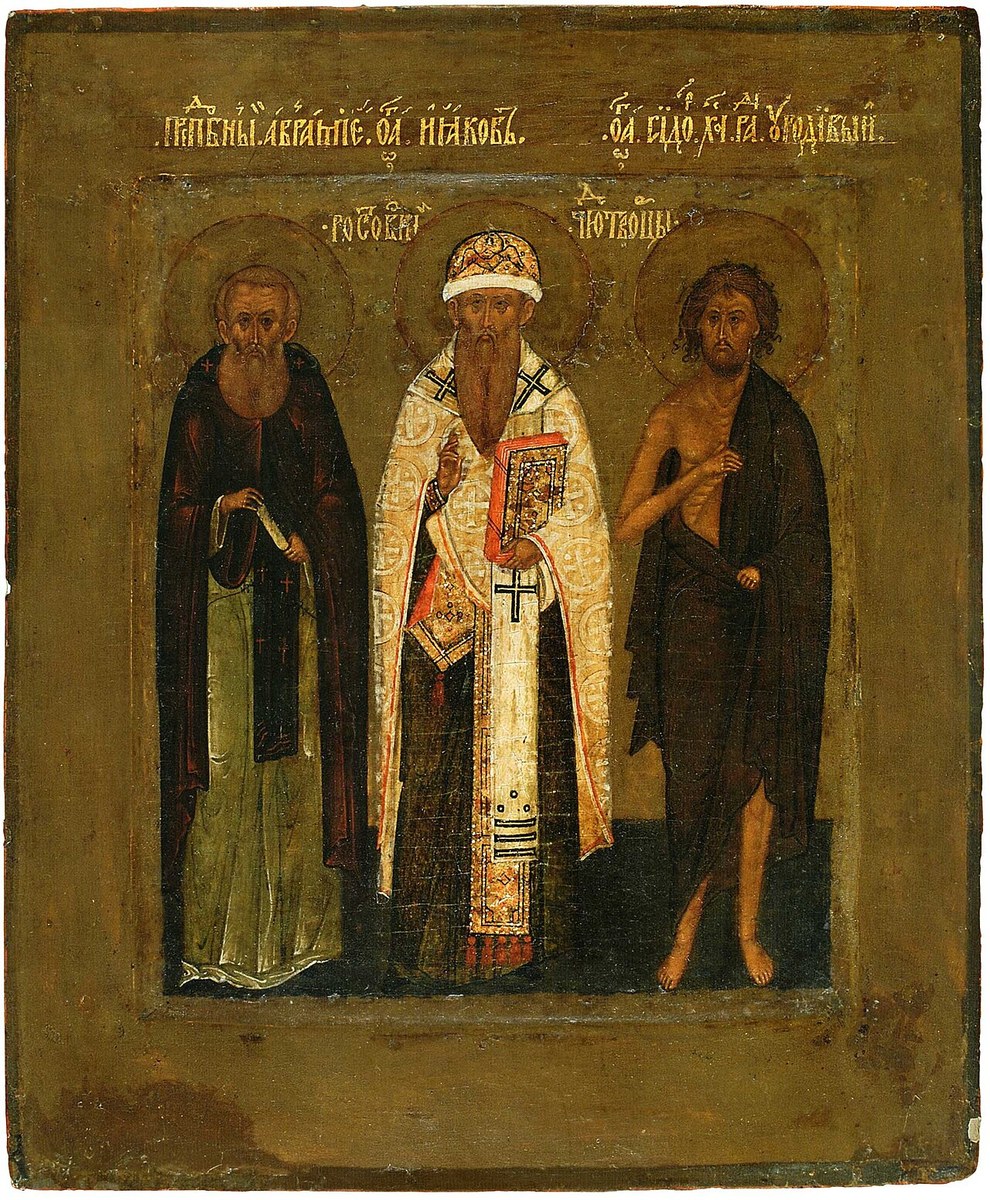
Isidore is painted according to the settled Russian type of the fool-for-Christ: a man of middle years, barefoot, with long dishevelled or curly hair and a short beard, the body largely bare and covered only by a dark mantle or a scrap of cloth thrown over one shoulder, one hand raised to the breast or in prayer. He wears nothing that marks rank or office — no monastic schema, no vestment, no book — and the nakedness is the attribute. He is most often shown not alone but in the company of the Rostov saints, and specifically in the triad with the hierarch James of Rostov in full episcopal vesture at the centre and the venerable Abraham of Rostov in the monastic mantle on the other side, a grouping that sets the three states of life — bishop, monk, fool — beside one another. Fuller cycles add his hut in the marsh and the fragrance discovered at his death.
The stored image is precisely that triad: a Russian panel of the late sixteenth or early seventeenth century, attributed to the Moscow master Istoma Savin, inscribed along the top "the venerable Abraham, the hierarch James, blessed Isidore the fool for Christ" and, in the field, "the Rostov wonderworkers." Isidore stands at the right, half-naked, dark-mantled, barefoot, curly-haired, his right hand at his breast — one of the earliest surviving portraits of him.
Disputed questions
- His homeland. The Life says "the German land," and later sources have variously proposed Germany proper, Prussia, or the Baltic lands; nothing in the text allows a decision, and the designation "German" in fifteenth-century Russian usage covers the whole Latin north. The claim that he was of noble birth as well as rich appears only in later retellings.
- Where he became Orthodox. Unknown; the Life says only that he was raised in Catholicism and that it is not known where he received the Orthodox faith. Attempts to place his reception at Constantinople, in Novgorod, or at Rostov itself are conjectural.
- The meaning of Tverdislov. See above: "firm of word" (his sayings came true) or "constant in speech" (he never ceased speaking of Christ). The first is the older and more natural reading of the Slavonic.
- Not to be confused with the other saints Isidore, and least of all with Isidore of Chios — the third-century sailor-martyr of Chios who shares this very day, and with whom the Slavonic books commemorate him side by side. Nor with Isidore of Pelusium (February 4); Isidora of Tabenna (May 1), the first woman fool-for-Christ; or Isidore of Yuriev (Dorpat) and the seventy-two martyrs with him (January 8).