
Jerome of Stridon
Our Venerable Father Jerome of Stridon, Presbyter, Translator of the Divine Scriptures
Venerable · Priest · b. c. 347, at Stridon on the border of Dalmatia and Pannonia — d. 30 September 419 or 420, at Bethlehem
Commemorated 15 June — Commemoration of the presbyter and translator of the Scriptures
Jerome (c. 347–419/420) was a Dalmatian-born scholar, ascetic and presbyter who gave the Latin West its Bible. Educated at Rome, baptised there in his twenties, drawn eastward to the desert of Chalcis beyond Antioch where he learned Hebrew among the Syrian monks, he was ordained priest at Antioch by Paulinus, heard Gregory the Theologian at Constantinople, and served as secretary to Pope Damasus at Rome before the enmity of the Roman clergy drove him out for good. From 386 he lived in a cave at Bethlehem beside the birthplace of Christ, where in thirty-odd years of relentless labour he translated the Old Testament afresh from the Hebrew — the version that became the Vulgate — wrote commentaries on most of the prophets, and conducted a series of ferocious controversies, most damagingly the Origenist quarrel that set him against his oldest friend Rufinus of Aquileia and against Melania the Elder and John of Jerusalem. The Orthodox Church keeps him on June 15, honouring the scholar and ascetic while recording, without evasion, the violence of his pen.

Stridon, Rome, and the vow in a fever
Jerome — Eusebius Sophronius Hieronymus — was born about 347 at Stridon, a town on the border of Dalmatia and Pannonia which he himself says was later destroyed by the Goths and whose site is still disputed. His family were Christians of some property, and they sent him, with his lifelong friend Bonosus, to Rome to be educated. There he studied grammar under the great Donatus and rhetoric in the schools, acquired the Latin prose style that never afterwards deserted him, and, by his own confession, acquired also the habits of a young man free in a great city: in the Confessions of his own letters he speaks of sins that he wept for long afterwards, and of Sunday visits to the tombs of the martyrs in the catacombs as the counterweight to a week's dissipation. He was baptised at Rome about his twentieth year, by his own account under Pope Liberius.
From Rome he went with Bonosus to Trier in Gaul, where — in the imperial city, in the neighbourhood of the court — he seems first to have conceived the monastic vocation; then to Aquileia, where he formed part of a circle of ascetically minded clergy that included Rufinus, afterwards his translator-rival, and Chromatius. Some quarrel, of which he says only that it was bitter, broke the group up. About 372 he returned to Stridon to find his parents dead and the care of his younger sister and his brother Paulinian on his hands; having settled their affairs he took ship with friends for the East.
At Antioch in 374 he fell dangerously ill, and in the fever had the dream that he never forgot and never quite obeyed: dragged before the judgement seat and asked what he was, he answered Christianus sum — I am a Christian — and was told, Thou liest; thou art a Ciceronian, not a Christian, for where thy treasure is, there is thy heart also. He swore never again to read the pagan classics. His own later pages, thick with Virgil and Cicero, are the measure of how the promise held; but the dream marks the turn of his life.
The desert of Chalcis and the learning of Hebrew
He went out into the desert of Chalcis, southeast of Antioch — "the Syrian Thebaid" — and lived there for some four or five years among the scattered anchorites. His letters from that period are the most famous he wrote: the account of the scorpions and wild beasts, of his body wasted with fasting while his imagination filled with the dancing-girls of Rome, of the grinding boredom and the still worse quarrels of the Syrian solitaries over the Trinitarian formulae then dividing Antioch into three rival obediences. Two things came out of the desert with him. The first was a permanent, if idiosyncratic, monastic conviction. The second was Hebrew: he engaged a converted Jew to teach him the alphabet and the grammar, complaining of the "hissing and panting" sounds, and stuck at it. No other Latin churchman of the age possessed the language, and everything he afterwards did that mattered rests on it.
The Antiochene schism drove him out of the desert. Refusing to subscribe any of the parties' demands, he came into the city and was ordained presbyter by Paulinus — on condition, he insisted, that he should not be attached to any church or obliged to exercise the priestly office, since he meant to remain a monk. He never celebrated the Liturgy as a matter of course. About 380 he was at Constantinople, where he heard the lectures of Gregory the Theologian — whom he always afterwards called his teacher in Scripture — and met Gregory of Nyssa; there he translated the Chronicle of Eusebius into Latin, continuing it to his own day, and turned the homilies of Origen on Jeremiah and Ezekiel into Latin, work he would later have cause to regret.
Damasus, the Roman ladies, and expulsion
In 382 the Antiochene dispute brought him to Rome, where Pope Damasus — himself a student of Scripture — made him his secretary and commissioned from him a revision of the Latin Gospels against the Greek. He produced it within two years, along with a first revision of the Psalter, and it was the beginning of the greatest work of his life.
At Rome he also became the spiritual director of a remarkable group of aristocratic Christian women on the Aventine: the widow Paula and her daughters Blaesilla and Eustochium, Marcella in her palace, Asella, Lea. He taught them Hebrew and the Psalms, wrote for them the treatises on virginity and widowhood that shaped Latin ascetic literature, and directed them toward a severity that Roman society found scandalous. When Blaesilla died after a few months of extreme fasting, the crowd at her funeral muttered that the monks should be driven out of the city or thrown into the Tiber. Jerome, meanwhile, had turned his satire on the Roman clergy — the fortune-hunting priests with curled hair and scented clothes who dined out among rich widows — and on rival ascetics, in a style that made enemies faster than he could count them. When Damasus died in 384 his protection went with him. An ecclesiastical enquiry was opened into Jerome's relations with Paula; nothing was found, but he left Rome in 385 with a farewell letter of undisguised bitterness, and never returned.
Bethlehem: the cave, the monasteries, and the Vulgate
With his brother Paulinian and a few companions he travelled through Antioch, Palestine and Egypt — where he sat at the feet of the blind Didymus at Alexandria and visited the monks of Nitria — and in 386 settled at Bethlehem. Paula followed with Eustochium and founded there, out of her fortune, a monastery for men under Jerome, three houses for women under herself, and a hospice for pilgrims on the road; Jerome took a cave near the cave of the Nativity for his cell and his library, and taught the boys of the village their grammar. He lived there for thirty-four years.
The work of those years is enormous. He revised, and then abandoned revising, the Old Latin Old Testament from the Greek, and undertook instead the thing no Latin had attempted: a fresh translation from the Hebrew original, book by book, with rabbis of Palestine consulted at his own expense and often by night. The principle he defended under the slogan Hebraica veritas — the Hebrew truth — was fiercely contested; Augustine of Hippo wrote to him warning that to abandon the Septuagint, which the Apostles used and the churches read, was to unsettle the faithful and to break communion with the Greeks. Jerome answered, at length and with some asperity, that a translator's business is the original. The version he made, combined later with his revised Gospels and Psalter and with Old Latin renderings of the books he did not touch, became the Vulgate, the Bible of the Latin West for eleven centuries and the vehicle in which nearly all of Western Christendom heard the Scriptures until the Reformation. He also produced the Prologues that go with it, the Book of Hebrew Names, the Book of Hebrew Places after Eusebius, commentaries on almost all the prophets and on Matthew, Galatians, Ephesians, Titus and Philemon, the Lives of the hermits Paul, Hilarion and Malchus, the biographical catalogue De viris illustribus, and some hundred and twenty surviving letters, which are among the finest in Latin.
His enemies got the same energy. He wrote against Helvidius on the perpetual virginity of the Theotokos, against Jovinian on virginity and fasting, against Vigilantius on the veneration of relics and the martyrs' shrines, and against the Pelagians in the last years of his life — a work which cost him his monastery, for in 416 a mob, which he blamed on the Pelagians, burned the buildings and killed a deacon; and in 411 or thereabouts the community had already been half-ruined by an incursion of desert raiders. He lived to see Rome sacked by Alaric in 410, and the letter in which he lays down his pen because "the city which took the whole world captive is itself taken" is one of the great pieces of late Latin prose. Refugees from the sack came to Bethlehem and were fed at the hospice.
The Origenist controversy
The hardest chapter, and the one that most affects his standing in the East, is the first Origenist controversy. Jerome had begun as an admirer and translator of Origen, whose exegesis he plundered all his life. When Epiphanius of Salamis opened a campaign against Origen's memory in Palestine about 393, Jerome went over to the attack — against John, Bishop of Jerusalem, against his own oldest friend Rufinus of Aquileia, who was translating Origen's On First Principles at the monastery on the Mount of Olives, and against Rufinus's patroness Melania the Elder, the Roman noblewoman whose reading of Origen on a scale that astonished Palladius made her a natural target. Jerome had earlier written of Melania with warm praise in his Chronicle; when the quarrel came he erased the notice and turned on her, and on Rufinus, with a violence that even his admirers have found hard to defend. The polemic was mutual, prolonged, and squalid; Epiphanius ordained Jerome's brother Paulinian irregularly to spite John of Jerusalem, and Bethlehem was for a time cut off from the sacraments. A reconciliation of sorts was patched up in 397 and broke down again.
The Orthodox Church, which keeps the memory of the saints on both sides of that dispute — Epiphanius, John of Jerusalem, Melania, and Jerome himself — has never treated Jerome's polemic as a verdict. Melania's entry in this collection records the erased notice and Palladius's own judgement in her favour; the same restraint governs the reading here. What the controversy shows is a man of immense learning and small charity, whose zeal for orthodoxy was real and whose incapacity for peace was equally real, and whom the Church canonised for the first without pretending the second away.
Repose and relics
Jerome died at Bethlehem, worn out and nearly blind, on 30 September, in the year 419 or 420; Paula and Eustochium had gone before him, and he was buried near them under the church of the Nativity. His relics are said to have been carried to Rome in the seventh century — the OCA notice gives 642 — and to have been laid in Santa Maria Maggiore; the Roman tradition points to a tomb there and to a relic of his hand kept near the Piazza Farnese, but the transfer is poorly documented and the present whereabouts of the body are not securely known. The empty tomb at Bethlehem is still shown to pilgrims.
Feast and commemoration
June 15 (church date; New Calendar civil June 15, Old Calendar civil June 28) — a synaxarion commemoration without a proper office, kept on the day whose service belongs to the Prophet Amos. He shares the day with the other great Latin father received into the Eastern calendar, Augustine of Hippo, his correspondent and his opponent on the question of the Hebrew text — a pairing which the Byzantine books evidently intended, and which makes June 15 the Orthodox calendar's day of the Latin doctors.
In the West he is one of the four traditional Doctors of the Latin Church and the patron of translators, librarians and scholars. Where his memory is kept liturgically in Orthodox parishes the propers used are ordinarily the common of a venerable father, composed or adapted locally.
Hymns
Apolytikion — Tone 8 (from the common of a venerable father)
In thee the image was preserved with exactness, O Father Jerome; for taking up thy cross, thou didst follow Christ, and by thy deeds thou didst teach us to overlook the flesh, for it passeth away, but to attend to the soul, since it is immortal. Wherefore thy spirit, O venerable one, rejoiceth with the angels.
Kontakion — Tone 2
Thou didst forsake the eloquence of the Latins for the hard speech of the Hebrews, and in the cave beside the cave of the Nativity thou didst labour to set the oracles of God in the tongue of the West: wherefore the whole Church that reads them calls thee blessed, O Jerome, teacher of the divine Scriptures.
Original translation from the Greek
Iconography
Jerome has two quite separate pictorial traditions, and the difference matters.
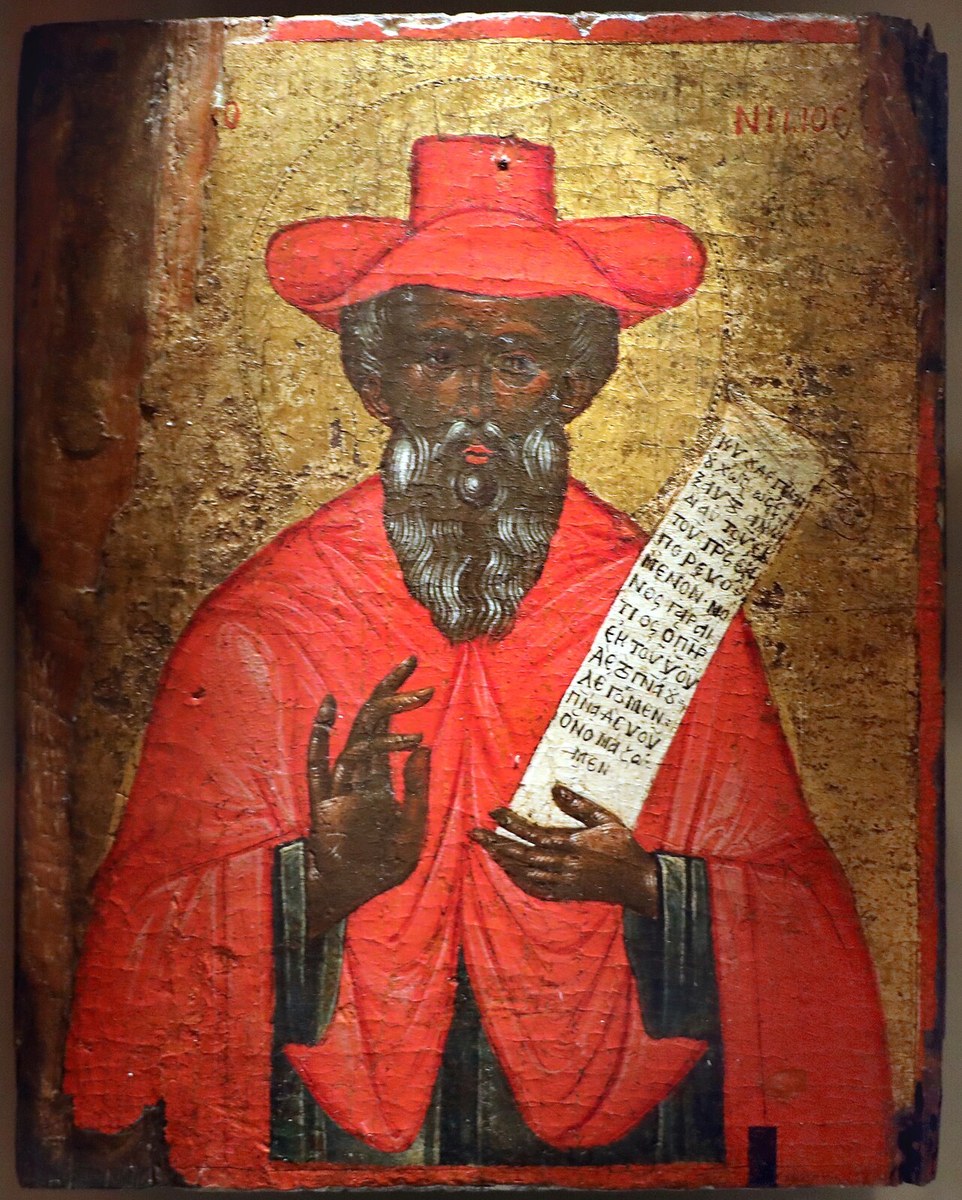
The Greek and Cretan tradition, which is the one proper to his Orthodox commemoration, paints him as an aged father with a long white beard, half-length or standing, holding an unrolled scroll with a Greek text and raising the right hand in speech — and, in the Venetian-Cretan icons of the fifteenth and sixteenth centuries, wearing the red robe and broad red hat that the Latin West had by then attached to him on the (mistaken) supposition that he had been a cardinal. Those icons, painted in Crete and the Ionian islands for both Orthodox and Latin patrons, are the meeting-point of the two traditions.
The Western tradition, vastly richer, shows him in three types: the penitent in the wilderness, half-naked, beating his breast with a stone before a crucifix; the scholar in his study, at the desk among books with the cardinal's hat hung up behind him; and the doctor enthroned. To all of these is attached the lion, from the story — which belongs to the legend of Gerasimus of the Jordan, transferred to Jerome by a confusion of names (Gerasimus/Hieronymus) — of the beast whose paw the saint healed and who served him thereafter. The skull, the hourglass and the trumpet of judgement are later attributes. None of this is Byzantine.
The stored image is a Greek panel icon of about 1500 in the Byzantine and Christian Museum at Athens, inscribed at the head Ο [ΑΓΙΟΣ] … ΝΙΜΟΣ (the surviving letters of Ἱερώνυμος): the saint half-length against a gold ground, white-bearded, in the red mantle and the broad red hat, the right hand raised in the gesture of speech and a long Greek scroll held in the left. The inscription was read on the image itself before storing.
Disputed questions
- Whether the Orthodox calendars keep him, and on what day. They do, and on June 15. The OCA carries a full proper entry for "Saint Jerome (Hieronymus) of Stridon" on June 15 in its Lives of the Saints; the Slavic books commemorate Иероним Стридонский on the corresponding old-calendar day, and Greek listings give Ὅσιος Ἱερώνυμος. The Western date is 30 September, the day of his death, which the East does not keep. Why June 15 was chosen is not explained in the sources consulted; it is not the date of death, and no translation of relics is assigned to it, so the day appears to be a Byzantine or Slavic calendrical assignment rather than an anniversary. That is recorded here as an open question rather than guessed at.
- His rank and epithet. The Greek and Slavic books style him Ὅσιος / преподобный — venerable — the monastic rank, not "father among the saints," and not hieromartyr or hierarch: he was a presbyter who declined priestly duty and lived as a monk. He is classified here venerable, priest.
- The year of his death. The Roman tradition and most modern scholarship give 420; some sources, including a strand followed by the OCA notice, give 419 or simply "about 420." The day, 30 September, is fixed.
- Stridon. The town's location is genuinely unknown. Candidates have been proposed in Croatia (near Grahovo), in Slovenia, and in Bosnia; Jerome says only that it was on the Dalmatian–Pannonian border and that the Goths destroyed it. Both Croatian and Slovenian local tradition claim him.
- Not to be confused with the many later Jeromes of the Western calendar, nor with Hieronymus the name-form used of several Greek hierarchs of modern times.