
Job of Ushchelsk
The Holy Venerable-martyr Job, Hieromonk, Founder of the Ushchelsk Monastery on the Mezen
Venerable Martyr · Priest · d. August 5, 1628, at the Ushchelsk monastery on the Mezen
Commemorated 5 August — His martyrdom at the hands of robbers at the Ushchelsk monastery, 1628
Job was a hieromonk of Solovki sent in 1614 into the wilderness of the Mezen, in the far north of Russia, to plant a monastery among a scattered and half-heathen population. He built his chapel at the meeting of the rivers, kept his brotherhood alive through years of destitution until the tsar endowed them, and on 5 August 1628, while the monks were out at the hay, was seized by a band of robbers who supposed a monastery must have money. They tortured him to make him show the treasury, and when he would not, they cut off his head. There was nothing to find; they went away empty-handed. The north venerated him almost at once — fifty miracles were recorded in the seventeenth century, his icon was painted in 1658 and his life written in the 1660s — and his relics were formally examined and his services authorised in 1739.

Solovki
He was, the northern tradition says, the son of a man named Patrick Mazovsky, and took the monastic habit at the Solovetsky monastery in the White Sea — the great fortress- abbey of the Russian north, which through the sixteenth and seventeenth centuries served as the mother house, the school, the granary and the outpost of Christianity for the whole Pomorye. On 10 November 1608 he was ordained hieromonk by Metropolitan Isidore of Novgorod, under whose jurisdiction the northern churches then stood.
The Mezen
In 1614 he was sent out from Solovki to the Mezen — the river that runs north into the White Sea through the taiga east of the Dvina, a country of forest and bog, of scattered Russian settlements and of Nenets and Komi peoples, with almost no churches and no monastic life. His commission was to found a house there.
He settled at a place called Ushchelye, at the point where the little rivers Ezhuga and Vashka run into the Mezen, and raised a chapel dedicated to the Nativity of Christ. The foundation was desperately poor. There was no endowment, no land, no fishery; the brethren, few in number, could not be fed from the house and lodged with their own lay relatives in the villages round about, coming in to the services. That is an unusual and telling detail: for years the Ushchelsk "monastery" was a chapel with a priest and a handful of monks billeted on their families.
Relief came from the crown. Tsar Michael Fyodorovich (1613–1645), the first of the Romanovs, granted the house land and fishing rights on the river — the standard instrument by which the Muscovite state colonised its north — and with that income Job was able to build a proper church and cells and to gather the brotherhood into one place.
The robbers
On 5 August 1628 the whole brotherhood was out in the hayfield, as everyone in that country is in early August, cutting the short northern grass on which the winter depends. Job had stayed behind alone at the monastery.
A band of robbers came upon the house. Their assumption was the ordinary one: a monastery keeps a treasury, and a lone monk knows where it is. They seized Job and tortured him to make him show it. He told them nothing — the sources do not agree whether from courage or simply because there was nothing to show — and they beheaded him. Then they searched the place, found nothing worth taking, and left.
The monks came in from the hayfield to find their founder dead, and buried him with honour where he had built.
Veneration and relics
The reverence of the Mezen country for him was immediate and did not need any decree. Some fifty miracles are recorded at his grave in the course of the seventeenth century. An icon of the saint was painted in 1658, thirty years after his death, and his life was written down in the 1660s, evidently from the memory of men who had known him. A chapel was built over his relics, and afterwards rebuilt as a church.
On 3 November 1739 Archbishop Barsanuphius of Archangelsk made the formal examination of the relics and gave authorisation for services to be celebrated to him — the canonical ratification, more than a century after the fact, of a veneration that had never waited for it. The Ushchelsk house continued as a small monastery, and afterwards as a women's community, until the twentieth-century closures.
Feast and commemoration
August 5 (church date; Old Calendar civil August 18) — the day of his death, which is also the forefeast of the Transfiguration and falls within the Dormition fast. His commemoration is local to the Russian Church and is not carried in the Greek synaxaria; he is kept with the Synaxis of the Saints of Karelia and among the saints of the Archangelsk land, and the Mezen villages keep his day as their own.
Hymns
Troparion — Tone 8 (common of a venerable-martyr)
Thou wast led into the wilderness by obedience and didst make the desert a house of prayer; and when the lawless came upon thee thou wouldest not give up thy trust, but didst bow thy head beneath the sword, O venerable-martyr Job: wherefore thou dost pour forth healings upon them that honour thee, and dost pray for our souls.
Original translation from the Slavonic
Iconography
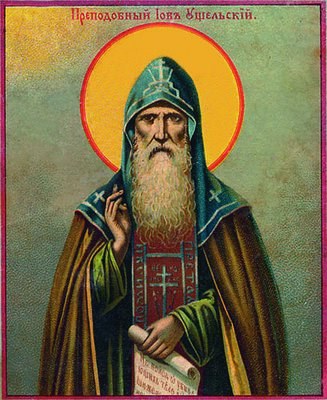
Job is painted as a monastic priest of the Russian north: in the black mantiya and klobuk, or in the schema, with a short greying beard, blessing with the right hand and holding a scroll in the left; as a martyr he may bear the cross, and the northern tradition sometimes shows him holding a model of his church at Ushchelye, in the manner of founder-saints, with the rivers and the forest behind. The manner of his death is occasionally indicated by the sword at his side or by a scene of the robbers in a border panel.
The earliest recorded image is the icon painted in 1658, thirty years after his death, which stood over his relics. The stored image is a 1911 image of the venerable martyr; copyright expired. The one candidate on Wikimedia Commons is a small (327 × 400 px) plate dated 1911 and credited to a modern Russian encyclopaedia, which fails this reference's pre-1900 requirement and is of unknown relation to any old panel; it is therefore rejected and the saint is listed among the wanted icons.
Disputed questions
- Venerable-martyr or venerable? Russian usage calls him преподобномученик, a monastic who died a violent death for Christ. Strictly, the robbers killed him for money and not for the faith, which is the classical objection; the Church has nevertheless reckoned him among the venerable-martyrs, as it has reckoned others killed in the course of their monastic obedience. The title is used here in the sense the Russian tradition gives it.
- Not to be confused with the other saints named Job: Job of Anzersk (†1720), who is the closest source of confusion, being also a hieromonk connected with the Solovetsky house and also commemorated in the northern calendar; Job of Pochaev (†1651), abbot of the Volhynian Lavra; Job of Moscow (†1607), the first Russian patriarch; and Job the Long-suffering, the righteous man of the Old Testament.
- The date of his ordination. 10 November 1608 is given by the Russian sources; the year of his birth and his life before Solovki are unknown.