
John Tornike
Our Venerable Father John-Tornike the Athonite, Co-founder of the Monastery of the Iberians
Venerable · d. c. 985, at Iviron on Mount Athos
Commemorated 12 June — Repose at the Monastery of the Iberians
John-Tornike was the Georgian general Tornike Eristavi, a commander and counsellor of David III Kuropalates of Tao, who laid down his rank to become a monk on Mount Athos beside his kinsman John the Iberian. About the year 979 the Byzantine court, in extremity before the rebellion of Bardas Skleros, begged David to send help; and Tornike was called out of the cloister to lead the Georgian army, which broke the rebel's force. He returned to Athos with the reward of that campaign, and with it the Georgians built the Monastery of the Iberians (Iviron) — so that he is honoured, with John the Iberian and Euthymius, as one of its three founders: the benefactor whose victory paid for the house. He returned to his obedience and to silence, and reposed about 985. His memory is kept on June 12.
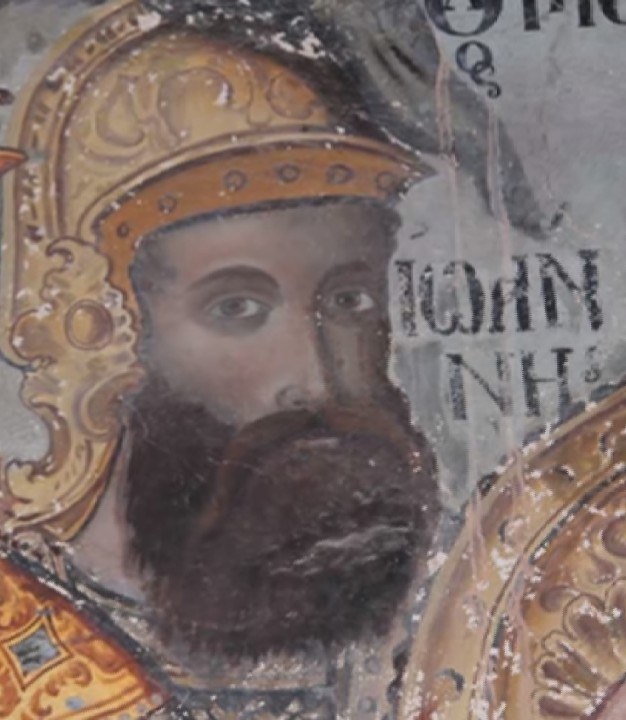

Tornike Eristavi
Tornike belonged to the great Georgian house of the Chordvaneli, and bore the title eristavi, "duke." He was famous as a soldier — the Georgian accounts say for his victories in the field — and stood high in the favour of David III Kuropalates, the prince of Tao whose principality was then the strongest power in the Georgian lands and a decisive ally of the Byzantine emperors. At the height of that career he abandoned it: he came to Mount Athos, to the Great Lavra of St Athanasius, where his kinsman John, formerly toparch of Meskhia, was already living as a monk, and was tonsured with the name John. Georgian and Greek sources therefore call him John-Tornike, and the two names together are how the tradition distinguishes him from his kinsman.
The Life preserves the sentence with which he gave himself to his spiritual father — "I hand over myself and my will to you; save me as you will" — and it is quoted precisely because what follows turned on obedience: he did not want to go back to war, and he went because he was told to.
The campaign against Bardas Skleros
In 976 the general Bardas Skleros raised a rebellion against the young emperors Basil II and Constantine VIII, and by 978 he had beaten the imperial armies and stood in a position to take Constantinople. The court — the tradition names the empress Theophano — sent to David Kuropalates for aid; and the Georgians, and the imperial envoys, asked for Tornike, whose name the troops knew. He resisted, and yielded on the judgment of his abbot and his brethren, taking up arms once more but not the world with them.
At the head of, the accounts say, twelve thousand Georgian troops joined to the loyal imperial forces, he met the rebel army in 979 in Asia Minor — the battle is placed at Pankaleia, near Sarvenis — and destroyed it; Skleros fled to Arab territory, and the revolt was broken. Tornike was rewarded magnificently by the emperors, in treasure and in grants, and given the spoils of the campaign.
The building of Iviron
He carried the whole of it back to Athos, and it was spent on the foundation of a Georgian monastery. Tornike first raised, near the Lavra, a church of St John the Theologian with cells about it for the Georgian brethren; and out of this, with the imperial chrysobulls that followed, grew the Monastery of the Iberians — Iviron — on the eastern shore of the peninsula, the great Georgian house of the Holy Mountain and one of the decisive institutions in the history of Georgian letters. The Athonite tradition of the foundation names three men together: John the Iberian as the spiritual father, Tornike as the benefactor, and Euthymius as the builder, organiser and translator; the accounts differ over how the work is to be divided among them, and the entries for John and Euthymius record that disagreement.
Repose
Having done it, Tornike went back to his cell. He passed his last years, the tradition says, in silence and humility as a simple monk of the house his victory had built, and reposed peacefully about 985; he was buried at Iviron. No year is given in the notices that commemorate him, and the date is an inference from the documents of the monastery's early history.
Feast and commemoration
June 12 (church date; Old Calendar civil June 25). His is a commemoration of the Georgian tradition and of the Holy Mountain, carried into the Slavic calendars; on this day he stands beside Peter of Athos, the first hermit of the Mountain, and the juxtaposition of the anchorite and the general-benefactor is a fair summary of how Athos was actually made. He is also honoured with the other Georgian fathers of Iviron in their common commemoration on May 13, where the entries for John, Euthymius, George and Gabriel stand.
Hymns
Troparion — Tone 8 (common of a venerable father)
In thee, O father John, was that which is according to the image kept surely; for taking up the cross thou didst follow after Christ, and by thy deeds thou didst teach us to despise the flesh, for it passeth away, but to have care for the soul, a thing immortal. Therefore doth thy spirit rejoice with the angels.
Original translation from the Greek
Iconography
John-Tornike is painted as a monk of the schema, an elder with a full beard in the dark mantle and koukoulion, holding a scroll or a model of the monastery. Where he appears in the composite icons of the founders of Iviron — the standard Athonite subject, in which the three or four Georgian fathers stand together holding a model of the katholikon between them, sometimes with the Portaitissa icon above — he is the figure distinguished by military dress showing beneath the monastic habit, or by a sword laid at his feet: the painter's way of saying that this monk was a general. That convention, and the four-figure version of the group, are noted in the entry for John the Iberian. The stored image is the Iviron fresco of exactly this convention: the bearded saint in the gilt helmet of a general, the name ΙΩΑΝΝΗ[Σ] inscribed beside the head — the monastery painting its soldier-founder in the dress of his first calling. (The Commons source dates the subject to the 10th century; the visible layer is later.)
Disputed questions
- Date of repose. The synaxarion notices give no year. The usual reckoning of about 985 comes from the Iviron documents and from the sequence of the foundation; some accounts place his death a little later, in the 990s.
- His share in the foundation. Greek and Georgian traditions weight the three founders differently, and modern historians of Athos differ on whether Iviron should properly be called Tornike's foundation (he provided the means and the imperial favour) or Euthymius' (he built and organised it). The question is discussed under Disputed questions in the entries for John the Iberian and Euthymius the Iberian.
- Not to be confused with his kinsman John the Iberian, with whom he shares a monastic name and a foundation, nor with Euthymius the Iberian, George the Iberian or Gabriel the Iberian.