
Lazarus the Iconographer
Our Venerable Father and Confessor Lazarus the Iconographer of Constantinople
Venerable · Confessor · Priest · b. c. 810 — d. c. 857
Commemorated 17 November — Principal commemoration
Lazarus the Iconographer (c. 810 – c. 857) was a monk, priest, and painter of holy images at Constantinople who confessed the veneration of icons through torture in the last iconoclast persecution. Under the emperor Theophilus his painting hands were seared with red-hot iron, and he was saved from death only by the intervention of the empress Theodora; after the restoration of the icons in 843 he returned to his art, and he died while returning from an embassy to Rome. He is honoured as one of the confessor-iconographers of the Triumph of Orthodoxy and is venerated as a patron of icon-painters.
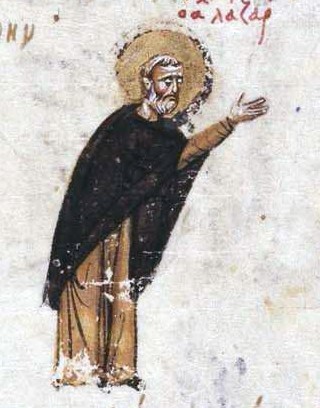

Ministry and confession
Lazarus lived at Constantinople in the first half of the ninth century. He was a monk of strict ascetic life, ordained to the priesthood, and by vocation a painter of holy icons — a zographos — at the height of the second iconoclast controversy. He set his gifts squarely against the heresy, painting images of Christ and the saints in defiance of the imperial ban and enduring, the sources say, afflictions from the enemies of the icons as he had already opposed the older errors of Nestorius and Eutyches.
Under the last and most determined of the iconoclast emperors, Theophilus (829–842), Lazarus was arrested. When neither argument nor threat would move him, he was cruelly tortured and thrown into prison; and because he would not cease to paint the images of Christ and the saints, the emperor ordered iron plates — the tradition says horseshoes — heated in the fire until they glowed, and laid upon the palms of his hands, that the very instruments of his art might be destroyed. He was brought near to death, and was spared execution only through the intercession of the empress Theodora, who secretly favoured the icons. Released, and his hands in time recovering their skill, he took up his brush again; the tradition relates that he painted an image of Christ once more, so that his art outlasted the fire meant to end it.
The Triumph of Orthodoxy and later mission
With the death of Theophilus and the regency of Theodora, the holy icons were restored to the churches at the Synod of 843 — the event kept ever since as the Triumph of Orthodoxy — and Lazarus, a living confessor of the images, was honoured among those whose sufferings had vindicated them. In his later years he was twice sent on embassies to Rome on the affairs of the Church, in the years of estrangement between the sees over the patriarchate of Photius. It was on the return from such a mission, sent to Pope Benedict III (855–858), that Lazarus died, about the year 857. His remains were brought back to Constantinople and buried in the church of Saint Evandrus.
Feast and commemoration
November 17 (church date; Old Calendar civil November 30), within the Nativity Fast, kept with Gregory the Wonderworker of Neocaesarea and the venerable Nikon of Radonezh. Lazarus is a saint of the whole Byzantine rite; some Greek books also list his memory in connection with the commemoration of the Triumph of Orthodoxy, of which he was a confessor.
Hymns
Troparion — Tone 8
In thee, O Father, was the image faithfully preserved: for taking up the Cross thou didst follow Christ, and by thy deeds didst teach us to despise the flesh, for it passes away, but to care for the soul, a thing immortal; therefore with the angels, O venerable Lazarus, thy spirit rejoices.
Original translation from the Greek
Iconography
Lazarus is depicted as a monk in dark mantle with a rounded beard, and — where his confession is shown — with his hands, the instruments of his art and of his suffering, held out or bearing the marks of the fire; painters sometimes give him a brush and an icon, marking him as the patron of iconographers. The stored image is the miniature of the twelfth-century Madrid Skylitzes manuscript (the illustrated Synopsis of Histories of John Skylitzes), which depicts Lazaros the iconographer, his name written in Greek beside his halo.
Disputed questions
- Year of repose. The received tradition places his death about 857, on the return from the embassy to Benedict III; some reference works (and Wikidata, Q2567661) give c. 867. The precise year is uncertain.
- Not to be confused with the two other saints named Lazarus commemorated in the Byzantine calendar: Lazarus of the Four Days, the friend of Christ raised from the tomb and bishop of Kition (Lazarus Saturday and October 17); and Lazarus of Mount Galesius, the eleventh-century stylite and wonderworker near Ephesus (November 7 and July 17). This Lazarus is the ninth-century confessor and iconographer of Constantinople.