
Martyrius of Novgorod
Our Father among the Saints Martyrius, Archbishop of Novgorod and Pskov
Bishop · b. at Stara Russa, mid-12th century — d. August 24, 1199, on the shore of Lake Seliger
Commemorated 24 August — Repose on the road to Vladimir, at Lake Seliger
Martyrius, called Rushanin from his native Stara Russa, was Archbishop of Novgorod from 1193 to 1199 — six years in which he did more building than most hierarchs do in twenty. Before his election he had founded the Transfiguration monastery at Stara Russa in 1192; chosen for the see by lot after the death of Archbishop Gregory, and consecrated at Kiev on 10 December 1193, he went on to raise the gate-church of the Mother of God at Novgorod, the Resurrection church of the new women's monastery at Lake Myachina, churches of St Cyril of Alexandria and St Euphemia, and at last the stone Transfiguration church at Stara Russa, consecrated on 15 August 1198. He died on 24 August 1199 on the shore of Lake Seliger, travelling to Vladimir on the city's business, and was carried back to lie in the Martyriev porch of the cathedral of Holy Wisdom, which still bears his name.

Stara Russa and the Transfiguration monastery
He was born at Stara Russa, the salt-town south of Lake Ilmen which was Novgorod's second city, and from it took the surname by which the chronicles know him: Rushanin, "the man of Russa." Nothing is recorded of his family or his early monastic life; the first firm date belongs to his work as a founder.
In 1192 he established a men's monastery of the Transfiguration of the Lord at Stara Russa, near the river Polista, and it was the making of him. A founder-abbot of a substantial house in the Novgorodian territory was, by the constitution of that republic, a public figure; and Novgorod chose its archbishops in a way no other Russian see did.
Elected by lot
The death of Archbishop Gregory in 1193 left the see vacant. Novgorod's practice — the distinguishing mark of a city that elected and expelled its princes and treated its archbishop as the head of the commonwealth — was to name candidates and then to cast lots on the altar of Holy Wisdom, so that the choice should be God's and not a faction's. The lot fell on Martyrius.
He travelled to Kiev, still the metropolitan city, and was consecrated archbishop on 10 December 1193 by the Metropolitan of Kiev and All Russia. The dignity mattered: the Novgorod hierarch alone among Russian bishops of the period bore the title archbishop, and he stood at the head of a veche-governed republic whose relations with the Grand Princes of Vladimir were a matter of constant negotiation.
Six years of building
The Novgorod chronicles record his episcopate almost entirely as a sequence of foundations and consecrations, and it is an unusually dense sequence:
- May 1195 — he contracted for a church of the Mother of God at the city gates of Novgorod.
- 13 September 1196 — he consecrated a church of the Resurrection of Christ at a new women's monastery at Lake Myachina, just outside the city.
- January 1197 — he consecrated a church of St Cyril of Alexandria, at a monastery three versts from Novgorod; a women's monastery dedicated to St Euphemia; and a church of St Nikephoros at his own Transfiguration monastery in Stara Russa.
- May 1198 — he began the stone church of the Transfiguration of the Lord at Stara Russa, and consecrated it on 15 August of the same year, the feast of the Dormition.
The stone Transfiguration church is the one that survives, rebuilt but standing, and it is the chief monument of his episcopate: the oldest building in Stara Russa, and among the earliest stone churches in the Novgorod land outside the city itself. Behind the list lies a policy — the systematic endowment of monastic houses, men's and women's, in and around the two cities of the republic — which the chronicler thought worth recording year by year.
Death at Lake Seliger
In 1199 the relations of Novgorod with Grand Prince Vsevolod the Big Nest of Vladimir needed mending, and a delegation of the city's men set out for Vladimir with the archbishop at its head. Martyrius did not complete the journey. He fell ill and died on 24 August 1199 on the shore of Lake Seliger, the great lake at the head of the Volga on the road south.
His body was carried back to Novgorod and buried in the porch of the cathedral of Holy Wisdom which has ever since been called the Martyriev paperts — the Martyrian porch — where his tomb remains. Local veneration followed, and he is numbered in the Synaxis of the Saints of Novgorod.
Feast and commemoration
August 24 (church date; Old Calendar civil September 6), the day of his death at Lake Seliger. He is kept locally at Novgorod and Stara Russa, and within the Synaxis of the Saints of Novgorod; he has no proper service in the general Menaion and is served at the common of a hierarch. In Russian usage the day belongs principally to the translation of the relics of Peter of Moscow, and Martyrius, like Arsenius of Komel, is a local commemoration that has come to share it.
Hymns
Troparion — Tone 4 (common of a hierarch)
The truth of things hath revealed thee to thy flock as a rule of faith, an image of meekness and a teacher of abstinence; therefore thou hast achieved the heights by humility, riches by poverty. O father and hierarch Martyrius, intercede with Christ God that our souls may be saved.
Original translation from the Slavonic
Kontakion — Tone 2
Chosen by lot and not by the will of men, thou didst shepherd the great city and fill its lands with houses of prayer; and going out upon its errand thou didst finish thy course by the waters of Seliger. Wherefore Sophia keepeth thee in her porch, O hierarch Martyrius, and Novgorod calleth thee blessed.
Iconography
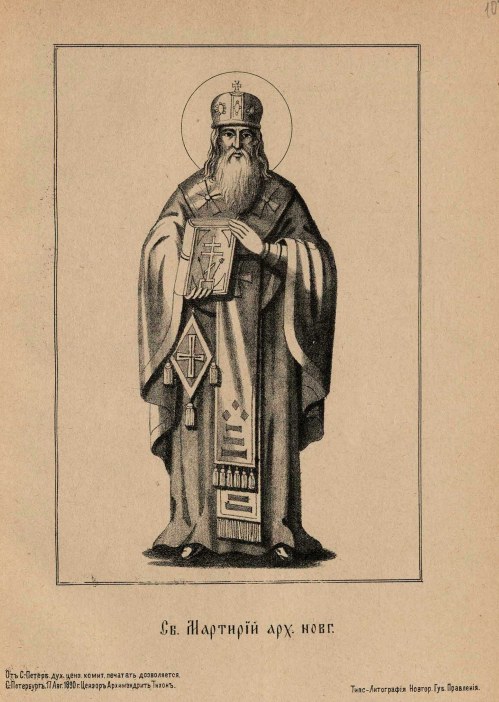
Martyrius belongs to the Novgorodian hierarch type: a middle-aged or elderly bishop with a long, narrowing, forked grey beard, vested in sakkos and omophorion with the epigonation at the side, wearing the jewelled mitre, blessing with the right hand and supporting the Gospel-book on the covered left. In the composite icons of the Synaxis of the Saints of Novgorod, in which the whole company of the city's hierarchs, princes and monastics is ranged in registers below the Sophia, he stands among the archbishops and is told apart only by the inscription.
The stored image is a lithograph plate of 1890 from the diocesan series of the hierarchs of Novgorod, printed by the Typo-Lithography of the Novgorod Provincial Administration under a censor's imprimatur of 11 August 1890 and captioned Св. Мартирій арх. новг. — "St Martyrius, Archbishop of Novgorod." It is not an icon in the strict sense but a printed devotional plate, of the kind produced in quantity for Russian diocesan publications in the last decades before the revolution, and it reproduces the traditional type faithfully: the hierarch full-length and frontal, haloed, in mitre and sakkos, the Gospel held before him. It is stored here because it is the only pre-1900 depiction of the saint identified, and its character as a print rather than a panel is stated rather than disguised. A panel icon of the Novgorod synaxis type would be the better image, and remains wanted.
Sixteenth-century miniatures from the Facial Chronicle of Ivan the Terrible illustrate two episodes of his life — the founding and consecration of the church of the Deposition of the Robe, and his death at Lake Seliger — and are the earliest surviving depictions of him; they are narrative illustrations rather than icons.
Disputed questions
- The day of his repose: 24 or 31 August? The Russian ecclesiastical tradition, the Novgorod local calendar, and the Orthodox Church in America all keep him on 24 August, which is also the day the chronicles give for his death. Some reference databases — Wikidata among them — record 31 August 1199, a figure that appears to come from a different reading of the chronicle entry. The commemoration is unambiguously 24 August, and this entry follows it.
- Archbishop or bishop? The nineteenth-century diocesan lithograph reproduced below captions him simply Св. Мартирій арх. новг. The see of Novgorod had been raised to archiepiscopal rank under his predecessors, and the chronicles style him archbishop from his consecration.
- Not to be confused with Martyrius of Zelenets (†1603), the Novgorodian-lands hermit and founder of the Trinity-Zelenets monastery, whose name and region invite the confusion but who lived four centuries later; nor with the martyr Martyrius, companion of Marcian, notary of Constantinople.