
Arsenius of Komel
Our Venerable Father Arsenius, Abbot of Komel, Wonderworker of Vologda
Venerable · Wonderworker · b. end of the 15th century, at Moscow, of the noble Sakharusov family — d. August 24, 1550, at his monastery on the river Kokhtysh in the Komel forest
Commemorated 24 August — Repose at the Komel monastery of the Placing of the Robe
Arsenius was a Moscow nobleman of the Sakharusov family who became a monk of the Trinity-Sergius Lavra, worked there as a copyist of books — a Gospel written by his hand in 1506 survives — and was made abbot of that greatest of Russian monasteries in 1525. Two years later he laid the office down and walked north into the Komel forest beyond Vologda carrying a large wooden cross, to live as a hermit. He fell in a marsh under the weight of the cross, and where he fell a beam of light showed him his place. Driven out once by hunters and once by Tatar raiders, he was granted land on the river Kokhtysh by Grand Prince Vasily III in 1530, and there built the church of the Placing of the Robe of the Theotokos and the monastery that carried his name for four centuries. He reposed on 24 August 1550.

The copyist of the Trinity Lavra
He was born at Moscow, late in the fifteenth century, into the noble family of the Sakharusovs, and while still young received the tonsure at the Trinity-Sergius monastery — the house of St Sergius of Radonezh, then at the height of its influence over Russian church life. His work there was the copying of books, in the years when the Russian monasteries were the country's only scriptoria and a good copyist was a person of consequence: a Gospel-book written by his hand in 1506 was preserved at the Lavra and is the earliest firm date in his life.
In 1525 he was made igumen of the Trinity monastery, and governed it until 1527. The office was among the most powerful in the Muscovite church — the abbot of the Trinity stood at the elbow of the Grand Princes — and Arsenius's response to it is the anecdote by which he is remembered.
The patched cassock
Grand Prince Vasily III came, as the sovereigns did, to venerate the relics of St Sergius, and found the abbot of the house wearing an old cassock covered with patches. The court took it for an affront, or a reproach; the Grand Prince asked, and learned that the abbot did not want the office at all, and wished to go into the wilderness. It is a scene that recurs in Russian hagiography, and it usually means what it means here: the collision between a monastery grown rich and administrative and a monk who had entered it to be poor.
Arsenius laid down the abbacy in 1527 and left, taking with him only his cell-elder and a large wooden cross.
The light in the marsh
He went north, into the forests of the Komel country, some fifty versts from Vologda — the region of dense woodland and bog between the Sukhona and the Volga watershed which in the fifteenth and sixteenth centuries filled with hermitages, and which produced the whole company of "Komel fathers" whom the calendar keeps: Cornelius of Komel, Cassian of Komel, Innocent of Komel and Laurence of Komel.
Crossing a marsh with the great cross on his shoulders, he fell beneath its weight; and at that moment, the life says, a beam of light from heaven fell upon him. He took it for the answer he had come to look for, and settled on that spot.
The first settlement did not hold. A disciple was killed by local hunters, who resented the monks in a forest they had hunted freely; and then came the threat of a Tatar raid — the 1520s and 1530s were years of deep incursions into the northern Russian lands. Arsenius withdrew to the Shelegod forest and lived there in hiding.
The monastery on the Kokhtysh
In 1530 the Grand Prince Vasily III granted him a charter and land on the river Kokhtysh, back in the Komel forest, and this foundation lasted. With his disciple Gerasimus he cleared the ground, and the life records — in the ordinary idiom of Russian forest-hagiography, which is also a statement about the restoration of Eden — that by prayer he tamed the wild beasts of the place, so that they did the monks no harm. He built the church of the Placing of the Robe of the Most Holy Theotokos, from which the monastery took its formal name, and gathered a brotherhood under a strict rule of fasting, prayer and manual labour.
His pastoral care ran out beyond the walls to the peasants of the surrounding villages, whom he taught, above all, to keep the feasts of the Church. The one miracle-story of this period preserved in the life is of that kind: a peasant who worked his field on a holy day saw the wind scatter his sheaves — a wonder more agricultural than spectacular, and exactly proportioned to the audience it was told to.
He reposed at the monastery on 24 August 1550.
The lost Life and the monastery after him
The written Life of Arsenius was burned in the monastery fire of 1596, and what survives is a reconstruction: a monk named John rewrote it from the memory of the brotherhood and appended an account of the miracles after his repose. This is why the entry as we have it is strong on anecdote and weak on chronology, and why the small internal discrepancies noted below cannot be resolved from the sources.
A century after his death the igumen Joasaph built a stone church over the site, with side-chapels dedicated to St Sergius of Radonezh — the father of the house where Arsenius had been tonsured — and to St Arsenius himself. The Arseniev-Komelsky monastery survived until the Soviet suppression.
Feast and commemoration
August 24 (church date; Old Calendar civil September 6), the day of his repose. He is kept in the Russian Menaion and by the Orthodox Church in America, and is numbered among the Synaxis of the Saints of Vologda, the local commemoration that gathers the northern forest-founders of that diocese. The day is otherwise dominated in Russian usage by the translation of the relics of Peter of Moscow, so that the Vologda hermit and the first Metropolitan of Moscow are commemorated together — a pairing the Russian service books make no attempt to harmonise, and which simply reflects two independent local calendars grown together.
Hymns
Troparion — Tone 4 (common of a venerable founder)
Having left the honour of thy fathers' house and the rule of the great monastery, thou didst take up the cross upon thy shoulders and go into the wilderness, O venerable Arsenius; and where the light of heaven shone upon thee, there thou didst raise a house to the Mother of God, and gather a flock in the trackless forest. Pray to Christ God that our souls may be saved.
Original translation from the Slavonic
Kontakion — Tone 8
Thou didst flee the praise of men and choose the marsh and the wild beasts for thy companions, and they did thee no harm; thou didst teach the labourers of the field to keep holy the day of the Lord, and thy monastery became a lamp in the northern forest. Wherefore we cry to thee: rejoice, O father Arsenius, wonderworker of Vologda.
Original translation from the Slavonic
Iconography
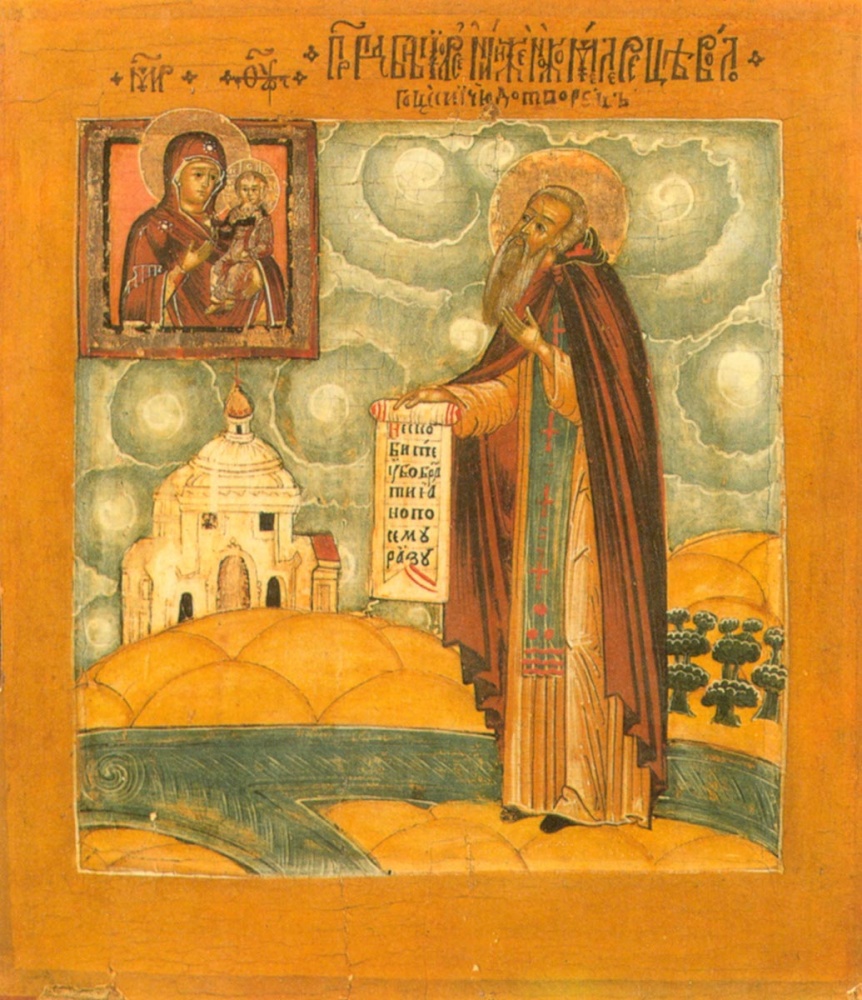
Arsenius is written according to the northern Russian type of the forest-founder: an aged monk with a long, narrow, pointed grey beard, in the dark mantiya and koukoulion or with the head bare, standing three-quarters turned in prayer toward an image of Christ or of the Mother of God set in a segment of heaven at the upper corner — the visual equivalent of the beam of light in the marsh. In his hand is an unrolled scroll with a line of monastic counsel, and beside him, on a hill, the white church and walls of his monastery, painted small, which identify the founder as surely as an inscription.
The stored image is a seventeenth-century panel from the Kazan church of the village of Poroshino in the Vologda region, inscribed across the top ПРѢПОДОБНЫЙ ОТЕЦЪ АРСЕНІЙ КОМЕЛЬСКІЙ ЧЮДОТВОРЕЦЪ — "the venerable father Arsenius of Komel, wonderworker." It shows every element of the type: the saint in a red-brown mantle over the monastic habit, the hand raised, the scroll held open, the monastery on its hill at the left, wooded slopes at the right, and the Hodegetria in a framed icon in the sky at the upper left — the Mother of God to whom his church of the Placing of the Robe was dedicated.
A second and later depiction places him beside Gregory of Pelshma in a nineteenth-century composition of Christ Pantocrator with the Saints of Vologda, which is the ordinary way the Vologda fathers are shown together.
Disputed questions
- The year of repose: 1527 or 1550? Some calendar indexes — the OCA's day-list among them — give 1527, which is in fact the year he resigned the abbacy of the Trinity Lavra; the body of the same life, the Vologda diocesan tradition and the modern reference works give 24 August 1550, and the grant of land in 1530 and the long labour on the Kokhtysh make 1527 impossible as a death-date. 1550 is followed here.
- Which Grand Prince? The English lives call him "Basil IV"; the sovereign in question is Vasily III Ivanovich (reigned 1505–1533), whose numbering differs between older Russian and modern Western usage. There is no ambiguity about the person.
- Not to be confused with the other saints of the name: Arsenius the Great of Scetis (May 8), Arsenius of Konevits (June 12), Arsenius of Tver (March 2), Arsenius of Corfu and Arsenios of Paros. The Vologda Arsenius is distinguished by the epithet Komelsky.