
Pambo of Nitria
Our Venerable Father Pambo, the Ascetic of the Nitrian Desert
Venerable · b. c. 303, in Egypt — d. c. 373–375, in the Nitrian desert, aged about seventy
Commemorated 18 July — Repose in the Nitrian desert
Pambo (c. 303 – c. 375) was one of the founding fathers of the desert of Nitria, the great monastic settlement south-west of the Delta, and one of the most quoted elders of the Apophthegmata Patrum. He came to the desert unlettered, asked a brother to teach him a psalm, heard the verse "I said, I will take heed to my ways, that I sin not with my tongue" — and refused to be taught the next verse until he had learned to do that one, which by his own account he was still learning nineteen years later. Out of that beginning came the two things for which the desert remembered him: an absolute economy of speech, so that he would sometimes take months to answer a question, and a face that shone, which the fathers set beside the face of Moses. Antony the Great said of him that by the fear of God he had made the Holy Spirit dwell in him. He taught Dioscorus, Ammonius, Eusebius and Euthymius — the "Tall Brothers" of the Origenist controversy — received Melania the Elder when she came out of Rome to the desert, and died weaving a basket, saying that he was going to the Lord as one who had not yet begun to serve God.

The desert of Nitria
The mountain of Nitria, named from the natron lakes at its foot, lay some forty miles south-east of Alexandria, and was the first of the three great monastic settlements of Lower Egypt — Nitria, the Kellia ("the Cells"), and Scetis — founded by Ammon about the year 330 on the counsel of Antony the Great. By the time Palladius saw it, some five thousand monks lived on that mountain, and this corpus keeps its collective memory as the Ten Thousand Fathers of Nitria (July 10). Pambo belonged to its first generation and was one of the four or five names — with Ammon, Arsisius, Serapion and Paphnutius — by which its authority was represented to the rest of the Church.
He was an Egyptian, born about the year 303, and came to the mountain as a young man, unable to read.
The psalm he never finished learning
The account of his beginning is given in the Apophthegmata and is the most famous thing about him. Being illiterate, he asked one of the brothers to teach him a psalm. The brother began the thirty-eighth psalm, and had read the first verse — "I said, I will take heed to my ways, that I sin not with my tongue" — when Pambo shut him off and went away, saying he would learn that one first. He did not come back. When, long afterwards, the brother reproached him for having stayed away, he answered that he had not yet succeeded in doing the verse; and to another who asked him about it he said that nineteen years had gone by and he had not yet accomplished it.
The whole of his ascesis follows from that verse. He held silence, weighed every answer, and was not ashamed to be seen deliberating: brothers who came to him with questions sometimes waited three months for the reply, and were sometimes told at the end that he had not found what to say. The desert did not read this as slowness but as the exact opposite of the fluency it distrusted; a word of Pambo's was known to have been paid for.
Work, poverty and the rule of the hands
He lived by the labour of his hands, plaiting ropes and baskets of palm-leaf, and would eat no bread but what he had earned. He said at the end of his life that he did not remember eating bread that was not his own, nor repenting of any word he had spoken since he left the world. Asked what a monk's clothing should be, he answered that it should be such that if he threw it out of his cell it would lie there three days and nobody would think it worth taking. And to those who wanted a rule he gave the shortest one in the collection: "If you have a heart, you can be saved."
The face like Moses
The fathers report — Palladius and the Apophthegmata alike — that the face of Pambo shone like lightning, so that the brothers could not look at him steadily, and that he sat among them "like a king upon his throne"; the same was said of Sisoes and of Silvanus, and behind all three lies the face of Moses coming down from the mountain. This is not told of him as a wonder but as a symptom: the desert took the shining face for the visible mark of a man whose inner life had become continuous.
Athanasius the Great, who governed Alexandria through the Arian storms and knew the monks as his allies, once summoned Pambo down to the city. There he saw an actress on the street, and wept. Asked why, he said that two things had moved him: her destruction; and that he did not take as much trouble to please God as she took to please men.
Melania and the three hundred pounds of silver
About the year 373 the Roman noblewoman Melania the Elder, widowed and newly arrived in Egypt, came out to Nitria and put into Pambo's hands a chest containing three hundred pounds of silver. He was weaving a basket, and did not look up. He said only, "May God reward you," and told his deacon to take the money and distribute it among the poorer monasteries of Libya and the islands, which were the neediest. Melania, standing there, waited to be thanked as the sum deserved; and when she said, more or less, that he ought to know how much it was, he answered that He to whom she had offered it did not need to be told the amount — He who weighed the mountains in a balance knew the measure of her silver better than she did. It is the single most quoted rebuke in the literature of Christian almsgiving.
Repose
He died about 373–375, aged about seventy, weaving to the last. Melania was with him at the end; he gave her the basket he had in his hands, and she kept it to her own death. His last words, spoken to the monks gathered round, were that he was going to the Lord as one who had not yet begun to serve God. He had never, in illness or in health, ceased his work, and the Lausiac account remarks that he was never sick.
Disciples and legacy
His disciples included Dioscorus, afterwards bishop of Hermopolis, and Ammonius, Eusebius and Euthymius — the four brothers of extraordinary stature whom Egypt called the Tall Brothers, and whose expulsion from the desert as Origenists by Theophilus of Alexandria brought them to Constantinople and set in motion the persecution of John Chrysostom. Pambo himself died a generation before that quarrel and had no part in it, but his household stands at the head of it, as Melania the Elder's does. Through Palladius, who came to Egypt a decade after his death and collected the memory of him on the spot, and through the alphabetical Apophthegmata, where fourteen sayings stand under his name, he became one of the fixed authorities of Byzantine and Slavonic ascetic literature.
Feast and commemoration
July 18 (church date; New Calendar civil July 18, Old Calendar civil July 31). Pambo is kept by the Greek, Slavonic and Antiochian calendars alike, and in the Slavonic books the day carries both Pambos — the Egyptian and the Kievan — one after the other. He is also remembered within the general commemoration of the fathers of Nitria (July 10) and in the Saturday of the Cheesefare week, when the Church sings the whole company of the ascetic fathers.
Hymns
Apolytikion — Tone 8
Thou didst crucify thyself to the world, O father Pambo, and taking one word of the Psalm for thy whole rule, thou didst learn it not with the tongue but with the deed; wherefore thy face shone like the face of Moses, and thou wast a light to the mountain of Nitria. Intercede with Christ God that our souls may be saved.
Kontakion — Tone 4
Silent before men that thou mightest speak with God, and eating no bread but that of thine own hands, thou didst count all the silver of the world as nothing beside the widow's mite; and going to the Lord thou didst say, *I have not yet begun to serve Him.* O Pambo, teach us to take heed to our ways.
Original translation from the Greek
Iconography
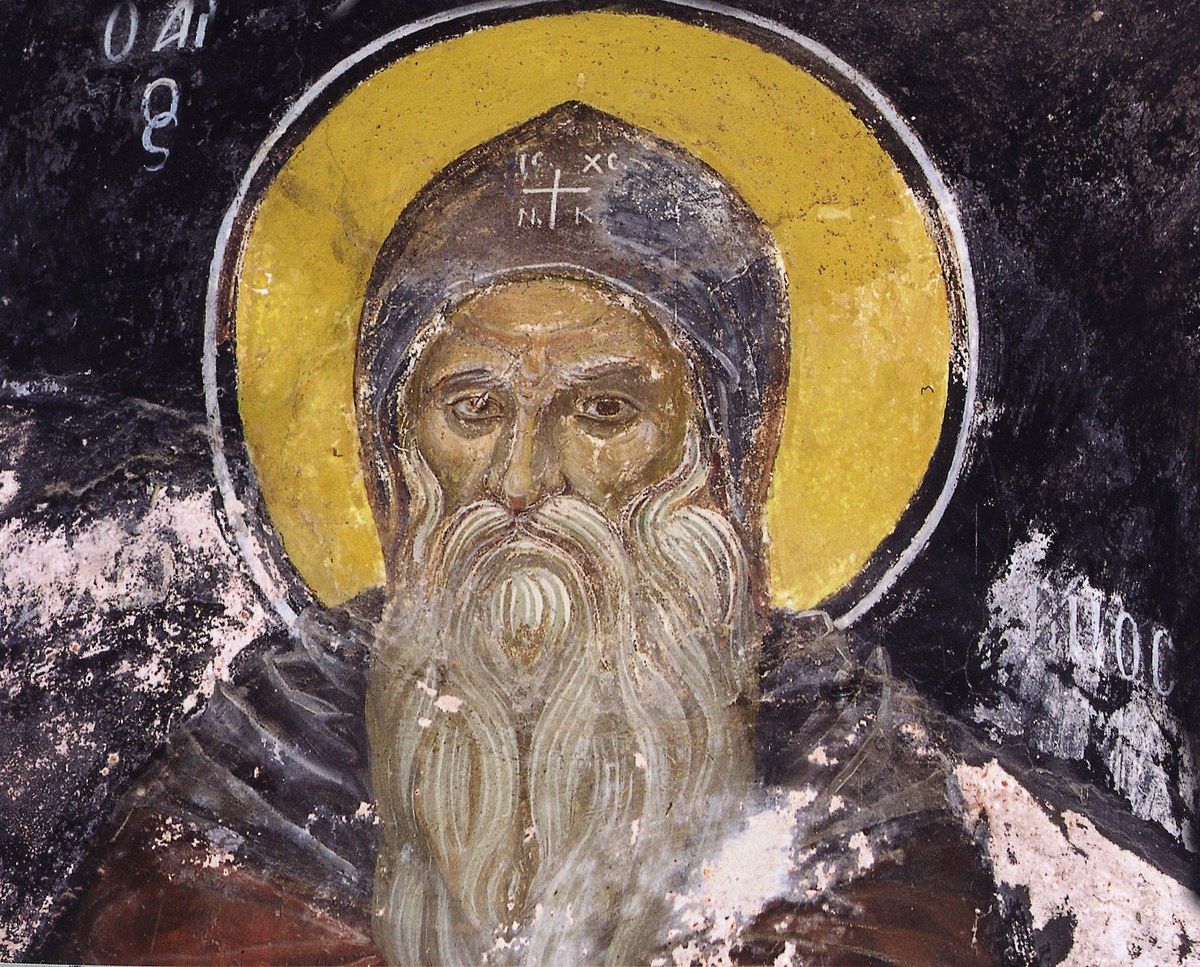
Pambo is painted as an aged desert father: barefoot, in the tunic, analavos and hood of the Egyptian monks, with a long white beard, a scroll in his hand, and often the plaited basket or rope-work that is his particular attribute — the only elder of the desert regularly shown with his handiwork in his lap. Where the sayings are illustrated, his shining face is rendered by a strengthened halo or by rays, and in the fuller compositions Melania stands before him with the chest of silver while he does not lift his eyes from his weaving. In menologion cycles he stands among the July fathers; because those cycles for the summer months are far less well preserved than the winter ones, and because the Menologion of Basil II covers only September to February, the search for him was long unrewarded. The stored image ended it: a fresco head of the abba — the schema-cowl with the IC XC cross, the great grey beard, fragments of Ο ΑΓΙΟΣ and the name flanking the halo — its paint losses and medieval palette themselves the evidence of age the source's bare "pre-20th-century" dating asserts. The earlier note that the repositories "return nothing at all under his name" was outdated by this upload.
Disputed questions
- Which Melania? The Orthodox Church in America's synaxarion for this day, following a Slavonic line of transmission, names Melania the Younger as the woman who brought the silver. That is chronologically impossible: the story is told by Palladius (Lausiac History 10) of Melania the Elder, who reached Egypt about 373 and was present at Pambo's death, while Melania the Younger, her granddaughter, was born about 383 — some ten years after Pambo died. This entry follows Palladius and records the variant.
- The date of the feast. The Greek synaxaria and the Slavonic menologia agree on July 18; a few Western and Coptic lists give other days, and the Apophthegmatic Pambo is occasionally confused in modern reference works with other Egyptians of the name.
- Nineteen years, or six months? The Apophthegmata transmit the story of the psalm in two measures — that he stayed away six months, and that after nineteen years he had still not learned the verse. They are not really in conflict: the first is the length of his absence, the second his own reckoning of the lesson, and the collection preserves both.
- Not to be confused with Pambo the Recluse of the Kiev Caves (†1241), who is commemorated on the same day, July 18, and whose Slavonic name (Памва) was given him precisely in memory of the Egyptian; the two are constantly run together in English calendars, which sometimes print a single line for "Venerable Pambo."