
Meletius of Antioch
Our Father among the Saints Meletius the Confessor, Archbishop of Antioch
Bishop · Confessor · b. early 4th century, at Melitene in Lesser Armenia — d. 381, at Constantinople during the Second Ecumenical Council
Commemorated 12 February — Repose at Constantinople during the Second Ecumenical Council
Meletius (early 4th century – 381) was Archbishop of Antioch and one of the most beloved and most tried of the Church's hierarchs. Raised to the great Syrian see about the year 360, he confessed the Nicene faith so plainly at his enthronement that within a month the Arians procured his exile; three times he was driven from his city under the Arian emperors, and three times he returned, always in the same gentleness that made his name a byword. Under him the young John Chrysostom was catechised, baptised, and ordained reader. His episcopate was shadowed by the long Meletian schism — a division of the Nicene party at Antioch itself, over the legitimacy of his election rather than over the faith. Vindicated at last, he presided over the opening of the Second Ecumenical Council at Constantinople in 381 and reposed while it sat; Gregory of Nyssa preached his funeral, and his relics were carried home to Antioch and laid beside the martyr Babylas.

Origins and the See of Sebaste
Meletius was a native of Melitene in Lesser Armenia, born of a noble family in the opening decades of the fourth century. The sources are unanimous on the beauty of his character before they can agree on anything else about his career: he was gentle, winning, transparently good, a man whom, in the phrase that clung to him, even his enemies could not hate for long. He was raised to the episcopate as bishop of Sebaste in Armenia about the year 357, succeeding the deposed Eustathius of Sebaste; but the see was turbulent and its people disaffected, and Meletius, unwilling to contend, withdrew from it and retired to Beroea (the modern Aleppo) in Syria, living quietly and without a charge. It was from this retirement that he was called, unexpectedly, to Antioch.
Archbishop of Antioch, and the sermon on Proverbs
About the year 360 the see of Antioch on the Orontes — the third city of the empire and the mother-church of Syria — fell vacant when its Arianising bishop Eudoxius was translated to Constantinople. In the delicate church politics of the reign of the emperor Constantius, who favoured a Homoian ("the Son is like the Father") settlement and distrusted the full Nicene party, Meletius seemed to all sides a safe and moderate choice: the Arian and Homoian bishops, Acacius of Caesarea among them, believed him one of their own or at least pliable, and the orthodox hoped for better. He was chosen and enthroned by the acclamation of the whole city.
The event that undeceived every party is among the famous scenes of the fourth century. Constantius, curious to hear the new archbishop's mind, invited him to preach before an assembly on the text long fought over in the Arian controversy — Proverbs 8:22, "The Lord created me the beginning of his ways" (the verse the Arians pressed as proof that the Son was a creature). Bishop after bishop spoke; when Meletius rose, he expounded the passage in a plainly Nicene sense, of the eternal Son who is of one essence with the Father. The tradition preserves a gesture that made the moment unforgettable: pressed to declare the faith in brief, Meletius held up three fingers, then folded two down and left one standing, and then joined the three again — signifying the Three who are One — and (so the synaxaria relate) a light like fire shone about him. The orthodox rejoiced; the Arians were dismayed; and Constantius, prompted by the party of Eudoxius, within about a month deposed and exiled him to his native Armenia, installing in his place the open Arian Euzoius, a former companion of Arius himself.
The Meletian schism
Here begins the tangle for which Meletius's episcopate is remembered as much as for his sanctity, and it must be told plainly, for it did him a lifelong injustice. When Meletius was exiled, the Nicene Christians of Antioch did not all rally to him. Antioch had for a generation been divided: the strict old-Nicene party, the Eustathians — followers of the sainted Eustathius, deposed by the Arians back in 327 — had held aloof from every bishop imposed since, worshipping apart under the presbyter Paulinus. They regarded Meletius with suspicion precisely because he had been elected with Arian goodwill and consecrated by bishops of the Homoian party; his orthodoxy of doctrine did not, in their eyes, cleanse the irregularity of his origin. So when the great body of Antiochene Nicenes gathered to Meletius on his return, the Eustathians would not join them, and in 362 the Western bishop Lucifer of Cagliari, passing through, consecrated Paulinus a rival bishop of the same Nicene faith — so that Antioch now had two orthodox bishops, Meletius and Paulinus, besides the Arian Euzoius.
This is the Meletian schism: a rupture not over the creed but over legitimacy, consecration, and the mutual mistrust of East and West. Rome and Alexandria — Athanasius among them — recognised Paulinus, holding the older line and doubting a bishop of Arian-tinged origin; the East and the great Cappadocian fathers, above all Basil the Great, laboured for years to have Meletius acknowledged as the true and canonical archbishop, whose faith was beyond reproach and whose flock was the whole city. Basil's letters are full of the grief of it — that two men equally orthodox, and their communions, should be kept apart by the suspicion of the great sees and the intransigence of a few. The schism outlived both bishops and was not fully healed until about 415. The Church, in canonising Meletius, has rendered its own verdict: his faith was the faith of Nicaea, and the reproach cast on his election was undeserved.
The three exiles
Meletius suffered the lot of every consistent Nicene under the Arian emperors — banishment, and again banishment. He was exiled first by Constantius within a month of his enthronement (361), and recalled the next year under Julian the Apostate, whose general amnesty for exiled bishops (whatever its cynical motive) brought him home to Antioch. Under Valens, the last and most determined of the Arianising emperors, he was twice more driven out — about 365 and again about 371 — spending long years away from his city, in Armenia and in retirement, while the Arians held his churches. Through all of it the sources dwell on his unbroken meekness: he neither cursed his persecutors nor intrigued for his restoration, but taught, wrote, and waited. On the death of Valens and the accession of the orthodox emperors he returned for the last time, about 378, to a city that received him with joy.
Meletius and John Chrysostom
To the Church of Antioch — and to the whole Church after — Meletius's most enduring act was his fatherhood of a greater son. It was Meletius who received the young John Chrysostom into the faith: who catechised him, baptised him about the year 368, kept him near his own person for three years, and ordained him reader. Chrysostom never forgot him. Years later, preaching at Antioch, he delivered a homily in praise of Meletius so warm that it is one of our best witnesses to the archbishop's hold on his people: John recalled how the Antiochenes loved the very name Meletius, gave it to their children, carved it on their walls and rings and cups, so that the name of their exiled shepherd was everywhere in the city that longed for him. Meletius also, the tradition holds, ordained others who became lights of the Church, and presided in 379 over the Council of Antioch of some 150 bishops that ranged the East behind the Nicene and Western formulas — the immediate preparation for the council that would be his crown and his death.
The Second Ecumenical Council, and repose
In 381 the emperor Theodosius the Great, having resolved to re-establish the Nicene faith throughout the empire, summoned the bishops of the East to Constantinople for what the Church numbers the Second Ecumenical Council — the council that completed the Creed and affirmed the divinity of the Holy Spirit against the Pneumatomachi. Meletius, as the senior and most honoured hierarch of the East and the acknowledged head of the Antiochene church, came to the capital and presided over the opening of the Council. It was he who confirmed Gregory the Theologian on the throne of Constantinople.
He did not live to see the Council end. While it sat — in the first weeks of its labours — Meletius fell asleep in the Lord. The assembled fathers mourned him as their father and president; Gregory of Nyssa pronounced the funeral oration, which survives, hailing him as a new Abraham, the meek shepherd taken up in the midst of his flock and his fellow-bishops. His body was borne with honour from Constantinople home to Antioch, and there laid to rest beside the tomb of the hieromartyr Babylas, the bishop-martyr he had venerated — two shepherds of Antioch together. His death, tragically, did not end the schism: his own party, against an earlier compact, elected Flavian to succeed him rather than yield the see to the aged Paulinus, and the division dragged on another generation.
Feast and commemoration
Meletius is kept on February 12 (church date; Old Calendar civil February 25), the day of his repose at Constantinople. The Greek, Slavic, and Antiochian calendars agree on the day; for the Church of Antioch he is one of the greatest of its archbishops, and his memory is dear there above all. The Greek Menaion appoints the common apolytikion of a hierarch and a proper kontakion; the Slavonic books diverge in the choice of kontakion (see Hymnography). He is also numbered among the fathers commemorated by the Church's memory of the Second Ecumenical Council.
Hymns
Troparion — Tone 4
A rule of faith and an image of gentleness, a teacher of temperance, the truth of things revealed thee to thy flock; therefore by humility thou didst gain the heights, and by poverty riches. O Father and Hierarch Meletius, intercede with Christ our God that our souls may be saved.
Original translation from the Greek
Kontakion — Tone 2
Adorned with the ways of Orthodoxy, thou wast shown to be the protector and champion of the Church, O all-blessed Meletius, setting the ends of the earth ablaze with the true doctrines: O most radiant lamp of the Church.
Original translation from the Greek
Iconography
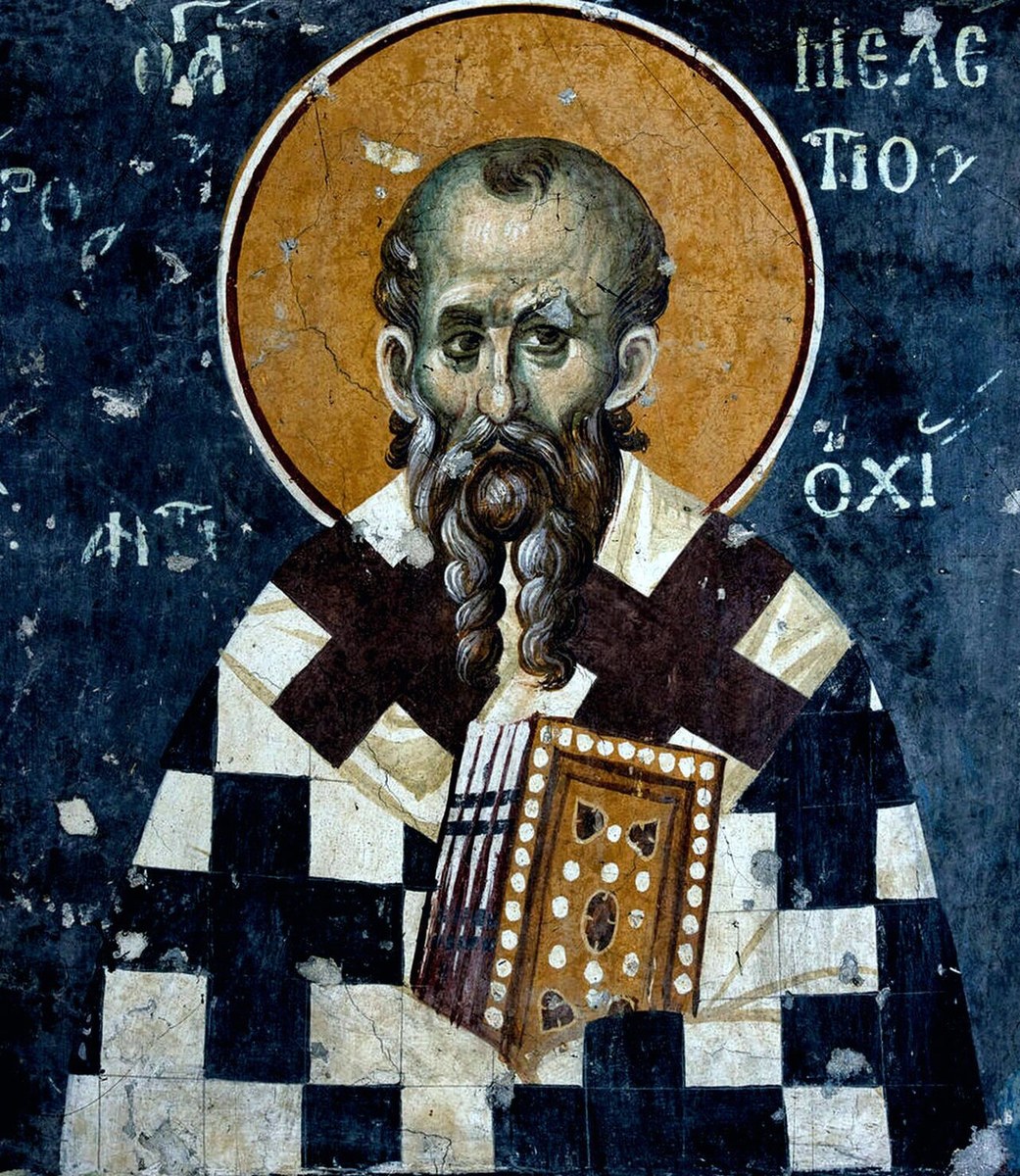
Meletius is depicted in the settled type of a Greek hierarch of the golden age of the fathers: an aged bishop, high-browed, with a rounded or slightly forked grey beard, vested in the phelonion or the cross-figured polystavrion, wearing the omophorion and holding or blessing over the Gospel-book. In the great fresco programmes he stands among the officiating hierarchs of the sanctuary apse — frequently beside John Chrysostom, his spiritual son — in the row of concelebrants of the eternal Liturgy.
The stored image is his figure from the fresco of the Church of Saint George at Staro Nagoričane (1317, a foundation of King Milutin), an accomplished work of the mature Palaiologan style, showing the archbishop full-length and vested as a hierarch (source, public domain, pd-old-work).
Disputed questions
- Meletius of Antioch and the "Melitian schism of Egypt." The division at Antioch associated with this Meletius must not be confused with the earlier and wholly separate Melitian schism of Egypt, caused by Melitius of Lycopolis (early 4th century) over the treatment of the lapsed and entangled with the rise of Arianism. The two "Meletian/Melitian schisms" share only the accident of similar names; they are different men, different provinces, and different questions.
- Not to be confused with Meletios Galesiotes, the Confessor of Mount Galesion (†c. 1283, kept January 19), a thirteenth-century monastic opponent of the Union of Lyons; nor with Meletius the New of Myoupolis, nor with the several later Meletii of the calendar. This Meletius alone is "of Antioch," the president of the Second Council.
- The character of his election. That Meletius was consecrated with the acquiescence of the Homoian party is historical fact, and it is the root of the schism; but that his faith was ever Arian is contradicted by the whole record from his enthronement sermon onward, and is affirmed by his canonisation, by Basil's advocacy, and by the honour the whole Church now pays him.