
Mstislav-George of Novgorod
The Holy Right-believing Prince Mstislav-George Rostislavich the Brave, of Novgorod
Prince · Righteous · b. c. 1150 — d. 14 June 1180, at Novgorod
Commemorated 14 June — Repose of the Prince at Novgorod (1180)
Mstislav Rostislavich, called the Brave and the Fearless, baptised George, was a prince of Smolensk and from 1179 prince of Novgorod, a grandson of Mstislav the Great and son of Rostislav-Michael of Kiev. He is remembered in the chronicles for two things above all: the defence of Vyshgorod in 1173, where with a small garrison he held out against the enormous coalition army of Andrei Bogolyubsky and broke it, having first sent the prince's envoy home shaved and shorn; and a personal charity so marked that the chronicler could write that he never kept property for himself but gave all of it to churches, monasteries, the ransoming of captives and the poor. He reposed suddenly at Novgorod on June 14, 1180, aged about thirty, and was buried in the cathedral of Holy Wisdom, where his relics rest incorrupt.
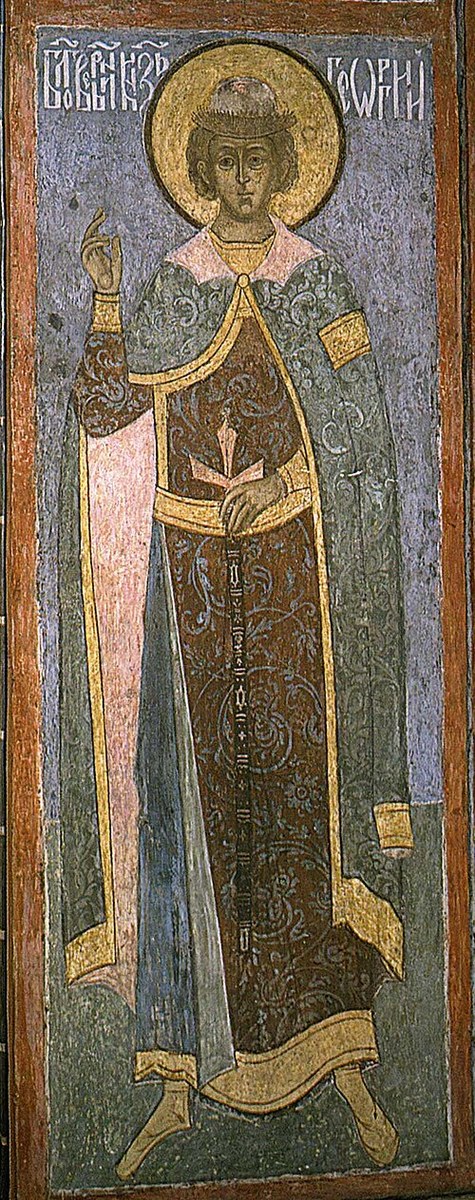

House and inheritance
Mstislav was born about the middle of the twelfth century, the son of Rostislav Mstislavich, prince of Smolensk and three times Grand Prince of Kiev, whom the Church commemorates on March 14, and thus a grandson of Grand Prince Mstislav I the Great and a great-grandson of Vladimir Monomakh. His uncle was Vsevolod-Gabriel of Pskov. The family was one of the most respected in the Rus' of that generation, and its centre was Smolensk, which Rostislav had raised to greatness and given a bishopric of its own; Mstislav and his brothers Roman and David were reared in a household where the alliance of prince and Church was the ordinary state of things.
He came to manhood in the years when the unity of the Kievan land was breaking apart, and made his name in war. In 1168 he rode in the great combined expedition of the southern princes against the Polovtsy of the steppe, and the chronicles credit him with the boldest part in the victories of that campaign.
Vyshgorod, 1173
His fame rests on the siege of Vyshgorod, the fortress above Kiev. In 1173 Andrei Yurievich Bogolyubsky, prince of Vladimir and the strongest ruler in the Rus', moved against the sons of Rostislav, who had refused to give up Kiev at his order and to hand over the men he demanded. He sent them a message by an envoy named Mikhno, in the terms of a lord to his servants. Mstislav's answer is the most quoted speech in his story. He had the envoy's head and beard shaved — the gravest possible insult, and one deliberately chosen — and sent him back with these words: until now we have held you as a father, in love; but since you have sent to us not as to a prince but as to an underling and a common man, do as you have devised, and God will judge between us.
Andrei gathered a coalition said to have numbered some twenty princes and tens of thousands of men, and laid siege to Vyshgorod, where Mstislav shut himself up with a small force. He held the place for weeks — the chronicles say nine — sallying out and giving battle in the open when he could; and in the end the vast army, quarrelling among itself and failing to take the walls, broke up and fled in confusion across the Dnieper. It was the ruin of Andrei's design on the south, and it is why the chroniclers gave Mstislav his name: he had beaten the most powerful prince in Rus' by refusing to be afraid of him.
Novgorod
After his brother Roman's death Mstislav held Smolensk; and in 1179 the men of Novgorod, who chose their princes and dismissed them, sent to invite him to rule over them. He accepted, and was received with great honour. Novgorod at that moment was under pressure from the west, where the Chud — the Estonian tribes — were raiding the Pskov country; and Mstislav gathered an army of some twenty thousand, marched into their land, drove them back, went through to the sea, and came home with a great weight of captured herds and goods. He was preparing a further campaign, toward Polotsk, when the Novgorodians dissuaded him from it.
The chronicler's portrait of him belongs to the small class of genuinely personal notices in the Rus' annals. He was of middling height and comely; he was quick to take up any cause for the Russian land, and never refused a fight for it; and — the point on which the Church's veneration turns — he kept nothing for himself. What came to him from tribute and from war he spent on churches and monasteries, on ransoming prisoners of war and captives of the steppe, and in alms; he held aloof from the princely feuds where he honourably could, and made it his rule to take the part of the weaker against the stronger. He was, in his biographers' summary, "always straining toward great deeds."
Repose and relics
In the summer of 1180, at the height of his standing and not yet thirty-five, he was struck down by a sudden and violent illness. He received the Church's last rites and reposed on June 14, 1180, at Novgorod. The chronicle records that the whole city wept, and that all the land of Rus' mourned him; and it adds the note of the hagiographers, that his face shone as he lay in death.
He was buried in the cathedral of the Holy Wisdom at Novgorod, where his tomb is in the chapel on the north side, among the graves of the princes and archbishops of the city. His relics were found incorrupt and are venerated there; his local cultus at Novgorod is early, and his name stands in the roll of the right-believing princes of Rus'. He is commemorated with the other saints of the city in the Synaxis of the Saints of Novgorod.
Feast and commemoration
June 14 on the church calendar (Old Calendar civil June 27), the day of his repose. The commemoration is Russian — the Moscow Patriarchate and the Orthodox Church in America keep it — and belongs to Novgorod in particular, where his relics rest in the cathedral of the Holy Wisdom. On the same day the universal calendar keeps the Prophet Elisha and Methodius of Constantinople, and the Russian books add the second commemoration of Methodius of Peshnosha; Mstislav's own office is therefore normally sung as a local addition to the day rather than in place of it. He is further commemorated in the Synaxis of the Saints of Novgorod.
Hymns
Troparion — Tone 4 (common of a right-believing prince)
Thou didst rule thy people in righteousness and defend the land of Rus' without fear, O right-believing prince Mstislav; and keeping nothing of thine own, thou didst pour out all thy substance upon the churches of God, upon the poor and upon the ransoming of captives. Wherefore, having been shown a brave soldier of Christ, intercede that our souls may be saved.
Original translation from the Slavonic
Kontakion — Tone 8 (common of a right-believing prince)
As a lover of mercy and a fearless defender of thy people, thou hast passed from an earthly principality to the Kingdom that has no end, O blessed Mstislav; and thy relics, kept incorrupt in the house of the Wisdom of God, pour out healing upon those who honour thee.
Iconography
Mstislav is painted as a young or middle-aged prince, beardless or lightly bearded, in the princely dress of the Russian tradition — a long patterned tunic under a fur-trimmed mantle, a low domed cap, sometimes a cross-topped staff or a sword sheathed and held down — and he is inscribed with his baptismal name George as often as with Mstislav, which is the chief source of confusion in identifying his images. He appears in the Novgorod compositions of the local saints gathered about the Holy Wisdom, and in the princely portrait galleries of Muscovite church painting.
The stored image is his figure from the great cycle of princely portraits in the Cathedral of the Archangel Michael in the Moscow Kremlin, painted 1652–1666 on the south-west pillar (northern face, second tier) and inscribed ГЕѠРГIИ: the prince standing full length and haloed, in a brown-gold patterned robe under a green-blue mantle, a low cap on his head, his right hand raised in prayer and a folded cloth over his left arm.
Disputed questions
- Year of birth. Not transmitted. Modern reference works give c. 1148 or c. 1152 by inference from his father's career and his own first appearance in the chronicles in 1168; "about 1150" is the honest statement, and his age at death is accordingly given as about thirty or a little more.
- Length of the siege of Vyshgorod. The chronicles differ; nine weeks is the usual figure. The size of Andrei's army — twenty princes, fifty thousand men — is a chronicler's round number and should be read as "overwhelming," not as a muster roll.
- The Novgorod synaxis. Mstislav is named among the saints of Novgorod, but the date of that synaxis is reckoned differently in different books — as a fixed day in some Russian calendars, and on the third Sunday after Pentecost in current Russian usage, which is movable. This entry therefore carries only his own June 14 feast and leaves the synaxis to the movable calendar.
- Not to be confused with his own grandfather Mstislav I the Great of Kiev (†1132), nor with his son Mstislav Mstislavich Udatny, "the Daring," of Novgorod and Galicia (†1228), who commanded at Lipitsa and at the Kalka and who is not among the saints; nor with Vladimir Yaroslavich of Novgorod, the builder of the Holy Wisdom in which Mstislav lies.