
Nicetas the Stylite of Pereyaslavl
Our Venerable Father Nicetas the Stylite, Wonderworker of Pereyaslavl-Zalessky
Venerable · Wonderworker · d. 1186
Commemorated 24 May — Slain by night at the Nikitsky monastery outside Pereyaslavl
Nicetas of Pereyaslavl (†1186) was a tax-farmer of the newly founded Russian city of Pereyaslavl-Zalessky who grew rich by extortion, was converted by a verse of Isaiah and by a terrible vision in his own kitchen, and became the first and most famous stylite of the Russian land — though his "pillar" was a pit dug in the earth, in which he stood in heavy iron chains and a stone cap, with a covered passage to the monastery church. He was murdered by night on 24 May 1186 by kinsmen who mistook his polished chains for silver. The recovery of the chains from the Volga, the incorrupt relics uncovered under Metropolitan Photius, and the devotion of Ivan the Terrible made the Nikitsky monastery one of the notable shrines of Muscovite Russia.

The tax-farmer of Pereyaslavl
In 1152 the prince Yuri Dolgoruky refounded the town of Pereyaslavl on a new site by the Trubezh, near Lake Pleshcheyevo — the city known afterwards as Pereslavl-Zalessky, "beyond the woods" — and built there a stone church of the Saviour. Among the officers of the new city's revenues was Nicetas, a native of the place, a mytnik: a collector and farmer of dues and tolls. He held the office for years, and the Life is unsparing about how he held it. He overcharged without mercy, kept the greater part of what he took, oppressed the poor and the widow, and lived in comfort on the proceeds. He was, in the phrase of the Russian tradition, a plunderer of his own townsmen.
Conversion
Two moments broke him. The first was in church, where he heard read the opening chapter of the prophet Isaiah: Wash yourselves, make yourselves clean, put away the evil of your doings from before mine eyes; cease to do evil, learn to do well; seek judgement, relieve the oppressed, judge the fatherless, plead for the widow. The words named his life exactly, and he went home shaken.
The second was in his own house. His wife was preparing a meal, and in the boiling pot there rose to the surface — so the Life relates — blood, and human heads, and hands, and feet. She cried out; Nicetas looked, and saw in the pot the flesh and blood of the people he had devoured. That night he did not sleep, and in the morning he left his house and his office and never returned to either.
The gate, the marsh, and the pit
He went to the monastery of the Great Martyr Nicetas, his own name-saint, some three versts from the city, and begged to be received. The abbot, who knew the reputation of the man and distrusted so sudden a change, set him a test: to stand at the monastery gates for three days and confess his sins aloud to everyone who passed. He did it. He was then sent into the marshy ground beside the gate and left there, where the gnats and mosquitoes covered him until he was bloody from head to foot; and when the brethren came for him they found him still at prayer. He was tonsured.
The asceticism he then took up was of the extreme Russian kind. He bound himself in heavy iron chains, wore an iron or stone cap, and dug himself a deep pit in the monastery ground — his stolp, his "pillar" — in which he stood day and night, keeping a covered underground passage by which he could reach the church for the services. The inversion is deliberate and much noticed in the Russian sources: where the Syrian stylite rose above the earth on a column, Nicetas of Pereyaslavl went down into it; the ascesis of standing, exposure, and unbroken prayer is the same, and the Church gives him the same title, Stolpnik — Stylite.
Wonderworking
The gift of healing followed. The best-known miracle of his lifetime is the cure of a prince of Chernigov named Michael, who was gravely ill — the tradition says paralysed in the legs — and was brought toward the monastery on a litter; Nicetas would not come out to him, but sent out his staff, and the prince, taking hold of it, rose and walked. A chapel and a cross were set up at the spot on the road where the healing happened, and were still shown to pilgrims centuries later.
Death
On the night of 24 May 1186 kinsmen of the saint came to him — relatives, the Life says, who had visited him before and had noticed how his chains and his crosses, worn smooth and bright by long wearing, shone like silver. Greed did the rest. They killed him in his pit and stripped the iron from him, and made off. The brethren, coming for the midnight office and finding him dead, found also that the body gave off a fragrance.
The murderers, once clear of the monastery, discovered that what they had killed for was iron and not silver, and threw the chains and crosses into the Volga. There the sequel took place: an elder named Simeon, of the monastery of the Apostles Peter and Paul at Yaroslavl, saw at night three bright rays standing over the water; and the people of the town, going out, found three crosses and the chains floating on the surface of the river. They were taken up and carried back to Pereyaslavl, and laid at the saint's grave, where healings began.
Relics and later cultus
The relics rested in the monastery church. Between about 1420 and 1425, with the blessing of Metropolitan Photius of Moscow, the grave was opened and the body found incorrupt. A chapel over the relics was built between 1511 and 1522.
The great period of the shrine was the sixteenth century. Ivan IV held the Nikitsky monastery in particular devotion, endowed it, and rebuilt it in stone in the 1560s, coming there with his family in the hope of the saint's help; the fortified monastery that survives at Pereslavl-Zalessky is substantially his. Nicetas's chains were kept and shown as a relic. An akathist to the saint was composed in the nineteenth century, and his memory, always strongest in his own city, belongs to the general Russian calendar.
Feast and commemoration
May 24 (church date; New Calendar civil May 24, Old Calendar civil June 6), the day of his death. The feast is kept in the Russian Church and in the calendars derived from it, and with particular solemnity at Pereslavl-Zalessky, where the Nikitsky monastery stands; it is not part of the Greek or Antiochian usage, in which the day belongs to Symeon of the Wonderful Mountain and the martyrs of Galatia. Local commemorations of the uncovering of his relics are also kept at the monastery.
Hymns
Troparion — Tone 4
Enlightened from on high by the words of the prophet, thou didst turn from robbery to repentance, and hast washed away with tears the wrong thou didst thy brethren; bound in iron and hidden in the earth, thou didst stand unshaken in prayer, and wast made a fountain of healings. O Nicetas, our venerable father, entreat Christ God that our souls may be saved.
Original translation from the Slavonic
Iconography
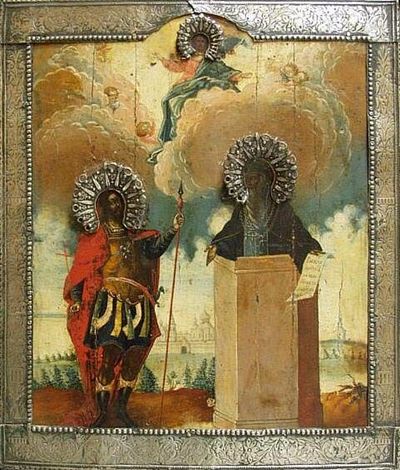
Nicetas is painted as a Russian monastic ascetic — bearded, in the schema or a dark mantle, often with the koukoulion — and his two constant attributes are the iron chains with their crosses and the stone cap; the pit or a squat masonry pillar from which he rises stands for his stylitism, and a scroll of repentance is often in his hand. Because his cult is inseparable from his monastery, shrine images regularly place the Nikitsky monastery in the background, and regularly pair him with the Great Martyr Nicetas in armour, the house's patron.
The stored image is exactly such a shrine composition: a Russian panel of 1799, a copy of the monastery's cathedral icon, in a chased silver riza. Beneath Christ in glory in the clouds stand two saints of the same name — on the left the warrior Great Martyr Nicetas in cuirass and red cloak with a spear (captioned in the Russian tradition Nikita Stratilat), and on the right this saint, the stylite, in monastic habit, rising from a square masonry pillar with an open scroll in his hand; behind them, across the landscape, the buildings of the Pereslavl Nikitsky monastery. The right-hand figure on the pillar, with the monastery of his own asceticism behind him, is the identification relied on here.
Disputed questions
- Is he a martyr? He was killed for the metal on his body, not for confessing Christ, and the Church accordingly numbers him among the venerable (prepodobny) rather than the martyrs; some Russian usage, feeling the violence of his end, styles him a venerable-martyr or ranks him with the passion-bearers. This entry follows the majority usage — venerable and wonderworker — and records the minority.
- Which Prince Michael of Chernigov? The Life names the prince healed by the saint's staff as Michael of Chernigov. He cannot well be the passion-bearer Michael of Chernigov martyred in the Horde in 1246, who was born about the very year of Nicetas's death. Either another Chernigov prince of the name is meant, or the episode has attached a famous name to an earlier benefactor of the monastery. The chronology is a genuine difficulty and is not resolved by the sources.
- The date 1186 and the identity of the murderers. The year is that of the tradition and is not fixed by any chronicle entry; the killers are called relatives in the received Life, robbers in some retellings, and the two versions may not be reconcilable.
- The relics. The uncovering under Metropolitan Photius is variously dated in the 1420s, and the later history of the relics through the closure of the monastery in the Soviet period is reported inconsistently in modern accounts.
- Not to be confused with the Great Martyr Nicetas the Goth (Nicetas the Goth, September 15) — his name-saint and the patron of the monastery in which he lived, with whom he is regularly paired on the same icon panel, so that the pairing is a standing source of misidentification; nor with Nikitas of Novgorod, the Russian bishop and wonderworker (†1108); nor with the Byzantine Nicetas of Medikion, Nicetas the Patrician, or Nicetas of Apollonias.