
Roman of Kirzhach
Our Venerable Father Roman, first Abbot of the Annunciation Monastery on the Kirzhach
Venerable · d. 29 July 1392, at the Annunciation monastery on the river Kirzhach
Commemorated 29 July — Repose at the Kirzhach monastery
Roman (†1392) was a disciple of Sergius of Radonezh and the first abbot of the monastery of the Annunciation on the river Kirzhach, in the Vladimir land. When Sergius, rather than contend for authority in his own Trinity monastery, quietly walked away from it, Roman was among the few who followed him into the forest; the two built there a church of the Annunciation and founded a new community (1371). After some three or four years the Metropolitan Alexis and the entreaties of the Trinity brethren brought Sergius back, and he left Roman — ordained hieromonk for the purpose — as abbot in his place. Roman governed the Kirzhach house for twenty years by his teacher's rule, "a zealous ascetic and a good but demanding instructor," and reposed on 29 July 1392, some two months before Sergius himself. He is buried in the Annunciation church and is numbered among the saints of Radonezh.

Sergius's withdrawal to the Kirzhach
The founding of Kirzhach begins with a quarrel that Sergius refused to have. Some time about 1371 a dispute arose in the Trinity monastery over the authority of the abbot — the chroniclers connect it with the introduction of the cenobitic rule and with the objections of Sergius's elder brother Stephen. Sergius, who would not divide the brotherhood by defending his own position, went out of the monastery without telling anyone, taking one companion, and walked away north-east into the forests of the Vladimir country.
He came to the river Kirzhach, a tributary of the Klyazma, and settled at a place he judged fit for prayer. Roman, one of his disciples at the Trinity, followed him there — the tradition makes him Sergius's constant helper in this period — and with such others as came they built cells and then a wooden church in honour of the Annunciation of the Most Holy Theotokos, blessed by Metropolitan Alexis of Moscow. A monastery formed around it in the ordinary way of the Russian north: a hermitage, then a brotherhood, then a rule.
First abbot
The Trinity brethren, meanwhile, were petitioning the Metropolitan for their abbot's return, and Alexis at length told Sergius plainly to go back. Sergius obeyed — after some three or four years on the Kirzhach — but would not leave the new house without a head. He asked that Roman be ordained to the priesthood and appointed abbot in his stead, and Alexis did so. It is a small transaction with a large meaning in Russian monastic history: Kirzhach is the first of the daughter-houses of the Trinity, the first of the many communities that would carry Sergius's cenobitic rule across the north, and Roman is the first of that long line of Sergiev abbots.
The record of his twenty years' rule is brief but consistent. He is described as a zealous ascetic who kept the fasts and the vigils himself before requiring them, and as a teacher at once kind and exacting — the Slavonic phrase carries both, a father who was gentle in manner and unyielding in the rule. Under him the Annunciation monastery grew from a forest hermitage into an established house with lands and a settled community; the town of Kirzhach grew up about it in later centuries.
Repose and veneration
Roman reposed on 29 July 1392, about two months before his teacher — Sergius of Radonezh died on 25 September of the same year — and was buried in the Annunciation church of his monastery. His relics rest there under a crypt beneath the church, and are uncovered; he is called a wonderworker in the Russian books, and the healings at his tomb are the basis of his local veneration, which was formalised in the seventeenth and eighteenth centuries. The Kirzhach monastery was closed under Catherine II in 1764 and its church became the parish church of the town, which is why the tomb has remained accessible; the monastery was re-founded as a convent in the twentieth century.
He is commemorated also in the Synaxis of the Saints of Radonezh (July 6), among the disciples of Sergius, and in the synaxis of the saints of Vladimir.
Feast and commemoration
July 29 (church date; New Calendar civil July 29, Old Calendar civil August 11), the day of his repose — a Russian commemoration, kept also by the OCA, and not found in Greek or Antiochian usage. He is kept with particular honour at Kirzhach and in the Vladimir and Alexandrov country, and named at the Synaxis of the Saints of Radonezh on July 6 and in the synaxis of the saints of Vladimir.
Hymns
Troparion — Tone 8 (common of a venerable father)
Thou didst follow thy teacher into the wilderness and didst not leave him in his exile; and when he returned, thou wast left as a shepherd in his stead, and didst keep his rule unbroken to the end. O venerable Father Roman, first abbot of the Annunciation, entreat Christ God that our souls be saved.
Original translation from the Slavonic
Iconography
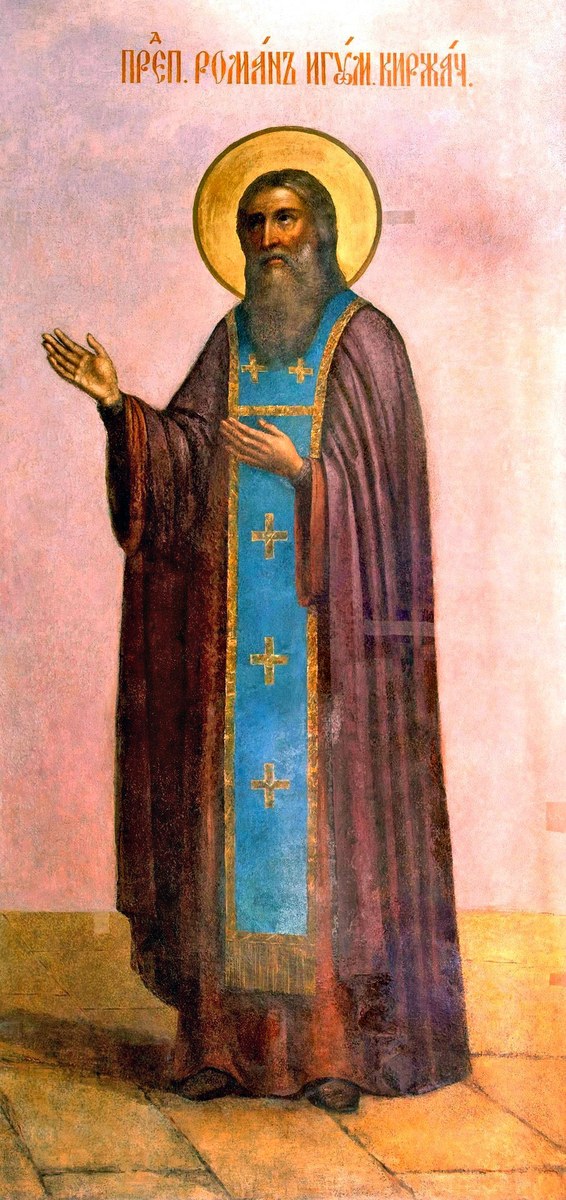
Roman is painted as a venerable abbot: a monk of middle years with a full grey-brown beard, in the dark mantiya over the ryasa, and — distinctively for him — wearing the epitrachelion with its rows of crosses, marking him as a hieromonk-abbot; his right hand is raised in address or blessing, the left open before him or holding a scroll. Where the fuller type is used he holds a model of the Annunciation church, or is shown standing beside Sergius of Radonezh in the assembly of the Radonezh saints.
The stored image is a nineteenth-century Russian icon (c. 1850) inscribed in Slavonic ПРЕП. РОМАНЪ ИГУМ. КИРЖАЧ. — "Venerable Roman, Abbot of Kirzhach": the saint full-length on a pale ground, in a violet-brown mantle over the blue-green epitrachelion crossed with gold crosses, the right hand extended and the left at his breast. The academic manner of the painting is that of the provincial Russian workshops of the mid-nineteenth century.
Disputed questions
- Date of the foundation. 1371 is the received date for the church on the Kirzhach; some accounts put the withdrawal of Sergius in 1373 and shorten his stay accordingly. The length of Sergius's absence is given as three years in most Russian sources and four in some.
- Not to be confused with the other Russian saints named Roman — Roman of Ryazan (July 19), the martyred prince, and the passion-bearer Roman (Boris and Gleb's baptismal names) — nor with Romanus the Melodist (October 1). Roman of Kirzhach is a monk of the Sergiev circle, not a prince and not a hymnographer.
- Roman and Stephen of Makhrishche. The tradition sometimes attributes the choice of the Kirzhach site to Stephen of Makhrishche, who guided Sergius into that country; Stephen's own foundation lay nearby, and the two houses are associated in the Vladimir menologia.