
Theodosius of Trebizond
Our Father among the Saints Theodosius, Metropolitan of Trebizond
Bishop · Venerable · b. c. 14th century, at Korytsa — d. 1392, at Trebizond
Commemorated 11 January — Repose at Trebizond
Theodosius, Metropolitan of Trebizond (fourteenth century – 1392), was an Athonite monk who became a hierarch of the empire of Trebizond. Born at Korytsa, near the hills of Kastoria, he took the monastic habit young, passed to the Philotheou monastery on Mount Athos, and there led so strict a life that he was chosen its abbot about 1375. For the holiness of his life he was afterward raised to be Metropolitan of Trebizond, the great Greek city and imperial capital on the southern shore of the Black Sea. He is remembered as a benefactor of the Holy Mountain — his influence moved the emperor to endow the building of the monastery of Dionysiou on Athos — and he reposed at Trebizond in 1392. He is commemorated on January 11.
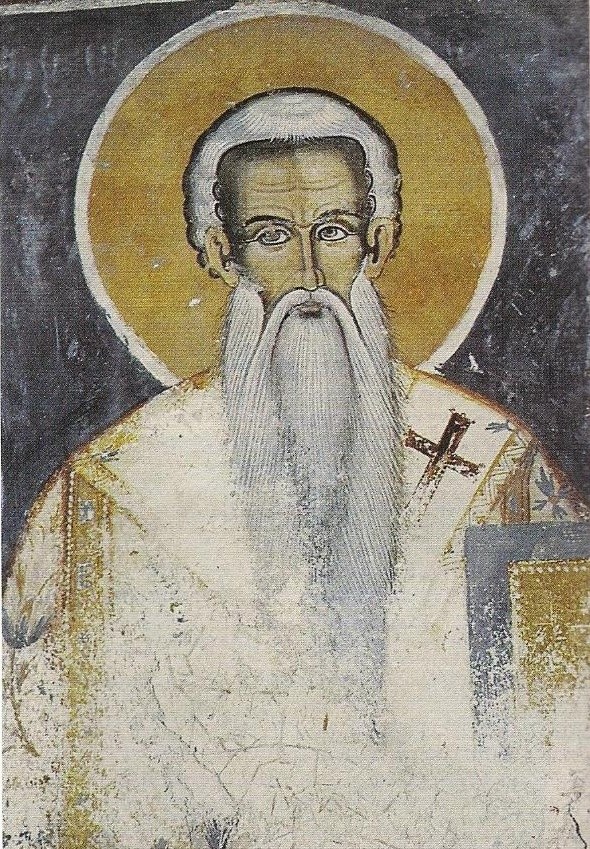

Theodosius was born in the fourteenth century at Korytsa (Koritsa), a place described as lying near the district of Kastoria in the mountainous borderland of Macedonia and Epirus. Drawn to the monastic life, he received the tonsure — the tradition says at Constantinople, about the age of eighteen — and then withdrew to the Holy Mountain of Athos, entering the monastery of Philotheou. There his ascetic labour and discernment so distinguished him that the brotherhood chose him abbot (igumen) about the year 1375.
His reputation for sanctity carried beyond the Mountain, and he was called from Philotheou to the episcopate, being consecrated Metropolitan of Trebizond — the see of the Grand Komnenoi, whose small Greek empire on the Black Sea outlasted even Constantinople's first fall. From that dignity he did not forget Athos: his counsel and intercession, the tradition holds, moved the Trapezuntine emperor Alexios III Komnenos to become the patron and benefactor of the newly founded monastery of Dionysiou, one of the great houses of the Holy Mountain, built in that age by Saint Dionysios of Korisos — a foundation for which the imperial endowment secured by Theodosius was remembered with gratitude. He governed the Church of Trebizond in holiness and reposed there in the year 1392.
Feast and commemoration
Theodosius of Trebizond is commemorated on January 11 (church date; Old Calendar civil January 24), within the afterfeast of the Theophany. He shares the day with the two elder saints of his name — Theodosius the Cenobiarch and Theodosius of Antioch — and is distinguished from them as the fourteenth-century Athonite metropolitan. His is a lesser and more local commemoration, kept especially in the Greek and Athonite tradition. He is not to be confused, further, with Theodosius of the Kiev Caves (†1074, May 3) or Theodosius of Chernigov (†1696), the two Theodosii of the Slavic calendar.
Iconography
Theodosius is depicted, where he appears, as a bishop-monk: vested as a hierarch in omophorion and holding the Gospel, or in the monastic habit, an ascetic of the Athonite type. The stored image is the fresco of the exonarthex of Philotheou Monastery on Mount Athos (1765) — the white-bearded hierarch with the Gospel-book, painted by the monastery of which he himself had been a monk before his elevation to the see of Trebizond: the house keeping the image of its own saint.