
Theophilus the New
The Holy Martyr Theophilus the New
Martyr · d. c. 784
Commemorated 30 January — Martyrdom of Theophilus the New, Byzantine commander, beheaded by the Arabs for refusing to deny Christ
Theophilus the New (†c. 784) was a Byzantine military commander and senator, honoured by the emperor and set at the head of the imperial forces, who was taken captive by the Arabs in a sea-campaign that ended in defeat. Held prisoner for some four years and pressed with threats and with the promise of great honours to deny Christ and embrace the faith of his captors, he refused steadfastly, and was at last beheaded. The Church keeps him on January 30 among the martyrs, styling him "the New" to distinguish him from the earlier saints of his name. His memory belongs with the long line of Byzantine soldiers and commanders who, taken in the wars with the Caliphate, sealed with their blood the confession they had made in arms.
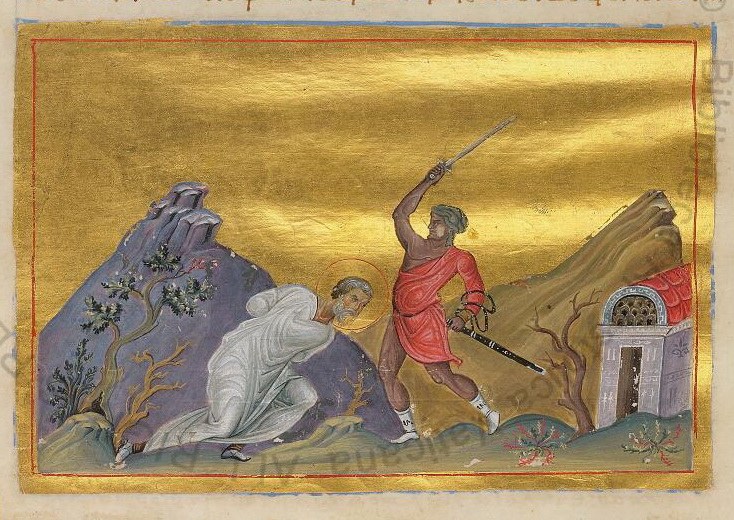

Theophilus held high rank in the service of the Christian empire in the eighth century — the sources make him a commander (stratelates) of the imperial armies and a man of senatorial dignity, honoured and trusted at the court. In the long struggle of the empire with the Arabs he was given command in a naval campaign; but the fleet was overwhelmed — the tradition lays the disaster to the cowardice or treachery of the admiral over him, who fled and left Theophilus and his men to be surrounded — and Theophilus was taken prisoner by the Saracens.
His captors, valuing so notable a prisoner, did not put him to death at once. For some four years they held him, pressing him by turns with flattery and with menace to renounce Christ and to take up the religion of Islam, promising him honours, freedom, and high place among them if he would deny his faith. Theophilus would not: neither the long imprisonment, nor the threats, nor the offered rewards could move him, and he confessed Christ before them without wavering. When it was plain that he could not be turned, he was beheaded — about the year 784 — and so received the crown of martyrdom. The Church added his name to the calendar of her martyrs and keeps him on January 30.
Feast and commemoration
Theophilus the New is commemorated on January 30 (church date; Old Calendar civil February 12), the same day as the Synaxis of the Three Holy Hierarchs, under whose great feast his memory is kept as a secondary commemoration. The Greek and Slavic synaxaria agree on the day and give the year of his martyrdom as about 784. Some notices connect his captivity or his death with Cyprus — a frequent theatre of the eighth-century sea-war between the empire and the Caliphate — though the place is not certainly fixed. He is one of the martyr-commemorations of the day that the calendars keep in the shadow of the hierarchs' feast.
Taxonomy note. Theophilus was a military commander, and his martyrdom belongs to the type of the soldier-saint; but TAXONOMY.md has as yet no soldier / warrior office term (the gap is noted at the project's record of open questions, which lists other warrior-martyrs awaiting the same decision), and he is typed here martyr alone, with his military office given in prose.
Hymns
Troparion — Tone 4
Thy martyr Theophilus, O Lord, in his contest received the crown incorruptible from thee our God; for, possessed of thy strength, he cast down the tyrants and broke the feeble insolence of the demons. By his prayers, O Christ God, save our souls.
Original translation from the Greek
Kontakion — Tone 4
As a soldier of the earthly king made worthy to soldier for the King of heaven, thou didst endure the long bondage and the sword, O martyr Theophilus, and wast not moved from the confession of Christ; wherefore thou hast received the unfading crown.
Original translation from the Greek
Iconography
Theophilus is depicted as a martyr and a man of rank — in some images in the garb of a Byzantine officer or with the chlamys of a senator, holding the martyr's cross; in others simply among the martyrs of the day. The stored image is the miniature of the Menologion of Basil II (Constantinople, 985) for the January 30 commemoration — the beheading of the martyr in captivity, the Greek caption of the manuscript above the frame. The identification is by the manuscript's own calendar: the Menologion's January 30 martyr-Theophilus is the New Martyr of 784, and the "c. 4th century" of the Commons file title is the uploader's error, not the manuscript's.
Disputed questions
- Not to be confused with the other Theophili. Theophilus "the New" is distinguished by that epithet from the many earlier saints of his name — among them Theophilus the Confessor (eighth century, October 2/10), one of the Theophilus of the four Egyptian hermits John, Heraclemon, Andrew and Theophilus, and the several martyr-Theophili of the early centuries. The epithet "the New" marks him as a later martyr bearing an old name.
- The date and place. The year of his martyrdom is given as about 784, in the wars of the empire with the Arabs; the place is variously connected with Cyprus and the eastern sea, and is not certainly fixed.