
Pentecost week, day 2 · 50 days since Pascha
Day of the Holy Spirit
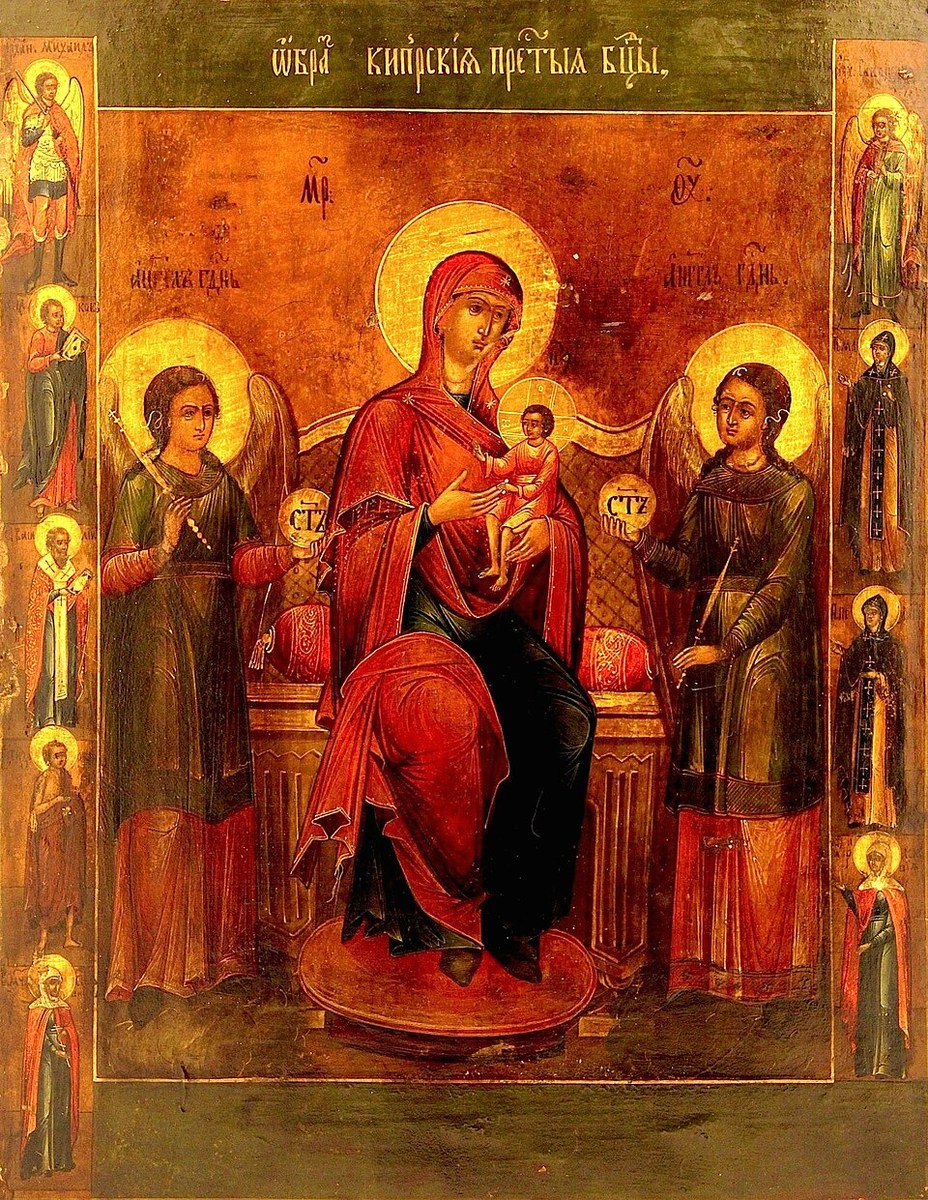
About Cyprus Icon of the Mother of God →

Saints commemorated
-
Trans. Rel. Theodore Stratelates
Theodore Stratelates (†319) — "the Commander," from the Greek stratelates, a general — was a Roman military officer of the early fourth century, governor and garrison-commander of Heraclea on the Thracian coast of the Black Sea, and one of the two great warrior-martyrs named Theodore whom the Church honours. A Christian in the years of Licinius's persecution, he was so loved by the city that the emperor himself came to him; entrusted with idols of gold and silver to offer in sacrifice, Theodore broke them up and distributed the pieces to the poor, then openly confessed Christ. He was scourged, racked, blinded, and — the tradition holds — crucified, and at the last beheaded on February 8, 319. His faithful servant Varus wrote down the acts of his passion. He is closely associated with, and in the calendars and iconography often paired with, Theodore the Recruit (Tyron), commemorated on February 17; the two Theodores are distinct saints. His relics were translated to his estate at Euchaita, kept as a second feast on June 8.
-
St Ephraim, Patriarch of Antioch (545)
Ephraim, a Syrian of Amida, was the imperial Count of the East (comes Orientis) under Anastasius and Justin — a soldier and administrator famous for his charity — when the great earthquake of 526 levelled Antioch and killed its patriarch. Sent back to rebuild the ruined city, he was raised from the lay state to its vacant throne in 527, and governed the see of Peter for eighteen years, until his repose in 545. He was among the firmest defenders of the Council of Chalcedon in the East, touring Syria and Mesopotamia to recover the non-Chalcedonian communities, presiding over the synod that condemned the writings of Severus of Antioch, and subscribing the condemnation of Origen in 543. The synaxarion remembers him above all for the trial by fire in which he met a heretical stylite: the pyre burnt three hours, and the patriarch's omophorion was drawn out of the ashes unharmed.
-
Our Holy Mother Melania the Elder (410)
Melania the Elder (c. 350 – c. 410) was a Roman noblewoman, widowed at twenty-two, who took ship for Egypt in the reign of Valens, spent half a year among the fathers of Nitria, followed the exiled Orthodox monks into Palestine disguised as a slave-girl to serve them, and then settled for twenty-seven years on the Mount of Olives, where with Rufinus of Aquileia she governed a house of fifty virgins and a companion monastery of men and kept open house for every pilgrim who came to Jerusalem. She was the friend of Evagrius of Pontus and Palladius, the teacher of Olympias, and a reader of Origen on a scale that astonished her contemporaries — which drew on her the anger of Jerome and set her at the centre of the first Origenist controversy. Returning to Rome in old age she carried her granddaughter Melania the Younger and half her kindred out of the world before the Gothic sack; she reposed at Jerusalem forty days after her final arrival, about the year 410.
-
St Zosimas, monk, of Phoenicia (Syria) (6th c.)
-
Kalliope
Kalliope was a Christian maiden of the middle of the third century, in the reign of Decius, remarkable — as her name says — for beauty, and no less for the gifts of mind and soul she gave wholly to Christ. She refused every offer of marriage, taught the word of God, and spent herself on the care of the sick and the comforting of the afflicted. Taken in Decius' persecution and brought before the local governor, she met first his flatteries and promises and then his fury: she was scourged without mercy, scored with knives, her wounds burned, and at last beheaded. The Greek synaxarion sums her up in a couplet: overlooking the beauties of things made, she was granted the sight of the beauty of the Maker.
-
Naucratius
Naucratius was the second son of Basil the Elder and Emmelia, and so the brother of Basil the Great, Macrina the Younger, Gregory of Nyssa and Peter of Sebaste. Brilliantly gifted and already launched on a career at the bar, he abandoned it at twenty-one for a hermitage in the forests by the river Iris in Pontus, where he lived five years in extreme austerity with a single servant, Chrysapius, hunting and fishing not for himself but to feed a company of poor and sick old men whom he had taken into his care. He died suddenly, still in his twenties, about the year 357 — the death whose news, in Gregory of Nyssa's telling, became the occasion of his sister Macrina's greatest act of courage. The Greek synaxarion keeps him on June 8, with the note that his identity is not certain.
-
Theodore of Rostov and Suzdal
Theodore, a Greek by birth, was consecrated in 991 or 992 — within a few years of the baptism of Rus' — as the first bishop of Rostov, and so the first hierarch sent into the wholly pagan forest country of the upper Volga and the Kliazma. The Merya and Slav population of Rostov would not receive him and drove him out; he withdrew to Suzdal, where his preaching took root, and there he baptised and taught until his repose in 1023. He is honoured as the founder of the see that Leontius, Isaiah and Ignatius afterwards made famous, as the enlightener of the Suzdal land, and — because his body was found incorrupt — as a wonderworker. His relics rest in the Cathedral of the Nativity of the Theotokos at Suzdal.
British Isles and Ireland
- St. Bron, bishop of Cassel-Irra (c.511)
- St. Levan (6th C)
- St. Muirchu (7th C)
- St. Syra (7th C)
Troparia & kontakia
Kontakion — Tone 6
Enthroned thou art shown in thine image, O Queen, with the angels standing about thee and the Word upon thine arm; the impious arrow drew blood from thee and the wound became a wonder, and to this day thou dost cleanse the eyes of them that look on thee. Wherefore we cry: hail, O thou refuge of the islands and of the Russian land.
Kontakion — Tone 4
Raised from the ranks of the world to the throne of Antioch, thou didst rebuild the fallen city and the fallen faith together, O wise Ephraim; and laying thy omophorion in the fire thou didst put the pride of heresy to shame. Wherefore we honour thy holy memory, and glorify the Lord who glorified thee.
Kontakion — Tone 4
The judge desired thy beauty and offered thee the world, but thou didst pour out thy blood for the Bridegroom whom thou hadst loved from thy youth, O Kalliope; and cut with knives and burned with fire, thou wast beheaded rejoicing. Wherefore we keep thy holy memory, and glorify the Lord who crowned thee.
Kontakion — Tone 4
Forsaking the wealth and the glory of Rome as a burden, thou didst put on the dress of a slave to serve the confessors in their exile, and upon the Mount of Olives thou didst gather a lamp-stand of virgins; O Mother Melania, thou didst keep open house for the whole Church, entreat Christ God that our souls may be saved.
Kontakion — Tone 2
Leaving the courts and the honours of the world in thy youth, thou didst hide thyself in the forests of the Iris, and what thy hands took from the waters thou gavest to the aged poor, O blessed Naucratius; wherefore, taken swiftly to God, thou didst leave to thy house an example of mercy.
Kontakion — Tone 4
Sent as the first shepherd into a land that knew not Christ, thou wast driven from Rostov and didst not turn back, but at Suzdal thou didst raise up a people to God; wherefore thy body was kept incorrupt, O hierarch Theodore, and we bless thy first labours in the north.
Kontakion — Tone 2
Having armed thy soul with faith through courage, and wielding the word of God as a spear, thou didst strike down the enemy, O Theodore, glory of the martyrs. With them cease thou never to intercede with Christ our God on behalf of us all.
Magnification
We magnify thee, O passion-bearer and holy Great-Martyr Theodore, and we honour thy precious sufferings, which thou didst endure for Christ.
Synaxarion
Overlooking the beauties of the things that are made, thou lookest, O Kalliope, on the beauties of the Maker.
Troparion — Tone 4 (common of an icon of the Mother of God)
Today the faithful keep radiant festival, overshadowed by thy coming, O Mother of God; and looking upon thy most pure image we cry with compunction: shelter us beneath the precious veil of thy protection, and deliver us from every evil, entreating thy Son, Christ our God, to save our souls.
Troparion — Tone 4 (common of a hierarch)
O guide of Orthodoxy, teacher of piety and holiness, luminary of the whole world, God-inspired adornment of hierarchs: by thy teachings thou hast enlightened all, O harp of the Spirit. O righteous father Ephraim, intercede with Christ our God that our souls may be saved.
Troparion — Tone 4 (common of a woman martyr)
Thy lamb Kalliope crieth out to Thee with a great voice, O Jesus: I love Thee, O my Bridegroom, and seeking Thee I contend; I am crucified and buried with Thee in Thy baptism, and I suffer for Thy sake that I may reign with Thee; I die for Thee that I may live in Thee. Receive me as an unblemished sacrifice, offered to Thee in love. By her intercessions, as Thou art merciful, save our souls.
Troparion — Tone 8 (common of a venerable woman)
In thee, O Mother, was the image of God preserved with exactness; for thou didst take up the Cross and follow Christ, and by thy deeds thou didst teach us to despise the flesh, for it passeth away, but to care for the soul, a thing immortal. Therefore doth thy spirit, O venerable Melania, rejoice together with the Angels.
Troparion — Tone 8 (common of a venerable ascetic)
In thee, O Father, was the image of God preserved with exactness; for thou didst take up the Cross and follow Christ, and by thy deeds thou didst teach us to despise the flesh, for it passeth away, but to care for the soul, a thing immortal. Therefore doth thy spirit, O venerable Naucratius, rejoice together with the Angels.
Troparion — Tone 4 (common of a hierarch)
O guide of Orthodoxy, teacher of piety and holiness, luminary of the whole world, God-inspired adornment of hierarchs: by thy teachings thou hast enlightened all, O harp of the Spirit. O righteous father Theodore, intercede with Christ our God that our souls may be saved.
Troparion — Tone 4
By true enlistment in the army of the heavenly King thou didst become his most comely commander, O Theodore; for with the weapons of faith thou didst wisely array thyself for battle and didst utterly rout the hordes of the demons, and wast shown to be a victory-bearing champion. Wherefore with faith we ever call thee blessed.
Readings
Epistle
Ephesians 5.8-19
8For ye were sometimes darkness, but now are ye light in the Lord: walk as children of light: 9(For the fruit of the Spirit is in all goodness and righteousness and truth;) 10Proving what is acceptable unto the Lord. 11And have no fellowship with the unfruitful works of darkness, but rather reprove them. 12For it is a shame even to speak of those things which are done of them in secret. 13But all things that are reproved are made manifest by the light: for whatsoever doth make manifest is light. 14Wherefore he saith, Awake thou that sleepest, and arise from the dead, and Christ shall give thee light. 15See then that ye walk circumspectly, not as fools, but as wise, 16Redeeming the time, because the days are evil. 17Wherefore be ye not unwise, but understanding what the will of the Lord is. 18And be not drunk with wine, wherein is excess; but be filled with the Spirit; 19Speaking to yourselves in psalms and hymns and spiritual songs, singing and making melody in your heart to the Lord;
Gospel
Matthew 18.10-20
10Take heed that ye despise not one of these little ones; for I say unto you, That in heaven their angels do always behold the face of my Father which is in heaven. 11For the Son of man is come to save that which was lost. 12How think ye? if a man have an hundred sheep, and one of them be gone astray, doth he not leave the ninety and nine, and goeth into the mountains, and seeketh that which is gone astray? 13And if so be that he find it, verily I say unto you, he rejoiceth more of that sheep, than of the ninety and nine which went not astray. 14Even so it is not the will of your Father which is in heaven, that one of these little ones should perish. 15Moreover if thy brother shall trespass against thee, go and tell him his fault between thee and him alone: if he shall hear thee, thou hast gained thy brother. 16But if he will not hear thee, then take with thee one or two more, that in the mouth of two or three witnesses every word may be established. 17And if he shall neglect to hear them, tell it unto the church: but if he neglect to hear the church, let him be unto thee as an heathen man and a publican. 18Verily I say unto you, Whatsoever ye shall bind on earth shall be bound in heaven: and whatsoever ye shall loose on earth shall be loosed in heaven. 19Again I say unto you, That if two of you shall agree on earth as touching any thing that they shall ask, it shall be done for them of my Father which is in heaven. 20For where two or three are gathered together in my name, there am I in the midst of them.