
Theodore of Rostov and Suzdal
Our Father among the Saints Theodore the Wonderworker, First Bishop of Rostov and Suzdal
Bishop · Wonderworker · b. 10th century, a Greek by birth — d. 1023, at Suzdal
Commemorated 23 May — Synaxis of the Saints of Rostov and Yaroslavl, 8 June — Principal commemoration of the first bishop of Rostov and Suzdal, 23 June — Synaxis of the Saints of Vladimir
Theodore, a Greek by birth, was consecrated in 991 or 992 — within a few years of the baptism of Rus' — as the first bishop of Rostov, and so the first hierarch sent into the wholly pagan forest country of the upper Volga and the Kliazma. The Merya and Slav population of Rostov would not receive him and drove him out; he withdrew to Suzdal, where his preaching took root, and there he baptised and taught until his repose in 1023. He is honoured as the founder of the see that Leontius, Isaiah and Ignatius afterwards made famous, as the enlightener of the Suzdal land, and — because his body was found incorrupt — as a wonderworker. His relics rest in the Cathedral of the Nativity of the Theotokos at Suzdal.

The first bishop of a pagan land
The conversion of Rus' under St Vladimir (988) created dioceses faster than it created Christians. Along with the metropolitan of Kiev, a company of Greek clergy was sent from Constantinople to occupy the new sees, and among them was Theodore, consecrated to Rostov in 991 or 992. The Russian chronicle tradition and the Rostov diocesan lists name him as the first of the bishops of Rostov, before Hilarion and before St Leontius.
What he was given was not a diocese but a mission field. The Rostov country — the lakes and forests between the Volga and the Kliazma — was inhabited by the Finnic Merya and by Slav settlers among them, and its religion was the old one: the sanctuaries, the diviners, the sacrifices in the groves. The town of Rostov itself, a trading place with a small Christian element, was in no mood for a Greek bishop who had come to close the shrines. Theodore preached, and, the accounts say, made some converts; but the mass of the people resisted him, and in the end drove him out of the city.
Suzdal
He did not go home. Theodore moved south-east to Suzdal, in the Kliazma country, and began again. There — whether because the settlement was newer, or its Slav population more open, or simply because the bishop had learned his ground — the mission succeeded: he baptised, built, and gathered a Christian community, and the second town of the region became the seat from which the faith spread through the Suzdal land. He governed his scattered flock, according to the reckoning of the Russian calendars, for some thirty years after his consecration, and reposed at Suzdal in 1023.
Of the substance of his life almost nothing else is transmitted. The Greek synaxarion notice is candid about it: "Saint Theodore was a Russian bishop; we have no other details of his life." What the tradition preserves instead is the shape of his labour — first bishop, driven out, and successful at the second attempt — and the witness of his relics.
Relics and veneration
Theodore's body was found incorrupt, and his relics became the chief treasure of Suzdal. They rest in the Cathedral of the Nativity of the Most Holy Theotokos in the Suzdal kremlin, the mother church of the diocese; portions are kept in the church of the Kazan Icon and in the church of SS Constantine and Helen in the same city, where the Greek synaxarion notes that one of his undecayed fingers is preserved. He is titled wonderworker in the Russian service books.
His veneration is a Suzdal and Rostov one rather than a general Russian one, and it is carried chiefly by the two great regional synaxes: the Synaxis of the Saints of Rostov and Yaroslavl on May 23 — the day of the uncovering of the relics of St Leontius in 1164, which gathers Leontius, Isaiah, Ignatius and the rest of the Rostov hierarchs — and the Synaxis of the Saints of Vladimir on June 23, which claims him for the Vladimir–Suzdal land. On his own day, June 8, he is kept at Suzdal with a proper festal service.
His place in the Rostov succession is best seen from the other end. When St Leontius came to Rostov in the middle of the eleventh century, the account of his episcopate records that two bishops, Theodore and Hilarion, had already been driven out by the pagans of the region — a sentence which is at once the earliest independent notice of Theodore and the measure of what he attempted. Leontius succeeded, at the cost of his life, where Theodore had been expelled; Isaiah consolidated the diocese; Ignatius two centuries later was the first Russian bishop whose relics were never buried. Theodore stands at the head of that line.
Feast and commemoration
June 8 (church date; New Calendar civil June 8, Old Calendar civil June 21). The day is principally the translation of the relics of the Great-Martyr Theodore Stratelates, whose office the Menaion appoints; the Russian calendars add the first bishop of Rostov to it, and the coincidence of the two names on one day is itself a small trap for readers of the calendar. He is kept also in the Synaxis of the Saints of Rostov and Yaroslavl (May 23) and the Synaxis of the Saints of Vladimir (June 23). His commemoration is Russian and OCA; the Greek synaxaria list him for June 8 as a Russian saint, with the notice that no details of his life survive, and he is absent from Antiochian and other Middle Eastern calendars.
Hymns
Troparion — Tone 4 (common of a hierarch)
O guide of Orthodoxy, teacher of piety and holiness, luminary of the whole world, God-inspired adornment of hierarchs: by thy teachings thou hast enlightened all, O harp of the Spirit. O righteous father Theodore, intercede with Christ our God that our souls may be saved.
Original translation from the Slavonic
Kontakion — Tone 4
Sent as the first shepherd into a land that knew not Christ, thou wast driven from Rostov and didst not turn back, but at Suzdal thou didst raise up a people to God; wherefore thy body was kept incorrupt, O hierarch Theodore, and we bless thy first labours in the north.
Original translation from the Slavonic
Iconography
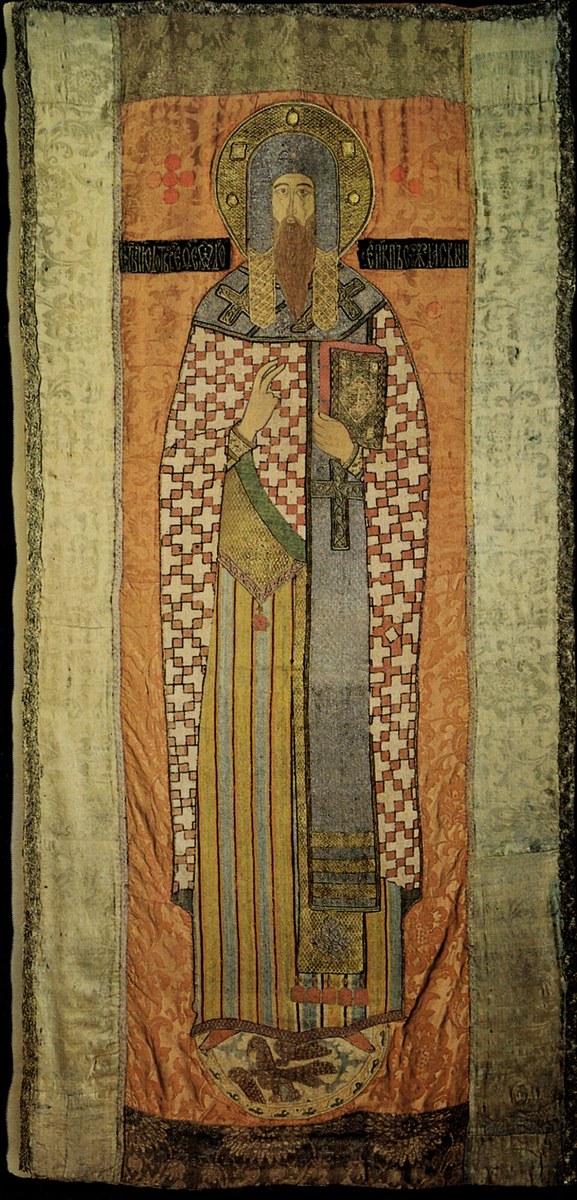
Theodore is painted as a Russian hierarch of the earliest period: full-length or bust-length, in the cross-covered polystaurion and the omophorion, blessing with the right hand and holding the Gospel in the left, with a broad dark-brown or greying beard, and always inscribed — since the vesting is indistinguishable from that of Leontius, Isaiah and Ignatius of Rostov, with whom he is sometimes ranged in the composite icons of the northern hierarchs. The white monastic koukoulion appears on some Suzdal images of him. He is not a common subject: his cultus is local, and where "Theodore of Rostov" is inscribed on a seventeenth-to-nineteenth-century Russian panel the saint intended is usually the fourteenth- century abbot of that name rather than the first bishop.
The stored image is the finest surviving representation of him: the embroidered funerary pall (pokrov) of 1581 made for his shrine at Suzdal, worked in coloured silks and gold thread on a ground of patterned damask, with the hierarch standing full-length in a white-and-red cross-patterned phelonion and omophorion, blessing, the Gospel in his covered left hand, and the Slavonic inscription across the shoulders naming him bishop of Suzdal. Palls of this kind were laid over the reliquary and are among the most reliable portraits of a local saint, being made for the shrine itself. The embroidery is long out of copyright; the photograph is used here under its CC BY-SA licence and attributed accordingly.
Disputed questions
- Not to be confused with Theodore of Rostov, †1394×1409 (the OCA life gives 1395, the Russian lists 1409) — the nephew of St Sergius of Radonezh, founder and abbot of the Borisoglebsky monastery near Rostov (and afterwards archbishop of Rostov). The OCA life for June 8 flags the confusion explicitly. The two are separated by nearly four centuries; the nineteenth-century icons of "the venerable Theodore and Paul of Rostov" belong to the later saint and his companion, not to the first bishop.
- Nor with the many other Theodores of this collection, and in particular not with Theodore Stratelates, the great-martyr whose translation of relics is kept on this same day, June 8, and who carries the day's service; nor with Theodore the Sanctified, Theodore the Studite, or Theodore the Silent of the Kiev Caves.
- Rostov or Suzdal? The Russian sources title him variously "first bishop of Rostov," "bishop of Rostov and Suzdal," and simply "bishop of Suzdal" — the last reflecting where he actually lived and died and where his relics lie. The composite title used here follows the Russian service books and the OCA calendar. Some older Suzdal local tradition treated the bishop of Rostov and the bishop of Suzdal as two saints named Theodore; the diocesan lists do not support the division, and the single-person identification is standard.
- The dates. 991 and 992 are both given for the consecration; 1023 is the transmitted year of repose, which would make an episcopate of some thirty years — long, but not impossible. Critical historians have questioned whether the earliest Rostov bishops can be dated at all from the surviving chronicle material, and treat Theodore and Hilarion as little more than names in a list. The Church's calendar keeps the traditional dates, and the incorrupt relics at Suzdal are the ground of the cultus in any case.