
Ephraim of Antioch
Our Father among the Saints Ephraim, Patriarch of Antioch the Great
Patriarch · Bishop · b. at Amida in Mesopotamia, late 5th century — d. 545, at Antioch
Commemorated 8 June — Repose at Antioch
Ephraim, a Syrian of Amida, was the imperial Count of the East (comes Orientis) under Anastasius and Justin — a soldier and administrator famous for his charity — when the great earthquake of 526 levelled Antioch and killed its patriarch. Sent back to rebuild the ruined city, he was raised from the lay state to its vacant throne in 527, and governed the see of Peter for eighteen years, until his repose in 545. He was among the firmest defenders of the Council of Chalcedon in the East, touring Syria and Mesopotamia to recover the non-Chalcedonian communities, presiding over the synod that condemned the writings of Severus of Antioch, and subscribing the condemnation of Origen in 543. The synaxarion remembers him above all for the trial by fire in which he met a heretical stylite: the pyre burnt three hours, and the patriarch's omophorion was drawn out of the ashes unharmed.

Count of the East
Ephraim was born at Amida (Diyarbakır) in Roman Mesopotamia, of Syrian stock, and rose in the imperial civil and military service under the emperors Anastasius (491–518) and Justin I (518–527). He held the office of comes Orientis — Count of the East, the governor charged with the whole Oriental diocese from its capital at Antioch — and had been granted senatorial honours by about 524–525. The synaxarion, which cares nothing for his titles, remembers what the archives confirm: that he was conspicuous for piety and for compassion to the destitute, and that the city knew him as a just administrator before it ever knew him as a bishop.
The earthquake, and an unlooked-for election
On 29 May 526 Antioch was destroyed by the worst earthquake in its long catalogue of disasters. The fires that followed burnt for days; the death toll was reckoned in the tens of thousands; and among the dead was the patriarch Euphrasius, killed in the collapse. The emperor sent Ephraim to Antioch with money and authority to raise the city out of its rubble.
While he was at that work, the tradition says, a bishop who was lodging in the city saw over his head the sign of his calling, and told him that he would be shepherd of the church of Antioch: let him only continue in his almsgiving and stand fast against the heretics. Ephraim took the word as a rebuke rather than a promotion. But when the clergy and people came to choose a patriarch in 527, they chose the layman who had been rebuilding their houses, and he was consecrated to the throne of Antioch — one of the small number of Byzantine patriarchs elevated directly from the secular service, and the second in the century to be so chosen at Antioch.
The defence of Chalcedon
Ephraim's episcopate falls in the sharpest phase of the struggle over the Council of Chalcedon (451) in Syria. His predecessor but one, Severus, had been the greatest theologian of the anti-Chalcedonian party and was still living in Egyptian exile, and much of the countryside of Syria and Mesopotamia — Ephraim's own homeland — held to Severus's teaching of the one nature of the incarnate Word.
Ephraim answered this with an energy that his opponents remembered bitterly and his own communion counted as apostolic zeal. He travelled the length of Syria, Mesopotamia and Osrhoene in person, preaching, disputing, receiving back clergy and communities and pressing the recalcitrant hard; he wrote against the Nestorian division of Christ on one side and against the Eutychian and Severan confusion of him on the other, teaching the one Christ in two natures, perfect God and perfect man. In 536 he took part in the proceedings at Constantinople and in his own synod at Antioch that anathematised the writings of Severus. His surviving letters, of which Photius preserved extracts in the Bibliotheca, are all of this kind: dogmatic, exact, and addressed to bishops, monasteries and individual dissenters — a working patriarch's correspondence rather than a treatise.
He was drawn also into the two great doctrinal actions of Justinian's reign. He subscribed the emperor's condemnation of Origen in 543 — the sentence that closed the long Origenist agitation which had begun in the generation of Rufinus and Melania the Elder, commemorated on this same day. Over the Three Chapters he resisted first and yielded afterwards, subscribing only when threatened with deposition: a hesitation the Church has never held against him, since the Fifth Ecumenical Council (553) settled the question in the same sense.
The stylite and the fire
The one story of Ephraim that every synaxarion tells is his encounter with a stylite near Hierapolis, a man of hard and genuine asceticism who held the doctrine of Severus. Ephraim went out to him himself and reasoned with him from the pillar's foot; the stylite answered that he would not be moved by arguments, but proposed a test — let them both go into a fire, and let God show which of them held the truth.
Ephraim, the account says, first refused as presumptuous, then reflected that the salvation of the man was worth the risk, and agreed. A great heap of wood was piled and lit. The patriarch took off his omophorion, laid it on the fire, and said: "Let the Lord judge between us." The wood burnt for three hours; when the ashes were raked over, the omophorion was drawn out whole and unsinged. The stylite came down from his pillar, confessed the Council, and was received into communion — and the tradition adds that Ephraim would never afterwards allow the miracle to be spoken of as his own.
Repose
Ephraim died at Antioch in 545, after eighteen years on the throne, and was succeeded by Domninus. His episcopate had spanned the rebuilding of the city after 526, the second earthquake of 528, and — if the chroniclers are followed — the Persian sack of Antioch by Khosrow I in 540, the worst calamity to fall on the city in that generation. That a patriarch who inherited a heap of ruins and outlived a Persian sack should be remembered chiefly for his almsgiving is the judgement of the tradition on him.
Feast and commemoration
June 8 (church date; New Calendar civil June 8, Old Calendar civil June 21). Ephraim is entered for this day in both the Greek and the Slavic traditions and on the OCA calendar, as a synaxarion commemoration on a day whose service belongs to the translation of the relics of Theodore Stratelates; no proper office is appointed him, and the common of a hierarch is used. Within the Antiochian tradition his memory carries a particular weight: he is one of the patriarchs of the see of Peter honoured by name in the Antiochian diptychs of saints, and he stands with Eustathius, Anastasius and Christopher among those Antiochene hierarchs remembered for holding the city to the councils in a time when much of its hinterland had gone another way. The Roman Martyrology keeps him on the same day.
Hymns
Troparion — Tone 4 (common of a hierarch)
O guide of Orthodoxy, teacher of piety and holiness, luminary of the whole world, God-inspired adornment of hierarchs: by thy teachings thou hast enlightened all, O harp of the Spirit. O righteous father Ephraim, intercede with Christ our God that our souls may be saved.
Original translation from the Greek
Kontakion — Tone 4
Raised from the ranks of the world to the throne of Antioch, thou didst rebuild the fallen city and the fallen faith together, O wise Ephraim; and laying thy omophorion in the fire thou didst put the pride of heresy to shame. Wherefore we honour thy holy memory, and glorify the Lord who glorified thee.
Original translation from the Greek
Iconography
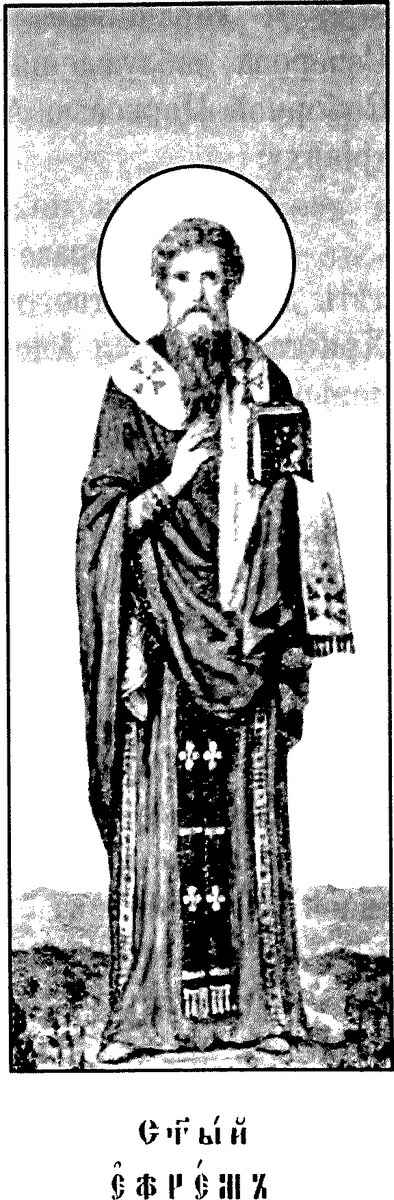
Ephraim is painted as a hierarch of the Byzantine type: middle-aged to elderly, with a full dark or greying beard, in phelonion and crossed omophorion, blessing with the right hand and holding the Gospel in the left, and inscribed as patriarch of Antioch. Where his history is shown rather than his person, the scene is the trial by fire: the pillar at one side with the stylite upon it, the heap of burning wood between, and the patriarch drawing his white omophorion out of the flames intact — an episode close in composition to the fire-ordeals painted for other confessor-hierarchs, and the surest way of telling him from the other saints named Ephraim. He may also be shown holding a scroll with a text on the two natures. The stored image is the captioned plate of the illustrated Zhitiya Svyatykh (1903–1911).
Disputed questions
- The Persian sack of 540. Procopius describes negotiations for the ransom of Antioch in which the patriarch took part, and a withdrawal into Cilicia when the city was lost. The hagiographical tradition passes over the episode entirely, and the details in the historians are not easy to reconcile; it is noted here as part of the setting of his episcopate rather than asserted as an act of his Life.
- Not to be confused with Ephrem the Syrian (†373, commemorated January 28), the deacon and hymnographer of Nisibis and Edessa. The names are identical in Greek and Syriac and both men were Syrians of Mesopotamia, but they are separated by more than a century and a half: Ephrem was a deacon and poet who never held a see, Ephraim a soldier-administrator who became patriarch of Antioch. Nor is he Ephraim of Pereyaslavl or the other Russian Ephraims.
- The heretic on the pillar. Sources place the stylite variously near Hierapolis (Mabbug) and near Heraclea, and describe him as a Severan (Monophysite) or, in later retellings, simply "a heretic." The core of the account — the challenge, the three hours, the unburnt omophorion — is stable across the witnesses.
- His writings. Nothing of Ephraim survives complete. What is known comes through the extracts and summaries of Photius (Bibliotheca, cod. 228), the acts of the synods of 536, and citations in later florilegia; the corpus is dogmatic letters and short treatises, with no continuous work transmitted.