
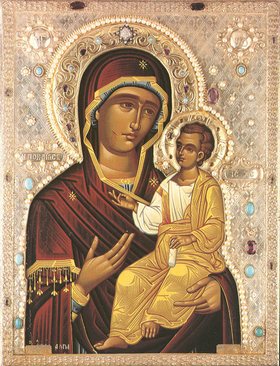
About Iveron Icon of the Mother of God →

Saints commemorated
-
Saint of the day
St Meletius, Archbishop of Antioch
Meletius (early 4th century – 381) was Archbishop of Antioch and one of the most beloved and most tried of the Church's hierarchs. Raised to the great Syrian see about the year 360, he confessed the Nicene faith so plainly at his enthronement that within a month the Arians procured his exile; three times he was driven from his city under the Arian emperors, and three times he returned, always in the same gentleness that made his name a byword. Under him the young John Chrysostom was catechised, baptised, and ordained reader. His episcopate was shadowed by the long Meletian schism — a division of the Nicene party at Antioch itself, over the legitimacy of his election rather than over the faith. Vindicated at last, he presided over the opening of the Second Ecumenical Council at Constantinople in 381 and reposed while it sat; Gregory of Nyssa preached his funeral, and his relics were carried home to Antioch and laid beside the martyr Babylas.
-
Saint of the day
St Aleksy, Metr. of All Russia
-
St Meletios, archbishop of Antioch (381)
-
Alexis of Moscow
Alexis (c. 1292/1305 – 1378) was Metropolitan of Kiev and All Russia and one of the great architects of Muscovite Russia — a saint remembered equally as a wonderworking hierarch and as a statesman who held the Russian land together in a perilous age. Born Eleutherius, of a boyar family of Chernigov settled at Moscow, he was a monk of the Theophany monastery for over twenty years before his elevation, and Metropolitan from 1354. Twice he journeyed to the Golden Horde; there, at the Khan's summons, he healed Taidula, the mother of the Khan, of blindness, and won by it protection and privileges for the Church. As guardian and regent for the boy-prince Demetrius Donskoy, he steadied the throne of Moscow and reconciled its warring princes. He founded the Chudov (Miracle) Monastery in the Kremlin and other houses, and reposed on February 12, 1378. His relics, uncovered incorrupt in 1431, made him one of the beloved wonderworkers of Russia and one of the Hierarchs of Moscow.
-
Antony II Kauleas
Antony Kauleas (c. 829 – 901), called "the Younger" to distinguish him from an earlier patriarch of the name, was Patriarch of Constantinople from 893 until his death, and a peacemaker of the Church. Of a Phrygian family settled in the capital, he was drawn from childhood to the monastic life, entering a monastery at twelve and becoming in time its abbot; he even brought his own widowed father into the brotherhood. Renowned for austere prayer through the night and for great mercy to the poor, he was raised to the patriarchal throne under the emperor Leo VI the Wise, and laboured to compose the divisions left by the long strife between the followers of Photius and of Ignatius, convening a synod that restored peace to the Church. He reposed on February 12; his memory was honoured with encomia by the learned men of his own generation, and the monastery of Kauleas long kept his name.
-
Christos the Gardener
Christos (Kristo) the Gardener (c. 1708 – 1748) was a new martyr of the Ottoman period — a simple Albanian market-gardener who died at Constantinople rather than deny Christ. Come to the great city about the age of forty to earn his living by his trade, he fell into a dispute over the price of apples with a Turk, who in his anger denounced him to the authorities with the false claim that Christos had said he wished to become a Muslim. Arrested on the word of Muslim witnesses, Christos steadfastly refused to apostatise, endured imprisonment and torture, and was beheaded on February 12, 1748. His memory was recorded by the monk and writer Kaisarios Dapontes, who ministered to him in prison, and he is numbered among the Neomartyrs of the Faith.
-
Mary (called Marinos)
Mary, called Marinos (fifth-to-sixth century), is the ascetic woman who lived out her whole monastic life disguised as a man, and bore in silence a slander that would have crushed a lesser soul. Left motherless, she would not be parted from her father Eugene when he resolved to become a monk; cutting her hair and putting on man's clothing, she entered the monastery with him as the young "monk Marinos," and so excelled in humility and obedience that none suspected her. Falsely accused by an innkeeper's daughter of having fathered her child, "Marinos" made no defence, accepted expulsion, and for years lived outside the gate, raising the child as her own. Restored at last to the monastery and set to the hardest labours, she bore all without complaint; only when she died was her secret revealed, to the confusion and repentance of her accusers. She is a beloved image of humility, patience, and unjust blame borne for Christ.
British Isles and Ireland
- St. Ethelwold, monk and bishop of Lindisfarne (740)
- St. Siadhal (Sedulius) (5th C)
Troparia & kontakia
Kontakion — Tone 8
Though thy holy icon was cast into the sea, O Theotokos, by a widow who could not save it from the enemies, yet hast thou been shown forth as the Guardian of Athos and the Keeper of the Gate of the Iveron monastery, striking terror into the foes, and delivering from all afflictions and calamities, in the Orthodox land of Russia, them that honour thee.
Kontakion — Tone 8
Let us all the faithful people faithfully hymn, and with love call blessed, the divine and most honoured hierarch of Christ, the new wonderworker Alexis, as a great shepherd, a servant, and a most wise teacher of the land of Russia. Today, running together to his memory, let us joyfully cry out a song to the God-bearer: since thou hast boldness before God, deliver us from manifold afflictions, that we may cry to thee: Rejoice, O confirmation of our city.
Kontakion — Tone 2
Adorned with the ways of Orthodoxy, thou wast shown to be the protector and champion of the Church, O all-blessed Meletius, setting the ends of the earth ablaze with the true doctrines: O most radiant lamp of the Church.
Troparion — Tone 1
The insolence of them that hate the image of the Lord, and the power of the ungodly, came godlessly upon Nicaea, and those sent thither cruelly tormented a widow who piously honoured the icon of the Mother of God; but she by night, together with her son, sent the icon forth upon the sea, crying aloud: Glory to Thee, O Pure One, for the untrodden sea hath lent Thee its shoulders; glory to Thy straight voyaging, O only Incorrupt One.
Troparion — Tone 8
As one enthroned together with the Apostles, a most excellent physician and a well-pleasing servant, we run to thy precious shrine, O God-wise hierarch Alexis, O wonderworker; gathered together in love, we keep thy memory in brightness, rejoicing in psalms and hymns and glorifying Christ, who hath given thee such grace of healings, and to thy city a great confirmation.
Troparion — Tone 4
Thy Martyr Christos, O Lord, in his contest received from Thee our God the crown of incorruption; for having Thy strength, he cast down the persecutors and broke the feeble boldness of the tormentors. By his prayers, O Christ God, save our souls.
Troparion — Tone 8
In thee, O Mother, was the image of God preserved unshaken; for taking up the Cross, thou didst follow Christ, and by thy deeds thou hast taught us to despise the flesh, which passes away, but to care for the soul, a thing immortal. Wherefore thy spirit, O venerable Mary, rejoices with the angels.
Troparion — Tone 4
A rule of faith and an image of gentleness, a teacher of temperance, the truth of things revealed thee to thy flock; therefore by humility thou didst gain the heights, and by poverty riches. O Father and Hierarch Meletius, intercede with Christ our God that our souls may be saved.
Readings
Epistle
2 Timothy 2.11-19
11It is a faithful saying: For if we be dead with him, we shall also live with him: 12If we suffer, we shall also reign with him: if we deny him, he also will deny us: 13If we believe not, yet he abideth faithful: he cannot deny himself. 14Of these things put them in remembrance, charging them before the Lord that they strive not about words to no profit, but to the subverting of the hearers. 15Study to shew thyself approved unto God, a workman that needeth not to be ashamed, rightly dividing the word of truth. 16But shun profane and vain babblings: for they will increase unto more ungodliness. 17And their word will eat as doth a canker: of whom is Hymenaeus and Philetus; 18Who concerning the truth have erred, saying that the resurrection is past already; and overthrow the faith of some. 19Nevertheless the foundation of God standeth sure, having this seal, The Lord knoweth them that are his. And, Let every one that nameth the name of Christ depart from iniquity.
Gospel
Luke 18.2-8
2Saying, There was in a city a judge, which feared not God, neither regarded man: 3And there was a widow in that city; and she came unto him, saying, Avenge me of mine adversary. 4And he would not for a while: but afterward he said within himself, Though I fear not God, nor regard man; 5Yet because this widow troubleth me, I will avenge her, lest by her continual coming she weary me. 6And the Lord said, Hear what the unjust judge saith. 7And shall not God avenge his own elect, which cry day and night unto him, though he bear long with them? 8I tell you that he will avenge them speedily. Nevertheless when the Son of man cometh, shall he find faith on the earth?