
Pentecost week, day 2 · 50 days since Pascha
Day of the Holy Spirit
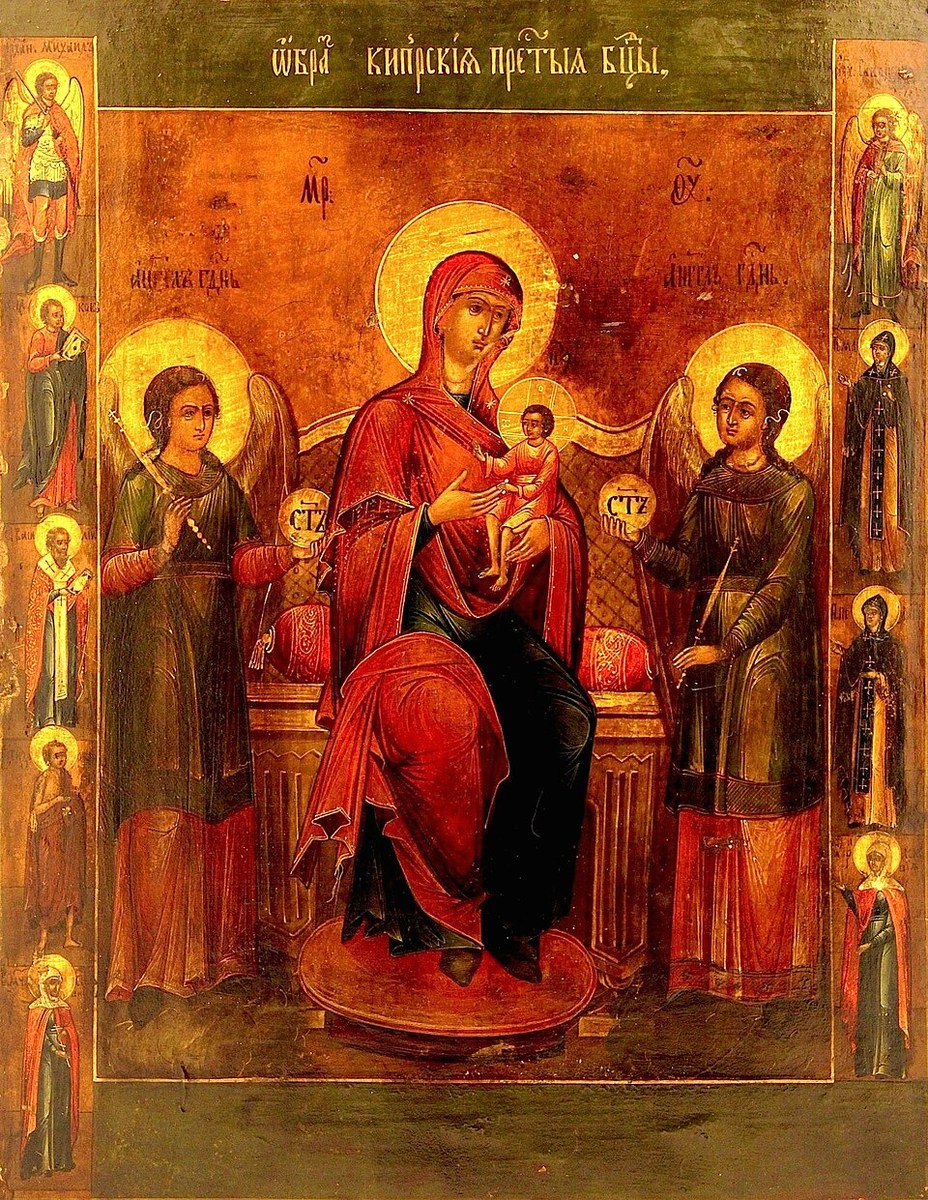
About Cyprus Icon of the Mother of God →

Saints commemorated
-
Martyr Aquilina of Byblos
Aquilina of Byblos (c. 281–293) is the girl-martyr of Phoenicia: a Christian child of Byblos, the ancient coastal city that is the modern Jbeil in Lebanon, who at the age of twelve was denounced for having persuaded a pagan schoolfellow to believe in Christ. Brought before the governor Volusian, she refused every flattery and every threat, answering that the more she suffered the more strength the Lord invisibly gave her; she was beaten and had heated iron rods driven through her ears, and was cast out of the city for dead. Raised by an angel and returning to confess Christ a second time before the same tribunal, she was sentenced to beheading and gave up her soul in prayer before the sword could fall, in the year 293. Her tomb outside Byblos became a place of healings, and her relics were afterwards carried to Constantinople.
-
Saint Triphyllius, bishop of Leucosia (Nicosia) in Cyprus (370)
Triphyllius (†c. 370) was Bishop of Leucosia — ancient Ledra, the modern Nicosia — in Cyprus, and the best-known disciple of Spyridon of Trimythous. Born at Constantinople and trained in law and rhetoric at Berytus (Beirut), he was by St Jerome's reckoning the most eloquent writer of his generation and the author of a commentary on the Song of Songs, now lost; yet he attached himself for a master not to a scholar but to the unlettered shepherd-bishop Spyridon, and the two stories the tradition tells best about him are both stories of Spyridon correcting his learning — the healing of the sick emperor, at which Triphyllius was recognised together with his teacher, and the rebuke in synod when he improved the Gospel's plain word for a sick man's bed. He founded a monastery at Leucosia out of his mother's inheritance, is counted among the Cypriot bishops at the Council of Sardica, and reposed in old age about the year 370.
-
St Anna and her son John (5h c.)
Anna and her son John were ninth-century ascetics of Constantinople and Bithynia. Anna was the daughter of a deacon of the church of the Blachernae in the capital; widowed young, she cut her hair, put on a man's habit, took the name Euthymianus, and went with her son to live the monastic life in one of the monasteries on Mount Olympus in Bithynia, where the two of them were received as father and son. She belongs to the small and much-loved company of Byzantine holy women who lived hidden in men's monasteries under a man's name. She returned at length to Constantinople, and there reposed in the year 826. Her memory — and her son's with hers — is kept twice in the year, principally on June 13 and again on October 29.
-
Andronicus of Moscow
Andronicus (†1404) was a native of Rostov, a disciple of Sergius of Radonezh, and the first abbot of the Monastery of the Saviour on the Yauza at Moscow — the house that took his own name and is known to this day as the Andronikov Monastery. It was founded by St Alexis, Metropolitan of Moscow, in fulfilment of a vow made when he was delivered from a storm at sea on the voyage home from Constantinople, and completed about 1361; Alexis set Andronicus over it, and Sergius came to see his disciple there. Under Andronicus the monastery became a place of severe fasting and of unusual humility, and — as it proved — the nursery of the greatest school of icon-painting in Russia: his own disciples Sabbas and Alexander were remembered a century later for their skill, and it was in this house that Andrei Rublev and Daniel the Black were monks. In extreme old age Andronicus resigned the abbacy to Sabbas and withdrew into silence, and he reposed in 1404 and was buried in the monastery church, where his relics were identified again in 1993. The Church keeps him on June 13.
-
Antipater of Bostra
Antipater was Bishop — properly Metropolitan — of Bostra, the capital of the Roman province of Arabia and one of the great metropolitan sees of the Patriarchate of Antioch, in the second half of the fifth century. He is one of the very few saints of the calendar who is remembered for a book: his Refutation of the Apology for Origen answered the defence of Origen composed by Pamphilus and Eusebius of Caesarea, and set out against the Origenist system — the pre-existence of souls, the final restoration of all things, the allegorising away of the Genesis creation — with a precision that later generations found useful. The work was ordered to be read in the Eastern churches during the Origenist crisis of Justinian's reign, and the Fathers of the Seventh Ecumenical Council in 787 cited him as an authority; it is now lost apart from the fragments preserved in those conciliar acts. He also wrote against the Apollinarians, and a small body of his homilies survives. His life is not recounted in the Synaxaristes: what the Church keeps of him on June 13 is a name, a see, and a body of teaching.
-
Antonina of Nicaea
Antonina of Nicaea (†c. 302) was a Christian woman of Nicaea in Bithynia who suffered martyrdom in the persecutions of the late third and early fourth centuries. Arrested for her confession of Christ and brought before the governor, she refused every inducement and threat to sacrifice to the idols; she was subjected to a succession of savage tortures — the rack, fire, and imprisonment — which she endured with unshaken constancy, and at last was put to death. The Church honours her among the martyrs of Nicaea and keeps her memory on March 1.
-
Sabbas of Moscow
Sabbas (†1410) was the disciple of Andronicus of Moscow and the second abbot of the Monastery of the Saviour on the Yauza — the Andronikov monastery — succeeding his teacher in 1395, when Andronicus in extreme old age laid down the government of the house and withdrew into silence. He is one of the two disciples named by St Joseph of Volokolamsk — Sabbas and Alexander — for the virtue and the skill in icon-painting for which that monastery became famous, and he governed it through the years in which Andrei Rublev and Daniel the Black were its monks. He reposed in 1410 and was buried in the monastery church beside Andronicus; the two burials were identified together in the excavations of 1993. The Church keeps him on June 13, with his teacher.
British Isles and Ireland
- St. Damhnade of Cavan
Troparia & kontakia
Apolytikion — Tone 8 (common of a venerable father)
By a flood of tears thou didst make the barren desert fruitful, and thy longing for God brought forth fruit in abundance by the labour of thy sighs a hundredfold; and thou didst become a shining lamp, illumining the world by thy miracles, O Andronicus our father. Intercede with Christ God that our souls may be saved.
Apolytikion — Tone 8 (common of a woman monastic-saint)
In thee, O mother, was preserved unimpaired that which is according to the image of God; for taking up the cross, thou didst follow Christ, and by thy deeds thou hast taught us to despise the flesh, which passeth away, and to care rather for the soul, a thing immortal. Wherefore, O venerable Anna, thy spirit rejoiceth with the angels.
Apolytikion — Tone 4 (common of a hierarch)
O God of our fathers, who dealest with us ever according to Thy gentleness: take not Thy mercy from us, but by the prayers of Thy hierarch Antipater, guide our life in peace.
Apolytikion — Tone 4 (common of a woman martyr)
Thy lamb Aquilina crieth out to Thee with a great voice, O Jesus: I love Thee, O my Bridegroom, and seeking Thee I contend, and I am crucified and buried together with Thee in Thy baptism; I suffer for Thy sake, that I may reign with Thee; I die for Thee, that I may live in Thee. Receive me as a spotless sacrifice, offered to Thee in love. By her intercessions, O merciful One, save our souls.
Apolytikion — Tone 8 (common of a venerable father)
By a flood of tears thou didst make the barren desert fruitful, and thy longing for God brought forth fruit in abundance by the labour of thy sighs a hundredfold; and thou didst become a shining lamp, illumining the world by thy miracles, O Sabbas our father. Intercede with Christ God that our souls may be saved.
Apolytikion — Tone 4 (common of a hierarch)
O God of our fathers, who dealest with us ever according to Thy gentleness: take not Thy mercy from us, but by the prayers of Thy hierarch Triphyllius, guide our life in peace.
Kontakion — Tone 6
Enthroned thou art shown in thine image, O Queen, with the angels standing about thee and the Word upon thine arm; the impious arrow drew blood from thee and the wound became a wonder, and to this day thou dost cleanse the eyes of them that look on thee. Wherefore we cry: hail, O thou refuge of the islands and of the Russian land.
Kontakion — Tone 2 (common of a virgin martyr)
Thou didst offer to Christ the first-fruits of thy years, O maiden, and the purity of a body untouched; and being a child in age thou wast found perfect in confession, and didst tread down the pride of the tyrant. Wherefore we cry to thee: rejoice, O Aquilina, bride of the Lord.
Troparion — Tone 4 (common of an icon of the Mother of God)
Today the faithful keep radiant festival, overshadowed by thy coming, O Mother of God; and looking upon thy most pure image we cry with compunction: shelter us beneath the precious veil of thy protection, and deliver us from every evil, entreating thy Son, Christ our God, to save our souls.
Troparion — Tone 4
Thy ewe-lamb, O Jesus, crieth out with a loud voice: "Thee, my Bridegroom, do I long for, and seeking Thee I contend; I am crucified and buried with Thee, and I suffer for Thy sake, that I may reign with Thee; I die for Thee, that I may live in Thee: receive me as an unblemished sacrifice offered to Thee with love." At her intercessions, O Merciful One, save our souls.
Readings
Epistle
Ephesians 5.8-19
8For ye were sometimes darkness, but now are ye light in the Lord: walk as children of light: 9(For the fruit of the Spirit is in all goodness and righteousness and truth;) 10Proving what is acceptable unto the Lord. 11And have no fellowship with the unfruitful works of darkness, but rather reprove them. 12For it is a shame even to speak of those things which are done of them in secret. 13But all things that are reproved are made manifest by the light: for whatsoever doth make manifest is light. 14Wherefore he saith, Awake thou that sleepest, and arise from the dead, and Christ shall give thee light. 15See then that ye walk circumspectly, not as fools, but as wise, 16Redeeming the time, because the days are evil. 17Wherefore be ye not unwise, but understanding what the will of the Lord is. 18And be not drunk with wine, wherein is excess; but be filled with the Spirit; 19Speaking to yourselves in psalms and hymns and spiritual songs, singing and making melody in your heart to the Lord;
Gospel
Matthew 18.10-20
10Take heed that ye despise not one of these little ones; for I say unto you, That in heaven their angels do always behold the face of my Father which is in heaven. 11For the Son of man is come to save that which was lost. 12How think ye? if a man have an hundred sheep, and one of them be gone astray, doth he not leave the ninety and nine, and goeth into the mountains, and seeketh that which is gone astray? 13And if so be that he find it, verily I say unto you, he rejoiceth more of that sheep, than of the ninety and nine which went not astray. 14Even so it is not the will of your Father which is in heaven, that one of these little ones should perish. 15Moreover if thy brother shall trespass against thee, go and tell him his fault between thee and him alone: if he shall hear thee, thou hast gained thy brother. 16But if he will not hear thee, then take with thee one or two more, that in the mouth of two or three witnesses every word may be established. 17And if he shall neglect to hear them, tell it unto the church: but if he neglect to hear the church, let him be unto thee as an heathen man and a publican. 18Verily I say unto you, Whatsoever ye shall bind on earth shall be bound in heaven: and whatsoever ye shall loose on earth shall be loosed in heaven. 19Again I say unto you, That if two of you shall agree on earth as touching any thing that they shall ask, it shall be done for them of my Father which is in heaven. 20For where two or three are gathered together in my name, there am I in the midst of them.