
Andronicus of Moscow
Our Venerable Father Andronicus, first Abbot of the Monastery of the Saviour at Moscow
Venerable · d. 1404
Commemorated 13 June — Repose of the first abbot of the Saviour-Andronikov Monastery
Andronicus (†1404) was a native of Rostov, a disciple of Sergius of Radonezh, and the first abbot of the Monastery of the Saviour on the Yauza at Moscow — the house that took his own name and is known to this day as the Andronikov Monastery. It was founded by St Alexis, Metropolitan of Moscow, in fulfilment of a vow made when he was delivered from a storm at sea on the voyage home from Constantinople, and completed about 1361; Alexis set Andronicus over it, and Sergius came to see his disciple there. Under Andronicus the monastery became a place of severe fasting and of unusual humility, and — as it proved — the nursery of the greatest school of icon-painting in Russia: his own disciples Sabbas and Alexander were remembered a century later for their skill, and it was in this house that Andrei Rublev and Daniel the Black were monks. In extreme old age Andronicus resigned the abbacy to Sabbas and withdrew into silence, and he reposed in 1404 and was buried in the monastery church, where his relics were identified again in 1993. The Church keeps him on June 13.

From Rostov to Radonezh
Andronicus was a native of Rostov — the old city of the upper Volga whose lands had already given Russia Sergius of Radonezh himself, whose parents Cyril and Maria were Rostov boyars ruined by the Muscovite annexation. Nothing is transmitted of Andronicus's family or of his age at conversion. What the sources record is that he came to Sergius, entered the Trinity monastery at Radonezh, and was formed there in the first generation of its brotherhood — the generation from which the whole northern monastic movement of the fourteenth century was seeded, as Sergius sent out disciple after disciple to found houses of his own observance.
The vow of Metropolitan Alexis
The occasion of the new monastery was a deliverance at sea. St Alexis, Metropolitan of Kiev and All Russia, returning from Constantinople, was caught in a violent storm; and he vowed, if he came safe to land, to build a church in honour of the feast falling on the day of his deliverance. The ship survived, and Alexis kept his vow: he founded a monastery on the bank of the Yauza, the little river that runs into the Moskva east of the Kremlin, in honour of the Image of the Saviour Not-Made-by-Hands, whose feast the day had been. The church and the house were finished about 1361.
For its first abbot Alexis went to Sergius and asked for a man; and Sergius gave him Andronicus. The pattern is the characteristic one of the age — the metropolitan's foundation, the Radonezh disciple set over it — and it is the reason the monastery, though a metropolitan's votive house, belonged from the start to the Sergian tradition.
Abbot on the Yauza
Andronicus governed the Saviour monastery for the greater part of the rest of his life. The qualities the sources name are three, and they are named in the same order every time: strict fasting, meekness, and humility. Men came to the house on his account, and it filled.
Sergius came more than once to visit his disciple and to strengthen him; and one of those visits is fixed in the record. In 1365, on his way to Nizhny Novgorod — the journey on which he was sent to reconcile the quarrelling princes of the Suzdal line — Sergius stopped at the monastery on the Yauza and venerated the Icon of the Saviour Not-Made-by-Hands there, the icon of its dedication. The detail is small and it is the kind of detail that gets remembered: the founder of Russian monasticism at prayer before the icon of his pupil's church, on his way to keep the peace of the Russian land.
The painters
The Saviour monastery on the Yauza became, within Andronicus's own lifetime and immediately after it, the centre of Russian icon-painting. St Joseph of Volokolamsk, writing in the generation of the great tradition's memory, praised the disciples of Andronicus — naming Sabbas and Alexander — for a virtue and an artistic skill that were remembered together and not separately: it was the ascetic discipline of the house that was held to account for the quality of its painting.
The two names the world knows came a little later. Andrei Rublev and Daniel the Black were monks of this monastery, and it was from here that they went out in the years 1405–1408 to the work that made them — the Annunciation cathedral in the Moscow Kremlin and the Dormition cathedral at Vladimir. Rublev is buried in the Andronikov monastery, which today houses the museum of early Russian art that bears his name. Andronicus did not live to see the Vladimir frescoes; but the school that produced them was his house's, and the tradition is right to connect them.
Silence, repose, and relics
Grown very old, Andronicus gave over the abbacy to his disciple Sabbas — in 1395, by the reckoning of the Russian lists — and withdrew from the government of the brotherhood into deep silence, the hesychia that was the goal of the whole Sergian observance. He reposed in 1404 and was buried in the cathedral church of his monastery.
His grave was lost in the centuries of rebuilding on the site. In the archaeological excavations of 1993 beneath the old altar of the Saviour cathedral — the oldest surviving stone church in Moscow — burials were uncovered and identified as those of Andronicus and Sabbas, restoring to the monastery the physical memory of its first two abbots.
Feast and commemoration
June 13 (church date; New Calendar civil June 13; Old Calendar civil June 26). He is kept in the Russian calendar and by the OCA, ordinarily together with his successor Sabbas of Moscow, the two abbots being commemorated on the one day; he is also numbered among the disciples of St Sergius of Radonezh, whose collective commemoration the Russian Church observes with the Radonezh saints. Depending on the date of Pascha, June 13 may fall before the Apostles' Fast or within it — the fast begins on the Monday after the Sunday of All Saints and so has no fixed start — and the day's position is therefore not asserted here.
The centre of his cult is the Saviour-Andronikov Monastery in Moscow, whose Saviour cathedral (c. 1420s) is the oldest surviving stone church in the city and stands over the burials identified in 1993.
Hymns
Apolytikion — Tone 8 (common of a venerable father)
By a flood of tears thou didst make the barren desert fruitful, and thy longing for God brought forth fruit in abundance by the labour of thy sighs a hundredfold; and thou didst become a shining lamp, illumining the world by thy miracles, O Andronicus our father. Intercede with Christ God that our souls may be saved.
Iconography
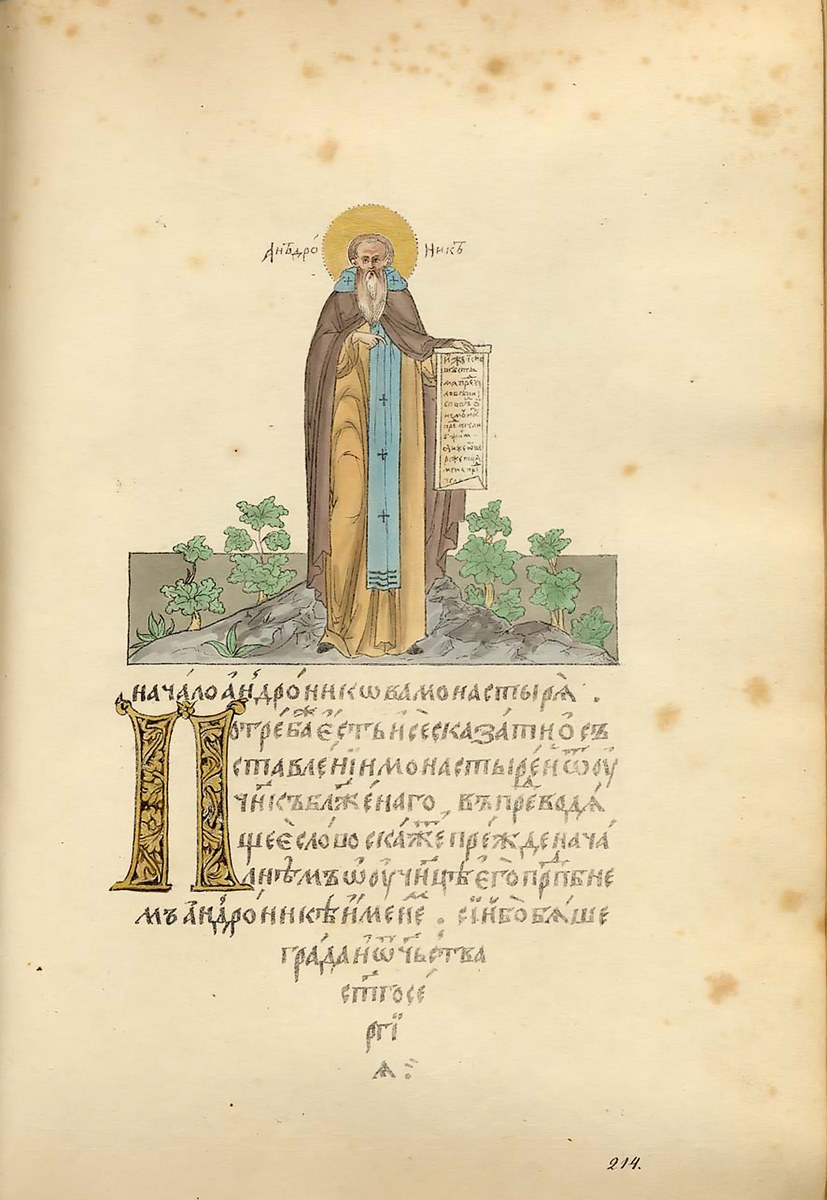
Andronicus is painted as a venerable Russian abbot: standing, in the dark monastic mantiya over the analavos, bare-headed or in the koukoulion, grey-bearded, with the right hand raised in prayer or blessing and a scroll in the left; where he is shown as founder he holds a model of the Saviour cathedral of his monastery, in the standard Russian founder-type. He appears most often not alone but in company: beside Sabbas, the two first abbots together, in the icons of the Andronikov monastery; and among the disciples of St Sergius, in the large composite icons of the Radonezh saints, where he stands in the ranks around Sergius and is identified only by his inscription.
The stored image is a 16th-century miniature from the illuminated Life: the abbot full-length above the opening of the chapter "the beginning of the Andronikov monastery," in mantle and blue-crossed analav, the scroll of the rule in his hand and his name АНДРОНИКЪ flanking the halo — page 214 of the manuscript, the founder heading his own foundation-narrative. (The earlier note that Commons searches returned nothing was outdated by this upload.)
Disputed questions
- The year of his repose: 1404 or 1373. The Russian tradition is divided. The date followed here, 1404, is that of the OCA and of the fuller Russian lives, and it agrees with the transmitted sequence in which Andronicus resigned to Sabbas in 1395 and then lived some years in silence. A well-attested alternative gives 1373, which would compress his abbacy to a dozen years and require another explanation of the 1395 succession. Where 1373 is given, he is indexed to the fourteenth century; this entry indexes him to the fifteenth on the 1404 dating, and the alternative is recorded here rather than resolved.
- The dedication and the vow. That the monastery was Metropolitan Alexis's votive foundation after a storm on the return from Constantinople, and that it was dedicated to the Image of the Saviour Not-Made-by-Hands, is consistently transmitted; the year of the voyage is variously given, and only the completion of the buildings — about 1361 — is firm.
- Rublev's relation to Andronicus. Andrei Rublev's membership of this monastery is certain and his burial there is the tradition of the house; that he was personally Andronicus's disciple is often said and is not demonstrable. The named disciples in the early witness (Joseph of Volokolamsk) are Sabbas and Alexander.
- Not to be confused with the several other saints named Andronicus — the Apostle Andronicus of the Seventy with Junia (May 17), Andronicus and Athanasia of Antioch (October 9), or the martyr Andronicus of the company of Probus, Tarachus and Andronicus (October 12). This Andronicus is the Muscovite abbot.