
Pentecost week, day 1 · 49 days since Pascha
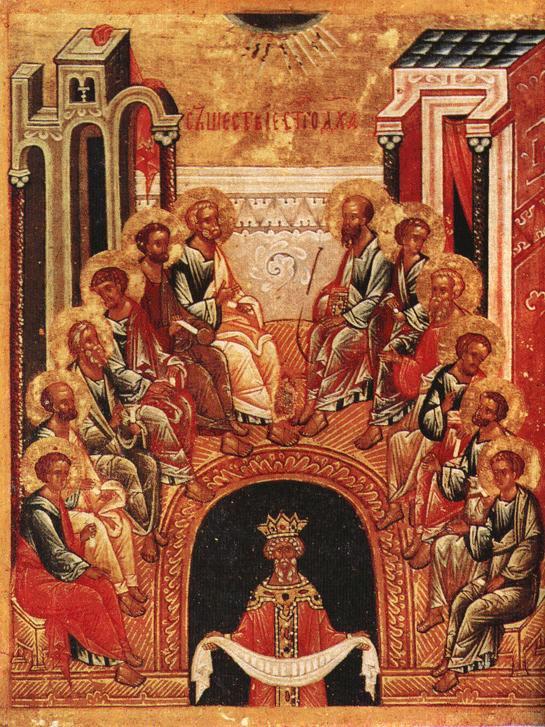
Holy Pentecost

Saints commemorated
-
Saint of the day
St Metrophanes, First Patriarch of Constantinople
Metrophanes was bishop of Byzantium in the years when the little see on the Bosporus became the see of the New Rome, and is honoured by the Church as the first Patriarch of Constantinople. The tradition makes him the son of Dometius, a convert brother of the emperor Probus, and the third of his family to hold the throne of Byzantium after his father and his brother Probus. Already extremely aged when the First Ecumenical Council met at Nicaea in 325, he could not attend in person and sent the presbyter Alexander as his vicar; Constantine the Great honoured him, and the Fathers of the Council are said to have confirmed his primacy in the new capital. He named Alexander his successor, foretold the patriarchates of Paul of Constantinople and of Athanasius of Alexandria, and reposed in extreme old age about 326, on June 4.
-
Holy Myrrh-bearers Mary and Martha, sisters of St Lazarus (1st c.)
Mary and Martha of Bethany are the sisters of Lazarus the Four-Days-Dead and, with him, the household in which the Lord was most at home. The Gospels give them to the Church in three scenes: Martha serving and Mary sitting at the Lord's feet (Luke 10:38–42); the two sisters meeting Jesus outside their brother's tomb, where Martha makes the confession "I believe that thou art the Christ, the Son of God" and hears the words "I am the resurrection and the life" (John 11); and the supper six days before the Passover, at which Mary anointed the Lord's feet with the pound of costly spikenard and wiped them with her hair (John 12:1–8). They believed in Christ before the raising of their brother, followed him to the tomb with the myrrhbearing women, and — after the martyrdom of Stephen drove Lazarus from Jerusalem — shared his exile and his preaching. The Church remembers them on the movable Sunday of the Myrrhbearers and, as a fixed commemoration, on June 4.
-
Alonius of Scetis
Alonius is one of the Desert Fathers of Egypt, an ascetic of Scetis of the generation that the Sayings of the Fathers preserves, remembered not for events but for four or five sentences of terrible concision. Of his life the synaxarion says only that he was among the ascetics famous for virtue in the desert, that his sayings are found in the Evergetinos, and that he reposed in peace. Those sayings — "If a man does not say in his heart, In this world there is only I and God, he will not find rest"; "If I had not destroyed everything, I could not have rebuilt myself" — put him among the most quoted of the fathers of the Apophthegmata, and he is commemorated on June 4.
-
Astius of Dyrrachium
Astius was bishop of Dyrrachium — the great Adriatic port at the western end of the Via Egnatia, the modern Durrës in Albania — in the reign of Trajan (98–117), and was crucified for Christ outside his own city. The passion relates that he was forewarned of his suffering in a dream; that he was beaten with leaden rods and with oxhide whips and would not deny Christ; and that his tormentors then smeared his body with honey and hung him on a cross, so that he died under the stings of wasps and flies in the sun. Christians took his body down and buried it with reverence. He is the protomartyr and patron of the church of Durrës and one of the earliest named saints of the Illyrian coast, commemorated on June 4.
-
Concordius of Spoleto
Concordius was the son of a Roman presbyter named Gordian, raised in the faith and made subdeacon by the bishop of Rome; with his father's leave he went to live in retirement near Rome with a kinsman named Eutychius, in prayer and almsgiving. His reputation reached Torquatus, the magistrate of the district, who summoned him, offered him a pagan priesthood and, when Concordius answered by preaching Christ to him, had him beaten and imprisoned. A bishop named Anthimus obtained his release and ordained him presbyter; but Torquatus summoned him again, asked him what he thought of his life, and heard the answer "for me, life is Christ." Chained to the wall of a prison by the neck and hands, he refused after three days to sacrifice, spat upon the image of Zeus brought to him, and was beheaded about the year 175. His relics rest near Spoleto in Umbria, and he is commemorated on June 4.
-
Frontasius, Severinus, Severian and Silanus
Four martyrs of Gaul, honoured as a company: Frontasius, Severinus, Severian and Silanus, sent to preach the word of God in the south of Gaul by Frontonus (Fronto), the bishop of Petragorium — Périgueux in the Périgord. The pagan governor, whom the passion names Squiridonus, arrested them and demanded that they renounce Christ; they answered that they had one desire only, to live or to die for Christ. He had them taken outside the city, bound to pillars, and nails driven into their heads in the form of a crown of thorns, and then beheaded. The tradition adds a cephalophore miracle: that they rose, took up their own heads, carried them to the church of the Mother of God where Bishop Frontonus was at prayer, laid them at his feet, made the sign of the cross and died. They are commemorated on June 4.
-
John of Monagria
John was abbot of the monastery of Monagria, and was put to death by being sewn into a sack and thrown into the sea — the standard penalty of the iconoclast persecution for monks who would not surrender the holy icons. Saint Nikodemos the Hagiorite, who preserves the notice, gives no more than this: the office, the manner of death, and the crown of martyrdom. The date usually attached to him is 761, in the reign of Constantine V Copronymus, and the monastery is placed on the Asian shore near Cyzicus. A portion of his skull is kept at the monastery of Panagia Amasgou in Cyprus. He is commemorated on June 4.
-
Martyrs of Niculitsel
Four martyrs of Scythia Minor — Zoticus, Attalus, Camasis and Philip — beheaded by the Roman authorities of Noviodunum on the lower Danube and buried in a brick crypt near the village of Niculitsel in the Dobrogea. Their tomb was discovered in September 1971, when a stream in flood exposed one of the oldest known martyria of the region: a two-storey crypt with the inscription Martyrs of Christ on one wall, the four names scratched on the other, and in the upper chamber a single wooden coffin holding four decapitated bodies. In the lower chamber were the bones of two older, unnamed martyrs, reinterred there about 370–380. The Syriac Martyrology and the Martyrology of Jerome give June 4 as the day of their execution, and that is the day the Church keeps. Their relics were translated in 1971 to the Cocoș monastery.
-
Methodius of Peshnosha
Methodius was a disciple of Sergius of Radonezh and the founder of the Nicholas-Peshnosha monastery on the river Yakhroma, north of Moscow near Dmitrov. Having spent some years under Sergius' direction, he withdrew with his blessing to a marshy solitude beyond the river and built himself a cell there; disciples gathered, and Sergius himself came to visit and counselled him to build a church and gather them into a coenobium. Methodius carried the timber for it on foot through the shallows, and it is from that — peshnosha, "carrying on foot" — that the monastery took its name. He became its abbot in 1391 and reposed in 1392, and was buried in the house he had founded. The spot two versts off where he and Sergius used to talk together is called to this day Beseda, the "conversation-place." His local veneration begins in the late seventeenth century; he is commemorated on June 4 and again on June 14.
-
Sophia of Ainos
Sophia of Ainos in Thrace is the Church's chief example of the ascetic life lived out inside a household and a marriage. Born to wealthy and prominent Christian parents in the tenth or eleventh century, she was married and bore six children, and lost husband and children all together to sickness. She did not despair: she turned the whole of her substance and the whole of her widowhood to the poor, and over some twenty years took in and raised about a hundred orphans, for which she is called the Mother of Orphans. She lived on bread and water, gave away her property, and was granted the sign of the wine-cask that never emptied while she kept the miracle secret. At the end of her life she was tonsured a nun and reposed in peace at the age of fifty-three, on June 4.
-
Zosimas of Babylon
Zosimas was a Cilician who left the world in his youth for Mount Sinai, withdrew from there to a still more solitary place in Lebanon, and was told by an aged ascetic whom he met that he would one day be a bishop in Babylon. Returning to Sinai, he was sent on business to Alexandria, and the Patriarch of Alexandria made him bishop of Babylon in Egypt — the fortress-town at the head of the Delta, in the district that became Old Cairo — where he governed his flock wisely into old age. Feeling his death approach, he returned to Sinai and reposed there in peace. He is commemorated on June 4.
British Isles and Ireland
- St. Nennoc of Brecknock (467)
- St. Petroc, abbot of Padstow (6th C)
- St. Breaca of Hayle (6th C)
- St. Berriona the Recluse (6th C)
- SS Croidan, Medan and Degan, companions of St. Petroc
- St. Gonand, Missionary
- St. Cronan the Tanner (617)
- St. Edfrith, bishop of Lindisfarne (721)
Troparia & kontakia
Apolytikion — Tone 8
Blessed art thou, O Christ our God, who hast shown forth the fishermen as all-wise, sending down upon them the Holy Spirit, and through them taking the whole world in thy net. O Lover of mankind, glory to thee.
Apolytikion — Tone 8 (common of a venerable father)
By the streams of thy tears thou didst make the barren desert to bring forth; and by thy sighing from the depths thou didst bear fruit a hundredfold in labours; and thou wast a beacon to the whole world, shining with miracles, O Alonius our father. Intercede with Christ God that our souls may be saved.
Apolytikion — Tone 4 (common of a hieromartyr)
As a sharer in the ways and a successor to the thrones of the Apostles, thou didst find in action the ascent to contemplation, O God-inspired one; rightly dividing the word of truth, thou didst contend for the faith even unto blood, O hieromartyr Astius: intercede with Christ God that our souls may be saved.
Apolytikion — Tone 4 (common of a martyr)
Thy martyr Concordius, O Lord, in his contest received an incorruptible crown from thee our God; for having thy strength, he cast down the tyrants and broke the feeble insolence of the demons. By his intercessions save our souls.
Apolytikion — Tone 4 (common of several martyrs)
Thy martyrs, O Lord, in their contest received incorruptible crowns from thee our God; for having thy strength, they cast down the tyrants and broke the feeble insolence of the demons. By their intercessions, O Christ our God, save our souls.
Apolytikion — Tone 4 (common of a venerable-martyr)
Having schooled thyself in the monastic life, and being crowned thereafter with the martyr's contest, thou wast sunk in the depths of the sea, O John, and didst rise unhindered to the heights of heaven; and now, standing before Christ with the venerable and with the martyrs, intercede that our souls may be saved.
Apolytikion — Tone 4 (common of several martyrs)
Thy martyrs Zoticus, Attalus, Camasis and Philip, O Lord, in their contest received incorruptible crowns from thee our God; for having thy strength, they cast down the tyrants and broke the feeble insolence of the demons. By their intercessions, O Christ our God, save our souls.
Apolytikion — Tone 8 (common of a venerable father)
By the streams of thy tears thou didst make the barren wilderness to bring forth; and by thy sighing from the depths thou didst bear fruit a hundredfold in labours; and thou wast a beacon to the whole world, shining with miracles, O Methodius our father. Intercede with Christ God that our souls may be saved.
Apolytikion — Tone 4
A rule of faith, an image of gentleness, a teacher of abstinence did the very truth of things show thee to be unto thy flock; therefore hast thou gained the heights by humility, and riches by poverty. Father and hierarch Metrophanes, intercede with Christ God that our souls may be saved.
Apolytikion — Tone 8 (common of a venerable woman)
In thee, O mother, was preserved unimpaired that which is according to the image; for taking up the Cross, thou didst follow Christ, and by thy deeds thou didst teach us to overlook the flesh, for it passeth away, but to care for the soul, a thing immortal. Wherefore, O venerable Sophia, thy spirit rejoiceth with the angels.
Apolytikion — Tone 8 (common of a venerable father)
By the streams of thy tears thou didst make the barren desert to bring forth; and by thy sighing from the depths thou didst bear fruit a hundredfold in labours; and thou wast a beacon to the whole world, shining with miracles, O Zosimas our father. Intercede with Christ God that our souls may be saved.
Kontakion — Tone 8
When the Most High came down and confounded the tongues, he divided the nations; when he distributed the tongues of fire, he called all men into unity; and with one accord we glorify the all-holy Spirit.
Kontakion — Tone 4
Let us hymn with one voice the hierarch of Christ, Metrophanes, the light-bearing lamp of the Church, who in the midst of the God-bearing Fathers proclaimed the Word to be of one essence with the Father, who adorned the throne of the Queen City among the first, and who plainly received from God the grace of prophecy.
Megalynarion — Tone 7
O Mother who hast not known man, Virgin Theotokos, who didst conceive without experience of corruption and didst lend flesh to the all-fashioning Word; vessel of him whom nothing can contain, place of thine own uncircumscribed Maker: thee do we magnify.
Oikos
Give swift and steadfast consolation to thy servants, O Jesus, when our spirits grow listless. Be not parted from our souls in afflictions, be not far from our minds in adversities, but come to us always before we call. Draw near to us, draw near, thou who art everywhere; and as thou wast ever with thine apostles, so unite thyself to those who long for thee, O compassionate one, that being joined to thee we may hymn and glorify thine all-holy Spirit.
Troparion — Tone 4 (common of righteous women)
Ye ministered without blame unto the Saviour, O holy sisters of Lazarus: thou, O honoured Martha, in the service of thy hands, and thou, O all-modest Mary, in the hearing of his word and in the myrrh poured out for his burial. Wherefore, having learned of his Resurrection with the myrrhbearing women, ye were filled with the light of God: entreat him that our souls may be saved.
Readings
Vespers
Numbers 11.16-17, 24-29
16And the LORD said unto Moses, Gather unto me seventy men of the elders of Israel, whom thou knowest to be the elders of the people, and officers over them; and bring them unto the tabernacle of the congregation, that they may stand there with thee. 17And I will come down and talk with thee there: and I will take of the spirit which is upon thee, and will put it upon them; and they shall bear the burden of the people with thee, that thou bear it not thyself alone. 24And Moses went out, and told the people the words of the LORD, and gathered the seventy men of the elders of the people, and set them round about the tabernacle. 25And the LORD came down in a cloud, and spake unto him, and took of the spirit that was upon him, and gave it unto the seventy elders: and it came to pass, that, when the spirit rested upon them, they prophesied, and did not cease. 26But there remained two of the men in the camp, the name of the one was Eldad, and the name of the other Medad: and the spirit rested upon them; and they were of them that were written, but went not out unto the tabernacle: and they prophesied in the camp. 27And there ran a young man, and told Moses, and said, Eldad and Medad do prophesy in the camp. 28And Joshua the son of Nun, the servant of Moses, one of his young men, answered and said, My lord Moses, forbid them. 29And Moses said unto him, Enviest thou for my sake? would God that all the LORD’s people were prophets, and that the LORD would put his spirit upon them!
Joel 2.23-32
23Be glad then, ye children of Zion, and rejoice in the LORD your God: for he hath given you the former rain moderately, and he will cause to come down for you the rain, the former rain, and the latter rain in the first month. 24And the floors shall be full of wheat, and the fats shall overflow with wine and oil. 25And I will restore to you the years that the locust hath eaten, the cankerworm, and the caterpiller, and the palmerworm, my great army which I sent among you. 26And ye shall eat in plenty, and be satisfied, and praise the name of the LORD your God, that hath dealt wondrously with you: and my people shall never be ashamed. 27And ye shall know that I am in the midst of Israel, and that I am the LORD your God, and none else: and my people shall never be ashamed. 28And it shall come to pass afterward, that I will pour out my spirit upon all flesh; and your sons and your daughters shall prophesy, your old men shall dream dreams, your young men shall see visions: 29And also upon the servants and upon the handmaids in those days will I pour out my spirit. 30And I will shew wonders in the heavens and in the earth, blood, and fire, and pillars of smoke. 31The sun shall be turned into darkness, and the moon into blood, before the great and the terrible day of the LORD come. 32And it shall come to pass, that whosoever shall call on the name of the LORD shall be delivered: for in mount Zion and in Jerusalem shall be deliverance, as the LORD hath said, and in the remnant whom the LORD shall call.
Ezekiel 36.24-28
24For I will take you from among the heathen, and gather you out of all countries, and will bring you into your own land. 25Then will I sprinkle clean water upon you, and ye shall be clean: from all your filthiness, and from all your idols, will I cleanse you. 26A new heart also will I give you, and a new spirit will I put within you: and I will take away the stony heart out of your flesh, and I will give you an heart of flesh. 27And I will put my spirit within you, and cause you to walk in my statutes, and ye shall keep my judgments, and do them. 28And ye shall dwell in the land that I gave to your fathers; and ye shall be my people, and I will be your God.
Matins Gospel
John 20.19-23
19Then the same day at evening, being the first day of the week, when the doors were shut where the disciples were assembled for fear of the Jews, came Jesus and stood in the midst, and saith unto them, Peace be unto you. 20And when he had so said, he shewed unto them his hands and his side. Then were the disciples glad, when they saw the Lord. 21Then said Jesus to them again, Peace be unto you: as my Father hath sent me, even so send I you. 22And when he had said this, he breathed on them, and saith unto them, Receive ye the Holy Ghost: 23Whose soever sins ye remit, they are remitted unto them; and whose soever sins ye retain, they are retained.
Epistle
Acts 2.1-11
1And when the day of Pentecost was fully come, they were all with one accord in one place. 2And suddenly there came a sound from heaven as of a rushing mighty wind, and it filled all the house where they were sitting. 3And there appeared unto them cloven tongues like as of fire, and it sat upon each of them. 4And they were all filled with the Holy Ghost, and began to speak with other tongues, as the Spirit gave them utterance. 5And there were dwelling at Jerusalem Jews, devout men, out of every nation under heaven. 6Now when this was noised abroad, the multitude came together, and were confounded, because that every man heard them speak in his own language. 7And they were all amazed and marvelled, saying one to another, Behold, are not all these which speak Galilæans? 8And how hear we every man in our own tongue, wherein we were born? 9Parthians, and Medes, and Elamites, and the dwellers in Mesopotamia, and in Judæa, and Cappadocia, in Pontus, and Asia, 10Phrygia, and Pamphylia, in Egypt, and in the parts of Libya about Cyrene, and strangers of Rome, Jews and proselytes, 11Cretes and Arabians, we do hear them speak in our tongues the wonderful works of God.
Gospel
John 7.37-52, 8.12
37In the last day, that great day of the feast, Jesus stood and cried, saying, If any man thirst, let him come unto me, and drink. 38He that believeth on me, as the scripture hath said, out of his belly shall flow rivers of living water. 39(But this spake he of the Spirit, which they that believe on him should receive: for the Holy Ghost was not yet given; because that Jesus was not yet glorified.) 40Many of the people therefore, when they heard this saying, said, Of a truth this is the Prophet. 41Others said, This is the Christ. But some said, Shall Christ come out of Galilee? 42Hath not the scripture said, That Christ cometh of the seed of David, and out of the town of Bethlehem, where David was? 43So there was a division among the people because of him. 44And some of them would have taken him; but no man laid hands on him. 45Then came the officers to the chief priests and Pharisees; and they said unto them, Why have ye not brought him? 46The officers answered, Never man spake like this man. 47Then answered them the Pharisees, Are ye also deceived? 48Have any of the rulers or of the Pharisees believed on him? 49But this people who knoweth not the law are cursed. 50Nicodemus saith unto them, (he that came to Jesus by night, being one of them,) 51Doth our law judge any man, before it hear him, and know what he doeth? 52They answered and said unto him, Art thou also of Galilee? Search, and look: for out of Galilee ariseth no prophet. 12Then spake Jesus again unto them, saying, I am the light of the world: he that followeth me shall not walk in darkness, but shall have the light of life.