
Dormition Fast, day 13
St Tikhon of Zadonsk
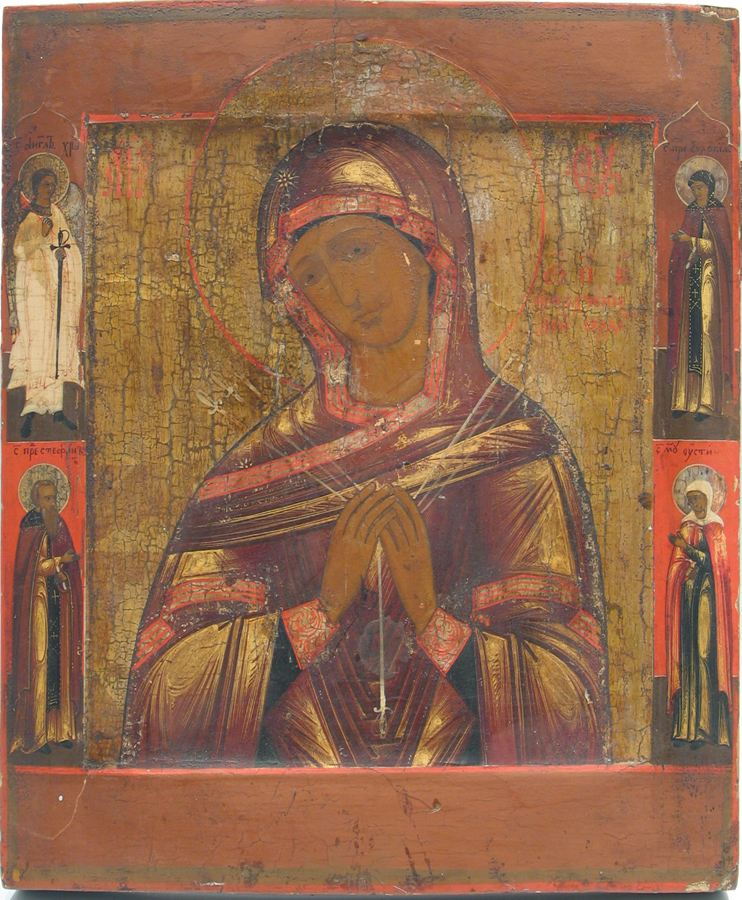
About Minsk Icon of the Mother of God → · About Passion Icon of the Mother of God → · About "Seven Arrows" Icon of the Mother of God →

Saints commemorated
-
St Maximos the Confessor (662)
Maximus the Confessor (c. 580 – 662) is the supreme theologian of the seventh century and one of the greatest fathers of the Church. A high official at the court of the emperor Heraclius who left the world for the monastic life, he became the tireless defender of the full humanity of Christ against Monotheletism — the imperial doctrine that the incarnate Word had but one (divine) will and one operation — insisting that because Christ is truly God and truly man he possesses two natural wills and two natural energies, human and divine, the human freely and always conformed to the divine. In the Ambigua, the Questions to Thalassius, and the Mystagogy he drew the Chalcedonian and Cyrilline inheritance into a single cosmic vision of creation, incarnation, and deification. For refusing communion with the heresy — and for the Lateran Council of 649, which condemned it — he and his disciples were tried at Constantinople, and, when he would not yield, his tongue and right hand were cut off so that he could neither speak nor write the truth; he was exiled to Lazica in the Caucasus, where he died on 13 August 662. Twenty years later the Sixth Ecumenical Council (680–81) vindicated his theology as the faith of the Church. His principal feast is January 21; August 13 keeps his repose and the translation of his relics.
-
St Tikhon of Zadonsk (1783)
Tikhon of Zadonsk (1724–1783) is the great hierarch and spiritual writer of eighteenth-century Russia, and the one figure of that Westernising age in whom the ascetic tradition of the Fathers and the pastoral scholarship of the new seminaries met without injury to either. Born Timothy, the youngest son of a destitute village cantor of the Novgorod land, so poor that his family nearly gave him away to a coachman for bread, he rose through the seminary to be its teacher, then bishop of Voronezh — and after four and a half years laid down his diocese and spent the last fourteen years of his life as a simple monk at Zadonsk, sleeping on straw under a sheepskin, giving away his whole pension, and writing the two books, On True Christianity and A Spiritual Treasury Gathered from the World, that made him the most widely read Russian spiritual author before the Philokalia. He was glorified in 1861, is called the Russian Chrysostom, and stands behind Dostoevsky's Bishop Tikhon and the elder Zosima.
-
Holy Martyr Hippolytus of Rome and 18 Martyrs with him (258)
Hippolytus was, in the Roman passion that bears his name, the officer of the prison at Rome under Decius and Valerian who had charge of the archdeacon Laurence, was converted by him together with his whole household, and — having gone out to bury Laurence's body after the roasting on the gridiron of 10 August 258 — was arrested, beaten with rods, stripped of his rank and property, and on 13 August 258 tied to untamed horses and dragged to death over the stones outside the city. With him suffered Concordia, the old nurse who had raised him, scourged to death with loaded whips, and her body thrown into a sewer; and Irenaeus and Abundius, two Christians who found it, drew it out and buried it beside him, and were drowned in the same sewer for the act. The four are kept together on August 13, the day of Hippolytus's burial on the Via Tiburtina.
-
Our Holy Mother the Empress Irene (Xenia in Monasticism) (12th c.)
Irene the Empress (1088 – 13 August 1134) was born Piroska, daughter of King Ladislaus I of Hungary, and came to Constantinople at sixteen as the bride of the future emperor John II Komnenos, taking the name Irene with her reception into the Orthodox Church. For thirty years she was empress of the Romans, and used the position as almost no other Byzantine empress did: her name stands with her husband's on the foundation of the monastery of Christ Pantokrator in Constantinople, whose typikon endowed a hospital of fifty beds in five wards, with salaried physicians and surgeons of both sexes, a dispensary, an almshouse and a leprosarium — one of the ancestors of the European hospital. She died on campaign in Bithynia on 13 August 1134, having received the great schema with the name Xenia, "the stranger", and was buried in her own foundation. She is the only Byzantine empress of the twelfth century to have been canonised, and her portrait in Hagia Sophia is the earliest surviving likeness of any member of the Árpád dynasty.
-
Maximus of Moscow
Maximus of Moscow (died 1434) was a fool-for-Christ of medieval Russia who bore the hardest form of ascetic self-emptying, walking about Moscow almost naked summer and winter, homeless and enduring heat and frost alike. Comforting the poor amid the calamities of the Tatar yoke, famine, and plague, and rebuking the rich and powerful for hardness of heart, he spoke his wisdom in the proverbs of the common people. Buried at the Moscow church of Saints Boris and Gleb, he was glorified as a wonderworker in 1547 and his relics uncovered the same year.
British Isles and Ireland
- St. Wigbert, abbot of Hersfeld and disciple of St. Boniface (c.738)
- St. Murtagh, bishop of Killala (6th C)
Troparia & kontakia
Kontakion — Tone 6
The waters bore what the impious cast away, and the light upon the Svisloch declared it; and the city that received thee, O Mother of God, hath thee for its wall and its rejoicing unto this day.
Kontakion — Tone 8
Beholding the cross and the lance borne by the angels, the Child turned to thee and took thy hand, O Virgin; and thou didst hold him fast, knowing what was to come. Wherefore hold us also in the hour of our fear, and let us not be shaken.
Kontakion — Tone 8
Seven swords pierced thy soul, O Virgin, when thou didst stand beneath the Cross of thy Son; and now thou standest for us before him, healing by thy wounds the hardness of our hearts. Wherefore we cry: rejoice, thou that art wounded for our sake.
Kontakion — Tone 2
Torn asunder by the horses of the tyrant, thou wast not divided from Christ, O glorious Hippolytus; and with thee thy nurse in her old age was crowned, and the two who went down into the pit for her sake. Wherefore we cry to you all: pray unfailingly for us.
Kontakion — Tone 2
Thou wast a mother to the sick and to the aged, O blessed one, and didst build a house of healing for the poor of the city; wherefore, having laid aside the empire, thou wast received into the mansions that pass not away.
Kontakion — Tone 2
Desiring the beauty of the world on high, thou didst count as nothing the sweetness below and the raiment of the body, and thou didst love non-acquisitiveness more than the vain world. Passing through an angelic manner of life, thou didst reach thine end, O blessed Maximus; with the angels pray thou unceasingly to Christ for us all.
Kontakion — Tone 8
Let us the faithful worthily praise the lover of the Trinity, great Maximus, who taught clearly the God-inspired faith — to glorify Christ in two natures, with twofold energies and wills alike — and let us cry aloud to him: Rejoice, O herald of the Faith.
Kontakion — Tone 8
O successor of the apostles, adornment of hierarchs, teacher of the Orthodox Church, entreat the Master of all to grant peace to the world and to our souls great mercy.
Troparion — Tone 4
Come, ye faithful, let us keep the radiant feast of the Mother of God; for lo, her holy image, cast into the waters by the hands of the ungodly, came to us shining upon the river, and abideth with us as a fountain of healing. O Sovereign Lady, deliver from every affliction those that flee to thee.
Troparion — Tone 4
Today the faithful keep radiant festival, overshadowed by thy coming, O Mother of God; and gazing upon thy most pure image we cry with compunction: shelter us beneath the precious veil of thy protection, and deliver us from every ill, entreating thy Son, Christ our God, to save our souls.
Troparion — Tone 4
Soften our evil hearts, O Mother of God, and quench the assaults of those that hate us, and loose every straitness of our soul; for beholding thy holy image we are pierced with compunction at thy suffering and thy tender mercy toward us, and we kiss thy wounds, and are afraid of the arrows of our own sins. Suffer us not, O Mother of compassion, to perish in our cruelty and from the cruelty of our neighbours.
Troparion — Tone 4
Thy martyrs, O Lord, in their contest received imperishable crowns from thee our God; for possessing thy strength, they cast down the tyrants and broke also the feeble insolence of demons. By their prayers, O Christ God, save our souls.
Troparion — Tone 8
Thou didst exchange a crown for the tonsure, and a throne for the cell, and the purple for the habit of a stranger; and having spent thy wealth upon the poor and the sick, thou didst depart to the Bridegroom with the name of a stranger upon thee. O righteous Irene, called Xenia, entreat Christ God that our souls be saved.
Troparion — Tone 5
By nakedness of body and by patience thou didst lay bare the wiles of the enemy, rebuking his ungodly deeds; grievously suffering the sun's scorching heat and the great and bitter cold, thou didst feel neither frost nor fire, sheltered by the help of God, O most wise Maximus. Pray for those who faithfully and with honour keep thy memory and who fervently draw near to thy relics, that they be delivered from misfortunes and escape from falling.
Troparion — Tone 8
O guide of Orthodoxy, teacher of piety and holiness, luminary of the Church, God-inspired adornment of monastics, O wise Maximus: by thy teachings thou hast enlightened all, O lyre of the Spirit. Intercede with Christ our God, that our souls may be saved.
Troparion — Tone 8
From thy youth thou didst love Christ, O blessed one, and wast shown forth as an example to all in word and life, in love, in spirit and in faith, in purity and in humility of mind. Wherefore thou dwellest now in the mansions on high, where thou standest before the throne of the All-holy Trinity: holy hierarch Tikhon, pray thou that our souls be saved.
Readings
Vespers
Composite 2 - Proverbs 10, 3, 8
1The memory of a just man is praised, and the Lord’s blessing is upon his head. Blessed is one who has found wisdom; a mortal who knows understanding. To import her is better than treasures of gold and silver. She is more valuable than precious stones; nothing of value equals her worth. Justice proceeds from her mouth; she bears law and mercy on her tongue. Therefore, my children, listen to me, for I speak weighty things. And blessed is the one who keeps my ways. For my goings out are the goings out of life, and favour is prepared from the Lord. Therefore I exhort you, and utter my voice to the children of humankind. Because I, Wisdom, have prepared counsel, knowledge and understanding. I have called on them. Counsel and sureness are mine; prudence is mine, strength is mine. I love those who are my friends, while those who seek me will find grace. You innocent, then, understand cunning; you untaught, take it to heart. Listen to me, for I will speak weighty things, and I will open right things from my lips. Because my throat will meditate truth; lying lips are abominable before me. All the words of my mouth are with justice, there is nothing crooked in them nor twisted. They are all straight for those who understand, and right for those who find knowledge. For I teach you what is true, that your hope may be in the Lord and that you may be filled with spirit.
Proverbs 10.31-11.12
31The mouth of the just bringeth forth wisdom: but the froward tongue shall be cut out. 32The lips of the righteous know what is acceptable: but the mouth of the wicked speaketh frowardness. 1A false balance is abomination to the LORD: but a just weight is his delight. 2When pride cometh, then cometh shame: but with the lowly is wisdom. 3The integrity of the upright shall guide them: but the perverseness of transgressors shall destroy them. 4Riches profit not in the day of wrath: but righteousness delivereth from death. 5The righteousness of the perfect shall direct his way: but the wicked shall fall by his own wickedness. 6The righteousness of the upright shall deliver them: but transgressors shall be taken in their own naughtiness. 7When a wicked man dieth, his expectation shall perish: and the hope of unjust men perisheth. 8The righteous is delivered out of trouble, and the wicked cometh in his stead. 9An hypocrite with his mouth destroyeth his neighbour: but through knowledge shall the just be delivered. 10When it goeth well with the righteous, the city rejoiceth: and when the wicked perish, there is shouting. 11By the blessing of the upright the city is exalted: but it is overthrown by the mouth of the wicked. 12He that is void of wisdom despiseth his neighbour: but a man of understanding holdeth his peace.
Wisdom of Solomon 4.7-15
7But though the righteous be prevented with death, yet shall he be in rest. 8For honourable age is not that which standeth in length of time, nor that is measured by number of years. 9But wisdom is the gray hair unto men, and an unspotted life is old age. 10He pleased God, and was beloved of him: so that living among sinners he was translated. 11Yea speedily was he taken away, lest that wickedness should alter his understanding, or deceit beguile his soul. 12For the bewitching of naughtiness doth obscure things that are honest; and the wandering of concupiscence doth undermine the simple mind. 13He, being made perfect in a short time, fulfilled a long time: 14For his soul pleased the Lord: therefore hasted he to take him away from among the wicked. 15This the people saw, and understood it not, neither laid they up this in their minds, That his grace and mercy is with his saints, and that he hath respect unto his chosen.
10th Matins Gospel
John 21.1-14
1After these things Jesus shewed himself again to the disciples at the sea of Tiberias; and on this wise shewed he himself. 2There were together Simon Peter, and Thomas called Didymus, and Nathanael of Cana in Galilee, and the sons of Zebedee, and two other of his disciples. 3Simon Peter saith unto them, I go a fishing. They say unto him, We also go with thee. They went forth, and entered into a ship immediately; and that night they caught nothing. 4But when the morning was now come, Jesus stood on the shore: but the disciples knew not that it was Jesus. 5Then Jesus saith unto them, Children, have ye any meat? They answered him, No. 6And he said unto them, Cast the net on the right side of the ship, and ye shall find. They cast therefore, and now they were not able to draw it for the multitude of fishes. 7Therefore that disciple whom Jesus loved saith unto Peter, It is the Lord. Now when Simon Peter heard that it was the Lord, he girt his fisher’s coat unto him, (for he was naked,) and did cast himself into the sea. 8And the other disciples came in a little ship; (for they were not far from land, but as it were two hundred cubits,) dragging the net with fishes. 9As soon then as they were come to land, they saw a fire of coals there, and fish laid thereon, and bread. 10Jesus saith unto them, Bring of the fish which ye have now caught. 11Simon Peter went up, and drew the net to land full of great fishes, an hundred and fifty and three: and for all there were so many, yet was not the net broken. 12Jesus saith unto them, Come and dine. And none of the disciples durst ask him, Who art thou? knowing that it was the Lord. 13Jesus then cometh, and taketh bread, and giveth them, and fish likewise. 14This is now the third time that Jesus shewed himself to his disciples, after that he was risen from the dead.
Epistle
1 Corinthians 4.9-16
9For I think that God hath set forth us the apostles last, as it were appointed to death: for we are made a spectacle unto the world, and to angels, and to men. 10We are fools for Christ’s sake, but ye are wise in Christ; we are weak, but ye are strong; ye are honourable, but we are despised. 11Even unto this present hour we both hunger, and thirst, and are naked, and are buffeted, and have no certain dwellingplace; 12And labour, working with our own hands: being reviled, we bless; being persecuted, we suffer it: 13Being defamed, we intreat: we are made as the filth of the world, and are the offscouring of all things unto this day. 14I write not these things to shame you, but as my beloved sons I warn you. 15For though ye have ten thousand instructers in Christ, yet have ye not many fathers: for in Christ Jesus I have begotten you through the gospel. 16Wherefore I beseech you, be ye followers of me.
Hebrews 7.26-8.2 (St Tikhon)
26For such an high priest became us, who is holy, harmless, undefiled, separate from sinners, and made higher than the heavens; 27Who needeth not daily, as those high priests, to offer up sacrifice, first for his own sins, and then for the people’s: for this he did once, when he offered up himself. 28For the law maketh men high priests which have infirmity; but the word of the oath, which was since the law, maketh the Son, who is consecrated for evermore. 1Now of the things which we have spoken this is the sum: We have such an high priest, who is set on the right hand of the throne of the Majesty in the heavens; 2A minister of the sanctuary, and of the true tabernacle, which the Lord pitched, and not man.
Gospel
Matthew 17.14-23
14And when they were come to the multitude, there came to him a certain man, kneeling down to him, and saying, 15Lord, have mercy on my son: for he is lunatick, and sore vexed: for ofttimes he falleth into the fire, and oft into the water. 16And I brought him to thy disciples, and they could not cure him. 17Then Jesus answered and said, O faithless and perverse generation, how long shall I be with you? how long shall I suffer you? bring him hither to me. 18And Jesus rebuked the devil; and he departed out of him: and the child was cured from that very hour. 19Then came the disciples to Jesus apart, and said, Why could not we cast him out? 20And Jesus said unto them, Because of your unbelief: for verily I say unto you, If ye have faith as a grain of mustard seed, ye shall say unto this mountain, Remove hence to yonder place; and it shall remove; and nothing shall be impossible unto you. 21Howbeit this kind goeth not out but by prayer and fasting. 22And while they abode in Galilee, Jesus said unto them, The Son of man shall be betrayed into the hands of men: 23And they shall kill him, and the third day he shall be raised again. And they were exceeding sorry.
Matthew 5.14-19 (St Tikhon)
14Ye are the light of the world. A city that is set on an hill cannot be hid. 15Neither do men light a candle, and put it under a bushel, but on a candlestick; and it giveth light unto all that are in the house. 16Let your light so shine before men, that they may see your good works, and glorify your Father which is in heaven. 17Think not that I am come to destroy the law, or the prophets: I am not come to destroy, but to fulfil. 18For verily I say unto you, Till heaven and earth pass, one jot or one tittle shall in no wise pass from the law, till all be fulfilled. 19Whosoever therefore shall break one of these least commandments, and shall teach men so, he shall be called the least in the kingdom of heaven: but whosoever shall do and teach them, the same shall be called great in the kingdom of heaven.