
Paschaltide, day 6 · 5 days since Pascha
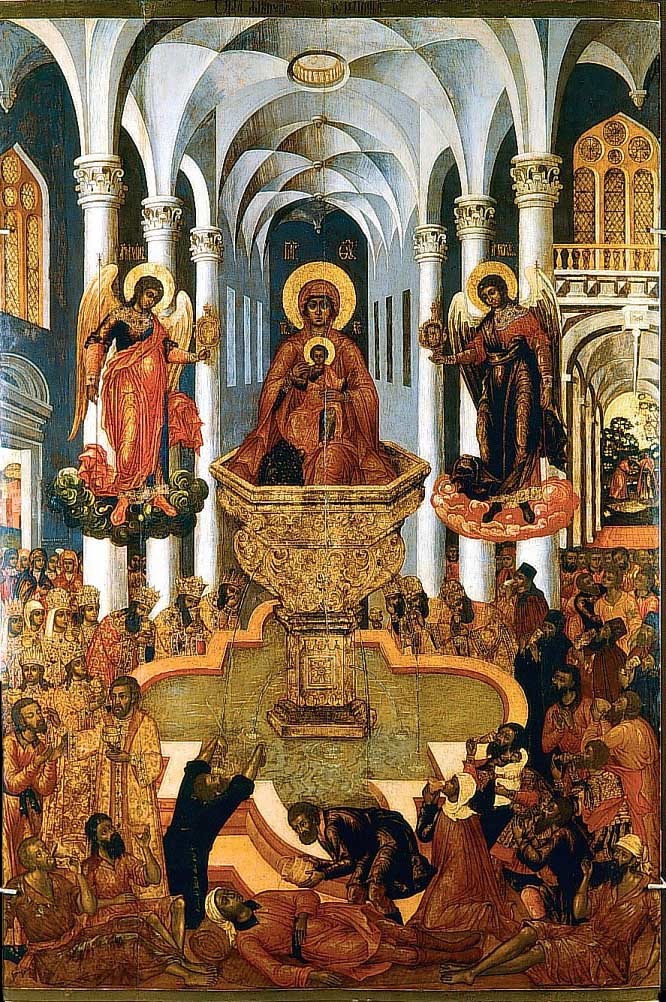
The Life-Giving Spring of the Most-holy Theotokos; Apostle Simon the Zealot
About The Life-Giving Fountain →

Saints commemorated
-
Holy Martyrs Alphaeus, Philadelphus and Cyprinus of Sicily (251)
Three brothers of a noble Italian house — Alphius, Philadelphus and Cyprian (called Cyrinus in the Latin books and Kyprinos in the Greek) — were, with a company of some twenty in all, put to death in the persecution of Decius, about the year 251. Sons of a governor named Vitalius from the Salentine country of southern Italy, they were catechised and baptised by the presbyter Onesimus, denounced, and sent as prisoners first to Rome and then, by way of Puteoli, into Sicily, where the governor Tertullus tried them at Lentini (the ancient Leontini). There Alphius had his tongue cut out and was beheaded, Philadelphus was roasted upon a red-hot gridiron, and Cyprian was fried in a great pan. Onesimus their teacher was crushed under a heavy stone at Rome, and Erasmus with fourteen others was beheaded there. The three brothers became the patrons of Lentini and of a wide belt of eastern Sicily, and their relics, long lost, were recovered at Lentini in 1517.
-
St Isidora the Fool of Tabenna (Egypt) (4th c.)
Isidora is the first fool-for-Christ whose story the Church records — a nun of the great Pachomian women's monastery at Tabennisi in the Egyptian Thebaid in the middle of the fourth century, who deliberately made herself despised. She wore a rag on her head instead of the monastic cowl, never sat at table but lived on the crumbs and the scourings of the pots, served four hundred sisters who mocked, struck and drenched her, and never in all those years spoke an idle or a resentful word. Her secret was disclosed by an angel to the hermit Piteroum, who was sent to the monastery to find "one wearing a crown upon her head" and holier than himself; and when the honour of the community turned upon her, she slipped away and was never found again. Her account, written by Palladius within living memory, is the foundation-text of the whole tradition of holy folly.
-
Blessed Thaïs (Taïsia) of Egypt (4th c.)
Thais — Taisia in the Slavonic books — was a well-born Egyptian girl left an orphan with a fortune, who spent the whole of it turning her house into a hospice for the monks of Scetis; and when her money was gone and the guests no longer came, she was left destitute, fell into bad company, and became a prostitute. The fathers of the desert sent John the Dwarf (Kolobos) to her. He sat down in her house and wept, and when she asked why, said, "I see Satan playing in your face." She asked whether there was repentance for her; and at his one word she rose and walked out into the desert without even stopping to set her house in order. That night, on a bed of sand which the old man had marked with the sign of the cross, she died — and John saw a shining road let down from heaven and the angels carrying up her soul, and was told that one hour of her repentance, made with the whole heart, had been accepted above the long penance of others. Her memory is kept on May 10.
-
Laurence of Pelion
The Greek books of May 10 carry, after the Apostle Simon and the martyrs of Lentini, a notice of five words: "Our venerable father Laurence was perfected in peace." Modern Greek usage, and the Metropolis of Demetrias in whose territory his memory is kept, identify this Laurence with the fourteenth-century monk who left the Great Lavra on Athos when teaching he judged heretical spread there, came to Magnesia, and founded on the eastern slope of Mount Pelion above Volos the monastery from which the village of Agios Lavrentios still takes its name — its church completed in 1378 with a chrysobull and money from the emperor Alexios Komnenos — and afterwards a skete of the Transfiguration and the Prophet Elias, which drew learned monks to the mountain. He reposed in peace in great age. Whether the ancient bare notice was originally written of this man is not certain, and the entry says so.
-
Simon of Vladimir
Simon (†1226) was a monk of the Kiev Caves who became abbot of the Nativity monastery at Vladimir and, in 1214, the first bishop of the newly separated see of Vladimir-on-the- Klyazma and Suzdal, appointed by the Grand Prince George Vsevolodovich and consecrated by the Metropolitan Matthew of Kiev. He governed the young diocese for twelve years, consecrating its churches, and is remembered above all as one of the authors of the Kiev Caves Paterikon: his narratives of the wonders of the Caves fathers, and the long epistle to the monk Polycarp which stands at the head of the collection, gave the Russian Church one of its classic monastic books and its most famous protest against ambition for office. He took the great schema before his death, and though buried at Vladimir his relics were carried, according to his own wish, to the Near (Antoniev) Caves at Kiev, where they rest. His memory is kept on May 10.
-
Simon the Zealot
Simon the Zealot is the eleventh name in every apostolic list of the New Testament and one of the Twelve of whom the Gospels record nothing but the name. Matthew and Mark call him Σίμων ὁ Καναναῖος, the Cananaean; Luke and Acts call him Σίμων ὁ ζηλωτής, the Zealot — the same epithet, once in Aramaic and once in Greek. Byzantine tradition, reading "Cananaean" as "of Cana in Galilee," made him the bridegroom of the wedding at Cana who, seeing the water made wine, left his own marriage-feast to follow Christ, and derived his surname from the burning zeal with which he afterwards preached. The Greek synaxaria send him through Egypt, Cyrene, Libya and Mauretania and at last to Britain, where idolaters crucified him; the Latin books martyr him in Persia with Jude, sawn asunder; and the Abkhazians keep his grave on the Black Sea coast at Nikopsia. His feast is May 10, and he is numbered again in the Synaxis of the Twelve on June 30.
British Isles and Ireland
- St. Comgall, abbot of Bangor, ‘Father of Monks’ (c.601)
- St. Conleth, monk and hermit (520)
- St. Cathal, bishop of Taranto (7th C)
Troparia & kontakia
Apolytikion — Tone 4 (common of several martyrs)
Thy martyrs, O Lord, in their contest received incorruptible crowns from Thee our God; for possessing Thy strength, they cast down the tyrants and shattered the feeble insolence of the demons. By their intercessions, O Christ God, save our souls.
Apolytikion — Tone 3
Holy Apostle Simon, intercede with the merciful God, that He grant unto our souls forgiveness of offences.
Exapostilarion
Thou art in very truth the fount of living water, O Lady; therefore thou dost wash away the grievous sicknesses of souls and of bodies by thy touch alone, who pourest forth Christ, the water of salvation.
Kontakion — Tone 8 (to the automelon *Τῇ ὑπερμάχῳ*)
Out of thine inexhaustible Fountain, O thou who art graced of God, thou bestowest upon me the waters of thy grace, which stream forth unfailingly and beyond all speech; for as thou didst bear the Word past all understanding, I entreat thee to bedew me with thy grace, that I may cry to thee: Rejoice, O water of salvation.
Kontakion — Tone 2
Let us praise in hymns the great Simon, who set the sure teachings of wisdom in the souls of the pious; for he stands now before the throne of glory and rejoices with all the bodiless hosts, unceasingly interceding for our souls.
Megalynarion
Let us honour with faith the life-flowing water of the Fountain, which poureth out the immortal dew, the manna, the divine nectar, the strange ambrosia, the honey out of the rock.
Oikos — Tone 8
O immaculate Theotokos, who ineffably didst bear the pre-eternal Word of the Father, enlarge my mouth, O pure one, and take me with thee unto thy praise, that I may sing thy Fountain and cry aloud: Rejoice, fount of unceasing gladness; rejoice, stream of beauty past telling. Rejoice, undoing of every sickness; rejoice, flood that drowns the manifold passions. Rejoice, clearest current, that makest the faithful whole; rejoice, most gracious water, to them that are many times diseased.
Synaxarion
Philadelphus, brother-loving, by the sword found with his brothers the divine crown.
Synaxarion
Well may Simon say this to Thee, O Christ: zealous for Thy Passion, I endure the passion of the Cross. On the tenth, great-souled Simon was stretched upon the tree.
Troparion — Tone 8 (common of a venerable woman)
In thee, O Mother, was the divine image kept secure; for taking up thy cross thou didst follow Christ, and by thy deeds thou didst teach us to despise the flesh, for it passeth away, but to care for the soul, a thing immortal. Therefore doth thy spirit, O venerable Isidora, rejoice together with the angels.
Troparion — Tone 8 (common of a venerable father)
In thee, O father, was the divine image kept secure; for taking up thy cross thou didst follow Christ, and by thy deeds thou didst teach us to despise the flesh, for it passeth away, but to care for the soul, a thing immortal. Therefore doth thy spirit, O venerable Laurence, rejoice together with the angels.
Troparion — Tone 4 (common of a hierarch)
O God of our fathers, who dealest with us ever according to Thy gentleness: take not Thy mercy from us, but by the prayers of Thy hierarch Simon guide our life in peace.
Troparion — Tone 8 (common of a venerable woman)
In thee, O Mother, was the divine image kept secure; for taking up thy cross thou didst follow Christ, and by thy deeds thou didst teach us to despise the flesh, for it passeth away, but to care for the soul, a thing immortal. Therefore doth thy spirit, O blessed Thais, rejoice together with the angels.
Readings
Vespers
1 John 3.21-4.6
21Beloved, if our heart condemn us not, then have we confidence toward God. 22And whatsoever we ask, we receive of him, because we keep his commandments, and do those things that are pleasing in his sight. 23And this is his commandment, That we should believe on the name of his Son Jesus Christ, and love one another, as he gave us commandment. 24And he that keepeth his commandments dwelleth in him, and he in him. And hereby we know that he abideth in us, by the Spirit which he hath given us. 1Beloved, believe not every spirit, but try the spirits whether they are of God: because many false prophets are gone out into the world. 2Hereby know ye the Spirit of God: Every spirit that confesseth that Jesus Christ is come in the flesh is of God: 3And every spirit that confesseth not that Jesus Christ is come in the flesh is not of God: and this is that spirit of antichrist, whereof ye have heard that it should come; and even now already is it in the world. 4Ye are of God, little children, and have overcome them: because greater is he that is in you, than he that is in the world. 5They are of the world: therefore speak they of the world, and the world heareth them. 6We are of God: he that knoweth God heareth us; he that is not of God heareth not us. Hereby know we the spirit of truth, and the spirit of error.
1 John 4.11-16
11Beloved, if God so loved us, we ought also to love one another. 12No man hath seen God at any time. If we love one another, God dwelleth in us, and his love is perfected in us. 13Hereby know we that we dwell in him, and he in us, because he hath given us of his Spirit. 14And we have seen and do testify that the Father sent the Son to be the Saviour of the world. 15Whosoever shall confess that Jesus is the Son of God, God dwelleth in him, and he in God. 16And we have known and believed the love that God hath to us. God is love; and he that dwelleth in love dwelleth in God, and God in him.
1 John 4.20-5.5
20If a man say, I love God, and hateth his brother, he is a liar: for he that loveth not his brother whom he hath seen, how can he love God whom he hath not seen? 21And this commandment have we from him, That he who loveth God love his brother also. 1Whosoever believeth that Jesus is the Christ is born of God: and every one that loveth him that begat loveth him also that is begotten of him. 2By this we know that we love the children of God, when we love God, and keep his commandments. 3For this is the love of God, that we keep his commandments: and his commandments are not grievous. 4For whatsoever is born of God overcometh the world: and this is the victory that overcometh the world, even our faith. 5Who is he that overcometh the world, but he that believeth that Jesus is the Son of God?
Matins Gospel
John 21.15-25
15So when they had dined, Jesus saith to Simon Peter, Simon, son of Jonas, lovest thou me more than these? He saith unto him, Yea, Lord; thou knowest that I love thee. He saith unto him, Feed my lambs. 16He saith to him again the second time, Simon, son of Jonas, lovest thou me? He saith unto him, Yea, Lord; thou knowest that I love thee. He saith unto him, Feed my sheep. 17He saith unto him the third time, Simon, son of Jonas, lovest thou me? Peter was grieved because he said unto him the third time, Lovest thou me? And he said unto him, Lord, thou knowest all things; thou knowest that I love thee. Jesus saith unto him, Feed my sheep. 18Verily, verily, I say unto thee, When thou wast young, thou girdedst thyself, and walkedst whither thou wouldest: but when thou shalt be old, thou shalt stretch forth thy hands, and another shall gird thee, and carry thee whither thou wouldest not. 19This spake he, signifying by what death he should glorify God. And when he had spoken this, he saith unto him, Follow me. 20Then Peter, turning about, seeth the disciple whom Jesus loved following; which also leaned on his breast at supper, and said, Lord, which is he that betrayeth thee? 21Peter seeing him saith to Jesus, Lord, and what shall this man do? 22Jesus saith unto him, If I will that he tarry till I come, what is that to thee? follow thou me. 23Then went this saying abroad among the brethren, that that disciple should not die: yet Jesus said not unto him, He shall not die; but, If I will that he tarry till I come, what is that to thee? 24This is the disciple which testifieth of these things, and wrote these things: and we know that his testimony is true. 25And there are also many other things which Jesus did, the which, if they should be written every one, I suppose that even the world itself could not contain the books that should be written. Amen.
Epistle
Acts 3.1-8
1Now Peter and John went up together into the temple at the hour of prayer, being the ninth hour. 2And a certain man lame from his mother’s womb was carried, whom they laid daily at the gate of the temple which is called Beautiful, to ask alms of them that entered into the temple; 3Who seeing Peter and John about to go into the temple asked an alms. 4And Peter, fastening his eyes upon him with John, said, Look on us. 5And he gave heed unto them, expecting to receive something of them. 6Then Peter said, Silver and gold have I none; but such as I have give I thee: In the name of Jesus Christ of Nazareth rise up and walk. 7And he took him by the right hand, and lifted him up: and immediately his feet and ancle bones received strength. 8And he leaping up stood, and walked, and entered with them into the temple, walking, and leaping, and praising God.
1 Corinthians 4.9-16 (St Simeon)
9For I think that God hath set forth us the apostles last, as it were appointed to death: for we are made a spectacle unto the world, and to angels, and to men. 10We are fools for Christ’s sake, but ye are wise in Christ; we are weak, but ye are strong; ye are honourable, but we are despised. 11Even unto this present hour we both hunger, and thirst, and are naked, and are buffeted, and have no certain dwellingplace; 12And labour, working with our own hands: being reviled, we bless; being persecuted, we suffer it: 13Being defamed, we intreat: we are made as the filth of the world, and are the offscouring of all things unto this day. 14I write not these things to shame you, but as my beloved sons I warn you. 15For though ye have ten thousand instructers in Christ, yet have ye not many fathers: for in Christ Jesus I have begotten you through the gospel. 16Wherefore I beseech you, be ye followers of me.
Philippians 2.5-11 (Theotokos)
5Let this mind be in you, which was also in Christ Jesus: 6Who, being in the form of God, thought it not robbery to be equal with God: 7But made himself of no reputation, and took upon him the form of a servant, and was made in the likeness of men: 8And being found in fashion as a man, he humbled himself, and became obedient unto death, even the death of the cross. 9Wherefore God also hath highly exalted him, and given him a name which is above every name: 10That at the name of Jesus every knee should bow, of things in heaven, and things in earth, and things under the earth; 11And that every tongue should confess that Jesus Christ is Lord, to the glory of God the Father.
Gospel
John 2.12-22
12After this he went down to Capernaum, he, and his mother, and his brethren, and his disciples: and they continued there not many days. 13And the Jews’ passover was at hand, and Jesus went up to Jerusalem, 14And found in the temple those that sold oxen and sheep and doves, and the changers of money sitting: 15And when he had made a scourge of small cords, he drove them all out of the temple, and the sheep, and the oxen; and poured out the changers’ money, and overthrew the tables; 16And said unto them that sold doves, Take these things hence; make not my Father’s house an house of merchandise. 17And his disciples remembered that it was written, The zeal of thine house hath eaten me up. 18Then answered the Jews and said unto him, What sign shewest thou unto us, seeing that thou doest these things? 19Jesus answered and said unto them, Destroy this temple, and in three days I will raise it up. 20Then said the Jews, Forty and six years was this temple in building, and wilt thou rear it up in three days? 21But he spake of the temple of his body. 22When therefore he was risen from the dead, his disciples remembered that he had said this unto them; and they believed the scripture, and the word which Jesus had said.
Matthew 13.54-58 (St Simeon)
54And when he was come into his own country, he taught them in their synagogue, insomuch that they were astonished, and said, Whence hath this man this wisdom, and these mighty works? 55Is not this the carpenter’s son? is not his mother called Mary? and his brethren, James, and Joses, and Simon, and Judas? 56And his sisters, are they not all with us? Whence then hath this man all these things? 57And they were offended in him. But Jesus said unto them, A prophet is not without honour, save in his own country, and in his own house. 58And he did not many mighty works there because of their unbelief.
Luke 10.38-42, 11.27-28 (Theotokos)
38Now it came to pass, as they went, that he entered into a certain village: and a certain woman named Martha received him into her house. 39And she had a sister called Mary, which also sat at Jesus’ feet, and heard his word. 40But Martha was cumbered about much serving, and came to him, and said, Lord, dost thou not care that my sister hath left me to serve alone? bid her therefore that she help me. 41And Jesus answered and said unto her, Martha, Martha, thou art careful and troubled about many things: 42But one thing is needful: and Mary hath chosen that good part, which shall not be taken away from her. 27And it came to pass, as he spake these things, a certain woman of the company lifted up her voice, and said unto him, Blessed is the womb that bare thee, and the paps which thou hast sucked. 28But he said, Yea rather, blessed are they that hear the word of God, and keep it.