
Tuesday 19 August 2025
Martyr Andrew Stratelates and Companions
Tuesday of the 11th week after Pentecost
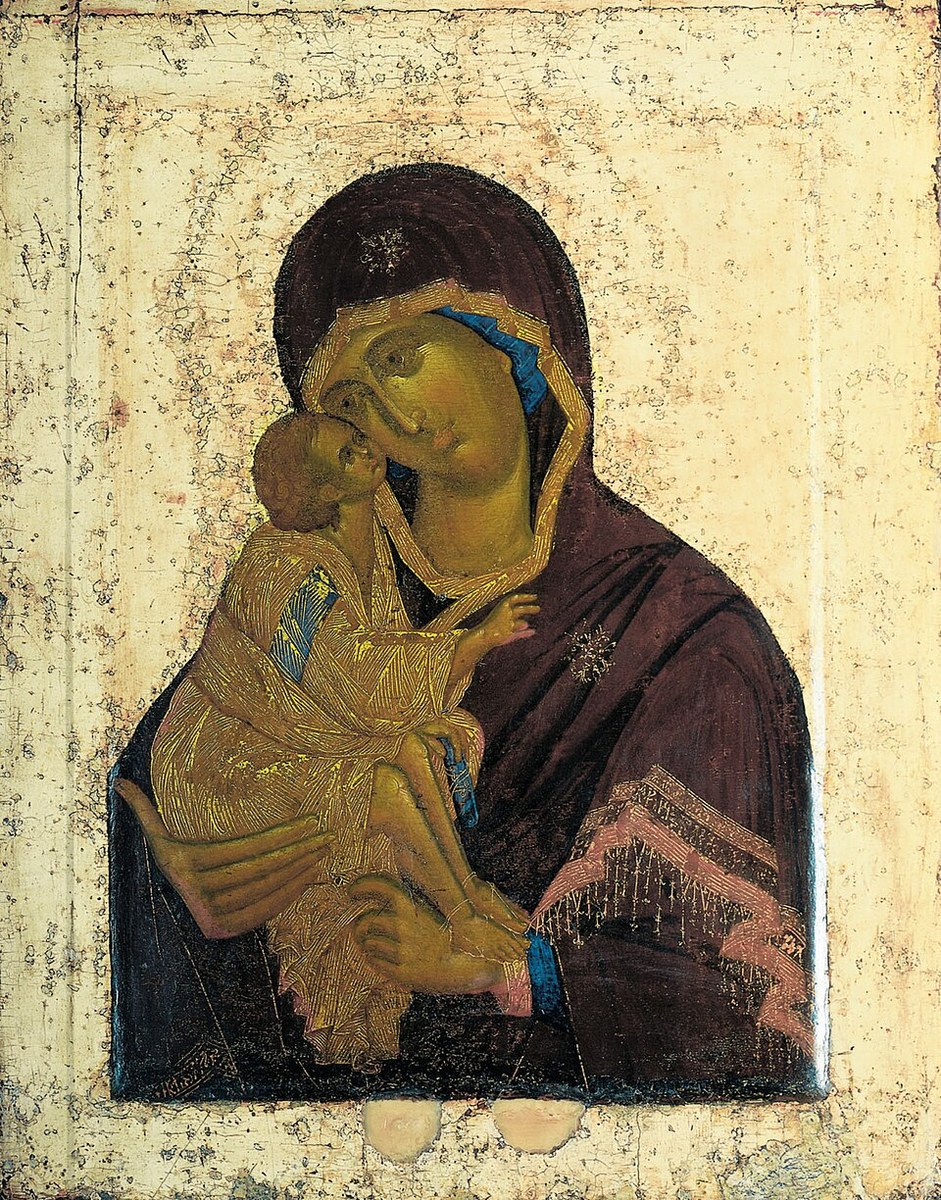
About Donskaya Icon of the Mother of God →

Saints commemorated
-
Saint of the day
Martyr Andrew Stratelates and Companions
Andrew, called Stratelates — "the General" — was a Roman field commander of the eastern armies under Maximian who won a victory over a Persian invasion of the Syrian frontier with a small detachment of pagan soldiers whom he had first persuaded to call, in the battle, upon a God they did not yet worship. Denounced for it, tried, tortured and released by an emperor who feared what the army would do if its favourite were executed, he was baptised at Tarsus with his men, and then hunted down and beheaded with them in the passes of the Taurus on the pretext of desertion, about the year 300. The synaxarion numbers the company 2,593. A spring of water broke out at the place of their blood, for which Andrew had prayed as he died, and the Greek verses for the day turn on the exchange: the lakes of blood they set up, and the lakes of water he set up for them. He is one of the great soldier-martyrs of the Byzantine calendar, and the largest single company of martyrs kept on any day of August.
-
Martyr Andrew Strateletes and 2,593 soldiers with him in Cilicia (ca. 289)
-
Eutychian and Strategius
Eutychian and Strategius are two martyrs of whom the Greek synaxarion for August 19 has kept four things and nothing else: their names, that Eutychian was a soldier, that they were perfected by fire, and two couplets of verse composed on the puns their names make. Neither the persecution, nor the place, nor the year, nor the manner of their arrest has come down. They are recorded here at the length the record allows, which is short, and no life is constructed for them.
-
Gennadius of Kostroma
Gennadius of Kostroma and Liubimograd (early sixteenth century – 1565) was a Russian monastic founder, a disciple of Cornelius of Komel and, through him, an heir of the great northern tradition of forest-dwelling ascetics. Born at Mogilev in a wealthy family under the name Gregory, he abandoned home and riches as a youth, was tonsured by Cornelius in the Vologda forest, and after sharing his master's flight into the deeper wilderness founded, on the shore of Lake Sura in the Kostroma country, the Monastery of the Transfiguration (afterwards called the Gennadiev Monastery). Famed for his labours, his charity, and a gift of spiritual counsel and foresight, he reposed on January 23, 1565, and was glorified when his relics were uncovered incorrupt in 1646.
-
Gerasimus, Pitirim and Jonah of Perm
Gerasimus, Pitirim and Jonah were three successive bishops of Great Perm, seated at Ust-Vym on the Vychegda, who in the fifteenth century carried forward the mission begun by Stephen of Perm among the Zyrians (Komi) and the pagan tribes of the far north-east of Russia. Gerasimus (†c. 1441) and Pitirim (†1455) were both martyred — the one strangled by a heathen of his own household, the other killed in a raid of the pagan Voguls (Mansi) — while Jonah (†1470) completed the conversion of Great Perm on the upper Kama and reposed in peace. Venerated together as the wonderworking hierarchs of Perm, their relics rest in the cathedral of Ust-Vym, and they are commemorated as a company on January 29.
-
Theophanes the New of Naousa
Theophanes, called the New to distinguish him from the older saints of his name and the Wonderworker for what was done through him, was a sixteenth-century monk of Ioannina who became abbot of Docheiariou on Mount Athos, and who lost that office because he rescued a boy. When his sister's son was carried off to Constantinople in the devshirme, the levy of Christian children for the janissary corps, Theophanes went after him, got him out before his conversion to Islam was complete, brought him back to the Holy Mountain and tonsured him. The brotherhood, terrified of Ottoman reprisal, turned against their abbot; rather than let the house be divided over him, Theophanes left — took his nephew, left Athos altogether, and began again in Macedonia. He founded a monastery at the skete of the Forerunner near Veria and set his nephew over it, and a second at Naousa, dedicated to the Holy Archangels, and governed both as their common father until he died in great old age on 19 August. He is one of the patron saints of Veria and Naousa, and the whole shape of his life is a single choice made twice: to lose position in order not to lose a person.
-
Timothy, Agapius and Thecla
Timothy, Agapius and Thecla are three of the earliest named victims of the Great Persecution in Palestine, put to death in 304, its second year, under the governor Urbanus. They are not synaxarion figures but people whose deaths were recorded, within living memory and probably from the writer's own eyes, by Eusebius of Caesarea in his little book On the Martyrs of Palestine. Timothy, a learned and eloquent teacher of the faith, was tortured at length and then burned to death over a slow fire at Gaza — a mode of execution designed to be as long as possible; the Greek verses for the day turn the horror into an image of worship, the furnace a censer and the martyr the incense in it. Agapius and Thecla, condemned in the same season, were given to the wild beasts in the amphitheatre. Their memory stands on August 19 immediately after that of Andrew Stratelates, and their arena is the same one into which, days later, the eight martyrs of Agapius and his Companions deliberately walked.
British Isles and Ireland
- St. Clydog, king and martyr (492)
- St. Mochta, 1st bishop of Louth, Ireland (534)
- St. Credan, abbot of Evesham (c.780)
Troparia & kontakia
Apolytikion
Thy martyrs, O Lord, in their contest received incorruptible crowns from thee our God; for possessing thy strength, they cast down the tyrants and shattered the feeble insolence of the demons. By their supplications, O Christ our God, save our souls.
Apolytikion — Tone 8 (common of a venerable father)
In thee, O Father, was the divine image preserved with exactness; for taking up the cross thou didst follow after Christ, and by thy deeds thou didst teach us to despise the flesh, for it passeth away, but to care for the soul, a thing immortal. Wherefore, O venerable Theophanes, thy spirit rejoiceth with the angels.
Exapostilarion — Tone 2
Andrew the all-lauded, the general and the martyr, by the divine grace of the Cross brought down the boldness of the tyrant and took up the crown of glory; and with him shines the godly host of the martyrs, a phalanx bearing the trophy, a shield-wall unbreakable and unconquered — whose memory we keep in gladness, hymning Christ.
Kontakion — Tone 2
Having passed over in the body to the dwellings of heaven, thou hast in no way forsaken those who are on earth, O Theotokos; for thou hast granted to those who love thee to look upon the divine and much-wondrous likeness of thy most pure face, and to venerate it, as a sign of thy grace: which we honour, and kiss.
Kontakion — Tone 4
Standing before the Lord in prayer, like the morning star that runs before the sun, thou hast beheld the longed-for treasure of the Kingdom and art filled with joy unspeakable; and to the immortal King, whom the angels praise unceasingly, thou singest through the ages without end, O Andrew Stratelates. With them pray thou also, without ceasing, for us all.
Second
All-hymned and all-glorious Queen and Theotokos, Mother of the Maker of every creature, hope and protectress of Christians, swift expectation of those who have no hope and are in despair: we pray thee, be merciful to us sinners; forsake not thy servants, and reject not the prayer of the unworthy. We pray, looking upon thine honoured likeness in this thy holy and wonderworking icon, and we cry: let thy mercy be with those who sail and those who travel; O Sovereign Lady, shelter us with thy precious veil, keep the faithful safe in every evil place, and pray to Christ our God who was born of thee, that he may save our souls from sin.
Troparion — Tone 4
O most gracious and swift protectress of the faithful, most pure Virgin Theotokos: we pray thee before thy holy and wonderworking image, that as of old thou didst grant thy defence through it to the city of Moscow, so now also thou wouldst mercifully deliver us from every evil and calamity, and save our souls, for thou art merciful.
Troparion — Tone 5
Leaving behind the glory of earthly rank, thou didst inherit the Kingdom of Heaven; with the drops of thy blood, as with jewels of wondrous price, thou hast adorned the crowns that fade not, and hast led to Christ a whole company of passion-bearers. With the choirs of the angels, in the light that knows no evening, thou hast found Christ, the Sun that never sets, O holy Andrew Stratelates: pray to him without ceasing, together with those who suffered with thee, that he may save our souls.
Troparion — Tone 4 (common of martyrs)
Thy martyrs, O Lord, in their contest received incorruptible crowns from thee our God; for possessing thy strength, they cast down the tyrants and shattered the feeble insolence of the demons. By their supplications, O Christ our God, save our souls.
Troparion — Tone 8
In thee, O Father, that which is according to the image was preserved unimpaired; for taking up the Cross thou didst follow Christ, and by thy deeds thou didst teach us to despise the flesh, for it passeth away, but to care for the soul, a thing immortal. Therefore doth thy spirit, O venerable Gennadius, rejoice together with the Angels.
Troparion — Tone 4 (from the common of hierarchs)
O God of our fathers, who ever dealest with us according to thy gentleness, take not thy mercy from us, but by the prayers of thy holy hierarchs Gerasimus, Pitirim and Jonah, govern our life in peace.
Troparion — Tone 4 (common of martyrs)
Thy martyrs, O Lord, in their contest received incorruptible crowns from thee our God; for possessing thy strength, they cast down the tyrants and shattered the feeble insolence of the demons. By their supplications, O Christ our God, save our souls.
Readings
Epistle
2 Corinthians 2.14-3.3
14Now thanks be unto God, which always causeth us to triumph in Christ, and maketh manifest the savour of his knowledge by us in every place. 15For we are unto God a sweet savour of Christ, in them that are saved, and in them that perish: 16To the one we are the savour of death unto death; and to the other the savour of life unto life. And who is sufficient for these things? 17For we are not as many, which corrupt the word of God: but as of sincerity, but as of God, in the sight of God speak we in Christ. 1Do we begin again to commend ourselves? or need we, as some others, epistles of commendation to you, or letters of commendation from you? 2Ye are our epistle written in our hearts, known and read of all men: 3Forasmuch as ye are manifestly declared to be the epistle of Christ ministered by us, written not with ink, but with the Spirit of the living God; not in tables of stone, but in fleshy tables of the heart.
Gospel
Matthew 23.23-28
23Woe unto you, scribes and Pharisees, hypocrites! for ye pay tithe of mint and anise and cummin, and have omitted the weightier matters of the law, judgment, mercy, and faith: these ought ye to have done, and not to leave the other undone. 24Ye blind guides, which strain at a gnat, and swallow a camel. 25Woe unto you, scribes and Pharisees, hypocrites! for ye make clean the outside of the cup and of the platter, but within they are full of extortion and excess. 26Thou blind Pharisee, cleanse first that which is within the cup and platter, that the outside of them may be clean also. 27Woe unto you, scribes and Pharisees, hypocrites! for ye are like unto whited sepulchres, which indeed appear beautiful outward, but are within full of dead men’s bones, and of all uncleanness. 28Even so ye also outwardly appear righteous unto men, but within ye are full of hypocrisy and iniquity.