
Theophanes the New of Naousa
Our Venerable Father Theophanes the New and Wonderworker, of Docheiariou, who struggled at Naousa
Venerable · Wonderworker · d. 19 August, later 16th century, at the monastery of the Forerunner near Veria
Commemorated 19 August — Repose at the monastery of the Forerunner near Veria; his relics are honoured at Naousa and Veria
Theophanes, called the New to distinguish him from the older saints of his name and the Wonderworker for what was done through him, was a sixteenth-century monk of Ioannina who became abbot of Docheiariou on Mount Athos, and who lost that office because he rescued a boy. When his sister's son was carried off to Constantinople in the devshirme, the levy of Christian children for the janissary corps, Theophanes went after him, got him out before his conversion to Islam was complete, brought him back to the Holy Mountain and tonsured him. The brotherhood, terrified of Ottoman reprisal, turned against their abbot; rather than let the house be divided over him, Theophanes left — took his nephew, left Athos altogether, and began again in Macedonia. He founded a monastery at the skete of the Forerunner near Veria and set his nephew over it, and a second at Naousa, dedicated to the Holy Archangels, and governed both as their common father until he died in great old age on 19 August. He is one of the patron saints of Veria and Naousa, and the whole shape of his life is a single choice made twice: to lose position in order not to lose a person.

Ioannina and Docheiariou
Theophanes was born at Ioannina in Epirus, the Greek city that in the Ottoman centuries produced an extraordinary number of monks, merchants, teachers and martyrs. He went young to Mount Athos, and received the tonsure at the monastery of Docheiariou, one of the older coastal houses on the western side of the peninsula. He was in time elected its abbot, the sources say for the height of his virtue rather than for any other qualification.
The nephew taken for the janissaries
Then his sister's message reached him. Her son had been taken by the Ottoman authorities to Constantinople — the παιδομάζωμα, the child-levy, by which the Porte took Christian boys from the Balkan provinces, converted them to Islam and made them soldiers of the janissary corps or servants of the palace. It was the standing terror of Greek and Slav family life for two centuries, and it was ordinarily final: the child did not come back.
Theophanes went to Constantinople and got him back. The accounts are agreed on the essentials and vague on the method — he searched for the boy, found him before the conversion had been completed, and secured his release by persistence — which is very likely all that was ever known, since the details of such a transaction, in the sixteenth century, were not the sort of thing anyone wrote down. He brought the boy to Docheiariou, gave him refuge, and blessed him to take the monastic habit.
The departure from Athos
The brotherhood did not thank him. What they saw was an abbot who had removed a boy from the sultan's service and hidden him in their monastery, and what they feared was reprisal — against the house, against the Holy Mountain, against themselves. Murmuring began against Theophanes.
His response is the hinge of the whole life. He did not defend himself, did not appeal to the Protaton, did not attempt to hold the office. Judging that he would not be the cause of discord and division, he took his nephew and withdrew — from the abbacy, from Docheiariou, and from Athos altogether. He was, by then, an old monk leaving the only home he had had.
Veria and Naousa
He came down into Macedonia, to Veria (Beroea), the city where the Apostle Paul had preached and whose Jews Acts calls more noble-minded than those of Thessalonica. Above it, in the ravine of the Aliakmon, lay the skete of Saint John the Forerunner, a settlement of hermitages. There Theophanes built a church in honour of the Most Holy Theotokos, and as monks began to gather about him he gave them a cenobitic rule — a common table, common property, common obedience, in a place that had been a colony of solitaries. He set his nephew over the house as its abbot: the boy he had fetched out of the janissary barracks became a Greek hegumen.
When the monastery at Veria grew too full, Theophanes withdrew again — this time not from trouble but from success — and went further up into the hills, to Naousa on the slopes of Vermion. There he built a church of the Holy Archangels, the Taxiarchs, and founded a second monastery around it. To the end of his life he did not abandon either community, and both regarded him as their common father: two houses, thirty kilometres apart, under one old man who had no office in either.
Repose and relics
Having received, the tradition says, a revelation of his own end, he took leave of his flock and died in extreme old age at the monastery near Veria, on 19 August. The precise year is not transmitted; the sixteenth century is secure.
Even in his lifetime the Lord had glorified him. The wonders that the accounts attach to him are the wonders of a coastal and travelling life: he calmed a storm at sea by his prayer and saved those aboard from destruction, and he turned seawater into drinking water for men who were perishing of thirst. After his death the miracles did not stop, and it is from them that his second title, the Wonderworker, comes.
His relics were divided between the two houses he founded, which is why the Greek synaxarion says his relic is "already at Naousa" while the Veria tradition keeps his head in a silver reliquary at the monastery of the Forerunner; the remaining bones were translated into the sanctuary of the Forerunner's church in 1926. He is honoured as a patron of both cities, and his name stands in the calendar of the Metropolis of Veria, Naousa and Kampania.
Feast and commemoration
August 19 (church date; New Calendar civil August 19, Old Calendar civil September 1), within the afterfeast of the Dormition. His memory is appended to the synaxarion of the day after Andrew Stratelates and the martyrs Timothy, Agapius and Thecla, with the notice that he "reposed in peace" — the formula the synaxaria use for a saint who was not a martyr. He is a Greek commemoration, kept with particular solemnity in the Metropolis of Veria, Naousa and Kampania, where he is one of the local patrons, and carried into the OCA calendar; the Antiochian books do not have him. His office in local use is a modern composition.
Hymns
Apolytikion — Tone 8 (common of a venerable father)
In thee, O Father, was the divine image preserved with exactness; for taking up the cross thou didst follow after Christ, and by thy deeds thou didst teach us to despise the flesh, for it passeth away, but to care for the soul, a thing immortal. Wherefore, O venerable Theophanes, thy spirit rejoiceth with the angels.
Iconography
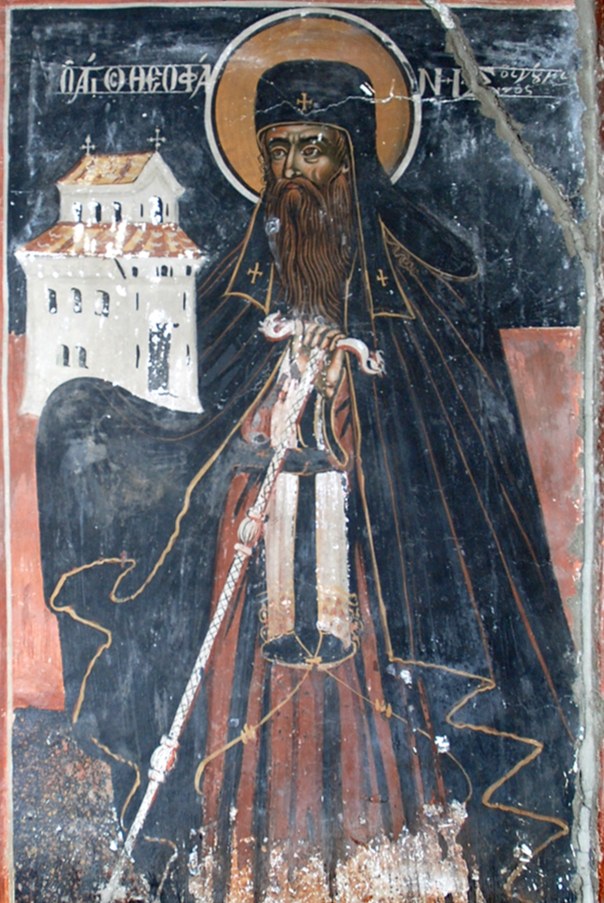
Theophanes is painted as a venerable elder: full length or half-length, in the black rason and the koukoulion or analavos of the great schema, with a long white beard falling to the chest, the right hand raised in blessing or held to the breast and the left holding an open scroll. Where the scroll carries a text it is one of the sayings of the fathers on the renunciation of the world. In the local icons of Veria and Naousa he is shown holding a model of a church — the sign of a founder — and in fuller compositions the two monasteries appear in the landscape at either side of him, the Forerunner's house in the Aliakmon ravine and the Archangels' on the slope of Vermion; the sea with a ship on it is sometimes set at the foot of the panel for the stilled storm.
No pre-1900 icon of this saint has been identified for this collection. The images in circulation are modern panels and wall-paintings of the Veria and Naousa churches, which are the copyrighted work of living or recently deceased iconographers and cannot be stored under §8; a search of Wikimedia Commons for the saint under his Greek name returned no results at all. The entry accordingly carries prose only, and he is listed among the wanted icons.
The stored image is the 1744 Docheiariou icon of the saint as ktetor of that house.
Disputed questions
- The year of his repose. August 19 is fixed; the year is not. Both the Greek and the Slavonic notices place him simply in the sixteenth century, and nothing is invented here.
- Not to be confused with the older Theophaneses. He is called the New precisely for this reason. Distinguish Theophanes the Confessor of Sigriane (†818), the chronicler; Theophanes the Branded (†845), the hymnographer whose face was tattooed by the iconoclasts; Theophanes the Merciful of Gaza; Theophanes of Mount Diabenos; and Theophan the Recluse (†1894). None of them is this saint, and the epithet ὁ Νέος in the Greek books is the mark that the day means the Athonite of Naousa.
- Docheiariou or Naousa? The OCA heads the entry "Venerable Theophanes of Docheiariou, Mount Athos," which names where he was formed; the Greek synaxarion heads it by the mountain of Naousa, which names where he struggled and where his relic lies. Both are correct and the entry carries both.