
Pentecost week, day 1 · 49 days since Pascha
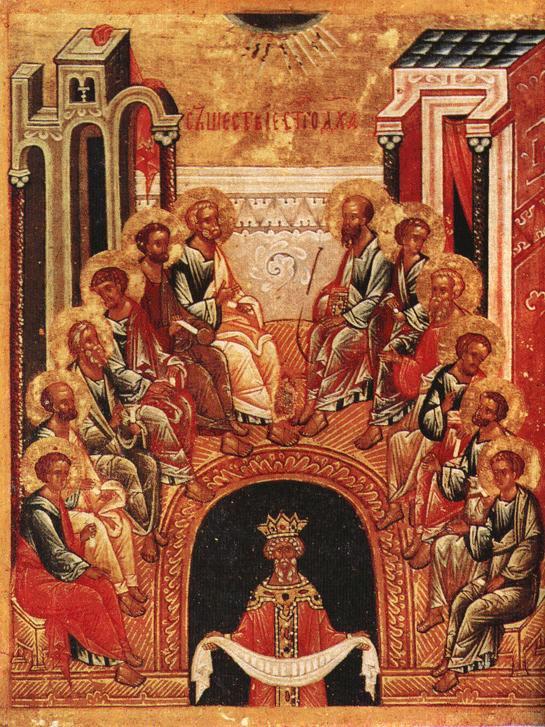
Holy Pentecost

Saints commemorated
-
Hieromartyr Methodius, Bishop of Patar
-
St Kallistos I, Patriarch of Constantinople (1363)
Callistus I (†August 1363) was an Athonite hesychast who spent some twenty-eight years on the Holy Mountain as a disciple of Gregory of Sinai, and was then drawn out of the desert to govern the Church of Constantinople twice over — from 1350 to 1353 and again from 1355 until his death. He presided at the council of 1351 which set the seal of the Church on the theology of Gregory Palamas; he wrote the Life of his own teacher and the Life of Theodosius of Trnovo; he broke with the Emperor John VI Kantakouzenos rather than crown his son, and laid the Church of Serbia under excommunication for erecting a patriarchate without Constantinople's consent. He died at Serres, on the embassy sent to undo that very quarrel and to build an alliance against the Turks — as, the Athonite tradition says, St Maximos of Kavsokalyvia had foretold he would.
-
Blessed Studios (5th c.)
-
Aristocles, Demetrian and Athanasius
Three clerics of the Church of Cyprus — a presbyter, a deacon and a reader — put to death at Salamis about the year 306, in the last and worst of the persecutions. Aristocles was a priest of Tamassos in the copper country of the interior who fled the persecution into a cave on the mountain, was rebuked there by a vision, and came down again to die; on the road he fell in with the deacon Demetrian and the reader Athanasius at the church of the Apostle Barnabas, told them what he had seen, and the two chose to go with him. All three preached openly against the idols in Salamis, were arrested, and were beheaded together. They are among the small number of named Cypriot martyrs of the great persecution, and their memory is kept at Tamassos to this day.
-
Gleb of Vladimir
Gleb Andreevich (c. 1155–1174), baptised George, was the younger son of the Grand Prince Andrew Bogolyubsky of Vladimir. He is one of the very few saints of the Russian calendar honoured for nothing but his piety: he held no throne, fought no battle, founded nothing, and died at nineteen. From the age of twelve he lived, in the phrase of his Life, "a solitary spiritual life" in his father's house — fasting, keeping vigil, reading the Scriptures, honouring the clergy and giving away what he had. His body was found incorrupt and lay in the Dormition cathedral of Vladimir, where it survived the burning of the church in the Tatar sack of 1238 untouched by the fire; he was glorified in 1702 and is honoured as a protector of the city of Vladimir.
-
Gurias of Kazan
Gurias of Kazan (in the world Gregory Rugotin, c. 1500–1563) was the first archbishop of Kazan and the apostle of the newly-conquered Tatar lands of the middle Volga. A courtier's servant who suffered long imprisonment on a false charge, he became a monk and abbot of the Volokolamsk monastery, and in 1555 was chosen by lot to head the new Kazan diocese established after Ivan the Terrible's capture of the city. With his companions Herman and Barsanuphius he built churches, monasteries and schools and won many from Islam and paganism to Christ by gentleness rather than force. He died in 1563; his incorrupt relics, uncovered in 1595, made him one of the most venerated saints of the Russian Volga.
-
Inna, Pinna and Rimma
Inna, Pinna and Rimma were three men of Scythia Minor — the lands about the lower Danube and the western shore of the Black Sea, in what is now Romania and Bulgaria — who were converted and, the tradition says, ordained by the Apostle Andrew the First-Called in the first age of the Gospel. Preaching Christ among the barbarian tribes of the region and baptising many, they were seized by a pagan chieftain and, refusing to deny the faith, were bound to stakes set upright in the frozen river and lowered into the ice until the freezing water rose to their necks and they gave up their souls — a martyrdom by cold that is almost unique in the calendar. They are among the earliest martyrs of the northern lands, and are venerated as the first martyrs of the Scythian and Slavic world. They are kept on January 20, with a second commemoration on June 20 for the translation of their relics.
-
Leucius of Brindisi
Leucius the Confessor was an Alexandrian monk, born Eutropius, who was sent — the Life says by a direct command of Christ — from Egypt to the heel of Italy, and became the first bishop of Brindisi (Brundisium), the port at the end of the Appian Way. The Greek and Slavonic books, which call his see by the half-Hellenised name Vruntisiopolis, tell of a drought of two years broken by his prayer, and of the baptism of the governor and of the whole city after it. He is one of the very few saints of southern Italy to have entered the Byzantine synaxaria by the eastern road rather than the Latin one, and he is commemorated on June 20.
-
Menas of Polotsk
Menas (†1116) was a monk of the Kiev Caves monastery who on 13 December 1105 was consecrated Bishop of Polotsk, and is the first bishop of that ancient see whose name and consecration are securely recorded. He belongs to the first generation of native Russian hierarchs after the Baptism of Rus', when the Caves monastery was supplying bishops to the new dioceses of the north and west, and he governed Polotsk for eleven years in the years of its greatest independence from Kiev. Almost nothing of his episcopate is transmitted beyond the fact of it; his memory is preserved in the Paterikon of the Kiev Caves and in the service of the fathers of the Caves, and he is commemorated on June 20 and in the synaxis of the Saints of Belarus.
-
Methodius of Patara
Methodius (†c. 311–312) is the bishop, theologian and martyr whom the Church honours as the first great critic of Origen. Called in the Greek books Bishop of Patara and in the older Latin witness Bishop of Olympus in Lycia, he wrote in a polished Platonic Greek that no other Christian of his generation matched: above all the Symposium, or Banquet of the Ten Virgins, the only one of his works to survive whole in the original, in which ten virgins in a garden deliver ten speeches in praise of virginity and end by singing an alphabetical hymn to Christ the Bridegroom. Against Origen he defended the resurrection of this body, the goodness of the material creation, and the beginning of souls in time, refusing the doctrine that souls pre-existed their bodies and fell into them. He was beheaded in the persecution of the early fourth century, and is commemorated on June 20.
-
Naum of Ohrid
Naum of Ohrid (c. 830–910) was one of the seven Apostles of the Slavs — the Sedmochislenitsi — a direct disciple and co-worker of Cyril and Methodius who, after their mission in Great Moravia was broken up by the Latin clergy, carried the Slavonic letters and liturgy south into Bulgaria. There, with his companion Clement of Ohrid, he became a founder of Slavonic learning: a teacher at Pliska and Preslav under the princes Boris and Symeon, and then head of the school at Ohrid, where he built a monastery on the southern shore of the lake and reposed in 910. Venerated across the Bulgarian, Macedonian and Serbian lands as an enlightener and wonderworker, he is commemorated on December 23, and his monastery and relics at the springs of Lake Ohrid remain one of the great pilgrimage shrines of the Balkans.
-
Nicholas Cabasilas
Nicholas Cabasilas (c. 1320–c. 1392) of Thessalonica was a layman, a statesman's counsellor and a man of letters who became one of the greatest theologians the Orthodox Church has produced — and, so far as can be shown, was never ordained and never took the monastic habit. His two masterpieces, the Commentary on the Divine Liturgy and The Life in Christ, together set out a single vision: that the Christian life is not an imitation of Christ from outside but a real sharing in his life, given in baptism, chrismation and the Eucharist, and that the mysteries are therefore not aids to piety but the very substance of salvation. He stood with Gregory Palamas and the hesychasts in the controversies of his day and yet wrote for the ordinary Christian in the world. The Ecumenical Patriarchate glorified him in 1983, and appointed his memory to June 20.
British Isles and Ireland
- St. Govan of Dyfed (6th C)
- St. Edburgh of Castor, Virgin (7th C)
Troparia & kontakia
Apolytikion — Tone 8
Blessed art thou, O Christ our God, who hast shown forth the fishermen as all-wise, sending down upon them the Holy Spirit, and through them taking the whole world in thy net. O Lover of mankind, glory to thee.
Apolytikion — Tone 4
Thy martyrs, O Lord, in their contest received incorruptible crowns from Thee, our God; for possessing Thy strength, they cast down the tyrants and shattered the feeble insolence of the demons. By their intercessions save our souls.
Apolytikion — Tone 4
The truth of things revealed thee to thy flock as a rule of faith, an icon of meekness and a teacher of abstinence; therefore thou hast attained the heights by humility, and riches by poverty. O father and hierarch Callistus, intercede with Christ God that our souls may be saved.
Apolytikion — Tone 4
The truth of things revealed thee to thy flock as a rule of faith, an icon of meekness and a teacher of abstinence; therefore thou hast attained the heights by humility, and riches by poverty. O father and hierarch Leucius, intercede with Christ God that our souls may be saved.
Apolytikion — Tone 4
The truth of things revealed thee to thy flock as a rule of faith, an icon of meekness and a teacher of abstinence; therefore thou hast attained the heights by humility, and riches by poverty. O father and hierarch Menas, intercede with Christ God that our souls may be saved.
Apolytikion — Tone 4
As a sharer in the ways and a successor to the thrones of the Apostles, O divinely-inspired one, thou didst find in contemplation the means to ascend to divine heights; rightly dividing the word of truth, thou didst struggle for the faith even unto blood, O hieromartyr Methodius: intercede with Christ God that our souls may be saved.
Apolytikion — Tone 4
Wise in the learning of this world, thou wast wiser in the mysteries of God, and didst teach that the life of Christ is given to us in the font and at the holy Table, O righteous Nicholas; ornament of Thessalonica and interpreter of the Liturgy, entreat Christ God that our souls may be saved.
Kontakion — Tone 8
When the Most High came down and confounded the tongues, he divided the nations; when he distributed the tongues of fire, he called all men into unity; and with one accord we glorify the all-holy Spirit.
Kontakion — Tone 8 (common of a hesychast hierarch)
Nurtured in stillness upon the Holy Mountain, thou wast set as a shepherd upon the throne of the City, and didst confess the light that shone upon Tabor to be uncreated; having laboured for the peace of the Churches, thou didst lay down thy life upon the road. O father Callistus, teach us also the prayer of the heart.
Kontakion — Tone 8
Neither fire nor the swords of the godless could touch thy tomb, O prince, for the Lord kept whole what thou hadst kept pure; therefore Vladimir rejoices in thee and cries: hail, O Gleb, young in years and perfect in love.
Kontakion — Tone 4
Having overcome the passions of the senses, thou didst shine forth like the sun in purity, keeping thy life pure to the end, and thou didst lead many from unbelief to the faith of Christ; therefore, honoured by God with incorruption, thou didst astonish all by thy wonders. We entreat thee, O hierarch Gurias: by thy prayers deliver us from misfortunes, that we may cry to thee: Rejoice, O most wondrous father, the praise and confirmation of the city of Kazan.
Kontakion — Tone 2 (common of a hierarch)
Thou wast sent from the Nile to the sea of Italy as a cloud full of rain, O Leucius, and at thy prayer the parched land drank and the city was washed in the font. Wherefore we honour thee as a shepherd and a wonderworker, and as an intercessor for our souls.
Kontakion — Tone 2
From the caves of Kiev thou wast sent to the Dvina as a lamp to a dark room, O hierarch Menas, and having kept the monk's rule upon the throne, thou didst finish thy course in peace; wherefore we honour thee as a father of the land of Belarus.
Kontakion — Tone 2
Thou didst water the Church with the streams of thy teaching, O wise Methodius, and didst cut down the tares of error with the sickle of the word; then, offering thy neck to the sword, thou didst seal thy books with thy blood. Wherefore we cry to thee: rejoice, O hierarch and martyr, unshaken pillar of the faith.
Kontakion — Tone 3
Thou hast opened to us the meaning of the holy offering, and hast shown the love of God for man to be a love that seeks us out; wherefore, O all-blessed Nicholas, we who live in the world take courage from thy word, and keep thy memory with faith.
Megalynarion — Tone 7
O Mother who hast not known man, Virgin Theotokos, who didst conceive without experience of corruption and didst lend flesh to the all-fashioning Word; vessel of him whom nothing can contain, place of thine own uncircumscribed Maker: thee do we magnify.
Oikos
Give swift and steadfast consolation to thy servants, O Jesus, when our spirits grow listless. Be not parted from our souls in afflictions, be not far from our minds in adversities, but come to us always before we call. Draw near to us, draw near, thou who art everywhere; and as thou wast ever with thine apostles, so unite thyself to those who long for thee, O compassionate one, that being joined to thee we may hymn and glorify thine all-holy Spirit.
Synaxarion
The fire spared the deacon and the reader; one sword took all three, and gave them one crown.
The
I keep myself pure for Thee, and holding a lighted torch I go out to meet Thee, O Bridegroom.
Troparion — Tone 4 (common of a right-believing prince)
From thy youth thou wast enamoured of Christ, O blessed one, and didst choose fasting and vigil in the midst of a prince's house; wherefore the Lord glorified thy body with incorruption and gave it to thy city as a wall. O right-believing Gleb, entreat Christ God that our souls may be saved.
Troparion — Tone 4
A rule of faith and an image of chastity, a teacher of good works and a guide of salvation, the Lord gave thee to the newly-enlightened city of Kazan, wherein thou didst gain new peoples from among the nations and lead them to Christ. Wherefore, gathering with joy on thy memorial, we keep with honour thy holy dormition; O our father Gurias, hierarch of Christ, entreat Christ God that our souls may be saved.
Troparion — Tone 4
Thy Martyrs, O Lord, in their contest received incorruptible crowns from Thee our God; for, possessed of Thy strength, they cast down the tyrants and shattered the feeble insolence of the demons. By their prayers, O Christ God, save our souls.
Readings
Vespers
Numbers 11.16-17, 24-29
16And the LORD said unto Moses, Gather unto me seventy men of the elders of Israel, whom thou knowest to be the elders of the people, and officers over them; and bring them unto the tabernacle of the congregation, that they may stand there with thee. 17And I will come down and talk with thee there: and I will take of the spirit which is upon thee, and will put it upon them; and they shall bear the burden of the people with thee, that thou bear it not thyself alone. 24And Moses went out, and told the people the words of the LORD, and gathered the seventy men of the elders of the people, and set them round about the tabernacle. 25And the LORD came down in a cloud, and spake unto him, and took of the spirit that was upon him, and gave it unto the seventy elders: and it came to pass, that, when the spirit rested upon them, they prophesied, and did not cease. 26But there remained two of the men in the camp, the name of the one was Eldad, and the name of the other Medad: and the spirit rested upon them; and they were of them that were written, but went not out unto the tabernacle: and they prophesied in the camp. 27And there ran a young man, and told Moses, and said, Eldad and Medad do prophesy in the camp. 28And Joshua the son of Nun, the servant of Moses, one of his young men, answered and said, My lord Moses, forbid them. 29And Moses said unto him, Enviest thou for my sake? would God that all the LORD’s people were prophets, and that the LORD would put his spirit upon them!
Joel 2.23-32
23Be glad then, ye children of Zion, and rejoice in the LORD your God: for he hath given you the former rain moderately, and he will cause to come down for you the rain, the former rain, and the latter rain in the first month. 24And the floors shall be full of wheat, and the fats shall overflow with wine and oil. 25And I will restore to you the years that the locust hath eaten, the cankerworm, and the caterpiller, and the palmerworm, my great army which I sent among you. 26And ye shall eat in plenty, and be satisfied, and praise the name of the LORD your God, that hath dealt wondrously with you: and my people shall never be ashamed. 27And ye shall know that I am in the midst of Israel, and that I am the LORD your God, and none else: and my people shall never be ashamed. 28And it shall come to pass afterward, that I will pour out my spirit upon all flesh; and your sons and your daughters shall prophesy, your old men shall dream dreams, your young men shall see visions: 29And also upon the servants and upon the handmaids in those days will I pour out my spirit. 30And I will shew wonders in the heavens and in the earth, blood, and fire, and pillars of smoke. 31The sun shall be turned into darkness, and the moon into blood, before the great and the terrible day of the LORD come. 32And it shall come to pass, that whosoever shall call on the name of the LORD shall be delivered: for in mount Zion and in Jerusalem shall be deliverance, as the LORD hath said, and in the remnant whom the LORD shall call.
Ezekiel 36.24-28
24For I will take you from among the heathen, and gather you out of all countries, and will bring you into your own land. 25Then will I sprinkle clean water upon you, and ye shall be clean: from all your filthiness, and from all your idols, will I cleanse you. 26A new heart also will I give you, and a new spirit will I put within you: and I will take away the stony heart out of your flesh, and I will give you an heart of flesh. 27And I will put my spirit within you, and cause you to walk in my statutes, and ye shall keep my judgments, and do them. 28And ye shall dwell in the land that I gave to your fathers; and ye shall be my people, and I will be your God.
Matins Gospel
John 20.19-23
19Then the same day at evening, being the first day of the week, when the doors were shut where the disciples were assembled for fear of the Jews, came Jesus and stood in the midst, and saith unto them, Peace be unto you. 20And when he had so said, he shewed unto them his hands and his side. Then were the disciples glad, when they saw the Lord. 21Then said Jesus to them again, Peace be unto you: as my Father hath sent me, even so send I you. 22And when he had said this, he breathed on them, and saith unto them, Receive ye the Holy Ghost: 23Whose soever sins ye remit, they are remitted unto them; and whose soever sins ye retain, they are retained.
Epistle
Acts 2.1-11
1And when the day of Pentecost was fully come, they were all with one accord in one place. 2And suddenly there came a sound from heaven as of a rushing mighty wind, and it filled all the house where they were sitting. 3And there appeared unto them cloven tongues like as of fire, and it sat upon each of them. 4And they were all filled with the Holy Ghost, and began to speak with other tongues, as the Spirit gave them utterance. 5And there were dwelling at Jerusalem Jews, devout men, out of every nation under heaven. 6Now when this was noised abroad, the multitude came together, and were confounded, because that every man heard them speak in his own language. 7And they were all amazed and marvelled, saying one to another, Behold, are not all these which speak Galilæans? 8And how hear we every man in our own tongue, wherein we were born? 9Parthians, and Medes, and Elamites, and the dwellers in Mesopotamia, and in Judæa, and Cappadocia, in Pontus, and Asia, 10Phrygia, and Pamphylia, in Egypt, and in the parts of Libya about Cyrene, and strangers of Rome, Jews and proselytes, 11Cretes and Arabians, we do hear them speak in our tongues the wonderful works of God.
Gospel
John 7.37-52, 8.12
37In the last day, that great day of the feast, Jesus stood and cried, saying, If any man thirst, let him come unto me, and drink. 38He that believeth on me, as the scripture hath said, out of his belly shall flow rivers of living water. 39(But this spake he of the Spirit, which they that believe on him should receive: for the Holy Ghost was not yet given; because that Jesus was not yet glorified.) 40Many of the people therefore, when they heard this saying, said, Of a truth this is the Prophet. 41Others said, This is the Christ. But some said, Shall Christ come out of Galilee? 42Hath not the scripture said, That Christ cometh of the seed of David, and out of the town of Bethlehem, where David was? 43So there was a division among the people because of him. 44And some of them would have taken him; but no man laid hands on him. 45Then came the officers to the chief priests and Pharisees; and they said unto them, Why have ye not brought him? 46The officers answered, Never man spake like this man. 47Then answered them the Pharisees, Are ye also deceived? 48Have any of the rulers or of the Pharisees believed on him? 49But this people who knoweth not the law are cursed. 50Nicodemus saith unto them, (he that came to Jesus by night, being one of them,) 51Doth our law judge any man, before it hear him, and know what he doeth? 52They answered and said unto him, Art thou also of Galilee? Search, and look: for out of Galilee ariseth no prophet. 12Then spake Jesus again unto them, saying, I am the light of the world: he that followeth me shall not walk in darkness, but shall have the light of life.