
Pentecost week, day 2 · 50 days since Pascha
Day of the Holy Spirit
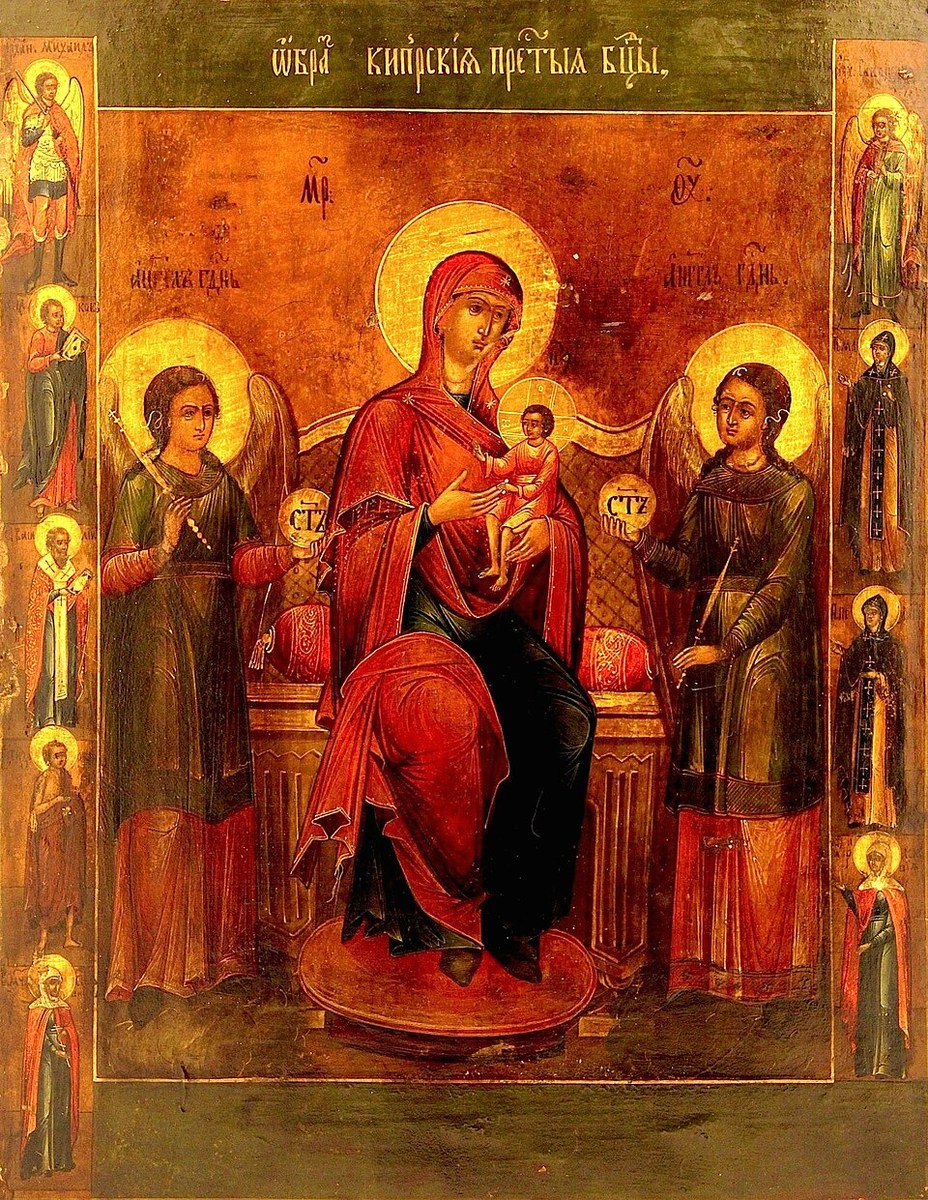
About Cyprus Icon of the Mother of God →

Saints commemorated
-
Martyr Julian of Tarsus
Julian (†c. 305) was a martyr of Cilicia, in the south-east of Asia Minor — a young man of senatorial family from Anazarbus who confessed Christ in the Great Persecution under the Roman governor and, after a year of being dragged from city to city and tortured, was sewn into a sack filled with sand and venomous vipers and scorpions and cast into the sea. The waves bore his body to the Cilician shore (the tradition says to Alexandria), whence his relics were gathered and at last enshrined at Antioch. There, some ninety years later, John Chrysostom preached a celebrated homily in his honour, which remains the chief witness to his martyrdom. He is commemorated on March 16.
-
Our Holy Fathers Julius and Julian (5th c.)
Julius and Julian were brothers, a presbyter and a deacon, Greeks by birth who in the fourth or fifth century carried the Gospel into the north Italian lake country and spent their lives throwing down the altars of the old religion and raising churches in their place — a hundred of them, the tradition says, the last of which Julius built on the island in Lake Orta that has borne his name ever since. Their memory is Western in its soil and Eastern in its calendar: the Latin Church keeps Julius at Novara on January 31 and Julian at Gozzano, while the Byzantine books commemorate the two brothers together on June 21, and the Slavonic synaxarion tells their story at length. Both reposed in peace and are honoured as venerable rather than as martyrs.
-
Ananias the Iconographer
Ananias was a monk of the Monastery of Saint Antony the Roman at Novgorod and a painter of icons, remembered for two things: the beauty of the images he made of the holy wonderworkers, and the fact that for thirty-three years he never once passed outside the monastery walls. He reposed in the sixteenth century — the year is given variously as 1521, 1561 and 1581 — and was buried in the monastery, at a place no longer known. He is commemorated on June 21, and again with the Synaxis of the Saints of Novgorod on the third Sunday after Pentecost.
-
Anastasia of Serbia
Anastasia — Ana in the world — was the wife of the Serbian Grand Prince Stefan Nemanja and the mother of the three men who made mediaeval Serbia: Stefan the First-Crowned, Vukan, and Rastko, who became Sabbas of Serbia. In 1196, when Nemanja abdicated at the council of Ras, the two took the monastic habit on the same day and by the same act — he as Symeon, she as Anastasia — and she withdrew to the monastery of the Theotokos, where she reposed in 1200. She is venerated as venerable in the Serbian Church, the mother of a saint and herself a monastic, and her relics rest at Studenica. She is commemorated on June 21.
-
Aphrodisius of Cilicia
Aphrodisius is a martyr of Cilicia — of Tarsus, where the tradition that names a city at all places him — commemorated by the Greek books on June 21, the day of his fellow-Cilician Julian of Tarsus. His notice is one of the shortest in the calendar: a name, a rank, and a province. No passion, no date, no emperor, no manner of death and no companions have come down with him, and this entry does not supply what the record does not contain. He is honoured as one of the many whose names the Church of Cilicia kept when their histories were lost.
-
Archil II of Georgia
Archil (†744) was a king of the Chosroid house, a descendant of Mirian's line, who ruled in Kartli and Kakheti during the catastrophic Arab invasion led by the commander the Georgian chronicles call Murvan the Deaf. He rebuilt what the invaders had razed, and when a second Arab army came he went into their camp to sue for peace for his people. Required to renounce Christ and accept Islam, the old king answered that he would not forsake the true God; he was imprisoned, tortured, and at last beheaded on 20 March 744, being about eighty years of age. His body was carried secretly to the church at Notkora in Kakheti, which he himself had built. Georgia keeps him with the later martyr-king Luarsab II on June 21.
-
Luarsab II of Georgia
Luarsab II (1587–1622), of the Bagrationi house, was king of Kartli from boyhood, a ruler remembered for learning and piety as much as for the victory his small army won over a far larger Ottoman force at Kvenadkotsi in 1609. Caught between the Ottoman and the Safavid empires, he was summoned by Shah Abbas I of Persia, went to him rather than let his country be laid waste, and refused both to break the fast at the Shah's table and to accept Islam. He was carried to Persia and held seven years in the fortress of Gulab-Kala near Shiraz, beaten and pressed to apostatise, and at last strangled with a bowstring in 1622, at thirty-five, two of his servants dying with him. Georgia keeps him with the eighth-century martyr-king Archil II on June 21.
-
Maximus the Greek
Maximus the Greek (c. 1470 – 1556) was an Athonite scholar-monk sent from Vatopedi to Muscovite Russia as a translator, who became one of the most learned men of his age and a confessor imprisoned for decades. Born Michael Trivolis at Arta in Epirus and educated in Renaissance Italy — Florence, Venice, Padua — he returned to Orthodoxy and became a monk on Mount Athos. Summoned to Moscow in 1516 to translate and correct the Slavonic service-books and Scriptures, he laid the foundations of Russian humanist learning; but his rebukes of injustice and avarice, his links to the "non-possessor" party, and errors seized upon from his corrections brought him, at councils of 1525 and 1531, condemnation on charges of heresy, sorcery, and treason. He was imprisoned in the monasteries of Volokolamsk and Tver for more than twenty years, cut off for long stretches from the sacraments, yet never ceased to write. Released at the last to the Trinity–St Sergius Lavra, he reposed there on January 21, 1556, and was glorified by the Russian Church in 1988.
-
Nicetas of Nisyros
Nicetas was a boy of Mandraki, on the volcanic island of Nisyros in the Dodecanese, whose father — a notable of the town — escaped execution for a crime by turning Muslim, and carried his household with him; the child, renamed Mehmed, was raised in Islam without knowing that he had ever been baptised. Learning the truth from a taunt, he fled to Chios, was received back into the Church with holy chrism at the monastery of Nea Moni, and, counselled that a Christian who has denied Christ must confess Him where he denied Him, went of his own will to declare himself before the Turkish judge. After ten days of prison and torture he was beheaded on 21 June 1732, at seventeen. His head is kept at Iviron on Mount Athos and his relics at the church that bears his name on Nisyros.
-
Terence of Iconium
Terence, bishop of Iconium in Lycaonia, is commemorated on June 21 as a hieromartyr of the first century — one of the earliest successors of the apostles in a see founded by the preaching of Paul and Barnabas. The whole of his surviving notice is a single line: that he governed the church of Iconium, was tortured for the confession of Christ, and was beheaded. The Slavonic books identify him with the apostle of the Seventy Tertius, the scribe who wrote out the Epistle to the Romans and who is elsewhere named second bishop of Iconium; the Greek books keep the June 21 hieromartyr under his own name and make no such equation. The identification is the one substantial question his entry raises.
British Isles and Ireland
- St. Mewan (617)
- St. Corbmac, abbot of Durrow (590)
- St. Engelmund, abbot and missionary (c.739)
Troparia & kontakia
Apolytikion — Tone 8 (common of a venerable monastic)
In thee, O Father, was the image of God preserved unimpaired; for taking up the Cross thou didst follow Christ, and by thy deeds thou didst teach us to despise the flesh, which passeth away, but to care for the soul, a thing immortal. Wherefore, O venerable Ananias, thy spirit rejoiceth with the angels.
Apolytikion — Tone 8 (common of a venerable woman)
In thee, O Mother, was the image of God preserved unimpaired; for taking up the Cross thou didst follow Christ, and by thy deeds thou didst teach us to despise the flesh, which passeth away, but to care for the soul, a thing immortal. Wherefore, O venerable Anastasia, thy spirit rejoiceth with the angels.
Apolytikion — Tone 8 (common of venerable monastics)
In you, O Fathers, was the image of God preserved unimpaired; for taking up the Cross you followed Christ, and by your deeds you taught us to despise the flesh, which passes away, but to care for the soul, a thing immortal. Wherefore, O venerable Julius and Julian, your spirits rejoice with the angels.
Apolytikion — Tone 4 (common of a hieromartyr)
As a sharer in the ways and a successor to the thrones of the Apostles, O divinely-inspired one, thou didst find in contemplation the means to ascend to divine heights; rightly dividing the word of truth, thou didst struggle for the faith even unto blood, O hieromartyr Terence: intercede with Christ God that our souls may be saved.
Kontakion — Tone 6
Enthroned thou art shown in thine image, O Queen, with the angels standing about thee and the Word upon thine arm; the impious arrow drew blood from thee and the wound became a wonder, and to this day thou dost cleanse the eyes of them that look on thee. Wherefore we cry: hail, O thou refuge of the islands and of the Russian land.
Troparion — Tone 4 (common of an icon of the Mother of God)
Today the faithful keep radiant festival, overshadowed by thy coming, O Mother of God; and looking upon thy most pure image we cry with compunction: shelter us beneath the precious veil of thy protection, and deliver us from every evil, entreating thy Son, Christ our God, to save our souls.
Troparion — Tone 4 (common of a martyr)
Thy martyr Aphrodisius, O Lord, in his contest received an incorruptible crown from thee, our God; for possessing thy strength, he cast down the tyrants and shattered the feeble insolence of the demons. By his intercessions save our souls.
Troparion — Tone 4 (common of a martyr)
Thy martyr Archil, O Lord, in his contest received an incorruptible crown from thee, our God; for possessing thy strength, he cast down the tyrants and shattered the feeble insolence of the demons. By his intercessions save our souls.
Troparion — Tone 4 (common of a martyr)
Thy martyr Julian, O Lord, in his contest has received from thee our God the crown of incorruption; for having thy strength, he cast down the tyrants and shattered the impotent insolence of the demons. By his supplications, O Christ God, save our souls.
Troparion — Tone 4 (common of a martyr)
Thy martyr Luarsab, O Lord, in his contest received an incorruptible crown from thee, our God; for possessing thy strength, he cast down the tyrants and shattered the feeble insolence of the demons. By his intercessions save our souls.
Troparion — Tone 4 (common of a martyr)
Thy martyr Nicetas, O Lord, in his contest received an incorruptible crown from thee, our God; for possessing thy strength, he cast down the tyrants and shattered the feeble insolence of the demons. By his intercessions save our souls.
Readings
Epistle
Ephesians 5.8-19
8For ye were sometimes darkness, but now are ye light in the Lord: walk as children of light: 9(For the fruit of the Spirit is in all goodness and righteousness and truth;) 10Proving what is acceptable unto the Lord. 11And have no fellowship with the unfruitful works of darkness, but rather reprove them. 12For it is a shame even to speak of those things which are done of them in secret. 13But all things that are reproved are made manifest by the light: for whatsoever doth make manifest is light. 14Wherefore he saith, Awake thou that sleepest, and arise from the dead, and Christ shall give thee light. 15See then that ye walk circumspectly, not as fools, but as wise, 16Redeeming the time, because the days are evil. 17Wherefore be ye not unwise, but understanding what the will of the Lord is. 18And be not drunk with wine, wherein is excess; but be filled with the Spirit; 19Speaking to yourselves in psalms and hymns and spiritual songs, singing and making melody in your heart to the Lord;
Gospel
Matthew 18.10-20
10Take heed that ye despise not one of these little ones; for I say unto you, That in heaven their angels do always behold the face of my Father which is in heaven. 11For the Son of man is come to save that which was lost. 12How think ye? if a man have an hundred sheep, and one of them be gone astray, doth he not leave the ninety and nine, and goeth into the mountains, and seeketh that which is gone astray? 13And if so be that he find it, verily I say unto you, he rejoiceth more of that sheep, than of the ninety and nine which went not astray. 14Even so it is not the will of your Father which is in heaven, that one of these little ones should perish. 15Moreover if thy brother shall trespass against thee, go and tell him his fault between thee and him alone: if he shall hear thee, thou hast gained thy brother. 16But if he will not hear thee, then take with thee one or two more, that in the mouth of two or three witnesses every word may be established. 17And if he shall neglect to hear them, tell it unto the church: but if he neglect to hear the church, let him be unto thee as an heathen man and a publican. 18Verily I say unto you, Whatsoever ye shall bind on earth shall be bound in heaven: and whatsoever ye shall loose on earth shall be loosed in heaven. 19Again I say unto you, That if two of you shall agree on earth as touching any thing that they shall ask, it shall be done for them of my Father which is in heaven. 20For where two or three are gathered together in my name, there am I in the midst of them.