
Thursday 17 May 2029
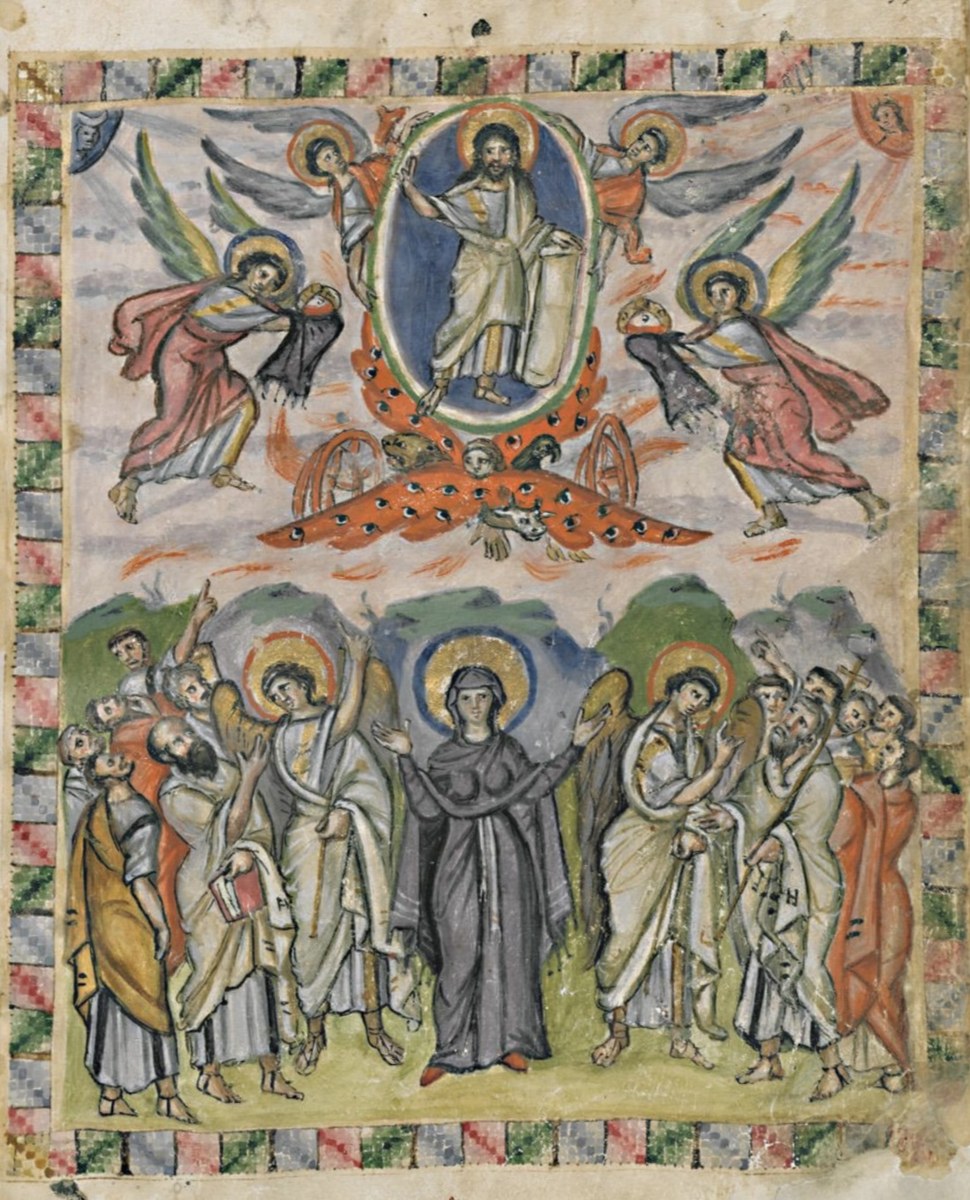
Ascension of the Lord
The Ascension of our Lord, God, and Saviour Jesus Christ
Ascensiontide, day 1 · 39 days since Pascha
Ascension of the Lord

Saints commemorated
-
Apostle Andronicus of the Seventy
-
Holy Martyr Solochon (298)
Solochon, Pamphamer and Pamphalon were Egyptian soldiers of a Roman legion moved to Chalcedon on the Asian shore opposite Byzantium, put to death there about the year 298 in the persecution of Maximian and Diocletian. Ordered by their tribune, Campanus, to sacrifice to the idols with the rest of the unit, the three refused; Pamphamer and Pamphalon died under the tortures, and Solochon, who survived them, was hung by one hand with a weight fastened to his leg and had a writing-stylus driven through his ear. Carried half-dead to the house of a Christian widow, he strengthened the faithful who gathered to him, prayed, and gave up his spirit. Their memory is kept on May 17.
-
Adrian of Ondrusov
Adrian of Ondrusov (†1549/1550) was, in the world, Andrei Zavalishin, a landowner of the Olonets country north-east of Lake Ladoga who, hunting a stag through the forest, came upon the hermitage of Alexander of Svir and was converted by the meeting. He supplied the hermit with bread for years, was tonsured at last on Valaam, and about 1520 founded on a peninsula of Lake Ladoga the hermitage of Saint Nicholas at Ondrusov, of which he became igumen; there he is said to have won over the brigands of the lake, one of whose chiefs gave the place its name. Called to Moscow to stand godfather at the baptism of a daughter of Ivan the Terrible, he was seized on the road home by peasants who believed he carried money, and killed, his body hidden in a marsh. Two years later, by his own appearing to his monks, the body was found incorrupt and brought back to the monastery. The finding is kept on May 17 and the burial on August 26.
-
Andronicus and Junia
Andronicus and Junia are the two Christians of the first generation whom the Apostle Paul greets at Romans 16:7 as "my kinsmen and my fellow-prisoners, who are of note among the apostles, who also were in Christ before me" — the only persons in the New Testament of whom that last phrase is said. The Byzantine tradition numbers Andronicus among the Seventy and makes him bishop of Pannonia, and honours Junia with him as his synergos, his fellow-labourer in the Gospel; both are remembered as having suffered for Christ. Their relics, hidden in the persecutions and long anonymous, were brought to light outside Constantinople at the Gate of Eugenius, and identified there by revelation. They are kept on May 17, and again on February 22 with the finding of those relics, and Andronicus a third time on July 30 with his fellow-apostles of the Seventy.
-
Dodo of Gareji
Dodo (†c. 623) was the first and closest disciple of David of Gareji, one of the Thirteen Syrian Fathers who established monasticism in the Georgian lands, and the founder of the second of the great cave-monasteries of the Gareji wilderness — the house called Dodo's Rqa, "Dodo's ridge," cut into the cliff-face across the ravine from David's own lavra. A nobleman of Kartli who gave away his inheritance to follow David into the semi-desert of Kakheti, he became there the father of a large community of hermits living in caves hewn from the soft rock, and reposed in extreme old age about the year 623. His relics lie at Dodo's Rqa. The Georgian Church keeps him with his teacher in the week after the Ascension; the Slavic and American calendars fix his commemoration on May 17.
-
Euphrosyne of Moscow
Eudokia Dmitrievna (c. 1353 – 1407), daughter of the grand prince of Suzdal and Nizhny Novgorod, was the wife of Dmitri Donskoy, the victor of Kulikovo, and after his early death the guide of her sons and of the principality of Moscow through eighteen dangerous years. Beneath the dress of a grand princess she wore iron chains and kept a hidden ascetic discipline, and she spent her wealth on churches: the stone church of the Nativity of the Theotokos in the Kremlin, raised in memory of Kulikovo, and above all the Ascension Convent within the Kremlin walls, which she founded and which became for five centuries the burial place of the women of the Muscovite house. When her children were grown she took the monastic habit there, on 17 May 1407, with the name Euphrosyne — "gladness" — and reposed seven weeks later, on 7 July, at the age of fifty-four. Her commemoration on May 17 is the feast of that tonsure.
-
Nectarius and Theophanes of Meteora
Theophanes and Nectarius, brothers of the noble Epirot family of the Apsarades of Ioannina, are the founders of the Monastery of Varlaam at Meteora, the second in size and honour of the rock-monasteries of Thessaly. Coming to the pillars of Meteora in the second decade of the sixteenth century, they took possession in October 1517 of a rock that had lain deserted for nearly two centuries since the death of the hermit Varlaam who first scaled it, restored his ruined chapel of the Three Hierarchs, and then spent twenty-two years hauling stone, brick and timber up the cliff-face in order to build, in a little over twenty days, the great church of All Saints that still stands. They ruled the community they had gathered in a strict coenobitic discipline and left a written foundation-account of their work. Theophanes reposed on 17 May 1544 and Nectarius in 1550; their relics are kept at Varlaam, and the Church commemorates the two brothers together on the day of Theophanes's repose.
-
Nicholas of Sofia
Nicholas the New of Sofia (1510 – 17 May 1555) was a shoemaker of Ottoman Sofia, born at Ioannina in Epirus of Christian parents, whose martyrdom in the middle of the sixteenth century became one of the great causes of the Bulgarian Church under the Turkish yoke. Made drunk by Muslim acquaintances and circumcised while insensible, he was thereafter claimed as a convert to Islam; he answered publicly that he had never left Christ and never would, was beaten, imprisoned and tried, and on 17 May 1555 was stoned to death by the mob outside the city at the place called the Three Wells, his body afterwards burned. His Life and Praise were written within a few years by Matthew the Grammarian of Sofia, and a diocesan council under the metropolitan James numbered him among the saints. He is one of the martyrs by whom the city of Sofia is chiefly known in the Orthodox calendar.
-
Stephen I of Constantinople
Stephen (c. 867 – 893) was the youngest son of the emperor Basil I the Macedonian and the brother of the emperor Leo VI the Wise, ordained to the diaconate by the great patriarch Photius and raised by his brother to the throne of Constantinople in 886, at little more than nineteen years of age, when Photius withdrew from it. He held the patriarchate for seven years and reposed in peace in 893, not yet thirty, and was buried in the monastery of the Sikelia. The Church remembers him not for any act of government — his youth and his short tenure left him little scope for one, and the Photian quarrel he inherited outlasted him — but for what his contemporaries thought worth recording of him: his abstinence, his mildness, his readiness to intercede for those in trouble, and his personal care for widows and orphans. He is one of the few Byzantine patriarchs canonised who were also born in the purple.
British Isles and Ireland
- St. Madern, hermit in Cornwall (545)
- St. Cathan, bishop of Bute (6th C)
- St. Mailduf, abbot of Malmesbury (673)
Troparia & kontakia
Apolytikion — Tone 4
Thou wast taken up in glory, O Christ our God, and didst gladden thy disciples with the promise of the Holy Spirit; and by the blessing they were made certain that thou art the Son of God, the Redeemer of the world.
Apolytikion — Tone 8
Thou didst forsake thy lands and thy hunting to follow a poor hermit in the forest, and thou becamest a shepherd of monks on the shore of the great lake, and a friend of thieves for their salvation; and at the last thou wast slain on thy road and hidden in the marsh, until thou didst thyself reveal thy body incorrupt. O venerable father and martyr Adrian, intercede with Christ God that our souls may be saved.
Apolytikion — Tone 3
Holy apostles Andronicus and Junia, intercede with the merciful God, that he may grant to our souls the forgiveness of transgressions.
Apolytikion — Tone 8
By a flood of tears thou didst make the barren desert fruitful, and thy longing for God brought forth fruit a hundredfold; thou becamest a beacon for the world, shining with miracles: O Dodo our father, intercede with Christ God that our souls may be saved.
Apolytikion — Tone 8
In thee, O mother, the image of God was preserved unimpaired; for taking up the cross thou didst follow Christ, and by thy deeds thou didst teach us to despise the flesh, which passeth away, and to care for the soul, a thing immortal. Wherefore, O venerable Euphrosyne, thy spirit rejoiceth with the angels.
Apolytikion — Tone 8
O God of our fathers, who hast made the desert of the rocks a city of monks: by the prayers of thy venerable ones Theophanes and Nectarius, who with long patience raised on the height a house to the praise of all thy saints, establish us also upon the rock of thy commandments, and save our souls.
Apolytikion — Tone 4
Thy martyr Nicholas, O Lord, in his contest received an incorruptible crown from thee our God; for possessing thy strength, he cast down the tyrants and shattered the feeble insolence of the demons. By his intercessions save our souls.
Apolytikion — Tone 4
Thy martyrs Solochon, Pamphamer and Pamphalon, O Lord, in their contest received incorruptible crowns from thee our God; for possessing thy strength, they cast down the tyrants and shattered the feeble insolence of the demons. By their intercessions save our souls.
Apolytikion — Tone 4
O God of our fathers, who always dealest with us according to thy gentleness: take not thy mercy from us, but by the intercessions of thy hierarch Stephen, direct our life in peace.
Exapostilarion — Tone 2 (sung three times)
Before the eyes of thy disciples thou wast taken up, O Christ, to be enthroned together with the Father; and the angels running on before thee cried aloud: Lift up the gates, lift them up, for the King has gone up to the glory that is the source of light.
Kontakion — Tone 6
Having fulfilled the dispensation for our sake, and united the things of earth with the things of heaven, thou wast taken up in glory, O Christ our God, in no way parted from us, but remaining inseparable and crying to those who love thee: I am with you, and no one is against you. Leaving on earth the things of earth, and yielding the ashes to the dust, come, let us wake and lift up our eyes and our thoughts on high; let us mortals send our sight and our senses together flying toward the gates of heaven; let us reckon that we are on the Mount of Olives and are gazing upon the Redeemer as he is borne upon a cloud.
Kontakion — Tone 2
Kinsmen of Paul and sharers of his bonds, who were in Christ before him and laboured with him in the Gospel: Andronicus, adornment of the hierarchs, and Junia, of note among the apostles — intercede unceasingly for those who honour your memory.
Kontakion — Tone 2
They stole thy body's mark by craft, but they could not steal thy confession; for with a free tongue thou didst cry, "I am a Christian and I have not denied," and beneath the stones thou wast crowned, O Nicholas, boast of the city of Sofia.
Kontakion — Tone 2
Soldiers of the earthly king, ye were found soldiers of the King of heaven, and ye would not be defiled with the blood of the sacrifices; wherefore, having borne the stones, the weight and the piercing, ye were crowned as three athletes of Christ, O Solochon, Pamphamer and Pamphalon.
The
O Lord, having in thy goodness fulfilled the mystery hidden from the ages and from the generations, thou didst come with thy disciples to the Mount of Olives, having with thee her who bore thee, the Maker and Fashioner of all things; for she who as a mother grieved above all others in thy Passion had also to enjoy the surpassing joy of the glorifying of thy flesh — in which we too, sharing it, glorify at thine ascent into the heavens, O Master, thy great mercy that has come upon us.
Readings
Vespers
Isaiah 2.2-3
2And it shall come to pass in the last days, that the mountain of the LORD’s house shall be established in the top of the mountains, and shall be exalted above the hills; and all nations shall flow unto it. 3And many people shall go and say, Come ye, and let us go up to the mountain of the LORD, to the house of the God of Jacob; and he will teach us of his ways, and we will walk in his paths: for out of Zion shall go forth the law, and the word of the LORD from Jerusalem.
Composite 21 - Isaiah 62.10-63.3, 7-9
1Thus says the Lord: Walk, go through my gates; prepare my way and make a way for my people, and cast the stones out of the way; raise up a standard for the nations. For see, the Lord has made it heard to the ends of the earth: Say to the daughter of Sion: See, your Saviour has come, and his reward is with him, and his work before his face. And he will call it a holy people, redeemed by the Lord; while you will be called a city sought after, and not forsaken. Who is this who comes from Edom, the scarlet of his garments from Bosor, thus beautiful in his apparel? He cries out with much strength. I reason of justice and judgement of salvation. Why are your garments red, and your clothing as from a trodden winepress? I am full of the trodden grape; I have trampled the winepress quite alone, and no man from the nations was with me. I have remembered the mercy of the Lord, I will recall the Lord’s virtues, the Lord’s praise for all the things with which He rewards us. The Lord is a good judge for the house of Israel; he deals with us according to his mercy and according to the multitude of his justice. And he said: Are you not my people? Children will surely not be rebellious; and he became for them salvation out of their every distress. It was not an emissary, not an Angel, but the Lord himself saved them because he loved them and spared them. He redeemed them and took them up and exalted them all the days of the age.
Composite 22 - Zechariah 14.1, 4, 8-11
1Thus says the Lord: See, the day of the Lord is coming, and on that day his feet will stand upon the mount of Olives, opposite Jerusalem, where the sun rises. And on that day living water will come out from Jerusalem, half towards the first sea and half towards the last sea; in spring and in summer it shall be so; and the Lord will be for a King over all the earth; in that day there shall be one Lord, and his name, compassing all the earth and the wilderness from Gabaa as far as Remmon, south of Jerusalem; and he shall be exalted and remain on his place from the gate of Benjamin as far as the place of the first gate, as far as the gate of Gomor and as far as the tower of Anameël and as far as the tower of the corners and as far as the king’s winepresses; they shall dwell in it and there shall be no more curse and Jerusalem shall dwell confidently.
Matins Gospel
Mark 16.9-20
9Now when Jesus was risen early the first day of the week, he appeared first to Mary Magdalene, out of whom he had cast seven devils. 10And she went and told them that had been with him, as they mourned and wept. 11And they, when they had heard that he was alive, and had been seen of her, believed not. 12After that he appeared in another form unto two of them, as they walked, and went into the country. 13And they went and told it unto the residue: neither believed they them. 14Afterward he appeared unto the eleven as they sat at meat, and upbraided them with their unbelief and hardness of heart, because they believed not them which had seen him after he was risen. 15And he said unto them, Go ye into all the world, and preach the gospel to every creature. 16He that believeth and is baptized shall be saved; but he that believeth not shall be damned. 17And these signs shall follow them that believe; In my name shall they cast out devils; they shall speak with new tongues; 18They shall take up serpents; and if they drink any deadly thing, it shall not hurt them; they shall lay hands on the sick, and they shall recover. 19So then after the Lord had spoken unto them, he was received up into heaven, and sat on the right hand of God. 20And they went forth, and preached every where, the Lord working with them, and confirming the word with signs following. Amen.
Epistle
Acts 1.1-12
1The former treatise have I made, O Theophilus, of all that Jesus began both to do and teach, 2Until the day in which he was taken up, after that he through the Holy Ghost had given commandments unto the apostles whom he had chosen: 3To whom also he shewed himself alive after his passion by many infallible proofs, being seen of them forty days, and speaking of the things pertaining to the kingdom of God: 4And, being assembled together with them, commanded them that they should not depart from Jerusalem, but wait for the promise of the Father, which, saith he, ye have heard of me. 5For John truly baptized with water; but ye shall be baptized with the Holy Ghost not many days hence. 6When they therefore were come together, they asked of him, saying, Lord, wilt thou at this time restore again the kingdom to Israel? 7And he said unto them, It is not for you to know the times or the seasons, which the Father hath put in his own power. 8But ye shall receive power, after that the Holy Ghost is come upon you: and ye shall be witnesses unto me both in Jerusalem, and in all Judæa, and in Samaria, and unto the uttermost part of the earth. 9And when he had spoken these things, while they beheld, he was taken up; and a cloud received him out of their sight. 10And while they looked stedfastly toward heaven as he went up, behold, two men stood by them in white apparel; 11Which also said, Ye men of Galilee, why stand ye gazing up into heaven? this same Jesus, which is taken up from you into heaven, shall so come in like manner as ye have seen him go into heaven. 12Then returned they unto Jerusalem from the mount called Olivet, which is from Jerusalem a sabbath day’s journey.
Gospel
Luke 24.36-53
36And as they thus spake, Jesus himself stood in the midst of them, and saith unto them, Peace be unto you. 37But they were terrified and affrighted, and supposed that they had seen a spirit. 38And he said unto them, Why are ye troubled? and why do thoughts arise in your hearts? 39Behold my hands and my feet, that it is I myself: handle me, and see; for a spirit hath not flesh and bones, as ye see me have. 40And when he had thus spoken, he shewed them his hands and his feet. 41And while they yet believed not for joy, and wondered, he said unto them, Have ye here any meat? 42And they gave him a piece of a broiled fish, and of an honeycomb. 43And he took it, and did eat before them. 44And he said unto them, These are the words which I spake unto you, while I was yet with you, that all things must be fulfilled, which were written in the law of Moses, and in the prophets, and in the psalms, concerning me. 45Then opened he their understanding, that they might understand the scriptures, 46And said unto them, Thus it is written, and thus it behoved Christ to suffer, and to rise from the dead the third day: 47And that repentance and remission of sins should be preached in his name among all nations, beginning at Jerusalem. 48And ye are witnesses of these things. 49And, behold, I send the promise of my Father upon you: but tarry ye in the city of Jerusalem, until ye be endued with power from on high. 50And he led them out as far as to Bethany, and he lifted up his hands, and blessed them. 51And it came to pass, while he blessed them, he was parted from them, and carried up into heaven. 52And they worshipped him, and returned to Jerusalem with great joy: 53And were continually in the temple, praising and blessing God. Amen.