
Thursday 6 June 2030
Ascension of the Lord
The Ascension of our Lord, God, and Saviour Jesus Christ
Ascensiontide, day 1 · 39 days since Pascha
Ascension of the Lord

Saints commemorated
-
Ven. Bessarion the Wonderworker of Egypt
Bessarion the Great (died c. 466) was one of the great desert fathers of fifth-century Egypt, a wonderworker of Scetis and disciple, the tradition holds, of Anthony the Great and of Macarius the Great. He is known above all from the Apophthegmata Patrum, the Sayings of the Desert Fathers, where a chapter of his sayings and a memoir by his disciple Doulas preserve both his teaching and his miracles: how on a waterless shore he prayed and the salt sea grew sweet to drink; how, to reach an elder before nightfall, he prayed and the sun stood still in its course; how he crossed a river dry-shod. He owned nothing and stayed nowhere, passing his life homeless "like a bird," sleeping in the open among the rocks and thorns, so poised in unceasing prayer and self-denial that his brethren likened him to the bodiless powers. He reposed in extreme old age. The day of his memory is not agreed: the Greek Menaion keeps him on February 20, the Slavonic books and the OCA on June 6, where he heads the day together with Hilarion the New of Dalmatia.
-
St Hilarion the New, abbot of the Dalmatian Monastery (845)
Hilarion, surnamed "the New" because he took the ancient Hilarion the Great for his model, was abbot of the monastery of the Dalmatians — the oldest monastery of Constantinople — through the whole of the second Iconoclasm, and one of the sternest confessors of the holy icons. Born in Cappadocia about 775, tonsured at twelve, he was drawn from his cell to govern Dalmatou at the urging of the Patriarch Nikephoros, ruled it eight years in peace, and then for a quarter of a century was imprisoned, starved, flogged and exiled in turn by Leo V the Armenian and Theophilos for refusing to sign against the images. Freed by the Empress Theodora at the Triumph of Orthodoxy in 843, he returned to his monastery and reposed there in 845, in his seventieth year.
-
Our Holy Mothers the Martyrs Archelaïs, Thekla and Susanna (293)
Archelais, Thecla and Susanna were three consecrated virgins of a small monastery near Rome who, when the persecution of Diocletian (284–305) reached the city, cut off their hair, put on men's clothing and fled south into Campania. There they lived hidden in a solitary place in fasting and prayer, and there God gave them the gift of healing, by which they cured the country people and brought many pagans to Christ. Denounced to the governor of the province, they were taken to Salerno and commanded to sacrifice. Archelais answered for the three, exposing the folly of worshipping lifeless statues; lions loosed upon her lay down at her feet; she was torn with iron and burnt with pitch, and a great stone meant to crush her fell instead upon the executioners. At the last the soldiers, who hesitated to strike, were urged on by the virgins themselves, and the three were beheaded in 293.
-
Anoub the Sign-bearer
Anoub, called σημειοφόρος, "the sign-bearer" — the Greek epithet for one through whom God works signs — is one of the desert fathers of Egypt whose sayings are gathered in the Apophthegmata Patrum, the Lausiac History and the Evergetinos. St Nikodemos the Hagiorite, summarising his notice, lists seven marks of his attainment: that from the day he first named the name of Christ no lie ever came out of his mouth; that in the deep desert he ate only what an angel brought him; that he desired nothing in the world but God alone; that God made known to him what was done on earth; that his one occupation night and day was the enjoyment of God; that whatever he asked of God was given him; and that he was taken up in ecstasy and saw the choirs of the saints singing before God, and Satan delivered to the eternal fire. Three days after that vision he departed, and those present heard angels singing as his soul was received.
-
Attalus the Wonderworker
Attalus is a wonderworking ascetic commemorated by the Greek synaxaria on June 6, known only from the synaxarion notice for that day. It describes a monk consumed with the desire to know God's law exactly and to keep it exactly: he ate once in two days, grudged himself sleep as a kind of death, and yet was of so gentle a heart that the birds came to him unafraid each morning and joined their voices to his in the praise of the Creator. God gave him the working of miracles, and he healed sicknesses of body and of soul. Forewarned of his end, he asked the brethren to embrace him while he yet lived, and so departed in the light. Neither his country nor his century is transmitted.
-
Five Virgins of Caesarea
Five women of Caesarea in Palestine — Martha, Mary, Cyria, Valeria and Marcia — were catechised by a devout Christian, baptised, and thereafter lived together in retirement, passing their lives in fasting, vigil and prayer for the strengthening of the Christian faith throughout the world. They were denounced to the governor; when they refused to sacrifice to the idols they were severely tortured, and each in turn gave up her life to Christ. Their names, their city and the manner of their end are all that the synaxarion transmits; neither the year nor the name of the governor is given.
-
Gelasius the Martyr
Gelasius is a martyr of one of the general persecutions, commemorated on June 6 and known from the synaxarion notice alone. Before he suffered himself he served those who were suffering: he gave away everything he owned to the poor, put on a long white garment, and went among the imprisoned and tortured Christians, kissing their wounds and strengthening them to endure. That white robe made him conspicuous, and he was arrested. Brought before the magistrate, he confessed Christ openly and denounced the emptiness of the idols; the judge at first treated him with contempt, then had him flogged and finally beheaded. Neither his country, his judge, nor the year of his martyrdom is transmitted.
-
Gerasimus, Pitirim and Jonah of Perm
Gerasimus, Pitirim and Jonah were three successive bishops of Great Perm, seated at Ust-Vym on the Vychegda, who in the fifteenth century carried forward the mission begun by Stephen of Perm among the Zyrians (Komi) and the pagan tribes of the far north-east of Russia. Gerasimus (†c. 1441) and Pitirim (†1455) were both martyred — the one strangled by a heathen of his own household, the other killed in a raid of the pagan Voguls (Mansi) — while Jonah (†1470) completed the conversion of Great Perm on the upper Kama and reposed in peace. Venerated together as the wonderworking hierarchs of Perm, their relics rest in the cathedral of Ust-Vym, and they are commemorated as a company on January 29.
-
Gudwal of Brittany
Gudwal — Gurval in Breton, Gudwall in the older English books — was a Welshman of noble family, ordained early and made bishop, who in the seventh century led a great company of monks (the tradition says 188) out of Britain across the sea to found monasteries on the coasts and islands of the Channel. He is remembered as a founder and abbot rather than as a diocesan bishop, in the manner of the Celtic hierarchs of his century, and his houses are placed variously in Cornwall or Devon, in Brittany, and at Cormont in Picardy. He reposed about 650; his body was carried to Montreuil, and in the middle of the tenth century his relics were translated to the abbey of Blandinium (Blandinberg) at Ghent, whence his cultus spread through Flanders and, by way of the relics kept there, to Worcester in England. He is commemorated on June 6.
-
Jonah of Klimetzk
Jonah of Klimetzk, in the world John, of the Novgorod merchant family of the Klementievs, was caught by a storm on Lake Onega in 1490 while travelling on his trade, and in the extremity cried out to the Lord to spare his life that he might repent and serve God. The boat was driven to safety on a sandbar of the island the Russians call Klimetsky, and there — the tradition says he found a holy icon in a juniper bush, and received the assurance that he should build on that spot — he fulfilled his vow. He was tonsured, and raised the Klimetzk monastery of the Holy Trinity, with a second church of St Nicholas, the patron of sailors and travellers. He refused the abbacy and lived out his life as a simple monk, and reposed on June 6, 1534. A church of the Righteous Zachariah and Elizabeth was built over his relics.
-
Paisius of Uglich
Paisius of Uglich (c. 1397 – 1504) was the founder and first abbot of the Protection (Pokrov) Monastery near Uglich on the Volga, and a wonderworker of the Russian north. Orphaned as a boy, he entered the monastery of his uncle, Saint Macarius of Kalyazin, at the age of eleven, and was formed there in obedience, fasting, and prayer, labouring at the copying of sacred books. At the wish of the Prince of Uglich, Andrew, he founded in 1464 the cenobitic Protection Monastery a few versts from the city, and served as its abbot; he founded a second monastery in 1489. He lived to a great age and reposed on June 6, 1504; his relics, glorified by miracles, rest in the monastery he built. He is commemorated on January 8, within the afterfeast of the Theophany, and on June 6, the day of his repose.
-
Photius the Monk
Photius — printed in the Greek books also as Φώτας, Photas — is a venerable monastic commemorated on June 6, of whom the service-books preserve, quite literally, one line: ὁ Ὅσιος Φώτας ἀπεβίωσεν εἰρηνικῶς, "the venerable Photas reposed in peace." Beyond that sentence and the commemorative distich which plays on his name — phōs, light, and its illumination — nothing is transmitted: no country, no century, no monastery, no act. He is entered here because his commemoration is genuine and consistently printed for the day, and because the honest record of such a saint is a line and not a page.
British Isles and Ireland
- St. Eigrad of Anglesey (6th C)
- St. Cocca
- St. Gudwall (6th C)
- St. Jarlath, bishop of Tuam (c.550)
Troparia & kontakia
Apolytikion — Tone 4
Thou wast taken up in glory, O Christ our God, and didst gladden thy disciples with the promise of the Holy Spirit; and by the blessing they were made certain that thou art the Son of God, the Redeemer of the world.
Apolytikion — Tone 8 (common of a venerable father)
By the streams of thy tears thou didst make the barren desert to bear fruit, and by thy sighings from the depths thou didst bring thy labours to hundredfold increase; and thou wast made a beacon to the world, shining with miracles, O Anoub our father: intercede with Christ God that our souls may be saved.
Apolytikion — Tone 4 (common of women martyrs)
Thy lambs, O Jesus, cry aloud with a great voice: We long for Thee, O our Bridegroom, and in seeking Thee we suffer; we are crucified and buried with Thee in Thy baptism, and we suffer for Thy sake that we may reign with Thee; accept us as spotless sacrifices offered unto Thee in love. At the prayers of Archelais, Thecla and Susanna, O merciful One, save our souls.
Apolytikion — Tone 8 (common of a venerable wonderworker)
By the streams of thy tears thou didst make the barren desert to bear fruit, and by thy sighings from the depths thou didst bring thy labours to hundredfold increase; and thou wast made a beacon to the world, shining with miracles, O Attalus our father: intercede with Christ God that our souls may be saved.
Apolytikion — Tone 4 (common of women martyrs)
Thy lambs, O Jesus, cry aloud with a great voice: We long for Thee, O our Bridegroom, and in seeking Thee we suffer; we are crucified and buried with Thee in Thy baptism, and we suffer for Thy sake that we may reign with Thee; accept us as spotless sacrifices offered unto Thee in love. At the prayers of Martha, Mary, Cyria, Valeria and Marcia, O merciful One, save our souls.
Apolytikion — Tone 4 (common of a martyr)
Thy martyr Gelasius, O Lord, in his contest received an incorruptible crown from Thee, our God; for possessing Thy strength, he cast down the tyrants and shattered the feeble insolence of the demons. By his intercessions save our souls.
Apolytikion — Tone 8 (common of a venerable hierarch and founder)
Thou didst leave thy country and thy kindred for the love of Christ, and didst lead thy company over the sea as Israel through the wilderness, planting monasteries on barbarous shores, O hierarch Gudwal; and though thy bones were carried far from the place of thy labours, thy prayer abides with the churches thou didst found: intercede with Christ God that our souls may be saved.
Apolytikion — Tone 8 (common of a venerable father)
By the streams of thy tears thou didst make the barren desert to bear fruit, and by thy sighings from the depths thou didst bring thy labours to hundredfold increase; and thou wast made a beacon to the world, shining with miracles, O Hilarion our father: intercede with Christ God that our souls may be saved.
Apolytikion — Tone 8 (common of a venerable father)
By the streams of thy tears thou didst make the barren desert to bear fruit, and by thy sighings from the depths thou didst bring thy labours to hundredfold increase; and thou wast made a beacon to the world, shining with miracles, O Photius our father: intercede with Christ God that our souls may be saved.
Exapostilarion — Tone 2 (sung three times)
Before the eyes of thy disciples thou wast taken up, O Christ, to be enthroned together with the Father; and the angels running on before thee cried aloud: Lift up the gates, lift them up, for the King has gone up to the glory that is the source of light.
Kontakion — Tone 6
Having fulfilled the dispensation for our sake, and united the things of earth with the things of heaven, thou wast taken up in glory, O Christ our God, in no way parted from us, but remaining inseparable and crying to those who love thee: I am with you, and no one is against you. Leaving on earth the things of earth, and yielding the ashes to the dust, come, let us wake and lift up our eyes and our thoughts on high; let us mortals send our sight and our senses together flying toward the gates of heaven; let us reckon that we are on the Mount of Olives and are gazing upon the Redeemer as he is borne upon a cloud.
Kontakion — Tone 2
Fleeing the city in the garb of men, ye were found women in the arena, O three virgins; the lions fell at your feet and the stone turned upon your slayers, and ye yourselves besought the sword that ye might not be robbed of the crown: pray for us who honour your martyrdom at Salerno.
Kontakion — Tone 2
Thou didst shepherd the ancient flock of the Dalmatians and wast proved gold in the furnace of prison and of exile; unshaken before emperors, thou didst honour the venerable image of Christ, and didst return in gladness to thy fold, O father Hilarion, boast of confessors.
The
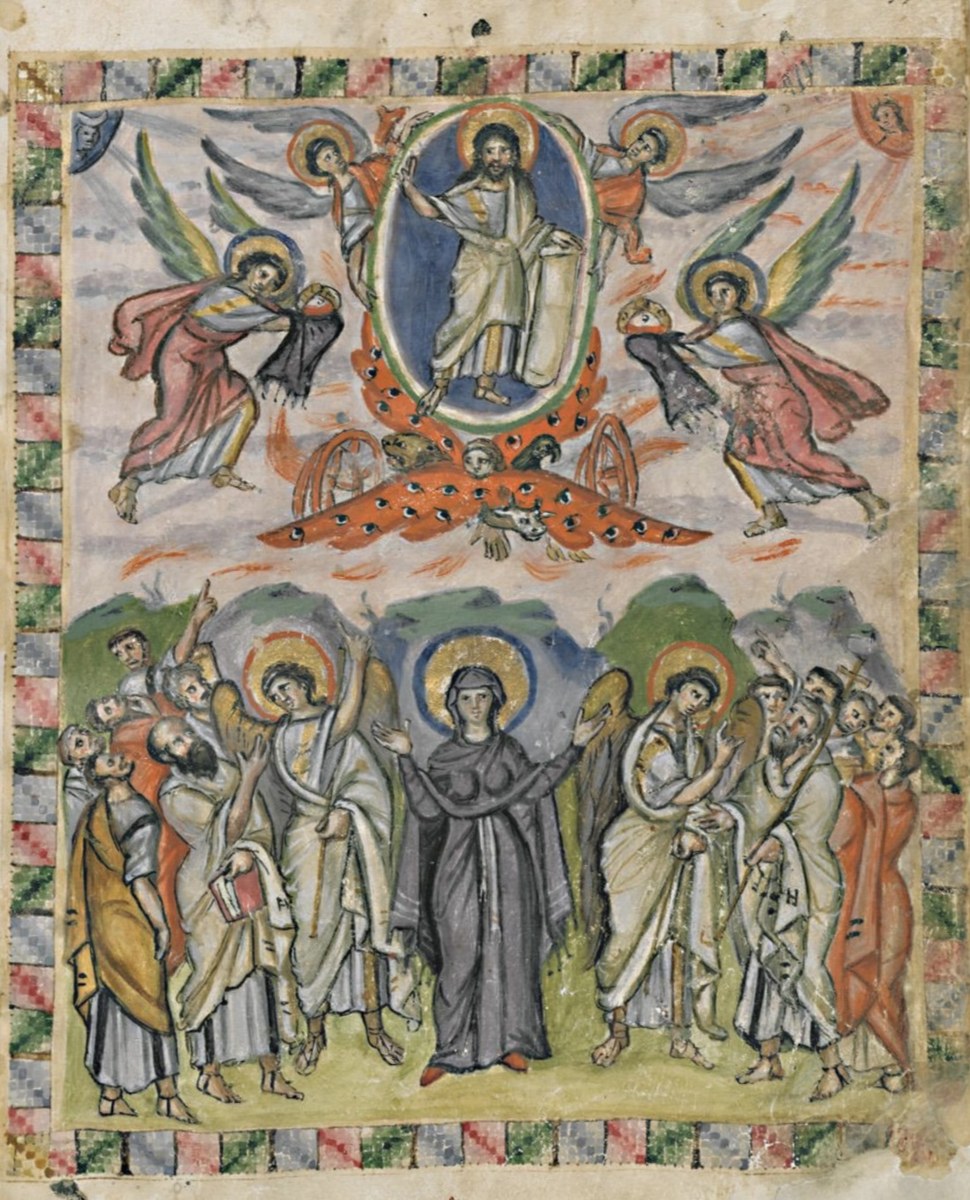
O Lord, having in thy goodness fulfilled the mystery hidden from the ages and from the generations, thou didst come with thy disciples to the Mount of Olives, having with thee her who bore thee, the Maker and Fashioner of all things; for she who as a mother grieved above all others in thy Passion had also to enjoy the surpassing joy of the glorifying of thy flesh — in which we too, sharing it, glorify at thine ascent into the heavens, O Master, thy great mercy that has come upon us.
Troparion — Tone 8
In thee, O Father, that which is according to the image was preserved with exactness; for taking up thy cross thou didst follow Christ, and by thy deeds thou didst teach us to despise the flesh, for it passeth away, but to care for the soul, a thing immortal. Therefore doth thy spirit, O venerable Bessarion, rejoice together with the angels.
Troparion — Tone 4 (from the common of hierarchs)
O God of our fathers, who ever dealest with us according to thy gentleness, take not thy mercy from us, but by the prayers of thy holy hierarchs Gerasimus, Pitirim and Jonah, govern our life in peace.
Troparion — Tone 4 (common of a venerable founder)
Thou didst call upon the Lord out of the deep waters and He heard thee, and thou didst pay Him thy vow with the labour of thy hands: for on the island of thy deliverance thou didst raise a house to the Holy Trinity and a temple to Nicholas the guide of voyagers, and being father of many thou wouldest be least of all, O venerable Jonah. Intercede with Christ God that our souls may be saved.
Troparion — Tone 4
Having lived on earth as a citizen of heaven, O Father Paisius, thou wast a teacher of the monastic life and an unshaken pillar of thy flock; by fasting, vigil, and prayer thou didst receive the gifts of the Spirit, to heal the sick and to guide the faithful. Wherefore we honour thy holy repose; intercede with Christ our God that our souls may be saved.
Readings
Vespers
Isaiah 2.2-3
2And it shall come to pass in the last days, that the mountain of the LORD’s house shall be established in the top of the mountains, and shall be exalted above the hills; and all nations shall flow unto it. 3And many people shall go and say, Come ye, and let us go up to the mountain of the LORD, to the house of the God of Jacob; and he will teach us of his ways, and we will walk in his paths: for out of Zion shall go forth the law, and the word of the LORD from Jerusalem.
Composite 21 - Isaiah 62.10-63.3, 7-9
1Thus says the Lord: Walk, go through my gates; prepare my way and make a way for my people, and cast the stones out of the way; raise up a standard for the nations. For see, the Lord has made it heard to the ends of the earth: Say to the daughter of Sion: See, your Saviour has come, and his reward is with him, and his work before his face. And he will call it a holy people, redeemed by the Lord; while you will be called a city sought after, and not forsaken. Who is this who comes from Edom, the scarlet of his garments from Bosor, thus beautiful in his apparel? He cries out with much strength. I reason of justice and judgement of salvation. Why are your garments red, and your clothing as from a trodden winepress? I am full of the trodden grape; I have trampled the winepress quite alone, and no man from the nations was with me. I have remembered the mercy of the Lord, I will recall the Lord’s virtues, the Lord’s praise for all the things with which He rewards us. The Lord is a good judge for the house of Israel; he deals with us according to his mercy and according to the multitude of his justice. And he said: Are you not my people? Children will surely not be rebellious; and he became for them salvation out of their every distress. It was not an emissary, not an Angel, but the Lord himself saved them because he loved them and spared them. He redeemed them and took them up and exalted them all the days of the age.
Composite 22 - Zechariah 14.1, 4, 8-11
1Thus says the Lord: See, the day of the Lord is coming, and on that day his feet will stand upon the mount of Olives, opposite Jerusalem, where the sun rises. And on that day living water will come out from Jerusalem, half towards the first sea and half towards the last sea; in spring and in summer it shall be so; and the Lord will be for a King over all the earth; in that day there shall be one Lord, and his name, compassing all the earth and the wilderness from Gabaa as far as Remmon, south of Jerusalem; and he shall be exalted and remain on his place from the gate of Benjamin as far as the place of the first gate, as far as the gate of Gomor and as far as the tower of Anameël and as far as the tower of the corners and as far as the king’s winepresses; they shall dwell in it and there shall be no more curse and Jerusalem shall dwell confidently.
Matins Gospel
Mark 16.9-20
9Now when Jesus was risen early the first day of the week, he appeared first to Mary Magdalene, out of whom he had cast seven devils. 10And she went and told them that had been with him, as they mourned and wept. 11And they, when they had heard that he was alive, and had been seen of her, believed not. 12After that he appeared in another form unto two of them, as they walked, and went into the country. 13And they went and told it unto the residue: neither believed they them. 14Afterward he appeared unto the eleven as they sat at meat, and upbraided them with their unbelief and hardness of heart, because they believed not them which had seen him after he was risen. 15And he said unto them, Go ye into all the world, and preach the gospel to every creature. 16He that believeth and is baptized shall be saved; but he that believeth not shall be damned. 17And these signs shall follow them that believe; In my name shall they cast out devils; they shall speak with new tongues; 18They shall take up serpents; and if they drink any deadly thing, it shall not hurt them; they shall lay hands on the sick, and they shall recover. 19So then after the Lord had spoken unto them, he was received up into heaven, and sat on the right hand of God. 20And they went forth, and preached every where, the Lord working with them, and confirming the word with signs following. Amen.
Epistle
Acts 1.1-12
1The former treatise have I made, O Theophilus, of all that Jesus began both to do and teach, 2Until the day in which he was taken up, after that he through the Holy Ghost had given commandments unto the apostles whom he had chosen: 3To whom also he shewed himself alive after his passion by many infallible proofs, being seen of them forty days, and speaking of the things pertaining to the kingdom of God: 4And, being assembled together with them, commanded them that they should not depart from Jerusalem, but wait for the promise of the Father, which, saith he, ye have heard of me. 5For John truly baptized with water; but ye shall be baptized with the Holy Ghost not many days hence. 6When they therefore were come together, they asked of him, saying, Lord, wilt thou at this time restore again the kingdom to Israel? 7And he said unto them, It is not for you to know the times or the seasons, which the Father hath put in his own power. 8But ye shall receive power, after that the Holy Ghost is come upon you: and ye shall be witnesses unto me both in Jerusalem, and in all Judæa, and in Samaria, and unto the uttermost part of the earth. 9And when he had spoken these things, while they beheld, he was taken up; and a cloud received him out of their sight. 10And while they looked stedfastly toward heaven as he went up, behold, two men stood by them in white apparel; 11Which also said, Ye men of Galilee, why stand ye gazing up into heaven? this same Jesus, which is taken up from you into heaven, shall so come in like manner as ye have seen him go into heaven. 12Then returned they unto Jerusalem from the mount called Olivet, which is from Jerusalem a sabbath day’s journey.
Gospel
Luke 24.36-53
36And as they thus spake, Jesus himself stood in the midst of them, and saith unto them, Peace be unto you. 37But they were terrified and affrighted, and supposed that they had seen a spirit. 38And he said unto them, Why are ye troubled? and why do thoughts arise in your hearts? 39Behold my hands and my feet, that it is I myself: handle me, and see; for a spirit hath not flesh and bones, as ye see me have. 40And when he had thus spoken, he shewed them his hands and his feet. 41And while they yet believed not for joy, and wondered, he said unto them, Have ye here any meat? 42And they gave him a piece of a broiled fish, and of an honeycomb. 43And he took it, and did eat before them. 44And he said unto them, These are the words which I spake unto you, while I was yet with you, that all things must be fulfilled, which were written in the law of Moses, and in the prophets, and in the psalms, concerning me. 45Then opened he their understanding, that they might understand the scriptures, 46And said unto them, Thus it is written, and thus it behoved Christ to suffer, and to rise from the dead the third day: 47And that repentance and remission of sins should be preached in his name among all nations, beginning at Jerusalem. 48And ye are witnesses of these things. 49And, behold, I send the promise of my Father upon you: but tarry ye in the city of Jerusalem, until ye be endued with power from on high. 50And he led them out as far as to Bethany, and he lifted up his hands, and blessed them. 51And it came to pass, while he blessed them, he was parted from them, and carried up into heaven. 52And they worshipped him, and returned to Jerusalem with great joy: 53And were continually in the temple, praising and blessing God. Amen.