
Pentecost week, day 2 · 50 days since Pascha
Day of the Holy Spirit
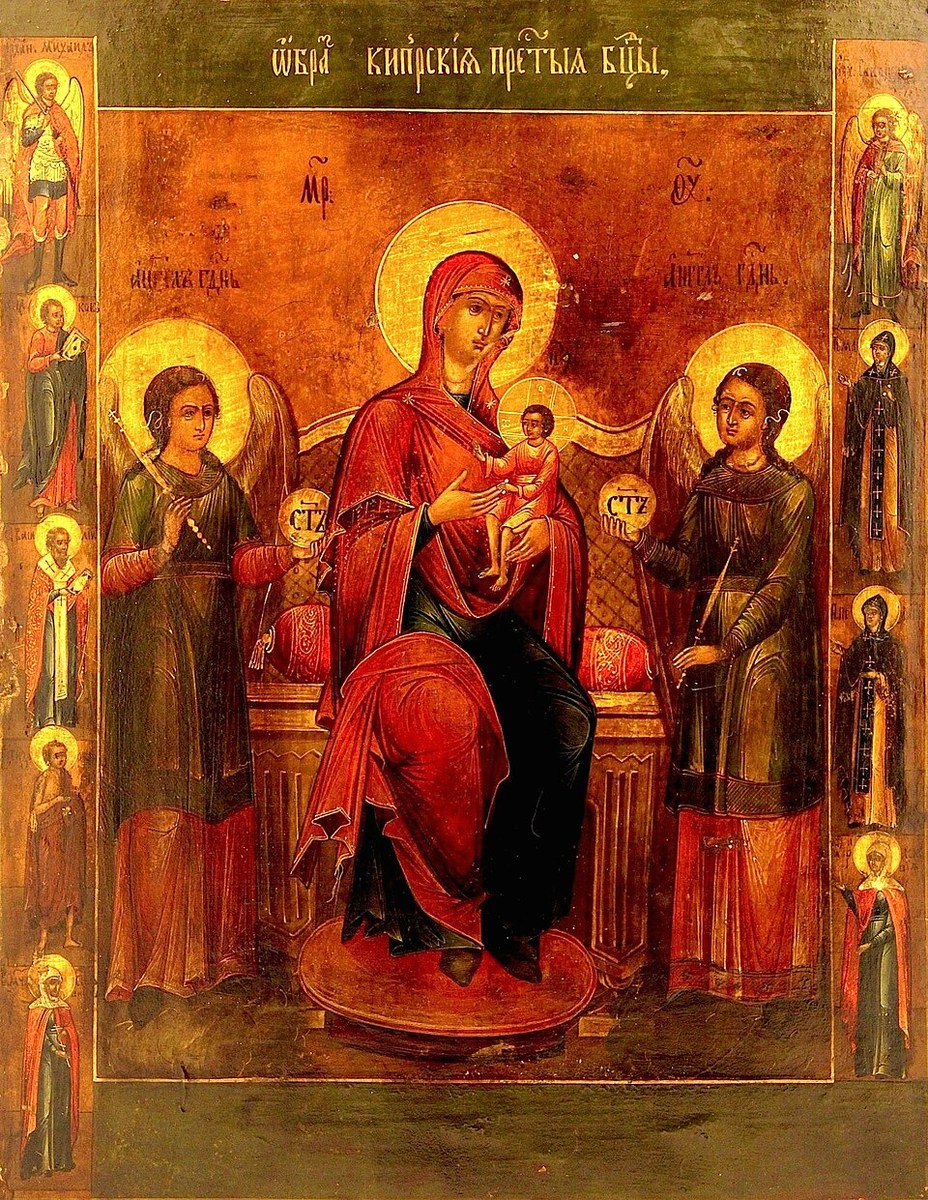
About Cyprus Icon of the Mother of God →

Saints commemorated
-
St Nicephorus the Confessor
Nicephorus the Confessor (c. 758 – 828) was Patriarch of Constantinople from 806 to 815 and, after Tarasius, the second of the great iconodule patriarchs to lead the Church. Born of a confessing family — his father had suffered exile for the holy icons — he served as imperial secretary, took part in the Seventh Ecumenical Council as a lay commissioner, and was raised from the lay state to the patriarchal throne. When the emperor Leo V the Armenian revived iconoclasm, Nicephorus resisted to his own ruin: refusing to surrender the images, he was deposed in 815 and exiled across the Bosphorus, where for thirteen years he wrote the great refutations of the heresy — and where, with his Breviarium and chronological tables, he left works of history besides. He reposed in exile in 828. After the Triumph of Orthodoxy (843), the Empress Theodora and Patriarch Methodius brought his relics home to the capital on 13 March 846, incorrupt, and laid them among the patriarchs in the Church of the Holy Apostles. He is kept on June 2 (repose) and March 13 (the translation of his relics).
-
Holy New Martyr Constantine (1819)
Constantine (†2 June 1819) was born a Muslim in the village of Ypsilometopo on Lesbos, and was healed in his blindness as a boy by the holy water of the Christians. Working afterwards as a greengrocer in Smyrna, he came to love the worship of the Church, and made his way to Mount Athos, where he was catechised at the Skete of Kavsokalyvia and baptised by the exiled Ecumenical Patriarch Gregory V, receiving the name Constantine. Not content to be saved alone, he went back among his own people to bring his brothers and sisters to Christ; he was recognised, denounced, tortured with a red-hot iron cap, and sent to Constantinople, where — having invited his judge to become a Christian — he was hanged on 2 June 1819. He is one of the last of the New Martyrs of the Ottoman yoke, and one of the small and precious company of them who came to Christ out of Islam.
-
Hieromartyr Erazmo of Ochrid (303)
-
Erasmus of Formia
Erasmus (†c. 303), bishop of Formia in Campania, is one of the most widely venerated and least securely documented of the martyrs of the great persecution. The tradition the Orthodox calendars have received makes him a bishop who fled the persecution to Mount Lebanon and lived there seven years in hiding; who was brought at an angel's bidding out of concealment, seized, and tried before Diocletian and afterwards before Maximian; who was scourged, smeared with pitch and set alight, shut in a spiked cask and rolled downhill, and each time preserved; who converted great multitudes — the Slavic and Greek notices say twenty thousand — by his endurance; and who at length was brought to Formia and reposed there. In the West he became Saint Elmo, patron of sailors, and one of the Fourteen Holy Helpers; the Orthodox books keep him on May 4, and the OCA styles him confessor rather than martyr, since the tradition has him die of his sufferings rather than by the sword.
-
John the New of Suceava
John the New (c. 1300 – c. 1330/1332) was a Greek merchant of Trebizond who was tortured to death at Cetatea Albă — the Asprokastron of the Greeks, the Akkerman of the Turks, the Belgorod of the Slavs, at the mouth of the Dniester — for refusing to abandon Christ for the religion of its Tatar governor. Denounced out of commercial envy by the Western shipmaster who had carried him there, he was beaten with rods until his flesh came away, dragged through the streets tied to a wild horse, and beheaded in the open street; and the pillar of light that stood over his body that night is the first of the wonders reported of him. Some seventy years later Alexander the Good, Voivode of Moldavia, brought his relics to Suceava, where they remain — and where they made a foreign merchant-martyr into the heavenly patron of Moldavia and of Bukovina, "the protector of all the Moldavian land." He is honoured on June 2 for his martyrdom and, in Romanian usage, on June 24 for the bringing of his relics.
-
Juliana of Vyazma
Juliana (†21 December 1406) was the wife of Prince Simeon Mstislavich of Vyazma, and died at Torzhok defending her marriage and her chastity against Yuri Svyatoslavich, the dispossessed Prince of Smolensk. Sheltering in the same town as his exiled kinsmen, Yuri conceived a passion for her; when she refused him he killed her husband at table and turned on her, and when she wounded him with a knife he cut off her hands and feet with his sword and had her body thrown into the frozen Tvertsa. In the spring her body was found — the tradition says floating against the current — and was buried at the Transfiguration Cathedral of Torzhok, where healings were reported at her tomb through four centuries until the Church uncovered her relics and glorified her on 2 June 1819. She is honoured among the Wonderworkers of Novy Torg and is one of the Russian Church's patrons of the sanctity of marriage.
-
Pothinus, Blandina and the Martyrs of Lyons
In the year 177, in the reign of Marcus Aurelius, the Christians of Lugdunum (Lyons) and Vienne in Gaul were seized by the mob and the magistrates and destroyed in the amphitheatre at the annual provincial games. Their bishop, the aged Pothinus — a Greek of Asia, and by tradition a hearer of Polycarp — was beaten and died in prison; the slave-girl Blandina, whose own mistress had feared she would prove too weak to confess, outlasted every torturer in the city and was killed last of all; and with them suffered Sanctus the deacon of Vienne, Maturus the newly baptised, Attalus of Pergamum, Alexander the Phrygian physician, Biblis who denied and then recovered her confession, the boy Ponticus, the nobleman Vettius Epagathus and the ascetic Alcibiades. Their bodies were burnt and the ashes swept into the Rhône. The letter in which the surviving Christians of Vienne and Lyons told the story to the churches of Asia — preserved by Eusebius — is one of the greatest documents of the early Church, and the company is kept on June 2 in East and West alike.
British Isles and Ireland
- St. Odo the Good, 22nd archbishop of Canterbury (959)
- St. Adalgis (c.686)
- St. Bodfan (7th C)
Troparia & kontakia
Kontakion — Tone 6
Enthroned thou art shown in thine image, O Queen, with the angels standing about thee and the Word upon thine arm; the impious arrow drew blood from thee and the wound became a wonder, and to this day thou dost cleanse the eyes of them that look on thee. Wherefore we cry: hail, O thou refuge of the islands and of the Russian land.
Kontakion — Tone 2
Neither fire nor pitch nor the iron teeth of the cask could turn thee from the confession, O hierarch Erasmus, but by thy patience thou didst draw a countless people to Christ; wherefore the sea and them that sail upon it cry out to thee: deliver us, O father, from the tempest.
Kontakion — Tone 4
The Church of Moldavia keepeth thee as her crown and her defence, O great martyr John: for thy blood, poured out in a stranger's city, hath watered our land, and thy relics, borne home in glory, pour forth healing upon all that draw near. Wherefore we cry unto thee: rejoice, O boast of Trebizond and guardian of Suceava.
Kontakion — Tone 1
O initiate of heaven's mysteries and unshaken herald of Orthodoxy, thou didst shine upon the Church as her radiant star, and for the icon of Christ didst gladly bear thine exile; and now thy sacred relics, returning in glory to thy city, pour forth sanctification on them that cry: Rejoice, O Father Nicephorus, boast of the faithful.
Kontakion — Tone 2
They were cast into the fire and their dust into the waters, that no memorial might remain of them; but their names are written in heaven and read in every church, and the letter of their brethren proclaims them still. Wherefore we honour the martyrs of Lyons, the boast of the West and the harvest of the East.
Troparion — Tone 4 (common of an icon of the Mother of God)
Today the faithful keep radiant festival, overshadowed by thy coming, O Mother of God; and looking upon thy most pure image we cry with compunction: shelter us beneath the precious veil of thy protection, and deliver us from every evil, entreating thy Son, Christ our God, to save our souls.
Troparion — Tone 4
Out of the darkness of Hagar's tents thou wast called into the marvellous light of Christ, and having washed thine eyes and thy soul in the water of grace, thou wouldst not be saved alone, O Constantine, but wentest back to thy kindred bearing the Gospel. Wherefore, when the tyrant bade thee deny, thou didst summon him to be baptised, and receivedst the noose as a crown: intercede with Christ God that our souls may be saved.
Troparion — Tone 4 (from the common of a hieromartyr)
As a sharer in the ways and a successor to the thrones of the Apostles, O divinely-inspired one, thou didst find in contemplation the means to ascend to divine heights; rightly dividing the word of truth, thou didst struggle for the faith even unto blood, O hieromartyr Erasmus: intercede with Christ God that our souls may be saved.
Troparion — Tone 4
Thou didst trade for the pearl of great price, O martyr John, and having found it thou didst gladly sell all that thou hadst: for setting at nought the threats of the tyrant and the fire he bade thee worship, thou didst confess the Light that no darkness overtakes, and wast beaten and dragged and beheaded for His name. Wherefore Christ hath given thee to Suceava as a treasure that fadeth not: intercede with Him, O athlete of the Lord, that our souls may be saved.
Troparion — Tone 4
Thou didst love thy husband and thy God more than thine own life, O right-believing Juliana, and wouldst not yield thy purity to a prince's violence; wherefore, mutilated by the sword and cast into the waters, thou wast borne up by God against the stream, and thy grave at Novy Torg became a fountain of healings. O passion-bearer, guard the marriages of the faithful, and pray that our souls may be saved.
Troparion — Tone 3
Thou didst bear in very deed the victory thy name foretells, O all-blessed Nicephorus: a teacher of the Orthodox faith, a defender of the sacred images, and a pillar unshaken of the Church of Christ. For the honour of the icon of the Lord thou didst endure deposition and long exile; wherefore, crowned as a confessor, intercede that our souls may be saved.
Troparion — Tone 4
The Church of Gaul, planted by the hands of Asia, brought forth a first harvest of martyrs: an aged bishop beaten in prison, a deacon burned with plates of brass, a boy and a slave-woman who wearied out their tormentors. O Photinus and Blandina and all the athletes of Lugdunum, whose ashes the river bore away and whose crowns no river can quench, intercede with Christ God that our souls may be saved.
Readings
Epistle
Ephesians 5.8-19
8For ye were sometimes darkness, but now are ye light in the Lord: walk as children of light: 9(For the fruit of the Spirit is in all goodness and righteousness and truth;) 10Proving what is acceptable unto the Lord. 11And have no fellowship with the unfruitful works of darkness, but rather reprove them. 12For it is a shame even to speak of those things which are done of them in secret. 13But all things that are reproved are made manifest by the light: for whatsoever doth make manifest is light. 14Wherefore he saith, Awake thou that sleepest, and arise from the dead, and Christ shall give thee light. 15See then that ye walk circumspectly, not as fools, but as wise, 16Redeeming the time, because the days are evil. 17Wherefore be ye not unwise, but understanding what the will of the Lord is. 18And be not drunk with wine, wherein is excess; but be filled with the Spirit; 19Speaking to yourselves in psalms and hymns and spiritual songs, singing and making melody in your heart to the Lord;
Gospel
Matthew 18.10-20
10Take heed that ye despise not one of these little ones; for I say unto you, That in heaven their angels do always behold the face of my Father which is in heaven. 11For the Son of man is come to save that which was lost. 12How think ye? if a man have an hundred sheep, and one of them be gone astray, doth he not leave the ninety and nine, and goeth into the mountains, and seeketh that which is gone astray? 13And if so be that he find it, verily I say unto you, he rejoiceth more of that sheep, than of the ninety and nine which went not astray. 14Even so it is not the will of your Father which is in heaven, that one of these little ones should perish. 15Moreover if thy brother shall trespass against thee, go and tell him his fault between thee and him alone: if he shall hear thee, thou hast gained thy brother. 16But if he will not hear thee, then take with thee one or two more, that in the mouth of two or three witnesses every word may be established. 17And if he shall neglect to hear them, tell it unto the church: but if he neglect to hear the church, let him be unto thee as an heathen man and a publican. 18Verily I say unto you, Whatsoever ye shall bind on earth shall be bound in heaven: and whatsoever ye shall loose on earth shall be loosed in heaven. 19Again I say unto you, That if two of you shall agree on earth as touching any thing that they shall ask, it shall be done for them of my Father which is in heaven. 20For where two or three are gathered together in my name, there am I in the midst of them.