
Pentecost week, day 1 · 49 days since Pascha
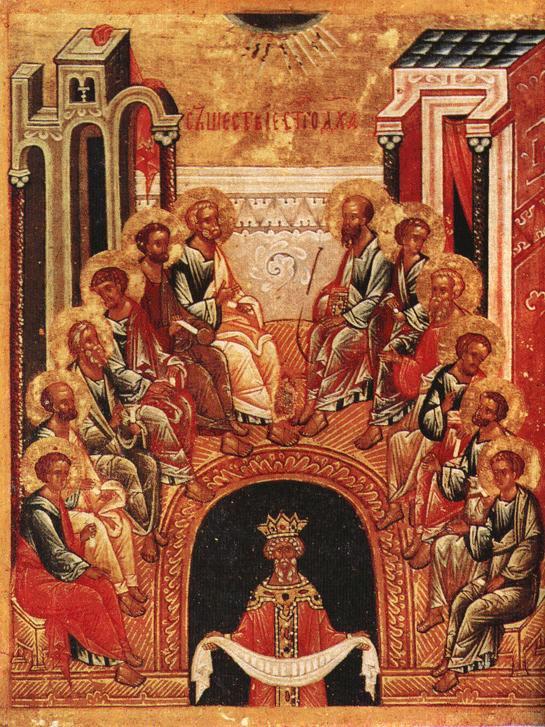
Holy Pentecost
About Nicaea Icon of the Mother of God → · About Pentecost →

Saints commemorated
-
St Nicetas, Bishop of Chalcedon
Nicetas, bishop of Chalcedon on the Asian shore opposite Constantinople, was one of the hierarchs who lost their sees for the holy icons in the second period of Byzantine Iconoclasm, under the emperor Leo V the Armenian (813–820). The synaxarial notice remembers him twice over: for a bishop's charity — he kept an open house for travellers, maintained the poor, took the part of orphans and widows, and made himself the advocate of anyone who had been wronged — and for the plainness with which he told his flock that the images of Christ, of His Mother and of the saints were to be venerated, when the emperor had forbidden it. He was tortured and sent into exile, where he reposed early in the ninth century; healings were reported at his relics. He is one of a crowded family of holy Nicetases and is frequently confused with them.
-
St Ignaty, Bishop of Rostov
Ignatius (†1288) was bishop of Rostov for twenty-six years, in the second and third generations of the Mongol yoke, and is one of the very few Russian saints whose veneration began at his own funeral. A monk of Rostov who rose through the city's Epiphany monastery to be its archimandrite, he was consecrated bishop in 1262 and spent his episcopate holding together a principality that the Horde and its own princes were pulling apart: he reconciled the feuding brothers Dmitry and Konstantin Borisovich, went himself to the Golden Horde on the Church's business, sat at the reforming council of Vladimir in 1274, and once — notoriously — passed sentence on a dead prince by removing his body from the cathedral. He reposed on 28 May 1288, and at his burial, in the sight of the people, his hand was seen to rise from the bier to take the prayer of absolution; he was never lowered into the ground but laid openly in the Dormition cathedral of Rostov, where his relics have rested ever since. He is one of the three founding hierarchs of Rostov, with Leontius and Isaiah.
-
St Nicetas the Confessor, bishop of Chalcedon (9th c.)
-
Eutychius of Melitene
Eutychius is remembered in a single line of the synaxarion: a co-worker of the holy apostles who was bishop of Melitene in Armenia Minor and who suffered for Christ there in the first century. Nothing further about him has been transmitted — no passion, no account of his preaching, no name of a persecutor, not even a manner of death. The Church keeps him on May 28 as a hieromartyr of the apostolic generation, and the whole of what can honestly be said about him is that the memory of a bishop-martyr of Melitene from the very first age of the Church was preserved at Constantinople and passed into the Menaion under that description.
-
Germanus of Paris
Germanus (c. 496–576) was bishop of Paris for the last twenty years of his life and the most respected churchman in the Frankish kingdoms of his generation: a Burgundian of Gallo-Roman family, abbot of St Symphorian at Autun before his elevation, and thereafter a hierarch who spent his episcopate trying to restrain the Merovingian kings from murdering one another and their subjects. He fed and ransomed the poor on a scale that emptied his own house, presided at the councils of Paris and Tours, went so far as to excommunicate a reigning king for his marriages, and was appealed to by St Radegund for protection against her husband. The great abbey he founded beside the Seine, dedicated to the Holy Cross and St Vincent, took his own name after his burial in it and is known to this day as Saint-Germain-des-Prés. He is one of the pre-schism fathers of the West received into Orthodox commemoration, and is kept on May 28 in both the Greek Great Synaxaristes and the OCA calendar.
-
Heliconis of Thessalonica
Heliconis was a Christian woman of Thessalonica who, in the middle of the third century, went of her own accord to Corinth during a persecution and preached openly in the city against the worship of idols. Arrested and brought before the governor, she endured a long and inventive series of torments — the furnace, the flaying of her scalp, the burning of her head and breasts — and then, feigning consent to sacrifice, had herself led in procession to the temple, where she was left alone and broke every idol in it. Beaten and imprisoned, she was healed in the night by a vision of Christ with the Archangels Michael and Gabriel; thrown to three lions, she was not touched by them; and at last she was beheaded, in the year given by the tradition as 244. She is one of the boldest of the women martyrs of the Greek synaxarion, and among the very few whose passion is built around a deliberate, premeditated destruction of a pagan sanctuary.
-
Helladius the Hieromartyr
Helladius is remembered in the books as a bishop "in the East" — that is, somewhere in the vast Roman Diocese of Oriens, the territory of the Antiochene patriarchate — who was thrown into a fire for his faith in Christ and came out of it unhurt, and who died afterwards of the beating inflicted on him. His service adds one further detail, and it is the one his commemoration is really built on: that the Lord Jesus Christ came to him in his prison and healed his wounds. Neither his see nor the name of his persecutor has been transmitted, and the sources are divided over his century, some placing him among the Christians who suffered in the Persian invasions of the Roman East, others four centuries later. He is a saint of whom the Church has kept the substance — a bishop, a fire, a scourging, a visitation — and lost every circumstance.
-
Sophronius the Bulgarian
Sophronius — Stephen before his tonsure — was a Bulgarian hieromonk of the turn of the fifteenth and sixteenth centuries, from the village of Penkovtsi in the Sofia region, who served in the monastery of Penkovo near Sofia until word came that the Ottoman troops were about to fall on it. He fled north across the Danube into Wallachia, settled in a monastery on the river, and gave the rest of his life to fasting, vigil and prayer in the monastic community of Rusensk — a house associated in the tradition with St Joachim, Patriarch of Trnovo. He was known for almsgiving and for care of the poor, and reposed on 28 May 1510; some accounts say he was murdered by a servant, and that his relics were found incorrupt three years afterwards. He belongs to the small company of Bulgarian monastic saints of the first Ottoman century, whose lives were lived out largely in exile north of the Danube.
-
William of Gellone
William (c. 755–812) was a Frankish count and duke of Toulouse, a kinsman of Charlemagne and one of the commanders who held the Pyrenean frontier of Christendom against the emirate of Córdoba — he was in the field at the disaster on the Orbieu in 793 and at the capture of Barcelona in 801 — who then laid down his arms, founded the monastery of Gellone in the wild gorge of the Hérault in 804, enriched it with a relic of the True Cross given him by the emperor, and in 806 entered it himself as a simple monk. He died there on 28 May 812 and was formally canonised at Rome in 1066; the abbey and the village that grew around it are called Saint-Guilhem-le-Désert to this day. He is among the pre-schism saints of the West received into Orthodox commemoration, and he is the historical seed of an enormous cycle of medieval French epic, the Geste de Guillaume d'Orange, which buried the real man under a legendary one.
Troparia & kontakia
Apolytikion — Tone 8
Blessed art thou, O Christ our God, who hast shown forth the fishermen as all-wise, sending down upon them the Holy Spirit, and through them taking the whole world in thy net. O Lover of mankind, glory to thee.
Apolytikion — Tone 4 (common of a hieromartyr)
As a sharer in the ways and a successor to the thrones of the Apostles, thou didst find in action the means to ascend to divine contemplation, O divinely-inspired one; wherefore, rightly dividing the word of truth, thou didst also contend for the faith even unto blood, O hieromartyr Eutychius: intercede with Christ God that our souls may be saved.
Apolytikion — Tone 4 (common of a hierarch)
O holy hierarch Germanus, shepherd of the Church of Paris, thou didst feed the poor with thine own bread and ransom the captive with thine own goods, and thou didst rebuke kings without fear of their swords: intercede with Christ God that peace be given to the nations and great mercy to our souls.
Apolytikion — Tone 4 (common of a woman martyr)
Thy lamb Heliconis, O Jesus, cries out with a great voice: Thee, my Bridegroom, do I love, and seeking Thee I contend; I am crucified with Thee and buried in Thy baptism; I suffer for Thy sake, that I may reign with Thee; I die for Thee, that I may live in Thee. Accept me as a spotless offering, sacrificed to Thee in love. By her intercessions, as Thou art merciful, save our souls.
Apolytikion — Tone 4 (common of a hieromartyr)
As a sharer in the ways and a successor to the thrones of the Apostles, thou didst find in action the means to ascend to divine contemplation, O divinely-inspired one; wherefore, rightly dividing the word of truth, thou didst also contend for the faith even unto blood, O hieromartyr Helladius: intercede with Christ God that our souls may be saved.
Apolytikion — Tone 4
O God of our fathers, who dealest with us ever according to Thy gentleness: take not away Thy mercy from us, but by the prayers of Thy holy confessor Nicetas guide our lives in peace.
Apolytikion — Tone 8 (common of a venerable father)
Driven from thy monastery by the sword of the ungodly, thou didst carry the monastic rule across the river and there didst labour the more in fasting and in vigil, giving to the poor what thine own hands had earned. O venerable father Sophronius, glory of the Bulgarian land, intercede with Christ God that our souls may be saved.
Apolytikion — Tone 8 (common of a venerable father)
Having guarded the borders of the Christian people with the sword, thou didst lay the sword aside for the Cross, O William, and didst enter the desert of Gellone as the least of the brethren; and where thou hadst commanded armies thou didst learn to obey. O venerable father, intercede with Christ God that our souls may be saved.
Kontakion — Tone 8
When the Most High came down and confounded the tongues, he divided the nations; when he distributed the tongues of fire, he called all men into unity; and with one accord we glorify the all-holy Spirit.
Kontakion — Tone 2
Entering alone among the idols of Corinth, thou didst break them all in pieces, O bride of Christ; and the fire did not burn thee, and the lions lay down before thee. Wherefore, O Heliconis, healed in prison by the hands of thy Bridegroom and crowned by the sword, pray for those who honour thee.
Kontakion — Tone 8
Rostov rejoices in thee, O father, holding thy relics unburied as a treasure and a fountain of healings; for the earth did not receive thee whom the heavens had already glorified. Wherefore we cry to thee: rejoice, O wonderworker Ignatius, boast of the hierarchs of the Russian land.
Kontakion — Tone 2
The star of Chalcedon, the herald of the venerable image of Christ, the father of orphans and the shelter of strangers, let us praise with hymns: for having endured the tyrant's chastisement and exile, Nicetas the confessor now intercedes unceasingly for our souls.
Megalynarion — Tone 7
O Mother who hast not known man, Virgin Theotokos, who didst conceive without experience of corruption and didst lend flesh to the all-fashioning Word; vessel of him whom nothing can contain, place of thine own uncircumscribed Maker: thee do we magnify.
Oikos
Give swift and steadfast consolation to thy servants, O Jesus, when our spirits grow listless. Be not parted from our souls in afflictions, be not far from our minds in adversities, but come to us always before we call. Draw near to us, draw near, thou who art everywhere; and as thou wast ever with thine apostles, so unite thyself to those who long for thee, O compassionate one, that being joined to thee we may hymn and glorify thine all-holy Spirit.
Theotokion
Thy womb has become a holy table, holding the heavenly Bread, Christ; of which whoever eats does not die, as the Nourisher of all has said, O Theotokos.
Troparion — Tone 4 (common of an icon of the Theotokos)
O Lady, we thy servants have thine icon as a rampart and a shield, and by it we are delivered from every affliction; for thou dost swiftly avenge the honour of thy image and swiftly hear those who honour it. Wherefore we cry to thee: O Mother of God, save thy people.
Troparion — Tone 4
Enlightened from thy youth by the grace of God, thou wast shown to be a shepherd of the flock of Rostov, and a peacemaker among warring princes; and after thy repose thou didst stretch out thy hand to receive the word of forgiveness, and didst bless thy city from on high. O holy hierarch Ignatius, pray to Christ God that our souls may be saved.
Readings
Vespers
Numbers 11.16-17, 24-29
16And the LORD said unto Moses, Gather unto me seventy men of the elders of Israel, whom thou knowest to be the elders of the people, and officers over them; and bring them unto the tabernacle of the congregation, that they may stand there with thee. 17And I will come down and talk with thee there: and I will take of the spirit which is upon thee, and will put it upon them; and they shall bear the burden of the people with thee, that thou bear it not thyself alone. 24And Moses went out, and told the people the words of the LORD, and gathered the seventy men of the elders of the people, and set them round about the tabernacle. 25And the LORD came down in a cloud, and spake unto him, and took of the spirit that was upon him, and gave it unto the seventy elders: and it came to pass, that, when the spirit rested upon them, they prophesied, and did not cease. 26But there remained two of the men in the camp, the name of the one was Eldad, and the name of the other Medad: and the spirit rested upon them; and they were of them that were written, but went not out unto the tabernacle: and they prophesied in the camp. 27And there ran a young man, and told Moses, and said, Eldad and Medad do prophesy in the camp. 28And Joshua the son of Nun, the servant of Moses, one of his young men, answered and said, My lord Moses, forbid them. 29And Moses said unto him, Enviest thou for my sake? would God that all the LORD’s people were prophets, and that the LORD would put his spirit upon them!
Joel 2.23-32
23Be glad then, ye children of Zion, and rejoice in the LORD your God: for he hath given you the former rain moderately, and he will cause to come down for you the rain, the former rain, and the latter rain in the first month. 24And the floors shall be full of wheat, and the fats shall overflow with wine and oil. 25And I will restore to you the years that the locust hath eaten, the cankerworm, and the caterpiller, and the palmerworm, my great army which I sent among you. 26And ye shall eat in plenty, and be satisfied, and praise the name of the LORD your God, that hath dealt wondrously with you: and my people shall never be ashamed. 27And ye shall know that I am in the midst of Israel, and that I am the LORD your God, and none else: and my people shall never be ashamed. 28And it shall come to pass afterward, that I will pour out my spirit upon all flesh; and your sons and your daughters shall prophesy, your old men shall dream dreams, your young men shall see visions: 29And also upon the servants and upon the handmaids in those days will I pour out my spirit. 30And I will shew wonders in the heavens and in the earth, blood, and fire, and pillars of smoke. 31The sun shall be turned into darkness, and the moon into blood, before the great and the terrible day of the LORD come. 32And it shall come to pass, that whosoever shall call on the name of the LORD shall be delivered: for in mount Zion and in Jerusalem shall be deliverance, as the LORD hath said, and in the remnant whom the LORD shall call.
Ezekiel 36.24-28
24For I will take you from among the heathen, and gather you out of all countries, and will bring you into your own land. 25Then will I sprinkle clean water upon you, and ye shall be clean: from all your filthiness, and from all your idols, will I cleanse you. 26A new heart also will I give you, and a new spirit will I put within you: and I will take away the stony heart out of your flesh, and I will give you an heart of flesh. 27And I will put my spirit within you, and cause you to walk in my statutes, and ye shall keep my judgments, and do them. 28And ye shall dwell in the land that I gave to your fathers; and ye shall be my people, and I will be your God.
Matins Gospel
John 20.19-23
19Then the same day at evening, being the first day of the week, when the doors were shut where the disciples were assembled for fear of the Jews, came Jesus and stood in the midst, and saith unto them, Peace be unto you. 20And when he had so said, he shewed unto them his hands and his side. Then were the disciples glad, when they saw the Lord. 21Then said Jesus to them again, Peace be unto you: as my Father hath sent me, even so send I you. 22And when he had said this, he breathed on them, and saith unto them, Receive ye the Holy Ghost: 23Whose soever sins ye remit, they are remitted unto them; and whose soever sins ye retain, they are retained.
Epistle
Acts 2.1-11
1And when the day of Pentecost was fully come, they were all with one accord in one place. 2And suddenly there came a sound from heaven as of a rushing mighty wind, and it filled all the house where they were sitting. 3And there appeared unto them cloven tongues like as of fire, and it sat upon each of them. 4And they were all filled with the Holy Ghost, and began to speak with other tongues, as the Spirit gave them utterance. 5And there were dwelling at Jerusalem Jews, devout men, out of every nation under heaven. 6Now when this was noised abroad, the multitude came together, and were confounded, because that every man heard them speak in his own language. 7And they were all amazed and marvelled, saying one to another, Behold, are not all these which speak Galilæans? 8And how hear we every man in our own tongue, wherein we were born? 9Parthians, and Medes, and Elamites, and the dwellers in Mesopotamia, and in Judæa, and Cappadocia, in Pontus, and Asia, 10Phrygia, and Pamphylia, in Egypt, and in the parts of Libya about Cyrene, and strangers of Rome, Jews and proselytes, 11Cretes and Arabians, we do hear them speak in our tongues the wonderful works of God.
Gospel
John 7.37-52, 8.12
37In the last day, that great day of the feast, Jesus stood and cried, saying, If any man thirst, let him come unto me, and drink. 38He that believeth on me, as the scripture hath said, out of his belly shall flow rivers of living water. 39(But this spake he of the Spirit, which they that believe on him should receive: for the Holy Ghost was not yet given; because that Jesus was not yet glorified.) 40Many of the people therefore, when they heard this saying, said, Of a truth this is the Prophet. 41Others said, This is the Christ. But some said, Shall Christ come out of Galilee? 42Hath not the scripture said, That Christ cometh of the seed of David, and out of the town of Bethlehem, where David was? 43So there was a division among the people because of him. 44And some of them would have taken him; but no man laid hands on him. 45Then came the officers to the chief priests and Pharisees; and they said unto them, Why have ye not brought him? 46The officers answered, Never man spake like this man. 47Then answered them the Pharisees, Are ye also deceived? 48Have any of the rulers or of the Pharisees believed on him? 49But this people who knoweth not the law are cursed. 50Nicodemus saith unto them, (he that came to Jesus by night, being one of them,) 51Doth our law judge any man, before it hear him, and know what he doeth? 52They answered and said unto him, Art thou also of Galilee? Search, and look: for out of Galilee ariseth no prophet. 12Then spake Jesus again unto them, saying, I am the light of the world: he that followeth me shall not walk in darkness, but shall have the light of life.