
Pentecost week, day 2 · 50 days since Pascha
Day of the Holy Spirit
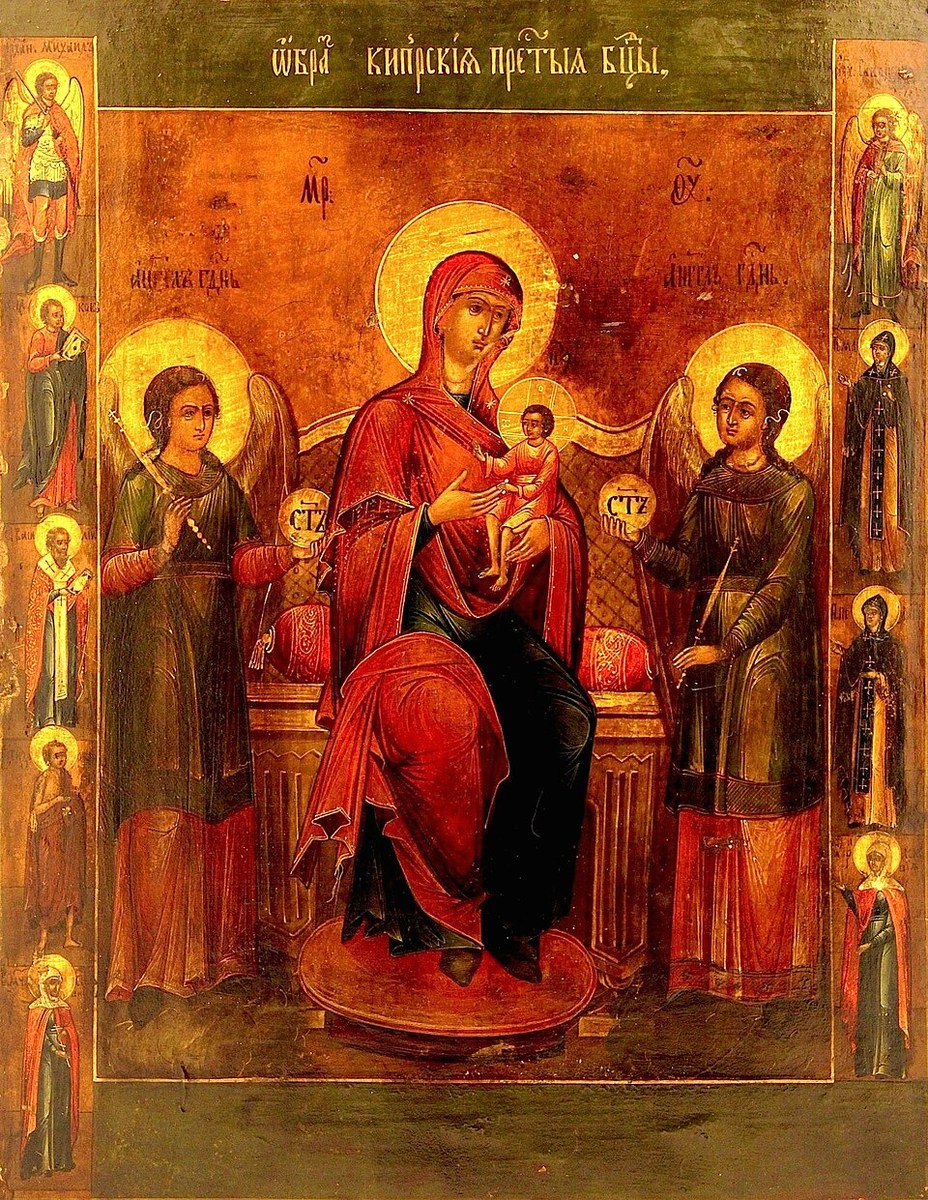
About Cyprus Icon of the Mother of God →

Saints commemorated
-
Virgin Martyr Theodosia of Tyre
Theodosia was a nun of the monastery of the Martyr Anastasia at Constantinople who, when soldiers of the emperor Leo III the Isaurian came to take down the venerated image of Christ that hung above the great bronze Chalke Gate of the imperial palace, ran with other women of the city, shook the ladder until the officer on it fell to his death, and was seized, beaten through a week of imprisonment, dragged to the Forum of the Ox and killed by a ram's horn driven into her throat. She is honoured as the first martyr of the iconoclast persecution — a monastic woman who met the first act of official iconoclasm with her own hands — and her shrine at the church of St Euphemia en to Petrio, afterwards renamed for her, became one of the great healing-shrines of Byzantine Constantinople. She is not Theodosia of Tyre, the maiden martyred in Palestine in 307, with whom the calendars constantly confuse her.
-
Rep. Bl. John of Ustiug
John of Ustyug (†29 May 1494) is the second of the two great fools-for-Christ of Great Ustyug in the Russian north, and one of the purest examples of the type: a young man of peasant stock who fasted from childhood, went barefoot and in rags through the Ustyug winters, slept on dung-heaps, prayed the nights through in a hut beside the city's Dormition cathedral, and bore the mockery of the town as his ascetic labour. He died young, and his tomb by the cathedral at once became a place of healing; the Russian Church honours him as a wonderworker and as an intercessor in the wars and invasions of the northern lands. He is the direct successor in that city of Procopius of Ustyug (†1303), the first Russian holy fool, with whom he is venerated as one of the Ustyug wonderworkers.
-
Commemoration of the First Ecumenical Council (325)
-
The Fall of Constantinople (1453); "Blessed Constantine XII, last of the Byzantine emperors, martyred by the Turks (1453)"
-
Alexander of Alexandria
Alexander, archbishop and pope of Alexandria from 313 until his death, is the hierarch who first identified and condemned the heresy of Arius — a priest of his own city and of his own clergy — and who thereby began the struggle that produced the First Ecumenical Council at Nicaea in 325 and the Creed of the Church. He deposed Arius in synod, circulated encyclical letters that put the whole episcopate on notice, went up to Nicaea as the chief accuser, and left as his successor his deacon and secretary Athanasius the Great, whom he had formed. He reposed within a few years of the Council, and the Church keeps his memory on May 29, close by the commemoration of the Fathers whose work he began.
-
Hypomone the Empress
Hypomone — "Patience" — was the monastic name of Helena Dragaš, the Serbian-born empress of Manuel II Palaiologos, mother of two Byzantine emperors and grandmother of none, who after her husband's death took the veil in the convent of Kyra Martha at Constantinople and lived out her life there as a nun while remaining the moral centre of the imperial house. She bore John VIII and Constantine XI, the last emperor, who took her family name and reigned as Constantine Dragases Palaiologos; she governed as regent in the interval between their reigns; and she held firmly against the union of Florence. She died on 23 March 1450, three years before the City fell, and the Greek Church keeps her memory on May 29 — the day of the fall — so that the mother is commemorated with the son and the end of the empire.
-
Luke of Simferopol
Luke of Simferopol — in the world Valentin Felixovich Voino-Yasenetsky (1877–1961) — was one of the foremost surgeons of the Russian twentieth century and, at the same time, a bishop who spent eleven years in Soviet prisons and exile for refusing to be silent. He pioneered regional anaesthesia, wrote the Essays on the Surgery of Purulent Infections that trained generations of Russian surgeons, operated in a cassock with an icon in the theatre, was tonsured and consecrated in secret in 1923, was arrested three times, ran the military hospitals of Krasnoyarsk as an exile through the Second World War, was given the Stalin Prize in 1946 and gave most of it away, governed the see of Simferopol and Crimea from 1946, went blind in his last years and went on preaching, and died on 29 May (civil 11 June) 1961. His relics were uncovered in 1996 and he is venerated with extraordinary warmth in Russia, Ukraine and above all in Greece, where he is invoked before surgery as the physician-hierarch of the modern world.
-
Martyred Fathers and Mothers of Atchara
The Martyred Fathers and Mothers of Atchara are the Christians — men and women, and by the name of the commemoration chiefly the elderly — of the mountainous Georgian province on the Black Sea coast who, through the long generations of Ottoman rule, were put to death for refusing to renounce Christ and accept Islam. They are venerated as a company rather than as named individuals: the hangings and beheadings were carried out village by village over roughly a century, with the year 1790 transmitted as the culminating persecution, and the bridge over the Atcharistsqali river — the medieval "Bridge of Queen Tamar" — remembered as the chief place of execution. The Georgian Church canonised them collectively, and keeps their memory on May 29.
Readings
Epistle
Ephesians 5.8-19
8For ye were sometimes darkness, but now are ye light in the Lord: walk as children of light: 9(For the fruit of the Spirit is in all goodness and righteousness and truth;) 10Proving what is acceptable unto the Lord. 11And have no fellowship with the unfruitful works of darkness, but rather reprove them. 12For it is a shame even to speak of those things which are done of them in secret. 13But all things that are reproved are made manifest by the light: for whatsoever doth make manifest is light. 14Wherefore he saith, Awake thou that sleepest, and arise from the dead, and Christ shall give thee light. 15See then that ye walk circumspectly, not as fools, but as wise, 16Redeeming the time, because the days are evil. 17Wherefore be ye not unwise, but understanding what the will of the Lord is. 18And be not drunk with wine, wherein is excess; but be filled with the Spirit; 19Speaking to yourselves in psalms and hymns and spiritual songs, singing and making melody in your heart to the Lord;
Gospel
Matthew 18.10-20
10Take heed that ye despise not one of these little ones; for I say unto you, That in heaven their angels do always behold the face of my Father which is in heaven. 11For the Son of man is come to save that which was lost. 12How think ye? if a man have an hundred sheep, and one of them be gone astray, doth he not leave the ninety and nine, and goeth into the mountains, and seeketh that which is gone astray? 13And if so be that he find it, verily I say unto you, he rejoiceth more of that sheep, than of the ninety and nine which went not astray. 14Even so it is not the will of your Father which is in heaven, that one of these little ones should perish. 15Moreover if thy brother shall trespass against thee, go and tell him his fault between thee and him alone: if he shall hear thee, thou hast gained thy brother. 16But if he will not hear thee, then take with thee one or two more, that in the mouth of two or three witnesses every word may be established. 17And if he shall neglect to hear them, tell it unto the church: but if he neglect to hear the church, let him be unto thee as an heathen man and a publican. 18Verily I say unto you, Whatsoever ye shall bind on earth shall be bound in heaven: and whatsoever ye shall loose on earth shall be loosed in heaven. 19Again I say unto you, That if two of you shall agree on earth as touching any thing that they shall ask, it shall be done for them of my Father which is in heaven. 20For where two or three are gathered together in my name, there am I in the midst of them.
Troparia & kontakia
Apolytikion — Tone 4 (common of a hierarch)
The truth of things hath shown thee to thy flock as a rule of faith, an image of meekness and a teacher of temperance; therefore thou hast attained the heights by humility and riches by poverty. O father and hierarch Alexander, intercede with Christ God that our souls may be saved.
Apolytikion — Tone 8 (common of a venerable woman)
In thee, O mother, the image of God was preserved with exactness; for taking up the Cross, thou didst follow Christ, and by thy deeds thou didst teach us to despise the flesh, which passeth away, and to care for the soul, a thing immortal. Wherefore, O venerable Hypomone, thy spirit rejoiceth with the angels.
Apolytikion — Tone 4 (common of a hierarch)
The truth of things hath shown thee to thy flock as a rule of faith, an image of meekness and a teacher of temperance; therefore thou hast attained the heights by humility and riches by poverty. O father and hierarch Luke, intercede with Christ God that our souls may be saved.
Kontakion — Tone 6
Enthroned thou art shown in thine image, O Queen, with the angels standing about thee and the Word upon thine arm; the impious arrow drew blood from thee and the wound became a wonder, and to this day thou dost cleanse the eyes of them that look on thee. Wherefore we cry: hail, O thou refuge of the islands and of the Russian land.
Kontakion — Tone 2
Thou didst discern the wolf in the sheepfold and didst not spare him, O wise hierarch, but didst cast down the blasphemy that made the Word a creature; and having summoned the shepherds of the whole earth to the judgement of the truth, thou didst leave Athanasius as thine heir. O father Alexander, pray for us who honour thee.
Kontakion — Tone 2
Thou wast crowned in the Great Church as empress and didst lay the crown down for the black habit, and thy very name became thy labour; for thou didst endure the ruin of the City's hope, and didst keep the faith undivided when others would have bartered it. O venerable mother Hypomone, teach us thy patience.
Kontakion — Tone 8
From thy childhood thou didst fast, and in thy youth thou didst cast away the honour of men; thou hadst a hut for thy cell and the dung-heap for thy bed, and the city that laughed at thee now runs to thy tomb for healing. Rejoice, O blessed John, boast of Ustyug and helper in the day of invasion.
Kontakion — Tone 2
Thou didst take the knife to heal and the cross to preach, and neither prison nor the northern ice could part thee from either; blind at the last, thou didst see more than thy persecutors. O holy hierarch and physician Luke, stretch out thy hand over those who lie under the surgeon's knife, and pray for our souls.
Kontakion — Tone 2
The fathers and mothers of Atchara would not sell Christ for their fields and their peace, and being grey-headed they were led to the bridge over the river and slain; their names are written in no book of ours, but in the book of life. O holy martyrs of Atchara, pray for the land that the Apostle first hallowed.
Kontakion — Tone 2
Thou didst spend thy patrimony upon the holy images, and for an image thou didst give thy blood; for when the destroyer set his hand to the Saviour's likeness above the gate, thou didst cast him down, O bride of Christ, and didst receive the ram's horn as a crown. Wherefore, O venerable martyr Theodosia, pray that our souls may be kept in the true faith.
Troparion — Tone 4 (common of an icon of the Mother of God)
Today the faithful keep radiant festival, overshadowed by thy coming, O Mother of God; and looking upon thy most pure image we cry with compunction: shelter us beneath the precious veil of thy protection, and deliver us from every evil, entreating thy Son, Christ our God, to save our souls.
Troparion — Tone 4 (common of a fool-for-Christ)
Thou didst hear the Apostle crying, *We are fools for Christ's sake*, and didst make his word thy whole life; naked and mocked thou didst walk the streets of thy city, and in the ashes of the furnace thou wast not burned, for the fire of the Spirit was within thee. O blessed John, pray to Christ God that our souls may be saved.
Troparion — Tone 4 (common of several martyrs)
Thy martyrs, O Lord, in their contest received incorruptible crowns from Thee, our God; for possessing Thy strength, they cast down the tyrants and shattered the feeble insolence of the demons. By their intercessions save our souls.
Troparion — Tone 4 (common of a woman-martyr)
Thy lamb, O Jesus, crieth with a loud voice: Thee, O my Bridegroom, do I love, and seeking Thee I pass through many sufferings; I am crucified and buried with Thee in Thy baptism, and I suffer for Thy sake that I may reign with Thee; I die for Thee that I may live in Thee. Accept me as a spotless sacrifice offered in love. By her prayers, O merciful One, save our souls.