
Juvenal of Jerusalem
Our Father among the Saints Juvenal, Patriarch of Jerusalem
Patriarch · Bishop · d. 458, at Jerusalem
Commemorated 2 July — Repose at Jerusalem, after thirty-eight years in the episcopate
Juvenal (†458) governed the Church of Jerusalem for some thirty-eight years, from about 422 until his death, and is the hierarch under whom the see of the Holy City ceased to be a bishopric under the metropolitan of Caesarea and became the fifth patriarchate of the Christian world. He stood with Cyril of Alexandria against Nestorius at Ephesus in 431, was among the leaders of the violent assembly of 449, and then at Chalcedon in 451 broke with Dioscorus, subscribed the definition of the two natures, and obtained from the council the three Palestines for his throne — a settlement made by agreement with Maximus of Antioch, at the cost of the Antiochian patriarchate. For his acceptance of Chalcedon the anti-Chalcedonian monks of Palestine drove him from Jerusalem, and he lived some twenty months in exile before imperial troops restored him. He reposed in peace among his flock in 458.
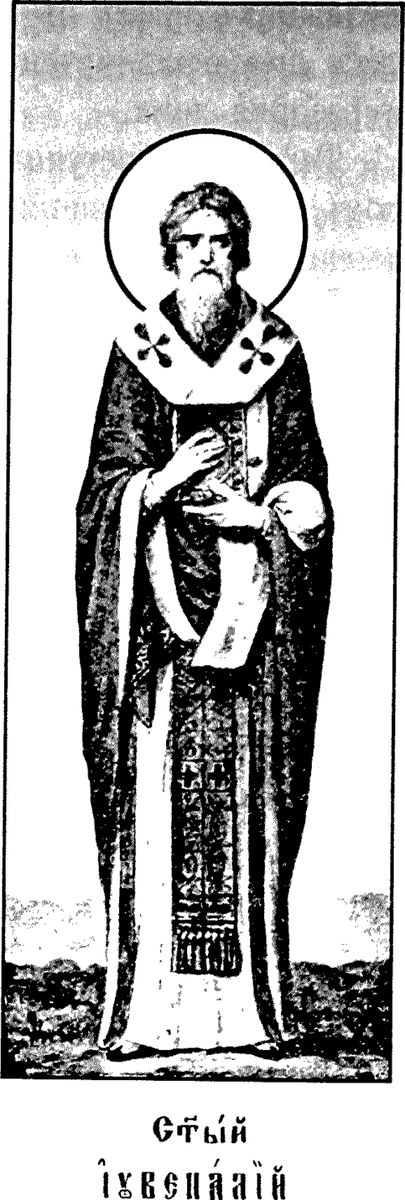
_-_икона_11022_Ювеналий.png)
Bishop of the Holy City
Nothing certain survives of Juvenal's origins. He appears in the record already as bishop of Jerusalem, about the year 422, and he held the see until 458 — thirty-eight years, as the synaxarion says, and among the longest episcopates of the fifth century. His Jerusalem was not yet the Jerusalem of later imagination: for all the glory of the Holy Places, the bishop of the city was canonically a suffragan of the metropolitan of Caesarea Maritima, who was himself under the great see of Antioch, whose patriarch held the whole civil Diocese of the East. Nicaea's seventh canon had granted the bishop of Aelia (Jerusalem) an honorary precedence "following the custom and ancient tradition," while expressly safeguarding the rights of the metropolitan — a phrase whose ambiguity Juvenal spent his life exploiting.
The years of his episcopate were the golden age of Palestinian monasticism, and his name is bound up with its fathers. He was the friend and confidant of Euthymius the Great, whose Life (by Cyril of Scythopolis, our best source for the period) shows the two men in constant dealing; he consecrated the church of Euthymius' laura; and the monastic witnesses of the age — Euthymius, Gerasimus of the Jordan, Symeon the Stylite in his Syrian pillar — are the men whose judgment counted more, in the end, than any imperial rescript. The empress Eudocia, widow of Theodosius II, spent her last years in Jerusalem under Juvenal's episcopate and endowed it magnificently.
Ephesus, 431, and the ambition of Jerusalem
At the Third Ecumenical Council at Ephesus in 431 Juvenal took his place beside Cyril of Alexandria, and the council he helped to carry condemned Nestorius and proclaimed the Virgin Theotokos. He also used the occasion to advance a claim: that the see of Jerusalem, the mother of all the churches, held its rank not from the civil order of provinces but by apostolic right, and should therefore be free of Antioch and set over the Palestinian provinces and even over Arabia and the two Phoenicias. John of Antioch resisted; Pope Celestine wrote against the pretension; and nothing came of it then. But the claim had been made, and Juvenal did not abandon it.
The council of 449
The years after Ephesus brought the second act of the Christological quarrel. The archimandrite Eutyches, condemned at Constantinople in 448 for teaching that after the union there was but one nature in Christ, appealed to Alexandria, and in 449 a council met again at Ephesus under Dioscorus of Alexandria which restored Eutyches, deposed Flavian of Constantinople, and terrorised the bishops into signing — the assembly Pope Leo called the latrocinium, the "Robber Council." Juvenal sat second to Dioscorus and was the first after him to subscribe. It is the least defensible passage of his life, and the sources do not conceal it.
Chalcedon, 451: the patriarchate of Jerusalem
Two years later Theodosius II was dead, Marcian and Pulcheria reigned, and the Fourth Ecumenical Council met at Chalcedon. On the first day, when the acts of 449 were read out and the temper of the assembly became plain, Juvenal rose from the Alexandrian side of the hall and crossed over to sit with the bishops of the opposite party, and a body of Palestinian bishops crossed with him. He signed the condemnation of Dioscorus and subscribed the definition of faith: one Christ acknowledged in two natures, without confusion, without change, without division, without separation.
The council then settled his jurisdiction. In its seventh session it ratified an agreement made between Juvenal and Maximus, patriarch of Antioch: the three Palestines (Palaestina Prima, Secunda and Tertia) passed to Jerusalem, while Phoenicia and Arabia, which Juvenal had also claimed, remained to Antioch. So the pentarchy of patriarchates received its fifth and smallest member, and the Church of Jerusalem became autocephalous. Seen from Antioch — and this collection looks from Antioch — the elevation of Jerusalem was a diminution: the great see of the East, already stripped of much of Cyprus and pressed by Alexandria, surrendered three provinces to a rival whose credentials were the Holy Places rather than the canons. The settlement has never been reversed, and the Antiochian tradition has generally accepted it as the price of concord and of Chalcedon; but it was a concession, not a gift, and the sources record the bargaining plainly.
Exile and restoration
Juvenal's change of side at Chalcedon cost him his city. The monks of Palestine were overwhelmingly of the Alexandrian mind, and when the news came that their patriarch had abandoned Dioscorus and confessed two natures, the monastic party rose. A monk named Theodosius, who had been at Chalcedon and carried back a lurid account of it, went ahead of Juvenal to Jerusalem, roused the monasteries and the people, and when the patriarch came back and refused to anathematise the council he was driven out. Theodosius was installed in his place, consecrated bishops through Palestine, and held the Holy City by force; blood was shed, and the bishop of Scythopolis was murdered. Juvenal fled to Constantinople, where the patriarch Anatolius and the emperor Marcian received him.
The usurpation lasted, the accounts say, some twenty months, and in 453 imperial troops restored Juvenal to his throne; Theodosius escaped to Sinai. Not all the sources agree on the reckoning of the interval — the synaxarion tradition gives twenty months of exile, while some modern chronologies compress the flight and the restoration into 453 itself — and the entry records the difference rather than choosing.
What ended the schism was not the soldiers but the monks. Euthymius the Great had refused from the first to communicate with Theodosius, and had withdrawn into the deep desert rather than be sought out; his refusal was decisive for the Palestinian ascetics. The empress Eudocia, who had at first gone with the anti-Chalcedonian party, sent to consult Symeon the Stylite, and afterwards Euthymius; both told her plainly to hold to Chalcedon and to communicate with Juvenal. She submitted, and with her a great part of Palestine returned. Juvenal governed his restored church for five years more and reposed in peace in 458, having been a bishop thirty-eight years.
Juvenal and the Robe of the Theotokos
A tradition of great antiquity binds Juvenal to the feast his memory shares. The so-called Euthymiac History, a passage cited in the third homily on the Dormition attributed to John of Damascus, relates that at Chalcedon the empress Pulcheria and the emperor Marcian asked Juvenal for the body of the Mother of God, to be laid in the church they had built at Blachernae; and that Juvenal answered that the tomb in Gethsemane had been found empty, the Apostles having opened it on the third day at Thomas' request, and that only the grave-clothes remained — which he sent to Constantinople. Byzantium therefore possessed a second account of how the Virgin's garments came to Blachernae, running beside the tale of Galbius and Candidus and attributing the transfer to Juvenal himself. Whether the Euthymiac History is a genuine fifth-century fragment or a later interpolation is disputed among scholars; but the pairing on July 2 of the patriarch of Jerusalem with the Deposition of the Robe is unlikely to be accidental, and the Slavonic troparion of Juvenal, hailing him as successor of James the Brother of God on the throne of Jerusalem, is sung on the day the City remembers what came from that throne.
Feast and commemoration
July 2 (church date; New Calendar civil July 2, Old Calendar civil July 15), on which he is named in the Greek synaxarion for the day alongside the martyr Quintus, in the Slavonic books, and in the Antiochian and Greek calendars — everywhere as the second commemoration after the Deposition of the Robe of the Theotokos, which governs the day's service. Because the feast of the Robe takes the whole office, the Greek Menaion appoints Juvenal no proper hymns; the Russian books supply a proper troparion. He is honoured with particular warmth in the Patriarchate of Jerusalem, whose patriarchal dignity dates from his tenure.
Hymns
Troparion — Tone 4
O successor upon the hierarchal throne of the Brother of God, praiseworthy hierarch of the holy city of Jerusalem: with the God-wise fathers at Chalcedon thou didst set forth the incarnation of the Son of God, who came to renew the world and to deify all men joined to him in his Church. O holy father Juvenal, who standest now in the kingdom of the Father of lights, pray for those who honour thee with love, that the peace and mercy of the Saviour may be with us.
Original translation from the Slavonic
Kontakion — Tone 2 (common of a hierarch)
Thou wast shown to be a shepherd of the holy city, guiding the flock of Christ by thy teaching; and when the wolves would have scattered it, thou didst suffer banishment for the true confession. Wherefore, O father Juvenal, we cry to thee: cease not to intercede for us all.
Original translation from the Greek
Iconography
Juvenal is painted as an aged hierarch of the Greek type: a long, pointed grey beard, high forehead, the phelonion and the crossed omophorion, blessing with the right hand and holding the closed Gospel in the left, veiled in a cloth. He carries no distinguishing attribute; where he is placed among the fathers of the Fourth Ecumenical Council he stands with the Chalcedonian bishops about the open book of the definition, and in the menaion-icons for July he stands second in the day's register, after the scene of the Deposition of the Robe. In Palestinian and Jerusalem usage he appears in the sequence of the patriarchs of the Holy City, between James the Brother of God at the beginning and the later hierarchs.
The stored image is the engraved plate for the second commemoration of July 2 from the Russian illustrated Lives of the Saints after St Dimitry of Rostov (1903–1911), inscribed СТЫЙ ІУВЕНАЛІЙ: the hierarch standing full-length in dark phelonion and white crossed omophorion, the Gospel held in a veiled hand.
Disputed questions
- The rank of the man. Juvenal is one of the more argued-over hierarchs of the fifth century. Western and much modern scholarship has judged him harshly — an ambitious politician who used three councils to enlarge his see, forging documents (so Leo of Rome charged) to support the claim of apostolic right, and changing sides at Chalcedon when the wind changed. The Orthodox calendars, by contrast, keep him as a saint and a confessor of the two natures who suffered exile for Chalcedon. Both records are true, and this entry sets them side by side: the elevation of Jerusalem was got by manoeuvre, and the man who got it afterwards paid for his orthodoxy with his throne.
- The date of his accession. Usually given as 422, sometimes 420 or 421; the OCA's notice reckons his episcopate 420–458. His repose in 458 and his thirty-eight years in the episcopate are firm in the tradition.
- Not to be confused with the hieromonk Juvenal of Alaska, the monk of Valaam martyred in Alaska about 1796, commemorated with the Synaxis of All Saints of Alaska on September 24 and not yet authored in this collection; nor with Juvenal, bishop of Narni (May 3), a western local saint carried on the Greek lists; nor with the Roman satirist whose Latin name the bishop bears.