
Alexander of Comana
The Holy Hieromartyr Alexander the Charcoal-burner, Bishop of Comana
Hieromartyr · Bishop · d. 3rd century, at Comana Pontica
Commemorated 12 August — Martyrdom by fire at Comana Pontica
Alexander, called the Charcoal-burner, is one of the most attractive figures of the third-century Church in Pontus: a trained philosopher who hid his learning and his birth under the soot of a coal-seller's trade in the marketplace of Comana Pontica, and who was drawn out of that concealment by Gregory the Wonderworker of Neocaesarea when the city could not agree on a bishop. Proposed in mockery and elected in earnest, he governed Comana with the wisdom his rags had hidden, and ended his life a martyr by fire. His story is told at length in Gregory of Nyssa's Life of Gregory Thaumaturgus, which makes him one of the very few minor saints of the fixed calendar with a genuinely fourth-century literary witness behind him. He is commemorated on August 12.

Comana Pontica and its vacant see
Comana Pontica lay in the valley of the Iris in northern Asia Minor, a day's journey from Neocaesarea, and had been from pagan times a temple-city of some wealth. In the third century it belonged to the missionary field of Gregory the Wonderworker (Gregory Thaumaturgus), bishop of Neocaesarea from about 240 to about 270, whose preaching — according to his biographer — found seventeen Christians in the city when he came and left seventeen pagans when he died. Comana had received the faith and, when its bishop's seat fell vacant, sent to Gregory as metropolitan to preside over the election and perform the consecration.
The election
The account of what followed is given by Gregory of Nyssa, writing about a century later and drawing on the memory of the Pontic Churches, and it is worth reading as a piece of ecclesiastical satire as much as hagiography. The notables of Comana put forward candidates on the usual grounds: birth, wealth, eloquence, presence, the dignity of the office and the figure the man would cut in it. Gregory checked them. A bishop, he said, is not chosen for what is outward. He is chosen for a clean heart and a holy life; and if the choice is to be made by the standard of appearances, the apostles themselves — fishermen, tent-makers — would never have been elected.
One of the company, nettled or amused, answered that on that principle they had better send for Alexander the coal-man, who was standing about the square. The remark was meant as a joke. Gregory took it as providence — Nyssa's narrative is explicit that the bishop recognised the hand of God in an idle word — and asked that the man be brought.
The charcoal-burner
Alexander came in as he was: blackened from head to foot with charcoal dust, ragged, and to all appearance the least considerable man in the city. The assembly laughed. Gregory drew him aside and questioned him, and the questioning uncovered what the soot had covered. Alexander was a Greek by education and a philosopher by training, a man of good family and of considerable learning, who had deliberately laid all of it down. He had taken up the meanest trade he could find and had lived by it in the public square, exposed to the contempt of everyone who passed, precisely in order to be despised — an ascesis of self-emptying, of the kind that the Church would later name folly for Christ's sake. Some accounts add that he adopted the trade also as a defence of his chastity, wishing to be unlookable-at.
Gregory had him washed and clothed and brought before the assembly, and there put him to the test in the Scriptures and in doctrine before the whole city. He answered with a command of the faith and a philosophical training that silenced the laughter; and the same men who had proposed him in jest elected him unanimously. Gregory consecrated him bishop of Comana.
Bishop and martyr
Of his episcopate the sources say little beyond that he governed the church of Comana wisely and well, and that the manner of life he had chosen in the marketplace did not change when he was raised to the throne. It is the pattern the Church has always found instructive: the man who had made himself contemptible was the one fit to be honoured.
His end came in one of the persecutions. Refusing to sacrifice to the idols, he was tortured and then burned, and so, the synaxaria say, "he who had lived among coals was perfected by fire" — a play the Greek calendar makes explicitly. The Church numbers him among the hieromartyrs.
Feast and commemoration
August 12 (church date; Old Calendar civil August 25), within the afterfeast of the Transfiguration and the Dormition Fast. He is entered in the Greek Menaion, the Slavonic Prologue and the OCA calendar for the day, in every case after the martyrs Anicetus and Photius, who carry the day's proper office. In the West his story travelled independently of his cult: Alexander Carbonarius was a favourite subject of seventeenth-century devotional engraving, and Jacques Callot etched him among the saints of the year.
Hymns
Apolytikion — Tone 4 (common of a hieromartyr)
As a sharer in the ways and a successor to the thrones of the Apostles, O divinely inspired one, thou didst find in contemplation the means to ascend to divine heights; rightly dividing the word of truth, thou didst struggle for the faith even unto blood, O hieromartyr Alexander: intercede with Christ God that our souls may be saved.
Kontakion — Tone 2 (common of a hieromartyr)
Living unknown among the coals of the marketplace, thou wast revealed a shepherd by the word of a saint, O wise Alexander; and having fed the flock of Comana with the doctrines of truth, thou wast perfected by fire: entreat Christ God for us who honour thee.
Original translation from the Greek
Iconography
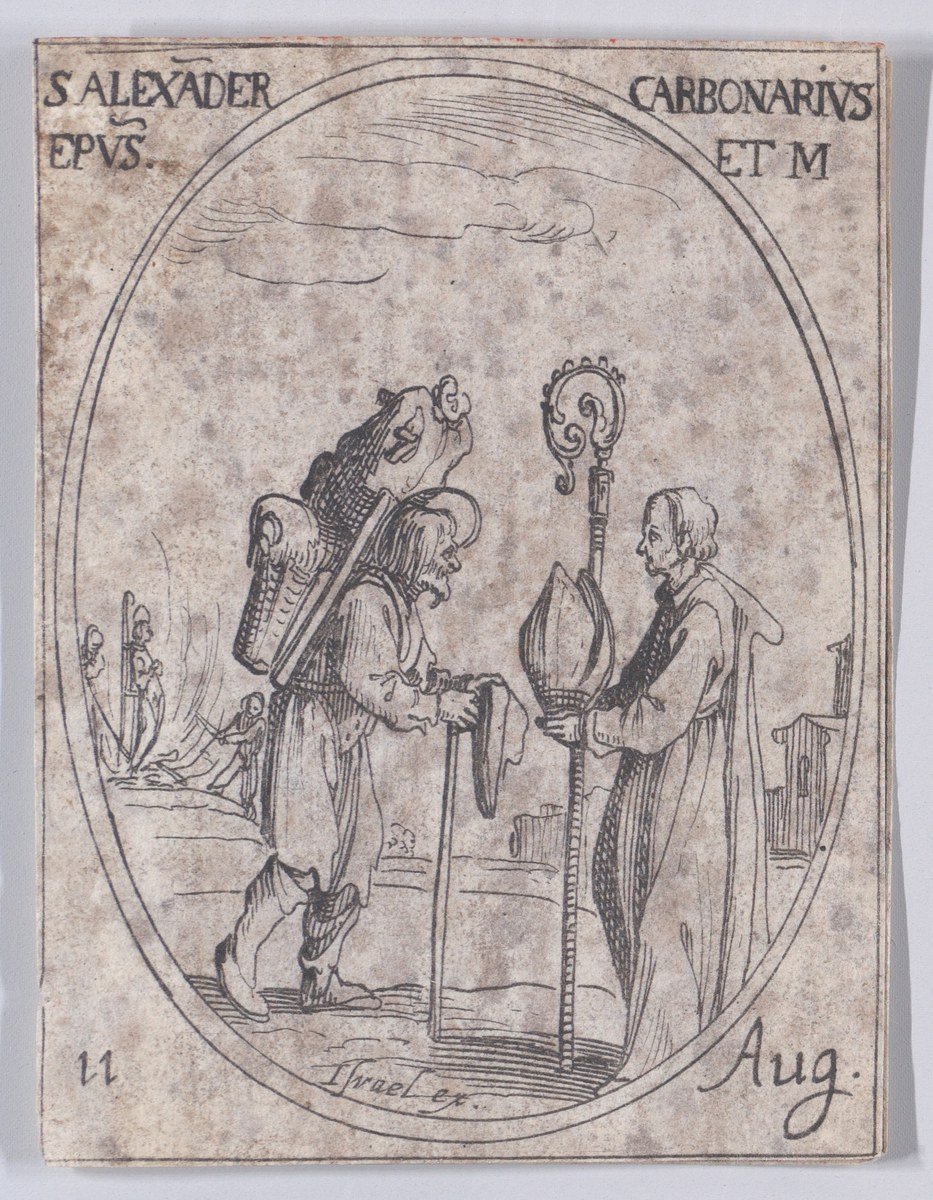
Alexander is painted as a hierarch: middle-aged to elderly, dark-bearded, in phelonion and omophorion, blessing with the right hand and holding the Gospel-book in the left, and as a hieromartyr he may carry the cross. Where the painter recalls his history — which Byzantine menologia rarely do and Western engraving almost always does — he is shown instead as the charcoal-burner: blackened face and hands, in a labourer's short tunic, with a basket or sack of coals, sometimes at the moment of being led before Gregory the Wonderworker. The contrast of the two types is the whole point of his cult, and the finest treatments set them side by side, the sooty collier and the vested bishop in one frame.
No pre-1900 Orthodox image of him has been located for this collection. What Wikimedia Commons holds is Western: Jacques Callot's etching of S. Alexandre Charbonnier (c. 1632–36), a related print in the Metropolitan Museum, and a series of Netherlandish devotional prints of Alexander de Kolenhandelaar. These are unquestionably in the public domain, and the ruling of the project's record of open questions — which names the Callot etchings as its very example — has since admitted such labelled Western works for saints with no located Eastern image. The stored image is accordingly Callot's etching from Les Images de tous les saincts (1636, Metropolitan Museum), captioned S. Alexander Carbonarius Epus et M.: the philosopher-bishop still in the charcoal-burner's rags, basket on his back, meeting the vested cleric who bears the crosier that awaits him — the very story of his unmasking. An Eastern image remains wanted and is listed among the upgrade-wanted icons. The Menologion of Basil II, the usual first resort for a saint of this kind, covers only September to February and cannot serve an August commemoration.
Disputed questions
- The date and the persecutor. The OCA's notice places his martyrdom under Diocletian (284–305), adding that some sources say Decius (249–251). Neither can be right if the consecration by Gregory the Wonderworker is historical: Gregory died about 270, so a Diocletianic martyrdom would require Alexander to have been bishop for a generation and more, and a Decian one would place his death before, or barely at the beginning of, the episcopate in which Nyssa sets his election. The likeliest reconstruction is a martyrdom in the persecution of Aurelian (c. 275) or in one of the local outbreaks of the 250s–260s under Valerian; the honest position is that the year is not transmitted, and the third century is as far as the evidence goes. This entry gives "3rd century" and records the disagreement rather than resolving it.
- The martyrdom itself. Gregory of Nyssa's Life of Gregory Thaumaturgus, the sole early source for the election, tells the story of Alexander's discovery and consecration and then says nothing of a martyrdom. The martyrdom appears in the synaxaria. It is not therefore false — Nyssa's subject was Gregory, not Alexander, and he had no occasion to follow the man to his death — but the two halves of the tradition rest on very different foundations, and only the first half has a fourth-century witness.
- Which Comana. Comana Pontica, in Helenopontus near Neocaesarea, not Comana in Cappadocia. The two were regularly confused in antiquity and are still confused in modern lists. It is the same Comana Pontica in which John Chrysostom died in exile in 407, and in which the martyr Basiliscus of Comana had suffered; Chrysostom was buried beside Basiliscus there.
- A fool for Christ? Alexander's concealment of his learning under a despised trade is the substance of the later ascesis of folly for Christ, and the Prologue of Ohrid says outright that he made himself a fool for Christ's sake. He is not, however, classed among the fools-for-Christ in the Greek or Slavonic calendars — his self-abasement was deliberate obscurity rather than the feigned madness of a Symeon of Emesa — and this collection follows the calendars in classifying him as a hieromartyr and bishop.
- Not to be confused with the many other Alexanders of the calendar, in particular Alexander of Alexandria (May 29), Alexander of Jerusalem (December 12), and Alexander of Side.