
Alexander of Svir
Our Venerable Father Alexander of Svir, Abbot of the Monastery of the Life-Giving Trinity
Venerable · Wonderworker · b. 15 June 1448, at Mandera on the Oyat, in the Obonezh land — d. 30 August 1533, at the Trinity monastery on the Svir
Commemorated 17 April — Uncovering of his incorrupt relics (1641) and glorification, 30 August — Repose at the Trinity monastery on the Svir (1533)
Alexander of Svir (1448–1533) is the great luminary of monasticism in the forests of the Russian north-east, and the one saint of the Russian Church to whom the tradition ascribes an appearance of the Holy Trinity in three Persons, as to Abraham at the oak of Mamre. Born of peasants on the river Oyat and named Amos at baptism, he fled a marriage arranged for him and made his way at nineteen to Valaam; after some twenty years there he withdrew into the wilderness by the Svir, where he lived seven years alone before disciples found him. Out of that solitude grew the Trinity monastery on the Svir, a mother-house of the whole Olonets and Karelian north, and a company of disciples — Athanasius of Syandem, Gennadius and Nicephorus of Vasheozero, Macarius of Oredezh, Adrian of Ondrusov, Gennadius of Kostroma — who carried his rule outward. His incorrupt relics, uncovered in 1641, were seized by the Bolsheviks in 1918 and held for eighty years in a Petrograd medical academy before being identified and returned in 1998.

Origins and early life
He was born on 15 June 1448 in the village of Mandera on the river Oyat, a tributary of the Svir, in the Obonezh territory of Novgorod the Great, of peasant parents named Stephen and Vassa. Because the day was the feast of the Prophet Amos, he was given that prophet's name at baptism. The tradition preserves the circumstance that he was a child of prayer: his parents, whose other children were already grown and gone, had asked God for one more son and were answered by a voice promising them a child through whom "God will give comfort to His Church."
Amos grew up strange to his village — obedient, silent, avoiding games and coarse talk, dressed poorly, and fasting so hard that his mother feared for him. He met on the Oyat a party of monks from Valaam, come down to buy supplies, and their account of the skete life and of the anchorites of the island took hold of him. When his parents arranged a marriage for him he left secretly, at nineteen, for Valaam. The life relates that a stranger met him on the road and showed him the way to the island, and that he understood afterwards that it had been an angel.
At Valaam
He lived at Valaam seven years as a novice and was tonsured Alexander in 1474. His labour there was of the severest northern kind: work by day, vigil by night, and — a detail the life insists on — prayer in the forest stripped to the waist through the short summer nights, covered with mosquitoes and gnats, until the hour of Matins. His parents, learning from Karelian traders where their son had gone, followed his example and were themselves tonsured, taking the names Sergius and Barbara. After their deaths Alexander asked and received the abbot's blessing to leave the community for an island of the archipelago, where he built himself a cell in a cleft of the rock.
The wilderness of the Svir
The fame of his asceticism began to reach the mainland, and in 1485 he left Valaam altogether. Guided, the life says, by an instruction from above, he settled in the forest by a lake afterwards called Holy Lake, some seven versts from the river Svir, and lived there seven years entirely alone, in a shelter of branches, eating what the forest gave. Hunger, frost, sickness and the assaults of the demons are all recorded of this period, and one episode in particular: struck down by a pain in the stomach so severe that he could neither rise nor lift his head, he lay on the ground chanting the Psalms until an angel appeared, laid a hand on the place, signed him with the cross and healed him.
He was discovered in 1493 by a landowner named Andrew Zavalishin, hunting deer, who told him that he had seen a pillar of fire standing over the place. Alexander, grieved to be found out, made him promise to tell no one until after his death and then, questioned, gave him the account of his seven years. Andrew came back often, and at last took the hermit's advice, went to Valaam, was tonsured Adrian, and founded the Ondrusov monastery (feast May 17 and August 26). He also broke his promise; and the north learned that there was a hermit on the Svir.
The Trinity monastery, and the vision
Monks gathered. Alexander, as always, withdrew from them — building a cell some 130 sazhen (about 280 metres) away from the growing settlement — and there met a second and fiercer assault of the demons, who took the shapes of wild beasts and hissed at him like snakes to leave the place.
In 1508, twenty-three years after he had come into the wilderness, occurred the event for which he is chiefly known in the Russian Church. Praying at night in his cell he saw a light of unbearable brightness and three men in shining white, each holding a staff, who came in to him. He fell on his face; they raised him by the hand and told him not to fear, and commanded him to build a church and gather a monastery. When he asked in whose name the church should be dedicated, the answer he received was: as you see us speaking with you in three Persons, so build the church in the name of the Father and of the Son and of the Holy Spirit, the consubstantial Trinity. The Russian hagiographical tradition treats this as unique in its history — an appearance not of an angel, nor of the Mother of God, nor of a saint, but of the Trinity itself in the manner of the hospitality of Abraham.
An angel afterwards showed him the site, standing in the air with outstretched wings and proclaiming the Εἷς Ἅγιος — "One is Holy, one is Lord, Jesus Christ, to the glory of God the Father" — and blessing the ground three times with the cross. In that year Alexander built a wooden church of the Life-Giving Trinity (rebuilt in stone in 1526).
Abbot
The brethren pressed him to be ordained; he refused for a long time as unworthy, and yielded only when they appealed over his head to Serapion, Archbishop of Novgorod (feast March 16), who ordained him. They then asked him to be their superior, and the office made him, as the life puts it, humbler than before. He wore rags, slept on the bare ground, cooked, kneaded dough and baked the bread himself. Told once by the cellarer to send an idle monk for firewood, he answered "I am not busy" and went and chopped it. At night he ground wheat by hand while the community slept, and walked the cells; where he heard idle talk he knocked softly on the door and passed on, and dealt with the matter in the morning — forgiving at once the brother who admitted it, giving a penance to the one who argued.
Near the end of his life, having resolved to raise a stone church of the Protection of the Theotokos, he was granted a second vision. After chanting the Akathist he told his cell attendant Athanasius to keep watch, "for at this hour there will be a wondrous visitation"; and the Mother of God appeared, seated as a queen on the foundation of the church where the altar would stand, the Child in her arms and a host of angels about her. She promised that the monastery would never lack what it needed, in his lifetime and after, and that whoever brought so much as a single brick to the building of her church in the name of her Son would not lose his reward.
Repose, relics, and their long exile
A year before the end he foretold the day, gave the brethren his last instruction and commended them to the Theotokos. Asked where he wished to be buried he answered that they should tie his sinful body by the legs, drag it into the marsh, cover it with moss and trample it; and when they refused, he directed them to bury him by the church of the Transfiguration. He reposed on 30 August 1533, aged eighty-five. Healings began at the grave at once. His disciple and successor Herodion wrote the life in 1545; local veneration and a proper service followed in 1547.
On 17 April 1641, during the rebuilding of the Transfiguration church, the relics were found incorrupt, and his veneration became general, on the two days he keeps still: the day of his repose, August 30, and the day of the uncovering, April 17.
The relics were taken from the monastery by the Bolsheviks on 20 December 1918, after several failed attempts, in the campaign against relics that ran from 1919 to 1922; examined repeatedly in the hope of exposing a fraud, they were sent at last to the Military Medical Academy in Petrograd, where they lay for nearly eighty years. They were identified again in December 1997 — still incorrupt, and answering the description recorded in 1641 — kept four months at the church of Saints Sophia, Faith, Hope and Love in Saint Petersburg, where a fragrant myrrh was observed to flow from them, and returned to the monastery on the Svir in November 1998.
Disciples
His disciples make a small hagiographical map of the Russian north. The life names Ignatius, Leonid, Cornelius, Dionysius, Athanasius, Theodore and Therapon of the Island; and among those with feasts of their own, Athanasius of Syandem (January 18), Gennadius and Nicephorus of Vasheozero (February 9), Macarius of Oredezh (August 9), Adrian of Ondrusov (May 17), and Gennadius of Kostroma (January 23). All but the last are depicted on the icon of the monastic fathers of Karelia; the Finnish Orthodox Church keeps their synaxis on the Saturday falling between October 31 and November 6.
Feast and commemoration
August 30 (church date; Old Calendar civil September 12), the day of his repose, with a second feast on April 17 for the uncovering of the relics in 1641. He is kept in the Russian Church and the OCA and, remarkably for a saint of the far north, has passed into the Greek synaxaristes as well, where he is listed on this day as "Alexander of the Svir." August 30 in the Russian usage is heavily loaded — the three patriarchs of Constantinople head it everywhere, and the day also carries the translation of the relics of Alexander Nevsky and the uncovering of the relics of Daniel of Moscow — but in the Olonets and Petersburg lands it is Alexander of Svir's day.
Hymns
Troparion — Tone 4
From thy youth thou didst love Christ, O blessed one, and taking upon thee His easy yoke thou didst show thyself a dwelling-place of the Holy Spirit; wherefore the Trinity, whom thou didst serve, was pleased to appear unto thee. Entreat, O venerable Alexander, that our souls may be saved.
Original translation from the Slavonic
Kontakion — Tone 8
Thou didst flee the marriage of this world and find the wilderness of the Svir a bridal chamber; and there, in the light that has no evening, the Three came in to thee as of old to Abraham. Wherefore thy monastery calls thee father, and we cry to thee: Rejoice, Alexander, lamp of the northern forests.
Original translation from the Slavonic
Iconography
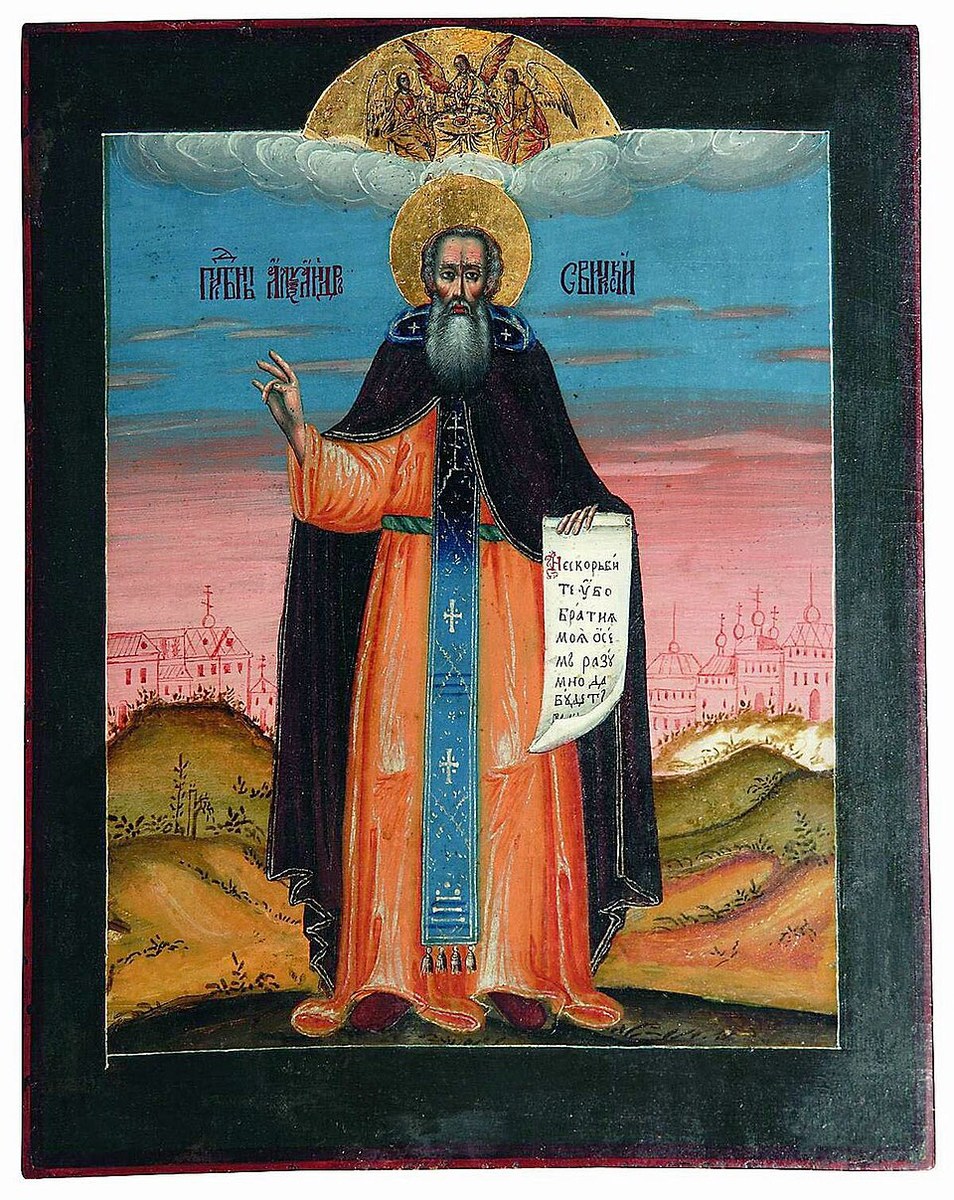
Alexander is painted as an old man of middle stature, in the monastic mantiya over the analavos, with a long grey-white beard narrowing at the point, most often standing at full length with the right hand raised in blessing or in prayer and an unrolled scroll of instruction to his brethren in the left. Two things identify him and no one else. Above his head, in a cloud or a segment of heaven, appear the three angels of the Holy Trinity — the vision of 1508 in the form the Church gave it; and behind or beside him stands the white monastery on the Svir, with its cluster of domes. A separate composition shows the vision itself, the three white-robed figures with staffs standing over the prostrate hermit outside his cell; another, of the "vita icon" type, ranges the scenes of his life in border panels.
The stored image is an eighteenth-century Russian panel inscribed ПРПБНЫ АЛЕѮАНДРЪ СВИРСКIЙ: the saint stands full-length in a landscape between two monastic settlements, in the dark mantiya over an ochre undergarment with the blue analavos hanging to his feet, the right hand blessing and the left holding an open Slavonic scroll; above him the Trinity appears as three winged figures in a golden glory over a bank of cloud.
Disputed questions
- Not to be confused with the other Russian venerables of the name — Alexander of Kushta (June 9), a contemporary of the northern colonisation, or Alexander the Sleepless (July 3), the fifth-century founder of the Akoimetoi — nor with the princely Alexander Nevsky, whose translation of relics falls on this same August 30 and who is, confusingly, styled in some Greek calendars simply "Alexander, ruler of Russia."
- The date of birth. The Russian tradition gives 15 June 1448 by attaching it to the feast of the Prophet Amos; the OCA's article prints July 15, which does not correspond to Amos's day and appears to be a slip. The year is not in doubt.
- The vision of the Trinity. The claim that this is the only such appearance in Russian hagiography is itself a claim of the tradition rather than a critical finding, and is reported here as the tradition reports it.