
Silas, Silvanus, Crescens and Epaenetus
The Holy Apostles of the Seventy Silas, Silvanus, Crescens and Epaenetus, kept with Andronicus
Apostle · Apostle of the Seventy · Bishop · Hieromartyr · d. 1st century (Crescens under Trajan, 98–117)
Commemorated 4 January — Kept with the whole company at the Synaxis of the Seventy Apostles, 30 July — The apostles of the Seventy Silas, Silvanus, Crescens and Epaenetus, with Andronicus
On July 30 the Church keeps together four apostles of the Seventy whose names stand in the New Testament itself: Silas, the prophet and "chief man among the brethren" whom the Council of Jerusalem sent to Antioch with its decree and who then walked the whole of Paul's second journey with him — beaten at Philippi, singing in the stocks at midnight, and left at last as bishop of Corinth; Silvanus, whom the tradition makes bishop of Thessalonica and a martyr, and whose name Peter writes at the end of his first epistle; Crescens, whom Paul's last letter sends away to Galatia and whom the synaxarion follows into Gaul before his martyrdom under Trajan; and Epaenetus, "the firstfruits unto Christ," greeted in Romans 16 and remembered as first bishop of Carthage. With them on this day the Menaion names Andronicus, bishop of Pannonia, whose own feast is May 17. The four are of the first apostolic generation, and their history is exactly as long as the few verses in which they appear and the short notices the synaxaria have added to them.
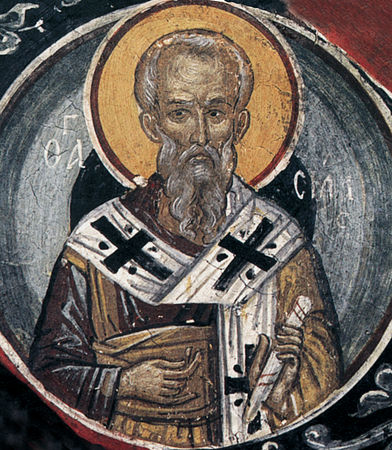

Silas: prophet of Jerusalem, fellow-prisoner of Paul
Silas enters the record at the Council of Jerusalem, about the year 49 or 50. When the apostles and elders had determined that the Gentile converts were not to be laid under the yoke of the Law, they chose two of their own number to carry the decree to Antioch and to say by word of mouth what the letter said in writing: "Judas surnamed Barsabas, and Silas, chief men among the brethren" (Acts 15:22). At Antioch the two "being prophets also themselves, exhorted the brethren with many words, and confirmed them" (Acts 15:32) — so that Silas belongs, on Luke's own testimony, to the order of the prophets of the apostolic Church, and to its leadership at Jerusalem.
When Paul and Barnabas parted over Mark, Paul chose Silas as his companion for the second journey (Acts 15:40), and from that moment Silas is at his side through the whole of the Aegean mission. They went up through Syria and Cilicia, confirming the churches; at Lystra they took Timothy with them; they were forbidden the word in Asia and in Bithynia, and came down to Troas, where the vision of the Macedonian called them over into Europe.
At Philippi Paul and Silas cast the spirit of divination out of the slave girl whose oracles brought her masters money, and the masters dragged them into the market-place. They were stripped, beaten with rods, thrust into the inner prison and their feet made fast in the stocks; and "at midnight Paul and Silas prayed, and sang praises unto God, and the prisoners heard them" (Acts 16:25). The earthquake that shook the foundations of the prison, the jailer's despair and his question "what must I do to be saved?", his baptism with all his house that same night, and the magistrates' alarm the next morning when the two prisoners proved to be Roman citizens — all of it Luke tells of the pair together, and Silas' citizenship, asserted with Paul's, is one of the few personal facts the New Testament gives about him.
From Philippi they went to Thessalonica, where the synagogue riot drove them out by night; to Beroea, whose Jews "were more noble," and where Silas and Timothy were left behind when Paul was hurried to the sea; and at length to Corinth, where "Silas and Timotheus were come from Macedonia" and Paul was "pressed in the spirit" to testify (Acts 18:5). There the Acts leave him. The Byzantine synaxaria carry him no further than Corinth either: he was set as its bishop, wrought many signs, and reposed there in peace.
Silvanus: the name in the epistles, and the see of Thessalonica
Wherever Luke writes Silas, Paul writes Silouanos — Silvanus. The name stands in the opening address of both letters to the Thessalonians, written from Corinth at exactly the moment Acts places Silas there ("Paul, and Silvanus, and Timotheus, unto the church of the Thessalonians", 1 Thess. 1:1; 2 Thess. 1:1), and again in the second letter to Corinth, where Paul recalls that "the Son of God, Jesus Christ, who was preached among you by us, even by me and Silvanus and Timotheus, was not yea and nay" (2 Cor. 1:19). At the close of the First Epistle of Peter the same name appears once more: "By Silvanus, a faithful brother unto you, as I suppose, I have written briefly" (1 Pet. 5:12) — the phrase that has made him, in the Church's memory, the secretary or bearer of that letter and a fellow-worker of the two chief apostles alike.
The Byzantine tradition receives Silvanus as a distinct apostle of the Seventy, sets him over the church of Thessalonica, and says that after many labours and afflictions he ended his life as a martyr there. The relation between this Silvanus and Silas of Corinth is the day's principal difficulty, and is treated below.
Crescens: Galatia, and the roads into the West
Crescens is named exactly once. In the last of his letters, written from prison and near the end, Paul tells Timothy that his companions have scattered: "Demas hath forsaken me, having loved this present world, and is departed unto Thessalonica; Crescens to Galatia, Titus unto Dalmatia" (2 Tim. 4:10). The verse gives a name, a destination, and the fact that he was of Paul's own circle at Rome in the last year of the apostle's life.
The synaxaria build from that a mission. Crescens preached in Galatia and was made bishop there; then, the account continues, he passed into Gaul, where he planted the Gospel and left his disciple Zacharias as bishop of Vienne on the Rhône; and, returning at last to Galatia, he was martyred under the emperor Trajan (98–117). The Gallic strand of the story is old — Latin writers from the fourth century onward read Paul's word as Gallia rather than Galatia — and the Church of Vienne long claimed Crescens for its founder. The synaxarion keeps both halves of the tradition and does not choose between them.
Epaenetus: the firstfruits, and the see of Carthage
Epaenetus is one of the twenty-six persons Paul salutes by name in the last chapter of Romans: "Salute my wellbeloved Epaenetus, who is the firstfruits unto Christ" (Rom. 16:5). Of what province he was the firstfruits the manuscripts disagree — the Byzantine text reads Achaia, the earliest witnesses Asia — but the honour is the same either way: he was the first convert of a whole country, the first sheaf of a harvest, and Paul remembers him as "beloved."
The catalogues of the Seventy make him bishop of Carthage in Roman Africa. Nothing else is transmitted of him: no acts, no martyrdom, no burial place. He is a name in a greeting and a see in a list, and the Church honours him for what those two things together mean — that a man converted in one province was sent to shepherd a church at the other end of the sea.
Andronicus, kept with them
The Menaion for July 30 names a fifth apostle with these four: Andronicus, Paul's kinsman and fellow-prisoner, "of note among the apostles" (Rom. 16:7), bishop of Pannonia. His principal feast is May 17, kept with Junia his fellow-labourer, and his full entry stands there; July 30 is a secondary commemoration in which Junia is not named. He is not re-minted here.
Feast and commemoration
July 30 (church date; New Calendar civil July 30; Old Calendar civil August 12). The day falls in the open season between the end of the Apostles' Fast on June 29 and the beginning of the Dormition Fast on August 1 — the last free day but one before that fast opens, and the ordinary Wednesday and Friday rule is all that applies to it.
The commemoration is universal and identically worded across the Antiochian, Greek and Slavic books: the holy apostles of the Seventy Silas, Silvanus, Crescens, Epaenetus and Andronicus. The office is that of apostles, taken from the common with the proper stichera and canon of the Menaion; the day is not of high rank and has no vigil. Each of the four is also kept, with the whole company, at the Synaxis of the Seventy Apostles on January 4, whose purpose the synaxarion states as the showing forth of "the equal honour of each" — which is precisely what a day like this one enacts, setting the well-documented Silas and the almost unknown Epaenetus side by side without distinction of rank.
Hymns
Apolytikion — Tone 3
Holy Apostles, intercede with the merciful God, that he may grant to our souls the forgiveness of transgressions.
Kontakion — Tone 4
As fellow-labourers of Paul and heralds of the word, you were sent out to the nations, O wise apostles: Silas the prophet, Silvanus the martyr-shepherd, Crescens who ran even to the western lands, and Epaenetus the firstfruits of the Gospel. Cease not to pray for those who keep your memory.
Original translation from the Greek
Iconography
All four are painted as apostles of the second rank and bishops: standing or in medallion busts, in the phelonion — often the polystavrion, the cross-covered vestment of the ancient hierarchs — and the omophorion, blessing with the right hand and holding a jewelled Gospel-book or a scroll in the left. Silas is given a long grey beard and a high forehead, the elder of the group; Silvanus is bearded and dark, and where his martyrdom is shown he holds the cross as well as the book; Crescens and Epaenetus, of whom the tradition preserves no distinct physiognomy, take the general hierarch type and are told apart only by their inscriptions. In the menologion cycles for July the five apostles of the day are ranged in a row, Andronicus among them; in the great Synaxis of the Seventy they stand in the crowd of that company. A second late-Byzantine fresco at the same site as the stored image shows the martyrdom of Silas and Silvanus together, a rare narrative subject for these apostles.
The stored image is a 14th–15th-century fresco medallion of Silas, inscribed Ὁ ἅγιος Σίλας: the apostle bust-length in a white polystavrion worked with black crosses and the omophorion, white-bearded, holding the Gospel-book and blessing — the settled Byzantine type of an apostle-bishop of the Seventy.
Disputed questions
- Silas and Silvanus: one apostle or two? The Church's calendar keeps them as two, with two sees and two ends — Silas bishop of Corinth, reposing in peace; Silvanus bishop of Thessalonica, a martyr. Historical criticism, and a good deal of ancient usage, takes them for one man under two forms of one name: Silas is the Greek rendering of a Semitic name (Aramaic Šeʾîlā, "asked for," the same name as Saul), and Silvanus the ordinary Latin cognomen a Roman citizen of the eastern provinces would carry — exactly the pattern of Saul/Paul and of John/Mark. The evidence for the identification is that Luke's Silas and Paul's Silvanus are in the same places at the same times with the same colleague: both are with Paul and Timothy at Corinth when the Thessalonian letters are written, and Luke never mentions a Silvanus nor Paul a Silas. The evidence on the other side is simply the liturgical tradition itself, which from the ancient catalogues of the Seventy onward has counted two names in the roll and supplied each with a distinct see; it is possible that the doubling arose precisely because compilers working from Acts and from the Epistles found what looked like two men. This repository keeps the calendar's arrangement, records the difficulty plainly, and joins the two in one entry rather than pretending to resolve it.
- Crescens: Galatia or Gaul? The Greek of 2 Timothy 4:10 is read Γαλατίαν (Galatia) by most witnesses and Γαλλίαν (Gaul) by others, and the two words were used interchangeably of the West in later Greek. The Eastern synaxaria make Crescens bishop in Galatia; the Latin West, and the church of Vienne in particular, made him its own apostle. The tradition preserved on July 30 has him do both, and the variant is the reason.
- Epaenetus: firstfruits of Achaia or of Asia? The received Byzantine text of Romans 16:5 reads Ἀχαΐας, and the Slavonic and Greek service books follow it; the oldest Greek manuscripts read Ἀσίας, which also agrees better with 1 Corinthians 16:15, where Paul calls the household of Stephanas "the firstfruits of Achaia." The reading affects nothing in the veneration.
- Crispus of Aegina. Several recensions of the roll of the Seventy — including the one followed in this collection's entry on the Synaxis of the Seventy Apostles — attach Crispus, bishop of Aegina to this same day. He is the ruler of the Corinthian synagogue converted with all his house (Acts 18:8) and baptised by Paul himself (1 Cor. 1:14). The printed Greek Menaion and the Slavic calendars name five apostles on July 30 and not six, and Crispus is therefore not treated here as a member of the day's company; the divergence between the roll and the day is recorded rather than resolved.
- Not to be confused. This Silvanus is neither Silvanus of Emesa, the bishop martyred with Luke the deacon and Mocius under Numerian, nor Silvanus of Gaza the confessor of the mines, nor Silouan the Athonite; and this Silas is not the Silvanus of the Kiev Caves. The name Crescens likewise belongs to more than one martyr of the Roman calendars.