
Basil and Constantine of Yaroslavl
The Holy Right-believing Princes Basil and Constantine Vsevolodovich, Wonderworkers of Yaroslavl
Prince · Righteous · Wonderworker · d. Basil 1249; Constantine 1257, in battle on Tugova Hill
Commemorated 3 July — Principal commemoration of the two princes of Yaroslavl
Two brothers, Basil (died 1249) and Constantine (died 1257), successively princes of Yaroslavl on the Volga, orphaned as boys when their father Vsevolod fell fighting the Mongols and left to rule a burnt and depopulated principality in the first generation of the Tatar yoke. Basil bore the whole weight of it — the journeys of submission to the Horde, the rebuilding of a ruined town, the death of his only son — without complaint, and died young. Constantine succeeded him and fell in battle against a Tatar raid on the hill above Yaroslavl afterwards called Tugova Gora, "the hill of grief." Their relics were found incorrupt in 1501 after a fire in the Dormition cathedral, and they have been honoured since as the wonderworkers and heavenly patrons of Yaroslavl.
.jpg)
Orphans of the Sit
Their father, Vsevolod Konstantinovich, first prince of the newly separated principality of Yaroslavl and grandson of Vsevolod the Big Nest, was killed on 4 March 1238 at the battle of the river Sit, where the grand prince Yuri of Vladimir and the assembled forces of the north-east were destroyed by Batu's Mongols. The two boys were left with their mother in a land that had just been overrun: Yaroslavl itself had been stormed and burned, the surrounding villages wasted, and much of the population killed or taken.
Basil, the elder, succeeded as prince. The lives are unusually candid about what that meant. There was no war left to fight and no glory to be had. The town and the countryside were in ruins; households were without roof or food; and everything — every family, every question — came to the young prince. To this was added the necessity that defined the age: he had to secure the goodwill of the Khan, and he went more than once to the Horde for that purpose, the long and humiliating journey down the Volga that was the price of his people's survival.
He suffered also a private grief, the death of his only son, which ended his line.
Basil's rule and repose
The lives make no claim that he was a warrior or a builder of empires. What they praise is precisely what he did in a situation with no good options: he bore every trouble without complaint; he governed as a Christian; he did not enter into the quarrels of the other princes, in a generation when the surviving Russian princes were destroying each other in the ruins and denouncing each other at the Horde; he cared for the wretched among his subjects; and he built churches. It is a portrait of endurance, not of achievement, and it is the characteristic sanctity of the princes of the Mongol period.
The strain broke his health early. He fell ill and died in 1249, still a young man. He had gone to Vladimir, and his body was brought home to Yaroslavl and laid in the Dormition cathedral.
Constantine and Tugova Hill
Constantine succeeded his brother and, the lives say, set himself deliberately to imitate him. But the conditions worsened: wherever he looked, the Tatars were plundering and killing.
In 1257 a Tatar force fell upon Yaroslavl itself. Constantine did not wait behind the walls; he went out to meet them, and in the battle he was killed. The place — a hill across the Kotorosl from the town — is called to this day Тугова гора, Tugova Gora, "the hill of grieving," from the mourning of the people of Yaroslavl over their dead; a church of St Paraskeva stood there afterwards, and it is from that church that one of the great Yaroslavl icons of the princes comes.
He was buried beside his brother in the Dormition cathedral.
The uncovering of the relics, 1501
In 1501 a fire destroyed the wooden Dormition cathedral of Yaroslavl. In clearing the ruins to lay the foundations of a stone church, the workmen came upon two coffins, and in them the bodies of the two princes incorrupt. The find was reported, healings followed, and the veneration of the brothers as wonderworkers of Yaroslavl dates from that year. Their glorification followed; they were entered into the general Russian calendar at the councils of the mid-sixteenth century, and the relics were kept in the Dormition cathedral of the Yaroslavl kremlin until the destruction of that cathedral in 1937, having been transferred in the Soviet period to the Yaroslavl museum. They are now again in the restored Dormition cathedral of Yaroslavl.
Feast and commemoration
July 3 (church date; New Calendar civil July 3, Old Calendar civil July 16), the principal commemoration of the two brothers together. Russian usage; kept also by ROCOR and the OCA. They are numbered further in the Synaxis of the Saints of Rostov and Yaroslavl (May 23). The day is one of the most crowded of the Russian July calendar — the translation of the relics of Philip of Moscow, the repose of Basil of Ryazan, the wonderworkers of Yarenga, the blessed John of Moscow and Nikodemos of Kozheozero all fall on it — and at Yaroslavl the princes' service naturally takes precedence. An akathist to them is in use in the Yaroslavl diocese.
Hymns
Troparion — Tone 8
O ye who by your piety adorned the land committed to you, and in a time of bitter bondage kept the faith of Christ unshaken: Basil the meek and Constantine the valiant, ye wonderworkers of Yaroslavl, entreat Christ our God that our souls may be saved.
Original translation from the Slavonic
Iconography
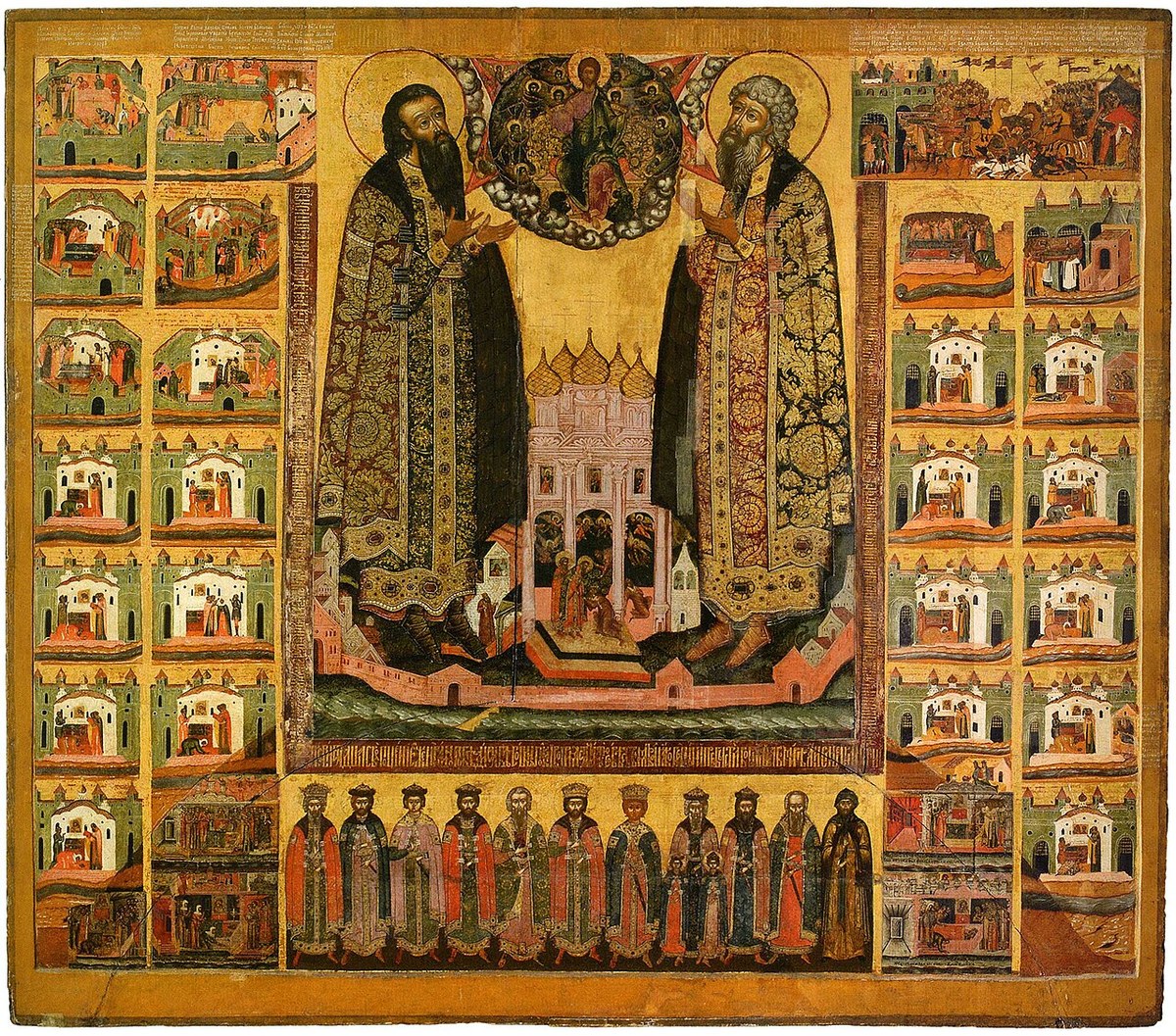
The princes are painted as a pair, standing frontally, in the long brocaded princely mantle over an under-robe, with fur-trimmed princely caps or bare-headed with the hair to the shoulders, and a cross or a scroll in the hand — never in armour, notwithstanding Constantine's death in battle. Basil, the elder, is normally shown with a darker and fuller beard, Constantine as the younger of the two. They are very frequently painted together with the other Yaroslavl wonderworker-princes Theodore, David and Constantine, standing in prayer before an icon of the Trinity, of the Sign, or of the Mother of God — a composition characteristic of the seventeenth-century Yaroslavl school, of which several examples survive.
The stored image is the great hagiographical icon of the two princes from the Dormition cathedral of Yaroslavl (Yaroslavl Museum-Reserve, inv. ЯМЗ 41010), some 207 × 240 cm: the border scenes were painted in the 1640s and the centre and part of the lower scenes repainted at the end of the eighteenth century. In the centre the two stand in heavy patterned mantles on either side of Christ in glory borne up in a cloud-mandorla, with the many-domed Dormition cathedral of Yaroslavl rising between them and the Volga at their feet; a register of chosen saints runs along the foot. The surrounding scenes give the history of the principality and of the cult — the founding of the stone Dormition cathedral by Constantine Vsevolodovich in 1215, the building of the church of the Archangel Michael in 1216, the battle with the Tatars on Tugova Hill and the taking of Yaroslavl, and, in scene after scene, the healings wrought at the tomb after the uncovering of 1501.
Disputed questions
- Their ages and dates. The chronicles are sparing. Basil's death is securely 1249. Constantine's fall is placed by the Life and by the liturgical tradition at the battle on Tugova Hill in 1257; some Russian historians have questioned that battle and would put his death at the Sit in 1238, alongside his father, which would make his whole reign a construction of the later Life. The traditional account is followed here and the doubt recorded, not resolved.
- Righteous or passion-bearers? They are classed in the Russian calendar as благоверные князья, right-believing princes, and not among the passion-bearers: Basil died of illness and Constantine in open battle, so neither death fits the pattern of Boris and Gleb. Their canonisation rests on the incorruption of the relics and the miracles, and on the character of their rule.
- Not to be confused with their kinsmen the other Yaroslavl wonderworker-princes, Theodore, David and Constantine (September 19), who are painted beside them on the Yaroslavl icons and belong to the following generation; nor with Constantine of Murom (May 21), the prince who brought the Murom icon of the Mother of God to a still-pagan city, whose legend is sometimes confused with theirs in Greek-language lists.