
George the Hagiorite
Our Venerable Father George the Hagiorite, Abbot of Iviron, the Translator and Enlightener of Georgia
Venerable · b. c. 1009, at Trialeti in Georgia — d. 29 June 1065, at Constantinople
Commemorated 27 June — Repose of the abbot and translator of Iviron
George the Hagiorite — Giorgi Mtatsmindeli, "George of the Holy Mountain" — was the greatest of the Georgian translators, abbot of the Monastery of the Iberians (Iviron) on Mount Athos from 1044, and the man to whom the Georgian Church owes the received text of its Scriptures, its Menaion, its Triodion and its Synaxarion. Born about 1009 in Trialeti and educated for twelve years at Constantinople, he was tonsured at Khakhuli, sought out the recluse George on the Black Mountain above Antioch, and came to Athos in 1040 to take up the unfinished work of Euthymius the Iberian. He wrote the Life of John and Euthymius on which nearly all knowledge of Iviron's founders depends, defended the apostolic standing of the Georgian Church at Antioch, and died at Constantinople on 29 June 1065 while bringing eighty Georgian orphans home to Athos to be trained. He is kept on June 27. He is not the George of the May 13 Greek notice, who was Euthymius' immediate successor.

Trialeti, Khakhuli, and twelve years in the City
George was born about 1009 in Trialeti, in the south of the Georgian kingdom, to parents named Jacob and Mariam; his father stood in the service of King Bagrat III. At the age of seven the boy was given to the convent of Tadzrisi, where his sister was a nun and the abbess Sabiana took charge of him; at ten he was moved to the great monastery of Khakhuli in Tao, one of the schools of the Georgian church, and was taught there by his uncle, another George the Scribe, and by the learned Hilarion Tualeli — Hilarion of Tvali, abbot of Khakhuli, who ended his own life on the Black Mountain above Antioch and is commemorated on July 24.
His education was then interrupted by politics. The nobleman Peris Jojikisdze took the uncle into his household and the boy with him, and when the emperor Basil II summoned the prince to Constantinople on a charge of conspiracy and had him executed, the widow kept the young George in the capital. He remained there twelve years, and — this is the decisive fact of his life — was put to the best masters the City could furnish, the philosophers and rhetoricians of the imperial schools. He came away with a command of Greek that no Georgian churchman of his generation could equal, and with it the instrument of everything he afterwards did.
About the age of twenty-five he returned to Khakhuli and was tonsured.
Jerusalem and the Black Mountain
Monastic life at home did not satisfy him. He left Georgia secretly, in the dress of a beggar, and made his way to Jerusalem and the Holy Places, and thence — as many Georgians did in that century — to the Black Mountain above Antioch, the great cosmopolitan ascetic massif where Greek, Syrian, Armenian and Georgian monks lived side by side. There he found the recluse George the Solitary, an aged Georgian ascetic of formidable reputation, and stayed with him as his disciple for three years, receiving from him the great schema.
It was the old recluse, according to the Life, who told him what he was for. Euthymius the Iberian had died in 1028 with his translating work unfinished; the Georgian books were few, corrupt and disordered; the elder sent his disciple to Athos to finish what Euthymius had begun. George obeyed, and arrived at Iviron about 1040.
Abbot of Iviron
By his own account, transmitted with unusual candour by his biographer, his first seven years on the Mountain were spent in what he called sloth — that is, in the ordinary obediences of the house rather than at the desk. Then, on the death of the abbot Stephen in 1044, the brethren elected him hegoumenos.
He governed Iviron for something over a decade, and governed it as a builder. He put the monastery's fabric, its finances and its discipline in order; he restored to it the standing it had held under John and Euthymius; and he did two things for the memory of the founders that fixed their cult for ever. He translated their relics into new and honourable tombs, and he wrote their Life — the Life of John and Euthymius, a substantial work of hagiography and, incidentally, of monastic history, which is the source of virtually everything that is known about the founding of Iviron, about John Tornike and the Georgian contingent, and about Euthymius' labours. Every modern account of those men, including the entries in this reference, descends from George's book.
The translator
His own translating is the reason the Georgian Church calls him Mtatsmindeli with the emphasis it does. Euthymius had translated freely, abridging and paraphrasing to make Greek theology readable in Georgian; George's principle was different — he went back to the Greek originals, compared them against the Georgian texts in circulation, and corrected, completed or replaced them. The Georgian Gospels and Psalter were revised to the Greek; the Great Synaxarion, the Menaion for the whole year, the Triodion, and a body of liturgical and canonical material were rendered entire; and to these he added the Fathers — Basil the Great, Gregory of Nyssa, Athanasius of Alexandria, John Chrysostom, John of Damascus, and others. The effect was to give the Georgian Church, in one lifetime, a full and reliable Byzantine liturgical and patristic library. The recensions he made remained the standard Georgian texts for centuries, and in the liturgical books they have never been wholly superseded.
Antioch: the apostolicity of the Georgian Church
Between about 1052 and 1057 he was at Antioch, where the Georgian monks of the Black Mountain and of the patriarchate had come under suspicion — the charge being that the Georgian Church was of recent and irregular foundation, and that its clergy were doctrinally unsound. George answered before the patriarch of Antioch (the sources name Theodosius III; some accounts put the confrontation under Peter III) and argued the case from history: that the Georgians had received the Gospel from the Apostle Andrew, who preached in Colchis and Iberia, and again from Nina, and that their Church stood therefore on apostolic ground and was rightly autocephalous. The patriarch was satisfied. It is a small episode in a long life, but it is the one for which Georgian historians honour him most, because it settled in Antioch — the see to which Georgian ecclesiastical questions were most often referred — the standing of the Georgian Church.
Georgia, the eighty orphans, and the end
King Bagrat IV offered him the great see of Chqondidi; he refused it. He did, however, accept the king's request to come home, and spent some five years in Georgia (roughly 1057–1062) as the conscience of the kingdom — correcting the clergy, regularising marriages among the nobility, and pressing the reform of monastic discipline. He then set out to return to the Holy Mountain, and took with him eighty orphaned children, gathered to be raised and educated at Iviron and sent back as clergy and translators for the Georgian church. It is the most characteristic act of his life: he had spent forty years making books for a Church that had few readers, and he ended by trying to make the readers.
He got as far as Constantinople, and there fell ill and died, on 29 June 1065, in the presence of the emperor's court and of the Georgian community of the City. His body was carried to Athos and buried at Iviron. About a year after his death his disciple George the Lesser (Giorgi Mtsire) wrote his Life, one of the finest works of Georgian medieval prose and the source of everything above.
Feast and commemoration
June 27 (church date; New Calendar civil June 27, Old Calendar civil July 10). The Georgian Orthodox Church, which keeps the Julian calendar, celebrates him on the civil 10 July and counts him among the chief saints of the nation; the Greek books commemorate him at Iviron and on the Holy Mountain; the Slavonic books and the Orthodox Church in America have him as "Venerable George of Mount Athos." He is also numbered among the Georgian fathers of the Holy Mountain kept together on May 13 with John, Euthymius and Gabriel; whether that synaxis intends him or the earlier George is the question set out above, and no May 13 feast has been added to this entry on the strength of it. June 27 falls in most years inside the window of the Apostles' Fast, which has no fixed beginning and ends on June 28; its position on this day is therefore not asserted.
Hymns
Troparion — Tone 8 (common of a venerable father)
In thee, O Father, that which is according to the image was preserved exactly: for taking up the cross, thou didst follow Christ, and by thy deeds didst teach us to despise the flesh, for it passeth away, but to care for the soul, a thing immortal; wherefore thy spirit rejoiceth with the angels, O venerable George.
Original translation from the Georgian
Iconography
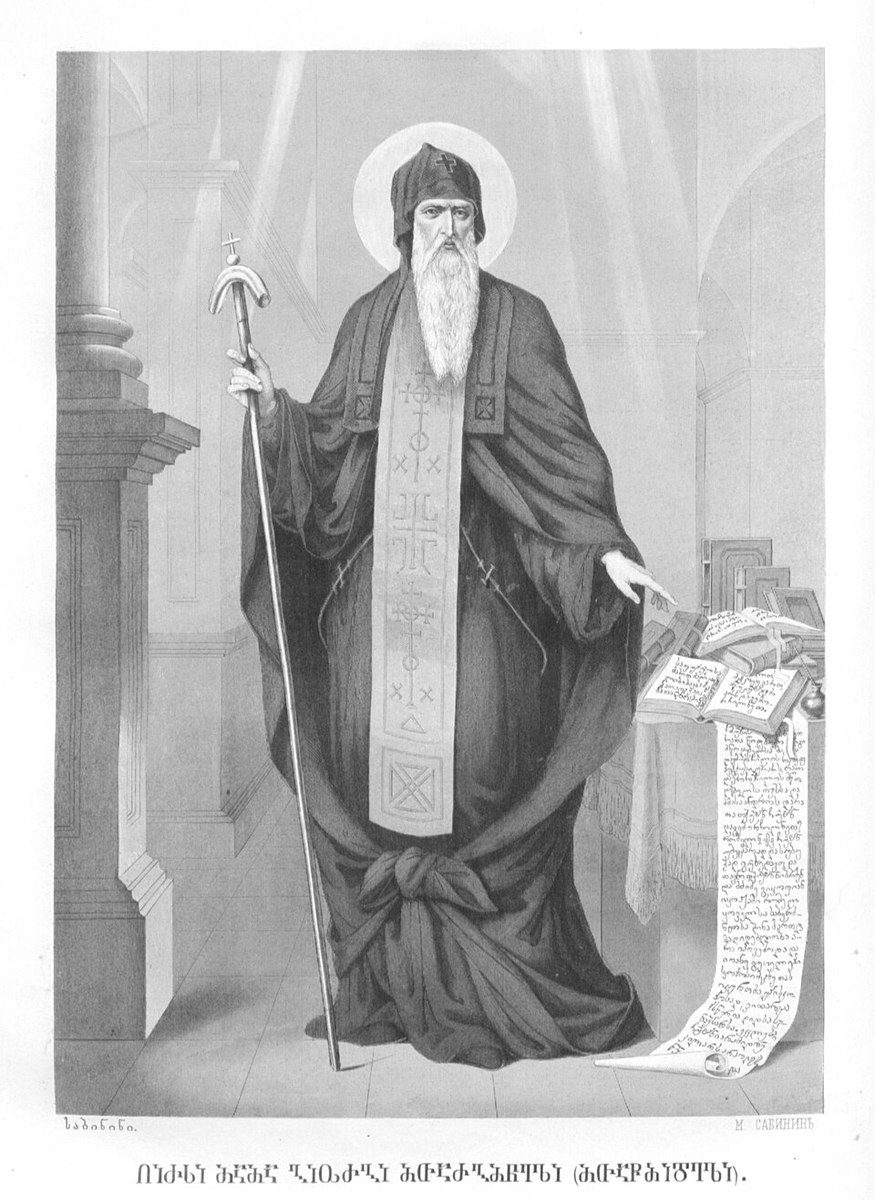
George the Hagiorite is painted as an aged monastic father of the great schema — long white beard, the koukoulion or klobuk, the mantle — and his attribute is books. Where a distinct type exists he is shown at a writing-desk or beside a lectern with open codices and an unrolled scroll in Georgian script, the pen or the abbot's staff in his hand; on Athos and in Georgian programmes he stands in the group of the Georgian Athonite fathers with John, Euthymius and Gabriel, and there he is normally the figure holding the book. Georgian inscriptions give him as წმ. გიორგი მთაწმინდელი.
The image stored here is the plate from Mikhail Sabinin's The Paradise of Georgia (საქართველოს სამოთხე, St Petersburg, 1882), the great illustrated corpus of Georgian hagiography: the saint in klobuk and mantle with the epitrachelion, holding the pastoral staff, his hand extended over a desk of open Georgian books with a long written scroll falling from it — the translator's portrait rather than the abbot's. It is a nineteenth-century academic composition rather than a Byzantine panel, and an older Athonite or Georgian image would be an improvement if one can be located. A Commons file captioned "Iviron fresco of George of Athos" and dated to the tenth century was examined and rejected: a fresco of a man who died in 1065 cannot be of the tenth century, and the file is in any case a frame captured from a modern documentary film, so neither the date nor the licence can be relied on.
Disputed questions
- He is not the George of the May 13 Greek notice. The Greek Great Synaxaristes commemorates on May 13, among the Georgian fathers of Iviron, Ὁ Ὅσιος Γεώργιος ὁ Ἴβηρας, of whom it says only that he was chosen hegoumenos after the resignation of Euthymius and reposed in peace — see George the Iberian. English calendars, following the Orthodox Church in America, have repeatedly identified that man with the Hagiorite, and the Russian books give both the same epithet, Иверский / Святогорец, which invites the confusion. The identification is chronologically impossible. Euthymius governed Iviron some fourteen years from 1005 and laid down the abbacy in or about 1019; George the Hagiorite was born about 1009 and was a child of ten in that year, was in Constantinople as a schoolboy through the 1020s, was tonsured only about 1034, and did not reach Athos until 1040 or hold the abbacy until 1044 — a quarter-century after the succession the May 13 notice describes. They are two Georgian abbots of the same house and the same name, a generation apart. This entry and the May 13 entry are therefore both retained, with reciprocal notes.
- Where and on what day did he die? The Georgian tradition and the Life by George the Lesser put his death at Constantinople, on the eve or the feast of Saints Peter and Paul — that is, 29 June 1065. Some modern reference works give Athens as the place (an error, or a confusion of Athos with Athenai), and the date 27 June, harmonising it with the feast. The commemoration has stood on June 27 in the Georgian and Greek books regardless, and the discrepancy of two days is not resolvable from the sources.
- A third George. His own elder on the Black Mountain, George the Solitary, the Recluse (†1068, July 3), is a distinct saint, and his biographer George the Lesser a fourth man of the name. Not to be confused, further, with George the Great-Martyr (April 23), George of Amastris, George of Mytilene, George the Chozebite, George of Maleon, George of Vladimir or George the New of Sofia.