
Maruthas of Martyropolis
Our Venerable Father Maruthas, Bishop of Martyropolis (Maiferkat)
Bishop · Venerable · b. 4th century, in Sophanene (Mesopotamia) — d. c. 422, at Martyropolis (Maiferkat)
Commemorated 16 February — Commemoration with the Persian martyrs of Martyropolis
Maruthas (died c. 422) was the Syrian bishop of Maiferkat in Mesopotamia — a learned man and, by repute, a physician — who gathered into his episcopal city the relics of the many Christians slain in the great persecution of the Persian king Shapur II, so that his see came to be called Martyropolis, the "city of martyrs." Trusted at the court of the Persian king Yazdegerd I and honoured by the emperors of Constantinople, he served repeatedly as an envoy between Rome and Persia, and used that favour to win peace for the Church of Persia after decades of blood. He presided, with the catholicos Isaac, at the Synod of Seleucia-Ctesiphon (410) that gave the Persian Church its ordered structure and received the Nicene faith. He wrote acts of the Persian martyrs and other works, and is venerated in East and West alike.
.jpeg)
Bishop of Maiferkat
Maruthas was a Syriac-speaking Christian of upper Mesopotamia, of the region of Sophanene on the Roman side of the frontier, and became bishop of Maiferkat (Miyafarqin; Greek Martyropolis, Arabic Mayyafariqin) before the close of the fourth century. He was a man of wide learning — versed in the Scriptures and in the doctrine of the Church, and, the tradition insists, skilled in the healing of the body as well as the soul, a physician whose art opened to him doors that were closed to other churchmen. He took part in the affairs of the wider Church early: he was present at councils in the Roman East, and is associated with the reaction against the Messalian error and with the memory of the exiled John Chrysostom, to whose cause he was sympathetic.
The city of martyrs
The deed for which his city and his name are joined forever was the gathering of the relics of the Persian martyrs. Across the fourth century the Church within the Sasanian empire had suffered a persecution of terrible length under Shapur II — bishops, clergy, ascetics, and laity without number put to death over some forty years (the martyrs whom the calendars keep under Shapur: bishops such as Sadoth of Persia, Milos of Persia, Abdias, and their companions). Maruthas laboured to recover the bodies and bones of these martyrs from Persia and to translate them across the border into Maiferkat, enriching his city with so great a treasure of relics that it was renamed Martyropolis — "city of the martyrs" — and became a centre of their veneration. To preserve their memory he is credited with composing Acts of the Persian Martyrs and a martyrology, so that the Syriac Church's record of that age owes much to his hand.
Peacemaker between the empires
Maruthas's standing at the Persian court is the second thread of his story. Under Yazdegerd I (399–420), a king milder toward the Christians than his predecessors, Maruthas won a remarkable favour — by his affable and holy life and (the sources add) by his medical skill, healing the king or those about him. The emperors Arcadius and Theodosius II employed him as their ambassador to Persia, and he used the trust of both courts to serve the Church: he helped turn Yazdegerd toward toleration, so that the churches destroyed in the persecution might be rebuilt and the faith practised in peace. A famous story — told with the relish of hagiography — has the Zoroastrian magi, jealous of his influence, hiding a man beneath the fire-altar to cry out as though the sacred fire itself denounced the bishop; Maruthas exposed the fraud, and the king's esteem for him grew the greater.
The organising of the Persian Church
The fruit of this peace was the Synod of Seleucia-Ctesiphon in 410, held under the presidency of the catholicos Isaac with Maruthas as the emperor's representative and the chief architect of its work. The synod set the Church of Persia in order under the catholicos of Seleucia-Ctesiphon as its head, received the canons and the Creed of Nicaea, and regularised the sees and the discipline of a Church that persecution had scattered. Maruthas thus stands among the founders of the ordered life of the Church of the East, having brought to it both the Nicene faith and a settled constitution. He is said also to have translated Greek conciliar canons into Syriac and to have written liturgical and exegetical works.
Repose
Maruthas returned to his own city and reposed there in peace about the year 422 (some place his death a little earlier, before 420). He was buried among the martyrs whose relics he had gathered, and Martyropolis kept his memory with theirs. He is honoured as Ὅσιος — a holy and venerable bishop — in the Byzantine calendars, and as a saint in the Syriac, Latin, and Oriental Churches; his feast in the East is kept on February 16 with the martyrs of his city, and the Roman martyrology commemorates him on December 4.
Feast and commemoration
Maruthas is kept on February 16 (church date; Old Calendar civil March 1) in the Byzantine calendars, together with the Persian martyrs of Martyropolis whose relics he gathered — the two commemorations belonging together, the bishop and the martyrs of his city. The Roman martyrology and some Eastern reckonings keep him on December 4. He is venerated across the Eastern Orthodox, Oriental Orthodox, and Latin traditions, a rare bond across the divisions that opened in the century after his death.
Hymns
Troparion — Tone 4
O guide of Orthodoxy, teacher of piety and holiness, luminary of the world, God-inspired adornment of hierarchs: by thy teaching thou hast enlightened all, O harp of the Spirit. O Father Maruthas, intercede with Christ our God that our souls may be saved.
Original translation from the Greek
Kontakion — Tone 2
As a physician of bodies and a shepherd of souls, thou didst gather the martyrs of Persia into thy city and win peace for the Church, O holy Maruthas; wherefore we honour thee, O adornment of hierarchs and companion of the martyrs.
Original translation from the Greek
Iconography
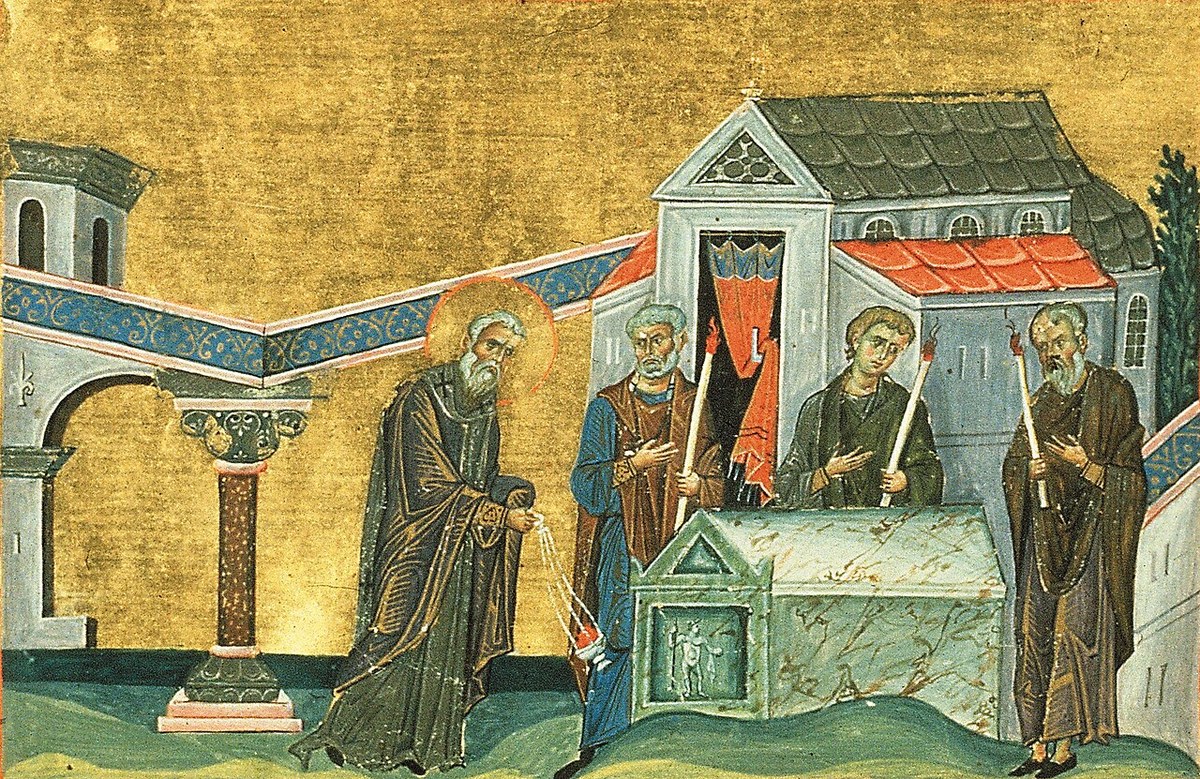
Maruthas is depicted as a bishop of the Syrian East — vested in the phelonion and omophorion, holding the Gospel-book — an elder with a full beard, in the settled hierarch type. Where his particular story is shown, he may be depicted receiving or bearing the relics of the martyrs into his city.
The stored image is the miniature for his commemoration from the Menologion of Basil II (Constantinople, c. 985; Vatican, Vat. gr. 1613), inscribed with his name as bishop of Martyropolis (source, public domain, pd-old-work).
Disputed questions
- Not one of the Persian martyrs. Maruthas is commemorated with the Persian martyrs of Martyropolis, and his name stands close to theirs in the synaxaria, but he was not himself martyred: he died in peace in his own see. The OCA notice that he "suffered for his faith under Sapor" compresses the truth — he suffered for the martyrs, gathering and honouring their remains, in the reigns after Shapur's persecution. He is to be distinguished from the several companies of actual Persian martyrs already in this collection (e.g. Sadoth of Persia, Milos of Persia, James the Persian, and the martyrs under James of Nisibis's generation): he is their rememberer and reliquary-keeper, not one of their number.