
Matthias the Apostle
The Holy and Glorious Apostle Matthias, numbered with the Eleven
Apostle · Apostle of the Seventy · Martyr · d. c. 63
Commemorated 30 June — Synaxis of the Holy Twelve Apostles, 9 August — Martyrdom, and his numbering with the Eleven
Matthias is the one member of the Twelve who was not called by the Lord in Galilee but chosen by lot in the ten days between the Ascension and Pentecost, when Peter stood up among the hundred and twenty and proposed that the place forfeited by Judas be filled (Acts 1:15–26). Already a disciple who had followed Christ "from the baptism of John" and numbered among the Seventy, he was set beside Joseph Barsabbas called Justus; the lot fell on him, "and he was numbered with the eleven apostles." The tradition sends him to preach in Judaea and then in Ethiopia — which the synaxaria locate on the eastern shore of the Black Sea, in Colchis — where he endured great hardship and was at last put to death, about the year 63. He is commemorated on August 9, and again with the whole college on the Synaxis of the Twelve, June 30.

Origins and early life
The Byzantine tradition, following the Great Synaxaristes and the menologia, makes Matthias a native of Bethlehem, of the tribe of Judah. It relates that from childhood he was given to the study of the Law under the guidance of the righteous Symeon the God-receiver — the aged man who took the infant Christ in his arms in the Temple — so that the boy was formed in the very expectation of the Messiah before he ever saw Him. When the Lord began to preach, Matthias believed and attached himself to Him, and he is reckoned among the Seventy whom Christ sent out two by two before His face (Luke 10:1). This is the whole of what the synaxaria transmit of his early life, and it is transmitted as tradition rather than as record: the New Testament says of him only what the requirement of Acts 1:21–22 implies — that he had "companied with us all the time that the Lord Jesus went in and out among us, beginning from the baptism of John, unto that same day that he was taken up." That single clause is the one indisputable fact of his life before his election: he had been there, unnamed, from the Jordan to the Mount of Olives.
The choosing by lot
The scene is the upper room in Jerusalem, in the ten days between the Ascension and the descent of the Spirit. Peter rose in the midst of about a hundred and twenty and spoke of the end of Judas, applying to him two psalms — "let his habitation be desolate, and let no man dwell therein," and "his bishopric let another take" (Psalms 68:26 and 108:8 LXX; Acts 1:20). The word rendered bishopric is ἐπισκοπή, "oversight," and the Fathers read the whole episode as the first ecclesiastical act of the Church: the filling of a vacant see by the assembly, under a scriptural warrant.
Peter laid down the qualification, and it is a strict one: the man must have been an eyewitness of the whole public ministry, "beginning from the baptism of John, unto that same day that he was taken up from us," so as to be "a witness with us of his resurrection." Two men in that company met it: Joseph called Barsabbas, who was surnamed Justus, and Matthias. The assembly did not vote between them. It prayed — "Thou, Lord, which knowest the hearts of all men, shew whether of these two thou hast chosen, that he may take part of this ministry and apostleship" — and then "they gave forth their lots; and the lot fell upon Matthias; and he was numbered with the eleven apostles" (Acts 1:23–26).
Three things in that sentence have occupied the commentators ever since. The first is the lot itself: the last appearance in Scripture of a mode of discernment that runs from the casting of lots for the scapegoat to the choosing of Zacharias to burn incense, and which the Church never uses again after Pentecost, the Spirit having come. The second is the verb: Matthias was not made an apostle but numbered (συγκατεψηφίσθη) with the eleven — the college being twelve by the Lord's own institution, answering to the twelve tribes and to the twelve thrones of the judgement (Matthew 19:28), and therefore requiring to be twelve again before the Spirit descended upon it. The third is the silence that follows: neither Matthias nor Joseph Justus is ever named again in the New Testament, and the Church has never taken that silence as a verdict.
Apostolic labours
After Pentecost, Matthias preached first in Jerusalem and Judaea with the rest, and then went out to the portion assigned him. Eusebius records the early tradition that the world was apportioned among the apostles by lot; the synaxaria give Matthias Ethiopia, and are careful — where they are careful at all — to mean by that name not the Nubian kingdom of the upper Nile but the "second" or "inner" Ethiopia of ancient usage: the wild country at the eastern end of the Black Sea, Colchis, the modern western Georgia and Abkhazia. Other notices carry him with Peter and Andrew through Antioch, Cappadocia and the region of Amasea on the Pontic shore, and one strand of the tradition adds Macedonia.
The stories attached to the Ethiopian mission are of the type that grew up around the apostolic journeys and were freely repeated in the menologia. In one, the pagans forced upon him a poisoned draught which had blinded some two hundred and fifty prisoners before him: he drank it in the name of Christ, took no harm, and restored the sight of all who had been blinded. In another, a mob came against him and the earth opened and swallowed his pursuers. In a third, the flood of a river was turned back at his prayer. The Coptic Acts place him among the anthropophagi — "the city of the man-eaters" — a setting the Greek Acts of Andrew and Matthias shares, in one of the clearest cases in the apocryphal literature of two similar names (Matthias and Matthew) being exchanged in transmission.
In Georgia the mission is not only remembered but localised. Local tradition places the apostle's grave at the Roman fort of Gonio-Apsaros near the mouth of the Chorokhi, on the coast south of Batumi, where a spot within the fortress walls is shown and venerated as his tomb to this day — one of the several rival claims to his relics, and the only one that stands where the Byzantine synaxaria actually send him.
Martyrdom
The Byzantine account brings him back to Jerusalem for his death. Arrested at the order of the high priest Ananias, he was brought before the Sanhedrin and made his defence out of the prophets, showing that Jesus is the Christ whom the Law and the prophets had promised; and the council, unable to answer him, condemned him. Two false witnesses were suborned against him, as against Stephen, and he was stoned; and — the notices agree — after he was dead the Jews struck off his head, so that it might appear to the Romans that he had died as an enemy of Caesar. The date usually given is about the year 63.
A second and equally old tradition has him crucified, in Colchis or in Jerusalem, and it is this that the couplet of the synaxarion for August 9 celebrates in an antithesis which cannot be reproduced in English without loss: Judas went out and was lifted up on a rope; Matthias went in and was lifted up on the wood. The one hanged himself and fell out of the apostolate; the other was hanged upon the cross and entered it. Set against both stands the sober note of Hippolytus of Rome, who says simply that Matthias died of old age at Jerusalem. The Church has never had to choose: the couplet is sung, the synaxarion notice tells the stoning, and the entry is honest that the manner of his death is not known.
Relics and translations
No apostle's relics have been claimed in more places. The Western tradition, which is much the loudest, holds that the Empress Helena brought his body from Jerusalem to Rome, and that a part of it was afterwards carried north to Trier, where the Benedictine Abbey of St Matthias (St Matthias-Abtei) preserves the tomb and is, on that claim, the only grave of an apostle north of the Alps — a pilgrimage of the Rhineland and the Moselle since the twelfth century. The remainder is claimed at Santa Maria Maggiore in Rome, with a further portion at the Abbey of Santa Giustina in Padua. In the East, a fragment is venerated at the Monastery of Kykkos in Cyprus, and the Georgian claim at Gonio-Apsaros is described above. The claims are not reconcilable, and the older of them cannot be traced behind the medieval translation-narratives; this entry records them and does not adjudicate between them.
Hymnographic and literary legacy
Two apocryphal works bear his name and neither is his. Clement of Alexandria quotes with approval, and Origen and Eusebius knew of, a book called the Traditions of Matthias (Παραδόσεις Ματθίου) — a collection of ascetic sayings, of which the best-known counsels that a man must "fight with the flesh and abuse it, yielding it nothing for pleasure." A Gospel of Matthias is named in the lists of rejected books by Eusebius and in the Gelasian Decree, and was apparently a Gnostic composition; nothing certain survives of it. The Acts of Andrew and Matthias among the Cannibals, a popular Greek romance of the apocryphal acts, is by its own internal evidence about Matthew, and its transfer to Matthias is a scribal accident of long standing — but it is the source of most of the picturesque matter that has attached to his name, including the version rendered in Old English as Andreas.
Feast and commemoration
August 9 (church date; Old Calendar civil August 22). The day falls within the afterfeast of the Transfiguration (August 6–13) and within the Dormition Fast (August 1–14), so the apostle's office is sung with the hymns of Tabor and kept on a fasting day; the rank is that of an apostle with a full office in the Menaion. He is commemorated a second time, with the whole college, at the Synaxis of the Holy Twelve Apostles on June 30.
The Western calendar diverges. Rome kept his feast on 24 February (25 February in leap years) from the eleventh century, and moved it in the 1969 revision to 14 May, so as to place it within the Paschal season and near the Ascension, where Acts sets the event; the older date survives in the traditional Roman calendar and in the Lutheran and Anglican kalendars. Trier, holding his tomb, keeps him with special solemnity.
Hymns
Apolytikion — Tone 3
O holy Apostle Matthias, make entreaty to the merciful God, that He grant unto our souls forgiveness of transgressions.
Kontakion — Tone 4
Thy word went forth over the world like a sun of many rays, enlightening with its beams the whole creation, O Matthias worthy of all wonder, apostle of God.
Original translation from the Greek
Appointed readings
Epistle — Acts 1:12–17, 21–26
12Then returned they unto Jerusalem from the mount called Olivet, which is from Jerusalem a sabbath day’s journey. 13And when they were come in, they went up into an upper room, where abode both Peter, and James, and John, and Andrew, Philip, and Thomas, Bartholomew, and Matthew, James the son of Alphaeus, and Simon Zelotes, and Judas the brother of James. 14These all continued with one accord in prayer and supplication, with the women, and Mary the mother of Jesus, and with his brethren. 15And in those days Peter stood up in the midst of the disciples, and said, (the number of names together were about an hundred and twenty,) 16Men and brethren, this scripture must needs have been fulfilled, which the Holy Ghost by the mouth of David spake before concerning Judas, which was guide to them that took Jesus. 17For he was numbered with us, and had obtained part of this ministry. 21Wherefore of these men which have companied with us all the time that the Lord Jesus went in and out among us, 22Beginning from the baptism of John, unto that same day that he was taken up from us, must one be ordained to be a witness with us of his resurrection. 23And they appointed two, Joseph called Barsabas, who was surnamed Justus, and Matthias. 24And they prayed, and said, Thou, Lord, which knowest the hearts of all men, shew whether of these two thou hast chosen, 25That he may take part of this ministry and apostleship, from which Judas by transgression fell, that he might go to his own place. 26And they gave forth their lots; and the lot fell upon Matthias; and he was numbered with the eleven apostles.
Gospel — Luke 9:1–6
1Then he called his twelve disciples together, and gave them power and authority over all devils, and to cure diseases. 2And he sent them to preach the kingdom of God, and to heal the sick. 3And he said unto them, Take nothing for your journey, neither staves, nor scrip, neither bread, neither money; neither have two coats apiece. 4And whatsoever house ye enter into, there abide, and thence depart. 5And whosoever will not receive you, when ye go out of that city, shake off the very dust from your feet for a testimony against them. 6And they departed, and went through the towns, preaching the gospel, and healing every where.
Iconography
Matthias is painted as an apostle of middle years: dark hair, a full rounded beard, the chiton and himation of the apostolic company, holding a scroll or a closed codex and blessing. He has no distinguishing instrument of his own in the Byzantine tradition — the West gives him the axe or halberd of a beheading, and sometimes a stone, but Greek practice leaves him without an attribute and identifies him by the inscription Ο ΑΓΙΟϹ ΑΠΟϹΤΟΛΟϹ ΜΑΤΘΙΑϹ. In the ranks of the apostles in a Deesis tier, or in the Pentecost image where the Twelve sit in the horseshoe of thrones, his place is at the end of the series, and it is his presence that makes the Pentecost icon an image of a college restored to its number rather than of eleven mourners.
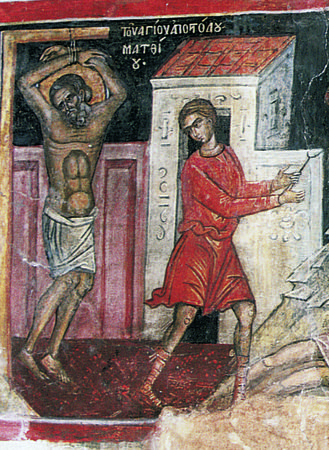
Two narrative subjects belong to him. The first is the choosing of the lot: the eleven standing in the upper room, Peter with hand raised in speech, Matthias and Joseph Justus set apart on either side. The second is his martyrdom, which is what the Athonite painters preferred. The image stored here is from the wall-paintings of the Monastery of Dionysiou on Mount Athos, dated 1547 — work of the Cretan school in the generation after Theophanes — and shows the apostle stripped and bound by the wrists to a post before a colonnaded building, an executioner in a red tunic striding towards him, and the ground beneath him already dark with blood; the inscription above reads ΤΟΥ ΑΓΙΟΥ ΑΠΟϹΤΟΛΟΥ ΜΑΤΘΙΑ, "of the holy Apostle Matthias."
Disputed questions
- Was the election of Matthias valid? A strand of modern Protestant commentary — never represented in the Fathers, and unknown to the Orthodox tradition — holds that the eleven acted prematurely in the ten days before the Spirit came, that the lot was an Old Testament expedient improperly used, and that God's own twelfth apostle was Paul. The Orthodox reading is the plain one: St Luke, writing under the Spirit's inspiration and after the fact, records the choice without a syllable of censure, describes the prayer that preceded it, and says that Matthias "was numbered with the eleven"; and the very next chapter opens with "the twelve" receiving the Spirit together. Chrysostom, preaching on Acts, praises Peter's restraint — he does not appoint, he sets the two before God and leaves the choice to Him — and takes the lot not as superstition but as the assembly's refusal to prefer one of its own by human judgement. The Church has never entertained the suggestion that a name written in the Acts of the Apostles is a mistake.
- Paul and the Twelve. The question is a real one but is not a rivalry. Paul was not of the Twelve and never claimed to be: he did not walk with the Lord in Galilee, and could not have met Peter's criterion at all. He is an apostle of another and later kind — called from heaven on the Damascus road, "as of one born out of due time," "the least of the apostles," who "laboured more abundantly than they all" (1 Corinthians 15:8–10). Byzantine usage keeps the two orders distinct and honours both without confusion: Paul is a Koryphaios, one of the two Chief Apostles with Peter on June 29; the Twelve as a college are gathered on June 30, and Matthias stands twelfth among them. The Apocalypse settles the arithmetic in its own way, giving the wall of the city twelve foundations bearing "the names of the twelve apostles of the Lamb" (Revelation 21:14) — a number the tradition has never tried to make thirteen.
- Which Ethiopia? The synaxaria's "Ethiopia" is the inner or second Ethiopia of the ancient geographers — the Colchian and Abkhazian coast of the Black Sea — and not the African kingdom evangelised in tradition by Matthew the Evangelist. The two apostles' names, both missions to an "Ethiopia," and the exchange of Matthew for Matthias in the apocryphal Acts have kept the confusion alive for fifteen centuries.
- Not to be confused with Matthew the Evangelist (the publican, November 16), whose name in Greek differs from his by two letters and whose mission field bears the same name; and the Justus set beside him is Joseph Barsabbas of the Seventy (October 30), not Justus of Rome.