
Paul the Apostle
The Holy, Glorious and All-Praised Chief Apostle Paul
Apostle · Martyr · b. Tarsus in Cilicia, c. 5–10; of the tribe of Benjamin, a Roman citizen by birth — d. c. 67 at Rome (c. 64–68 in the sources), beheaded at Aquae Salviae under Nero
Commemorated 29 June — Martyrdom at Rome, kept jointly with the Apostle Peter as the feast of the Chief Apostles
Paul — Saul of Tarsus, Pharisee, pupil of Gamaliel, and the fiercest persecutor the infant Church knew — was struck down on the Damascus road by the light and the voice that asked, "Saul, Saul, why persecutest thou me?", and rose from it the Apostle of the Nations. From Antioch, where the disciples were first called Christians and where he was sent out with Barnabas, he crossed and recrossed the Roman world on three great journeys, planting churches from Cyprus and Galatia to Macedonia, Athens, Corinth and Ephesus, and leaving behind the fourteen epistles that have shaped Christian theology more than any writing outside the Gospels. Arrested at Jerusalem, held two years at Caesarea, he appealed to Caesar as a Roman citizen, was shipwrecked on Malta, and reached Rome in chains. There, about the year 67, under Nero, he was beheaded at the place afterwards called the Three Fountains, and buried on the Ostian Way. The Church calls him, with Peter, prōtokoryphaios — chief and first-throned of the apostles — and keeps their memory together on June 29.
.jpg)
Saul of Tarsus
He was born at Tarsus in Cilicia, "no mean city" (Acts 21:39) — a Hellenistic university town on the Cydnus, a seat of Stoic philosophy, and a free city of the Empire — probably in the first decade of the Christian era. His family were Jews of the tribe of Benjamin (Rom. 11:1; Phil. 3:5), Pharisees and the sons of Pharisees (Acts 23:6), and they held Roman citizenship by birth: "But I was free born," he tells the tribune who had bought his own citizenship at a great price (Acts 22:28). The double name is not a conversion-name but the ordinary bilingual arrangement of a diaspora Jew with Roman status — Saul (Šaʾul, "asked for," the name of Benjamin's king) among his own people, Paulus in the Greek and Latin world.
Like every rabbinical student he was taught a trade, and his was tentmaking, or more exactly leatherworking (σκηνοποιός, Acts 18:3) — the trade of the Cilician goat-hair cloth called cilicium. He worked at it all his life, "labouring, working with our own hands" (1 Cor. 4:12), so as to be chargeable to no church, and it was the trade that brought him into the house of Aquila and Priscilla at Corinth.
He was sent up to Jerusalem and "brought up at the feet of Gamaliel, taught according to the perfect manner of the law of the fathers" (Acts 22:3) — Gamaliel the Elder, grandson of Hillel, the most respected teacher of his generation and the man whose counsel of restraint stayed the Sanhedrin's hand against the apostles (Acts 5:34–39). The pupil did not inherit the master's caution. "I profited in the Jews' religion above many my equals in mine own nation, being more exceedingly zealous of the traditions of my fathers" (Gal. 1:14).
The persecutor
He first appears in the Acts at the stoning of Stephen the Protomartyr: "the witnesses laid down their clothes at a young man's feet, whose name was Saul... And Saul was consenting unto his death" (Acts 7:58; 8:1). What followed he described himself, without mitigation, to the end of his life: "I persecuted this way unto the death, binding and delivering into prisons both men and women" (Acts 22:4); "beyond measure I persecuted the church of God, and wasted it" (Gal. 1:13); "I am the least of the apostles, that am not meet to be called an apostle, because I persecuted the church of God" (1 Cor. 15:9). He entered house after house, haling out men and women; he gave his vote against them when they were put to death; and he "made havock of the church" — the Greek verb is the one used of a wild boar ravaging a vineyard.
Not content with Jerusalem, "yet breathing out threatenings and slaughter," he obtained letters from the high priest to the synagogues at Damascus, that if he found any of the Way he might bring them bound to Jerusalem.
The Damascus road
The Acts tell the story three times — once as narrative and twice from Paul's own mouth, before the Jerusalem mob and before Agrippa — a repetition without parallel in the book, and the measure of what the event meant. As he came near Damascus about midday there shone a light out of heaven above the brightness of the sun; he fell to the earth, and heard a voice: "Saul, Saul, why persecutest thou me?" He asked, "Who art thou, Lord?" and the answer was, "I am Jesus whom thou persecutest" (Acts 9:3–5; 22:6–8; 26:13–15). In the third telling the Lord adds the Greek proverb, "it is hard for thee to kick against the pricks."
The Fathers dwell on the pronoun. The Lord does not say "why persecutest thou my disciples," but "me"; the whole Pauline theology of the Church as the Body of Christ is latent in that word, and Paul spent the rest of his life unfolding it.
He rose blind, was led by the hand into the city, and for three days neither ate nor drank. Then the Lord sent Ananias of Damascus, of the Seventy, who came in fear — "Lord, I have heard by many of this man, how much evil he hath done to thy saints at Jerusalem" — and was told, "Go thy way: for he is a chosen vessel unto me, to bear my name before the Gentiles, and kings, and the children of Israel: for I will shew him how great things he must suffer for my name's sake" (Acts 9:15–16). Ananias laid his hands on him, "and immediately there fell from his eyes as it had been scales," and he was baptised. He preached Christ in the synagogues of Damascus at once, "that he is the Son of God," to the confusion of everyone who had heard why he came.
Arabia, and the years of silence
Galatians supplies what Acts compresses. "I conferred not with flesh and blood: neither went I up to Jerusalem to them which were apostles before me; but I went into Arabia, and returned again unto Damascus. Then after three years I went up to Jerusalem to see Peter, and abode with him fifteen days" (Gal. 1:16–18). "Arabia" here means the Nabataean kingdom south and east of Damascus, under Aretas IV; how long he stayed and what he did there the sources do not say, and the Church has been content to call them years of prayer and of the revelation "not after man" which he insists he received directly. It was on his return that the ethnarch of Aretas set a watch on the gates to take him, and the disciples let him down over the wall in a basket — the first of the humiliations he lists ironically among his credentials (2 Cor. 11:32–33; Acts 9:23–25).
At Jerusalem the disciples were afraid of him until Barnabas took him and brought him to the apostles. Threatened again, he was sent home to Tarsus, and there he disappears from the record for some years.
Antioch
He was brought back into the Church's history by Antioch. When the Gospel first passed to Greeks in that city, the Jerusalem church sent Barnabas to see it; and Barnabas, finding the work greater than one man could hold, "departed to Tarsus, for to seek Saul: and when he had found him, he brought him unto Antioch. And it came to pass, that a whole year they assembled themselves with the church, and taught much people. And the disciples were called Christians first in Antioch" (Acts 11:25–26).
The sentence is the charter of the Antiochian Church, and it is the making of Paul. Antioch — the third city of the Empire, Greek-speaking, mixed, on the road to everywhere — became the base of his whole apostolate. From Antioch he and Barnabas carried the famine relief to Judaea; from Antioch, "as they ministered to the Lord, and fasted," the Holy Spirit said, "Separate me Barnabas and Saul for the work whereunto I have called them," and they were sent out with prayer and the laying on of hands (Acts 13:1–3) — the first missionary sending in Christian history, and it happened not at Jerusalem but at Antioch. To Antioch he returned from the first journey and from the second, and it was at Antioch that he withstood Peter to the face over table fellowship with the Gentiles (Gal. 2:11–14), an episode treated at length in Peter's entry. The prophets and teachers named with him in that Antiochian church — Simeon called Niger, Lucius of Cyrene, Manaen the foster-brother of Herod — are a fair portrait of the city that produced him.
The three journeys
The first journey (c. 46–48), with Barnabas and John Mark: Seleucia, then Cyprus, where at Paphos the proconsul Sergius Paulus believed and the sorcerer Elymas was struck blind — and from this point Luke calls him Paul and not Saul, and names him before Barnabas. Then over to the mainland (John Mark turning back at Perga, which caused the later parting with Barnabas), and inland to Antioch of Pisidia, Iconium, Lystra and Derbe. At Antioch of Pisidia he preached the sermon that ends with the turn to the Gentiles: "Lo, we turn to the Gentiles." At Lystra he healed a man lame from birth, and the crowd, taking Barnabas for Zeus and Paul for Hermes "because he was the chief speaker," brought oxen and garlands to sacrifice to them, and were barely restrained; days later the same crowd stoned Paul and dragged him out of the city for dead. He got up and went back in. It is at Iconium, in the second-century Acts of Paul and Thecla, that Thecla heard him preach.
The Council of Jerusalem (c. 49) intervened: the demand that Gentile converts be circumcised was carried up from Antioch, and Paul and Barnabas were the advocates of freedom. The Council's decree — "It seemed good to the Holy Ghost, and to us, to lay upon you no greater burden than these necessary things" (Acts 15:28) — vindicated the Antiochian practice and settled the shape of the Church.
The second journey (c. 49–52), with Silas after the parting from Barnabas: through Syria and Cilicia; at Lystra he took Timothy; then, forbidden by the Spirit to preach in Asia and Bithynia, the vision at Troas of the man of Macedonia — "Come over into Macedonia, and help us" — and with it the crossing of the Gospel into Europe. At Philippi: Lydia the seller of purple, the slave-girl with the spirit of divination, the beating and the inner prison, the midnight hymns and the earthquake, and the jailer baptised before dawn. At Thessalonica and Beroea, riots and flight. At Athens, the speech on the Areopagus before the Stoics and Epicureans — "as I passed by, and beheld your devotions, I found an altar with this inscription, TO THE UNKNOWN GOD" — which most of his hearers mocked, but from which came Dionysius the Areopagite and Damaris. At Corinth, eighteen months in the house of Aquila and Priscilla, the tentmakers, and the acquittal before the proconsul Gallio — whose term is dated by an inscription at Delphi to 51–52, and is the fixed point from which the whole Pauline chronology is reckoned.
The third journey (c. 53–57) centred on Ephesus, where he taught for over two years in the school of Tyrannus, "so that all they which dwelt in Asia heard the word," where the books of magic were burned, and where the silversmith Demetrius raised the riot of the shrine-makers of Artemis and the theatre roared for two hours, "Great is Diana of the Ephesians." From Ephesus and from Macedonia the Corinthian correspondence was written. The journey ended with the collection for the poor of Jerusalem carried up by delegates from the Gentile churches, and with the farewell to the elders of Ephesus at Miletus (Acts 20:17–38) — "I have not shunned to declare unto you all the counsel of God... Take heed therefore unto yourselves, and to all the flock, over the which the Holy Ghost hath made you overseers" — the earliest pastoral charge to bishops in Christian literature, and the kneeling on the shore afterwards, "sorrowing most of all for the words which he spake, that they should see his face no more."
The epistles and their theology
Fourteen letters stand under his name in the canon received by the Orthodox Church, Hebrews included (on which see Disputed questions). They are occasional writings — answers to crises in particular cities, dictated to secretaries, sometimes with a line added in his own large hand — and out of them the Church has drawn her vocabulary for grace, justification, the Body of Christ, and the last things.
Romans, written from Corinth about 57 to a church he had not founded, is the fullest statement: the universality of sin, Jew and Greek alike; justification by faith in Christ, apart from the works of the Law; baptism as death and resurrection with Christ (Rom. 6); the war of the two laws in the members (Rom. 7); the life in the Spirit and the groaning of the whole creation (Rom. 8); and the three chapters on Israel that refuse every easy answer — "the gifts and calling of God are without repentance."
1 and 2 Corinthians are the most pastoral and the most personal: the factions and the "wisdom of this world"; the discipline of a scandal; food offered to idols and the limits of liberty; the ordering of the assembly and the first written account of the Eucharist ("For I have received of the Lord that which also I delivered unto you," 1 Cor. 11:23); the gifts of the Spirit and the Body with many members; the hymn to love of 1 Corinthians 13; and the great chapter on the Resurrection, which is the Church's answer at every funeral. In 2 Corinthians he defends his apostleship by listing not successes but scourgings, shipwrecks, hunger and "the care of all the churches," and tells of the man caught up to the third heaven and into Paradise, who "heard unspeakable words," and of the thorn in the flesh given lest he be exalted, and the answer he received: "My grace is sufficient for thee: for my strength is made perfect in weakness" (2 Cor. 12:1–9). That passage is the Epistle of his own feast.
Galatians is the manifesto of Christian freedom against the imposition of the Law; Ephesians and Colossians set out the cosmic Christ and the Church as his Body, the mystery hidden from the ages; Philippians, written in chains, carries the hymn of the self-emptying — "he made himself of no reputation, and took upon him the form of a servant" (Phil. 2:5–11), the text at the root of all patristic Christology; 1 and 2 Thessalonians, the earliest of them, treat of the Parousia; the Pastorals to Timothy and Titus give the orders of the ministry; Philemon is a private note on a runaway slave, and one of the gentlest pages in the New Testament; Hebrews expounds the priesthood of Christ after the order of Melchizedek and is the source of the Church's whole language of the heavenly sanctuary.
The Byzantine tradition reads these letters through John Chrysostom, whose homilies on the entire Pauline corpus — preached at Antioch and Constantinople — remain the standard Orthodox commentary, and whose devotion to Paul was such that he confessed he was often carried away by the sound of the words. Chrysostom's seven Panegyrics on St Paul are the finest ancient praise of him in any language.
Arrest, appeal, and the voyage to Rome
At Jerusalem about the year 57, having taken a vow in the Temple at the suggestion of James to show that he had not taught apostasy from Moses, he was recognised by Jews from Asia and seized; the crowd would have killed him but for the Roman tribune, who took him into the Antonia and was about to scourge him when Paul asked whether it was lawful to scourge a Roman uncondemned. He addressed the crowd from the stairs in Aramaic, and split the Sanhedrin the next day by declaring himself a Pharisee on trial for the hope of the resurrection. A plot of forty men who had bound themselves by an oath was betrayed to the tribune by Paul's nephew, and he was taken by night under heavy escort to Caesarea.
There he lay two years under the procurator Felix, who "hoped also that money should have been given him," and who trembled as Paul reasoned of righteousness, temperance and judgement to come. Felix's successor Festus proposed sending him back to Jerusalem, and Paul used the right of a citizen: "I appeal unto Caesar" (Acts 25:11). He made his last and greatest defence before Festus and King Agrippa II with Bernice — the speech that ends with Agrippa's famous half-mocking word, "Almost thou persuadest me to be a Christian," and Paul's answer, "I would to God, that not only thou, but also all that hear me this day, were both almost, and altogether such as I am, except these bonds" (Acts 26:28–29). Agrippa's verdict to Festus was, "This man might have been set at liberty, if he had not appealed unto Caesar."
The voyage that follows (Acts 27) is the most detailed sea narrative to survive from antiquity, written by an eyewitness — Luke, in the "we" passages. Sailing late in the season against Paul's advice, the ship was caught off Crete by the north-easter called Euroclydon, driven for fourteen days, lightened of cargo and tackle, and at last run aground on Malta, all two hundred and seventy-six aboard reaching land alive as Paul had promised. On the island a viper fastened on his hand as he laid sticks on the fire and he shook it off unharmed, and he healed the father of Publius the chief man of the island and many others. After three months they sailed by Syracuse and Rhegium to Puteoli, and the brethren came out to meet him as far as Appii Forum and the Three Taverns, "whom when Paul saw, he thanked God, and took courage."
At Rome he was allowed to dwell by himself with the soldier that kept him, and for two whole years he "received all that came in unto him, preaching the kingdom of God, and teaching those things which concern the Lord Jesus Christ, with all confidence, no man forbidding him" (Acts 28:30–31). With that sentence the Acts of the Apostles end.
The martyrdom
The tradition — followed by most of the Fathers and by the synaxaria — is that Paul was released from this first imprisonment, made a further journey (Clement of Rome says he "reached the limits of the West," which Roman and later writers understood as Spain, and the Pastoral Epistles presuppose travels in Crete, Macedonia and Asia not found in Acts), and was arrested a second time in the Neronian persecution. The second letter to Timothy, whether written then or gathered from that period, is his farewell: "For I am now ready to be offered, and the time of my departure is at hand. I have fought a good fight, I have finished my course, I have kept the faith" (2 Tim. 4:6–7).
As a Roman citizen he could not be crucified or given to the beasts. He was taken out of the city along the Ostian Way to a place among the pines called Aquae Salviae, and there beheaded with the sword, about the year 67, in the same persecution that killed Peter. The place is called Tre Fontane, the Three Fountains, from the tradition — Western, and not found in the Greek synaxaria — that the head bounded three times on the ground and that a spring rose at each place; the same account says that milk and not blood flowed from the severed neck, which the ancient writers took as the sign of the purity of his teaching. He was buried on the Ostian Way in the ground of a Christian matron named Lucina, where Constantine raised the first church and the basilica of San Paolo fuori le Mura stands; excavations under its altar in 2006 uncovered the sarcophagus, undisturbed, bearing the fourth-century inscription PAVLO APOSTOLO MART.
Feast and commemoration
Paul's feast is June 29 (Old Calendar civil July 12), kept jointly with the Apostle Peter as the feast of the Chief Apostles; the day's history and rank are given at the feast entry. It is one of the five great feasts of the fixed year outside the Twelve, served with an all-night vigil, and it closes the Apostles' Fast. In the books there is one office for the two apostles, with a second Matins canon proper to Paul; the OCA and Greek sources also publish a separate life of each under the day, which is the practice followed here.
Paul is not one of the Twelve and so is not named in the June 30 Synaxis of the Twelve Apostles, nor is he of the Seventy; his rank is sui generis, and the Church resolves it by the title prōtokoryphaios, which she gives to him and to Peter alone. He is remembered with his disciples on their own days — Timothy (January 22), Titus (August 25), Silas and Silvanus (July 30), Luke (October 18), Aquila and Priscilla (February 13), Onesimus (February 15) — and in the many commemorations of the Seventy who were his fellow-workers, whose entries fill the autumn of the calendar. The Western calendar keeps the Conversion of St Paul on January 25, a feast the Orthodox East does not observe.
Hymns
Apolytikion — Tone 4
O first-enthroned among the Apostles and teachers of the inhabited world, intercede with the Master of all things to grant peace to the world and to our souls the great mercy.
Kontakion — Tone 2
The steadfast and God-inspired heralds, the chief of thy disciples, O Lord, thou hast taken to thyself for the enjoyment of thy good things and for rest; for their labours and their death thou hast received above every whole burnt offering, O thou who alone knowest the secrets of the heart.
Original translation from the Greek
Appointed readings
Epistle — 2 Corinthians 11:21–12:9
21I speak as concerning reproach, as though we had been weak. Howbeit whereinsoever any is bold, (I speak foolishly,) I am bold also. 22Are they Hebrews? so am I. Are they Israelites? so am I. Are they the seed of Abraham? so am I. 23Are they ministers of Christ? (I speak as a fool) I am more; in labours more abundant, in stripes above measure, in prisons more frequent, in deaths oft. 24Of the Jews five times received I forty stripes save one. 25Thrice was I beaten with rods, once was I stoned, thrice I suffered shipwreck, a night and a day I have been in the deep; 26In journeyings often, in perils of waters, in perils of robbers, in perils by mine own countrymen, in perils by the heathen, in perils in the city, in perils in the wilderness, in perils in the sea, in perils among false brethren; 27In weariness and painfulness, in watchings often, in hunger and thirst, in fastings often, in cold and nakedness. 28Beside those things that are without, that which cometh upon me daily, the care of all the churches. 29Who is weak, and I am not weak? who is offended, and I burn not? 30If I must needs glory, I will glory of the things which concern mine infirmities. 31The God and Father of our Lord Jesus Christ, which is blessed for evermore, knoweth that I lie not. 32In Damascus the governor under Aretas the king kept the city of the Damascenes with a garrison, desirous to apprehend me: 33And through a window in a basket was I let down by the wall, and escaped his hands. 1It is not expedient for me doubtless to glory. I will come to visions and revelations of the Lord. 2I knew a man in Christ above fourteen years ago, (whether in the body, I cannot tell; or whether out of the body, I cannot tell: God knoweth;) such an one caught up to the third heaven. 3And I knew such a man, (whether in the body, or out of the body, I cannot tell: God knoweth;) 4How that he was caught up into paradise, and heard unspeakable words, which it is not lawful for a man to utter. 5Of such an one will I glory: yet of myself I will not glory, but in mine infirmities. 6For though I would desire to glory, I shall not be a fool; for I will say the truth: but now I forbear, lest any man should think of me above that which he seeth me to be, or that he heareth of me. 7And lest I should be exalted above measure through the abundance of the revelations, there was given to me a thorn in the flesh, the messenger of Satan to buffet me, lest I should be exalted above measure. 8For this thing I besought the Lord thrice, that it might depart from me. 9And he said unto me, My grace is sufficient for thee: for my strength is made perfect in weakness. Most gladly therefore will I rather glory in my infirmities, that the power of Christ may rest upon me.
Gospel — Matthew 16:13–19
13When Jesus came into the coasts of Caesarea Philippi, he asked his disciples, saying, Whom do men say that I the Son of man am? 14And they said, Some say that thou art John the Baptist: some, Elias; and others, Jeremias, or one of the prophets. 15He saith unto them, But whom say ye that I am? 16And Simon Peter answered and said, Thou art the Christ, the Son of the living God. 17And Jesus answered and said unto him, Blessed art thou, Simon Bar-jona: for flesh and blood hath not revealed it unto thee, but my Father which is in heaven. 18And I say also unto thee, That thou art Peter, and upon this rock I will build my church; and the gates of hell shall not prevail against it. 19And I will give unto thee the keys of the kingdom of heaven: and whatsoever thou shalt bind on earth shall be bound in heaven: and whatsoever thou shalt loose on earth shall be loosed in heaven.
Iconography
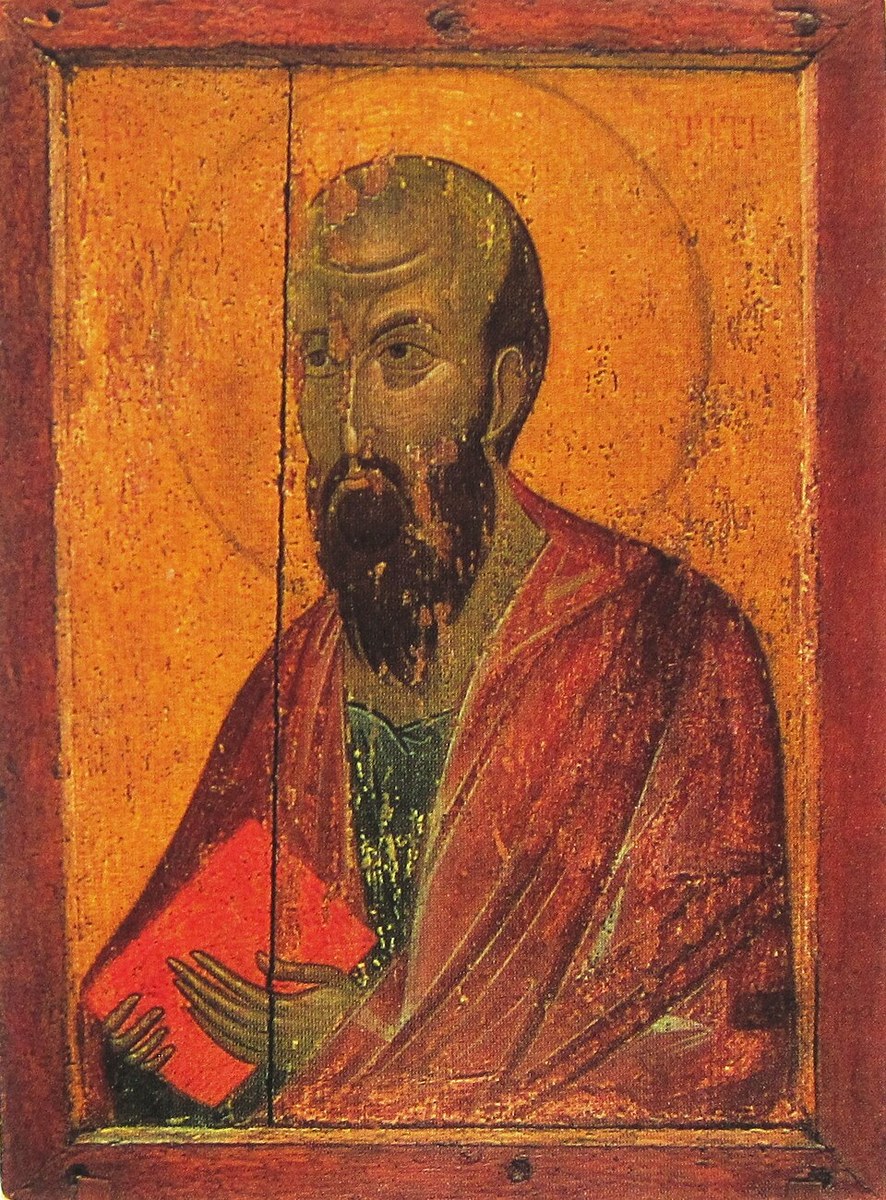
Paul's face is the most sharply individual in Byzantine art, and its features go back to a description in the second-century Acts of Paul and Thecla — a man "small of stature, with a bald head and crooked legs, meeting eyebrows and a somewhat hooked nose, full of grace." The icon keeps the essentials: a high domed bald forehead, a long dark pointed beard, a narrow contemplative face, ordinarily in a blue-green chiton and deep red or purple himation — the reverse of Peter's colours, so that the two read as a pair across a sanctuary. He almost always holds a closed book or codex, the Epistles, pressed to his breast with both hands or with one; the book, and not a scroll, distinguishes him as the writer among the apostles. From the middle Byzantine period he may hold a sword, the instrument of his martyrdom and the "sword of the Spirit, which is the word of God" (Eph. 6:17), and Western art made the sword his fixed attribute. In the Deesis and apostle tiers he stands at Christ's left, balancing Peter; in scenes of the Descent of the Holy Spirit the Byzantine iconographers place him among the apostles although he was not at Pentecost, because the icon shows the Church and not the hour. Narrative cycles give the road to Damascus with the falling horseman, the baptism by Ananias, the escape in the basket, the preaching on the Areopagus, the shipwreck, and the beheading.
The stored image is a fourteenth-century Georgian panel from the Deesis tier of the church at Ubisi, about 1350, now in the Shalva Amiranashvili Museum of Fine Arts at Tbilisi: the apostle bust-length in a red-brown mantle, the bald dome and dark wedge-shaped beard exactly as the type requires, holding the red-bound book of the Epistles in veiled hands. The joint images of the two apostles — the Embrace, and the seventeenth-century Aleppo icon of the Antiochian school — are described at the feast entry.
Disputed questions
The chronology. Almost every date in Paul's life is calculated, not transmitted. The one firm anchor is the Gallio inscription at Delphi, which places the proconsul's year at Corinth in 51–52 and so fixes Acts 18; from it the conversion is put around 34–36, the first journey in the middle 40s, the Council of Jerusalem about 49, the arrest about 57, and the arrival in Rome about 60. The tradition's own figures — Paul's "after three years" and "then fourteen years after" of Galatians 1–2 — can be reckoned inclusively or exclusively and yield a spread of several years either way. The synaxaria are not concerned with the question.
The relation of Acts to Galatians. Whether the Jerusalem visit of Galatians 2 is the famine-relief visit of Acts 11 or the Council of Acts 15 has been argued since antiquity and is not settled; the two reconstructions move the writing of Galatians, and with it the sequence of the Antioch incident, by several years. The Orthodox commentators, following Chrysostom, generally identify it with the Council.
The authorship of Hebrews. The Eastern Church received Hebrews as Paul's from an early date and reads it as his in the Menaion and the lectionary; the Alexandrians already noticed the difficulty. Origen observed that the thoughts are the apostle's but the Greek is better than his, and concluded with a sentence often quoted since — that who actually wrote the epistle, "God knows"; some in his day ascribed the writing to Clement of Rome and some to Luke. Eusebius records that the Roman church for a long time did not count it among Paul's. The Orthodox canon includes it among the fourteen and the Church has never made its attribution an article of faith; modern scholarship is nearly unanimous that Paul did not write it. Both facts are stated here without prejudice to the epistle's authority, which rests on the Church's reception.
The Pastorals and the second Roman imprisonment. The release, the journey to Spain and the second arrest are attested by Clement of Rome (1 Clem. 5), the Muratorian fragment and Eusebius, and are presupposed by the Pastoral Epistles; critical scholarship that regards those epistles as later compositions correspondingly doubts the release. The tradition of the Church, and this entry, follow the ancient witnesses.
Whether Peter and Paul died on the same day and in the same year. Very old and liturgically universal for the day; disputed for the year, and complicated by the Roman Depositio Martyrum of 354, which enters June 29 in the consulate of Tuscus and Bassus (258), so that many historians take the date to preserve a translation of relics in the persecution of Valerian rather than the date of death. The question is set out more fully in Peter's entry and in the feast entry.
"The thorn in the flesh." Paul does not say what it was, and the guesses of the Fathers and of later readers — an illness, a chronic eye complaint (Gal. 4:15; 6:11), malaria, a speech impediment, the unremitting opposition of adversaries, or the assaults of the flesh — are guesses. Chrysostom, against the last reading, insists it means the persecutors; the Church has kept the ambiguity, and with it the applicability of the answer to every reader.