
Menas of Constantinople
Our Father among the Saints Menas, Archbishop of Constantinople New Rome and Ecumenical Patriarch
Patriarch · Bishop · d. 25 August 552, at Constantinople
Commemorated 25 August — Repose at Constantinople
Menas, an Alexandrian by birth, was priest and warden of the great hospital of St Sampson at Constantinople — the poorhouse and hospice between the two cathedrals — when Justinian raised him, on 13 March 536, to the patriarchal throne left vacant by the deposition of the Monophysite Anthimus. He was consecrated by Pope Agapetus I of Rome in person: the only occasion in history on which a pope laid hands on a patriarch of Constantinople. His sixteen years were the sixteen busiest years of the sixth-century Church. He presided over the home synod of 536 that condemned Anthimus, Severus of Antioch and their party; the Great Church of the Holy Wisdom was consecrated in his patriarchate; and he was drawn, unwilling and then compliant, into the two doctrinal storms Justinian raised — the condemnation of Origen and the affair of the Three Chapters, in which he was twice excommunicated by Pope Vigilius and twice reconciled. He reposed in peace on 25 August 552. The synaxarion remembers him chiefly for the miracle of the glassblower's son.

The hospital of St Sampson
Menas was born in Alexandria. He came to Constantinople and was ordained presbyter there, and was given charge of the Xenon of St Sampson — the hospital and hospice founded by Sampson the Hospitable between Hagia Sophia and Hagia Eirene, the greatest of the capital's charitable houses, which took in the sick, the poor and the traveller without charge. Justinian rebuilt and endowed it after the Nika fire of 532, and it is in the emperor's own reign that Menas administered it. That is the whole of his recorded life before the patriarchate, and it is not incidental: the man Justinian chose to govern the Church of the capital in its hardest decade was chosen out of the poorhouse.
The deposition of Anthimus and the consecration by Pope Agapetus
The see fell vacant in the most public way possible. Anthimus, formerly bishop of Trebizond, had been translated to Constantinople in 535 under the patronage of the Empress Theodora, whose sympathies were with those who refused Chalcedon. Pope Agapetus I came to Constantinople in the spring of 536 on an embassy from the Gothic king Theodahad, refused communion with Anthimus, and pressed the case against him until Justinian gave way: Anthimus was deposed for having been uncanonically translated and for refusing to confess the two natures in Christ.
On 13 March 536 Menas was enthroned in his place, and Agapetus consecrated him with his own hands — an act without precedent or sequel, and one that the Roman see remembered afterwards with some emphasis. Agapetus died at Constantinople a month later, on 22 April, and his body was carried home to Rome in a lead coffin.
The synod of 536
Between 2 May and 4 June 536 Menas presided over five sessions of the endemousa or resident synod of Constantinople — the standing council of bishops present in the capital — convened by imperial order to try the case formally. The synod confirmed the deposition of Anthimus and anathematised him when he would not appear; with him it condemned Severus, the deposed patriarch of Antioch and the ablest theologian of the anti-Chalcedonian party, together with Peter of Apamea and the Syrian monk Zooras. Justinian gave the sentence the force of law. It was the decisive institutional defeat of the Monophysite party in the capital, and it was carried through under Menas's presidency in his first months in office.
The Great Church
On 27 December 537 the rebuilt Hagia Sophia — Anthemius and Isidore's church, raised in five years on the ashes of the Nika riot — was consecrated. Menas was the patriarch who consecrated it, and who first celebrated the Liturgy beneath the great dome; the second consecration after the dome's partial collapse and rebuilding fell in 562, ten years after his death. The Xenon of St Sampson, which he had once administered, stood beside it.
Origen, the Three Chapters, and Pope Vigilius
The rest of the patriarchate is the story of an archbishop caught between an emperor who legislated theology and a pope who would not be legislated to.
About 543 Justinian issued an edict against the errors ascribed to Origen — the pre-existence of souls, the final restoration of all things, and the rest of the propositions condemned in the fifteen anathemas. Menas convened a synod at Constantinople which subscribed it, and the condemnation went out to the other sees.
Far more damaging was the affair of the Three Chapters. Hoping to conciliate those who rejected Chalcedon, Justinian in about 544 condemned three long-dead figures whom the anti-Chalcedonians found offensive: the person and writings of Theodore of Mopsuestia, the writings of Theodoret of Cyrus against Cyril, and the letter of Ibas of Edessa to Maris. Because all three had been treated leniently at Chalcedon, the West read the edict as an attack on the council itself. Menas subscribed — under protest, and with a written reservation that his signature might be withdrawn if the pope did not consent.
Pope Vigilius, brought to Constantinople in 547, excommunicated Menas for the subscription; the two were reconciled within months, and Vigilius issued his own Iudicatum condemning the Three Chapters while safeguarding Chalcedon. When Justinian pressed further with a second edict in 551, Vigilius excommunicated Menas a second time, and Menas — after the emperor's soldiers had tried to drag the pope from the altar of St Peter's in Hormisdas, and after Vigilius had fled across the Bosphorus to Chalcedon — subscribed a written retraction and profession which restored communion between them. The Fifth Ecumenical Council, which Justinian had compelled him to summon, met in 553, the year after his death, under his successor.
Repose
Menas died in peace on 25 August 552, having held the throne sixteen years and five months. He was succeeded by Eutychius, who presided at the Fifth Council. His memory is kept in the East on the day of his repose, and the Roman martyrology keeps him on the same day.
Miracles and traditions
The one story the synaxarion tells of him at length is not about councils. In the patriarchate of Menas, it says, a Jewish boy of Constantinople, the son of a glassblower, went with his schoolfellows into the church and received Holy Communion with them. His father, learning of it, threw the child into his own furnace. The mother searched for him three days, and on the third heard him answering her from inside the fire. He was drawn out unhurt, and told her that a most radiant Lady had come to him in the furnace, had cooled the flame around him, and had brought him food and water. The mother and the boy were baptised; the father, being offered baptism, refused it, and was executed by the emperor as the murderer of his own child.
The story is not a hagiographer's invention: it is told by Evagrius Scholasticus in his Ecclesiastical History (IV.36), within living memory of the event, and it recurs in John Moschus, in the Latin collections, and in the Byzantine miracle-books of the Theotokos, where the radiant Lady is understood as the Mother of God. It became one of the most widely diffused Marian miracles of the Middle Ages, in the West as "the Jewish boy of Bourges," and it is the reason Menas's name is remembered by many who could not name a single act of his patriarchate.
Feast and commemoration
Menas is commemorated on 25 August (church date; New Calendar civil August 25, Old Calendar civil September 7), the day of his repose. He is not the principal commemoration of the day: the Menaion gives August 25 to the return of the relics of Bartholomew and to the repose of Titus, and Menas is carried in the synaxarion notice after them, with no proper hymnography. The Russian and American calendars name him explicitly; the Greek books group him with the other patriarchs of Constantinople commemorated on this day, John the Cappadocian and Epiphanius, his two immediate predecessors, so that August 25 carries a small synaxis of the sixth-century Constantinopolitan throne.
Hymns
Apolytikion — Tone 4
A rule of faith and an image of meekness, a teacher of abstinence, hath the truth of things shown thee to be unto thy flock; therefore hast thou gained by humility the things on high, and by poverty the things that are rich. O Father and Hierarch Menas, intercede with Christ God that our souls may be saved.
Iconography
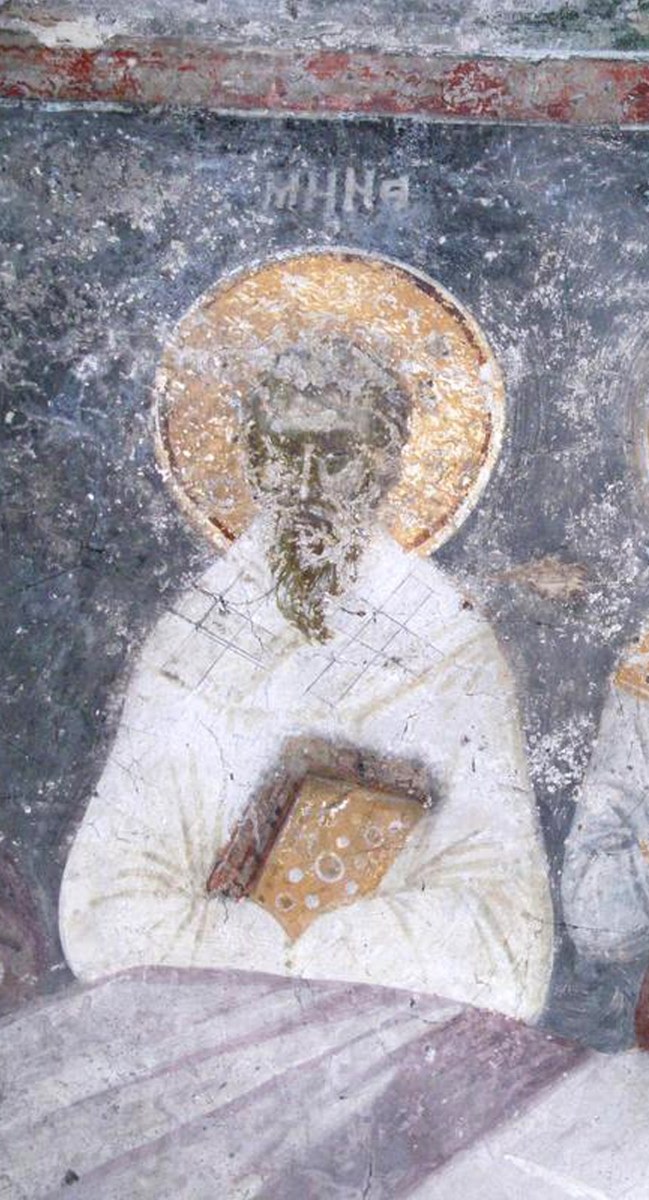
Menas is painted as a hierarch in the sanctuary register — the file of bishops who stand about the altar in the apse of a Byzantine church, vested for the eternal liturgy. He wears the polystaurion, the white phelonion strewn with dark crosses which is the vesture of the great sixth- to fourteenth-century hierarchs in painting, with the omophorion falling over it, and holds the jewelled Gospel in covered or bare hands. His type is an elderly man with a long, pointed and slightly forked grey beard and a high bare forehead; he carries no attribute, and identification depends entirely on the inscription, Ὁ ἍΓΙΟΣ ΜΗΝΑΣ or in Slavonic МИНА.
That last point is not academic. Because three saints named Menas are venerated in the same tradition, an unlabelled image is worthless as evidence: the soldier-martyr of Egypt is painted as a young beardless or short-bearded soldier, often flanked by two camels, and it is he whom most images titled "St Menas" depict. Only the vesture and the inscription mark the patriarch.
The stored image is a fourteenth-century fresco from the monastery of Gračanica in Kosovo, on the north wall of the northern transept, where Menas stands among a company of hierarchs. The Slavonic inscription МИНА is painted in white above the halo and is fully legible; the saint is shown bust-length in a white polystaurion of fine dark crosses with the omophorion crossed over the breast, the grey pointed beard, and a gold-and-jewelled Gospel held before him in both hands.
Disputed questions
-
A saint of the Three Chapters? Menas subscribed edicts that the Latin West regarded, at the time, as a betrayal of Chalcedon, and he was twice under papal excommunication. His veneration nonetheless stands in both East and West, and the Byzantine tradition treats his submissions as the pressure of an emperor upon a bishop rather than as heresy: the condemnation of the Three Chapters was in the event ratified by the Fifth Ecumenical Council, so that Menas's position was the one the Church came to hold. The entry records the reservation with which he signed and the retraction with which he ended, and does not smooth the episode over.
-
Not the martyr of Egypt. Menas the patriarch is repeatedly confused with the great soldier-martyr Menas of Egypt (November 11), the wonderworker of the Mareotis whose shrine at Abu Mena drew pilgrims from the whole Mediterranean, and with Menas, Hermogenes and Eugraphus of Alexandria (December 10). All three are Egyptians of the same name; only this one was a bishop. In images the difference is decisive — the martyrs are painted as soldiers or as laymen, the patriarch in the polystaurion and omophorion.