
Titus the Apostle
The Holy Apostle Titus of the Seventy, Bishop of Gortyna in Crete
Apostle of the Seventy · Bishop · b. 1st century, on Crete — d. c. 96–107, at Gortyna in Crete
Commemorated 25 August — Repose in peace at Gortyna
Titus is the Greek — the uncircumcised Gentile whom Paul took up to Jerusalem as a living argument, the disciple he trusted with the hardest errand of his ministry, and the man he left behind on Crete "to set in order the things that are wanting, and to ordain elders in every city" (Titus 1:5). He is numbered among the Seventy, is the addressee of one of the three Pastoral Epistles, and is honoured as the first bishop of Gortyna and the founder and patron of the Church of Crete. Born on the island of a distinguished pagan family, schooled in Greek philosophy and the poets, he came to Palestine, saw the Lord, was baptised by Paul and became his most trusted companion — carrying the severe letter to Corinth, gathering the collection for the saints of Jerusalem, going out to Dalmatia — and came home at last to Crete, where he reposed in peace at a great age and was buried at Gortyna. His feast is August 25, the day the Byzantine books keep together with the return of the relics of Bartholomew.
.jpg)
Origins on Crete
The synaxarion makes Titus a Cretan by birth, of an illustrious pagan house — some recensions of his Acts trace the family to the line of Minos, the island's mythical king — and his uncle is named as the proconsul or governor of Crete. He was given the education proper to such a family: Hellenistic philosophy and the ancient poets, in which he was thoroughly at home. What the lives insist upon is that the education did not corrupt him. He kept himself, they say, from the vices that were taken for granted in his world, and lived in virginity.
At about the age of twenty a voice came to him in a dream, telling him that this learning would not save his soul and that he must seek elsewhere. A year later he opened the book of the Prophet Isaiah and found there words that struck him as addressed to an islander like himself; the printed lives cite the chapter variously, and the reference is not stable across recensions. From that reading his conversion is dated.
To Palestine, and to Paul
When report came to Crete of a great Prophet in Judaea who healed the sick and raised the dead, the proconsul his uncle sent Titus to Palestine to see the thing for himself. He was there, the tradition says, for the whole of it: he heard the Lord's teaching, saw the Passion, and was in Jerusalem for the Resurrection and the Ascension; and — since the account places him among the crowd of Acts 2 — he heard the apostles speak in tongues at Pentecost. He received baptism at the hands of the Apostle Paul, and thereafter scarcely leaves his side.
This is the point at which the hagiographical life and the documentary record join. From here on Titus can be followed in Paul's own letters, which are unusually forthcoming about him — Paul writes of Titus with a warmth and a dependence he shows toward almost no one else.
The Greek who was not circumcised
The first firm notice is Galatians 2:1–5. Fourteen years after his conversion Paul went up to Jerusalem "with Barnabas, taking Titus with me also," to lay his gospel before the pillars of the mother church. Titus was a Greek, and Paul says flatly that he "was not compelled to be circumcised" — not, he adds, for all the pressure of "false brethren unawares brought in," to whom he "gave place by subjection, no, not for an hour."
Titus is therefore not merely a companion in that scene: he is the case. He stands in the apostolic history as the test instance of whether a Gentile could be a Christian without first becoming a Jew, and the answer given at Jerusalem is given over his uncircumcised body. The contrast with Timothy, whom Paul did circumcise (Acts 16:3) because his mother was a Jewess and the Jews of those parts knew it, is the sharpest single illustration in the New Testament of Paul's distinction between concession and principle.
The errand to Corinth
The second and fullest notice is in 2 Corinthians, and it is the record of a crisis. Paul had written the Corinthians a letter "out of much affliction and anguish of heart, with many tears" (2 Cor. 2:4) — the so-called severe letter, now lost — and had sent it by Titus. Then he could not bear the waiting. He went to Troas, where a door was opened to him in the Lord, and could not preach for anxiety: "I had no rest in my spirit, because I found not Titus my brother" (2:12–13). He crossed into Macedonia, and there at last the news came. "God, that comforteth those that are cast down, comforted us by the coming of Titus" (7:6); the Corinthians had received him "with fear and trembling," had repented, and Titus's own "inward affection is more abundant toward you" for it (7:15).
Paul then sent him back to Corinth a third time, to finish the collection for the poor saints at Jerusalem which the Corinthians had begun and left off — "as he had begun, so he would also finish in you the same grace also" (8:6). The language of the commission is remarkable: Titus is "my partner and fellowhelper concerning you" (8:23), he went "of his own accord" (8:17), and Paul's boasting of the Corinthians to Titus was not put to shame (7:14). When Paul answers the insinuation that his collection was a fraud, his defence is simply the character of the man who handled the money: "Did Titus make a gain of you? walked we not in the same spirit? walked we not in the same steps?" (12:18).
Crete, Dalmatia, and the Epistle
The Epistle to Titus finds him left on Crete: "For this cause left I thee in Crete, that thou shouldest set in order the things that are wanting, and ordain elders in every city, as I had appointed thee" (1:5). The letter is a bishop's charge — the qualifications of presbyters and of the episkopos, the silencing of "vain talkers and deceivers, specially they of the circumcision," the ordering of old men and old women, young women, young men, and servants, and one of the great compressed statements of the incarnation and of grace that trains the Christian in sober, righteous and godly living (2:11–14). It contains the famous quotation of the Cretan seer — Epimenides, by ancient identification — "the Cretians are alway liars, evil beasts, slow bellies," which Paul endorses as a true witness (1:12–13): a hard word about the island, quoted in a letter to the man who was to be its bishop.
The letter ends with a summons: "be diligent to come unto me to Nicopolis: for I have determined there to winter" (3:12). Whether Titus reached him is not said. The last mention of him in Scripture is a bleak one, from Paul's final imprisonment: "Titus is departed unto Dalmatia" (2 Tim. 4:10), in the same breath as the desertion of Demas. Byzantine tradition puts Titus in Rome at the end and has him present at Paul's martyrdom, after which he returned to Crete for good.
Bishop of Gortyna
Eusebius states plainly that "Titus was appointed to the churches in Crete" (Ecclesiastical History III.4.6) — the earliest external corroboration, and the ground of the whole later Cretan tradition. His see was Gortyna, the metropolis of the Roman province, on the Messara plain in the south of the island, and from that see the Church of Crete has counted its succession ever since. The lives credit him with the conversion of the island by preaching and by wonders, and record one set-piece: at his prayer the temple idols of Artemis (Diana) and of Zeus fell and were broken, and the crowds that had come to see the god defend himself were baptised instead. He is said to have ordained bishops for the other Cretan cities and to have governed his church in peace to the end.
Repose
Titus reposed in peace — one of the few apostolic men whose feast is not a martyrdom — at a very great age; the received life gives ninety-seven years, other recensions ninety-four. The Greek distich for the day is content simply to record it: "let a brief title go forth from us for Titus also, carrying his ending, which was in peace." At the moment of his death, the account says, his face shone like the sun. He was buried at Gortyna, in the church that bore his name.
Relics and later history
The Basilica of St Titus at Gortyna, whose sixth-century ruins still stand among the ruins of the ancient city, was the metropolitan church of Crete and the shrine of his tomb. When the Saracens overran the island in the ninth century the relic of his head was carried to safety at Venice, where it was kept in the treasury of St Mark's for well over a thousand years. It was restored to Crete in 1966, and is venerated today in the church of Agios Titos at Heraklion, the metropolitan church of the island.
Veneration and later cultus
Titus is the patron saint of Crete, and the invocation of his name has a political as well as a devotional history: "Ἅγιος Τίτος" — Saint Titus — was a Cretan rallying cry in the long insurrections against Venetian and then Ottoman rule, and the Church of Crete keeps him as its founder. His successors in the see of Gortyna include the hieromartyr Cyril of Gortyna (June 14), who was martyred there at ninety-three under Diocletian, and — after the see was reconstituted following the Arab period — Andrew of Crete (July 4), the great hymnographer, who as Archbishop of Crete sat in Titus's chair. A late-medieval Cretan fresco pairs Titus and Cyril as the two archbishops of the island, the first and the martyr; that fresco is the icon stored in Cyril's entry.
In the roll of the Seventy transmitted under the name of Dorotheus of Tyre he stands as bishop of Crete; see the Synaxis of the Seventy Apostles (January 4).
Feast and commemoration
Titus is commemorated on August 25 (church date; New Calendar civil August 25, Old Calendar civil September 7), the day of his repose. The Greek Menaion heads the day with two memories together — μνήμη τῆς ἐπανόδου τοῦ Λειψάνου τοῦ Ἁγίου ἐνδόξου Ἀποστόλου Βαρθολομαίου and μνήμη τοῦ Ἁγίου Ἀποστόλου Τίτου, Ἐπισκόπου Γορτύνης — so that the day belongs jointly to the returning relic of one of the Twelve and the repose of one of the Seventy. The apolytikion appointed is accordingly the common of apostles in the plural, serving both; the kontakia are proper and separate, Bartholomew's in Tone 4 and Titus's in Tone 2.
August 25 falls after the leavetaking of the Dormition (August 23) and four days before the strict fast of the Beheading of the Forerunner (August 29), in the free stretch at the end of the church year. The Dormition Fast has ended.
He is numbered with the rest in the Synaxis of the Seventy Apostles on January 4. On Crete his feast is kept as that of the founder of the local Church, with the greatest solemnity at Agios Titos in Heraklion, where his head is enshrined. The Latin Church keeps him on January 26 with Timothy, having moved him there in 1969 from February 6; the older Roman date was January 4.
Hymns
Apolytikion — Tone 3
Holy Apostles, intercede with the merciful God, that He grant unto our souls forgiveness of offences.
Kontakion — Tone 2
Shown forth as the companion of Paul, O Apostle, thou didst proclaim to us with him the word of the divine grace, O blessed Titus, speaker of the mysteries. Wherefore we cry to thee: cease not to intercede on behalf of us all.
Original translation from the Greek
Synaxarion
Let a brief title go forth from us for Titus also, bearing his ending, which was in peace. On the twenty-fifth, O Titus, thou didst obtain the heavenly pavement.
Iconography
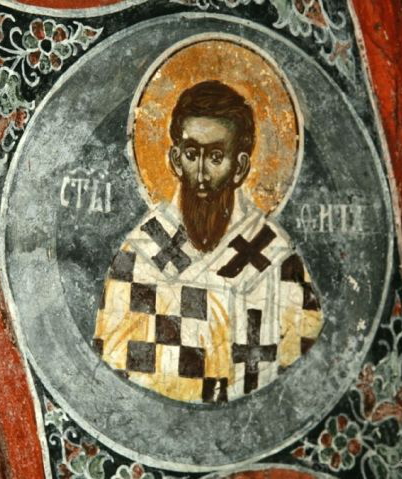
Titus is painted as a hierarch, not as a barefoot apostle: he wears the phelonion — often the white polystaurion, the cross-figured vestment of a bishop — with the omophorion over it, and holds the jewelled Gospel book in both hands or blesses with the right. His type is a man of middle to late years with dark hair going grey and a pointed brown beard of moderate length, thinner and less patriarchal than the great white beards of Basil or Nicholas. He is inscribed Ὁ ἍΓΙΟΣ ΤΙΤΟΣ or, in Slavonic, Стый апостолъ Титъ, and because he has no distinguishing attribute the inscription is what identifies him — an unlabelled bishop-medallion of his type could be any of a dozen saints.
His fixed places in a painted church are the hierarch register of the sanctuary, among the bishops who concelebrate the eternal liturgy around the altar, and, on Crete above all, the position of honour as founder of the local Church. Cretan and Venetian-Cretan painting frequently pairs him with Cyril of Gortyna as the two archbishops of the island, and later Cretan icons show him holding a scroll with the opening of his epistle or a model of the basilica at Gortyna.
The stored image is a fresco medallion of about 1350 from the church of St Nicholas at the Patriarchate of Peć in Kosovo — a bust of the hierarch in the white cross-patterned polystaurion and the omophorion, with the dark pointed beard, set in a painted roundel within a foliate border. The flanking inscription is damaged: Стый ("Holy") is clear to the left of the head and an abbreviated ап҃ ТI to the right, and the naming of the medallion in the Peć programme carries the rest of the identification.
Disputed questions
-
Why is Titus never named in Acts? He appears eleven or twelve times in the Pauline letters and not once in Luke's narrative, although the events of Galatians 2 and 2 Corinthians 7–8 fall squarely inside its span. The silence is old and unexplained. Proposals have included the guess that Titus was a relative of Luke's whom the evangelist passed over from modesty, and the identification of him with the Titius Justus of Acts 18:7, the God-fearer of Corinth in whose house Paul taught — a conjecture that has the merit of a name and a city but no early witness. The Church's books simply keep him without explaining the omission.
-
The date and authorship of the Epistle. Modern criticism treats the three Pastoral Epistles as a group and divides over whether Paul wrote them in a period of liberty after the Roman imprisonment of Acts 28, or whether they are the work of a later hand writing in his name to a settled church. The Orthodox Church receives them as Paul's, and the entry notes the debate without adopting the critical position; nothing in the Cretan tradition of Titus depends on it, since Eusebius's notice is independent of the letter.
-
How much of the Life is history? Almost every biographical detail outside the letters — the descent from Minos, the proconsul uncle, the dream at twenty, the reading of Isaiah, the presence at the Passion and Pentecost, the falling of the idols, the shining face — comes from the apocryphal Acts of Titus, a text ascribed to "Zenas the lawyer" (the Zenas of Titus 3:13) but in fact composed centuries after him, most probably on Crete and in the interest of the see of Gortyna. It is the direct source of the synaxarion notice. The entry reports it as tradition and not as record.
-
Ninety-four or ninety-seven? Both ages are in print in lives in current use. Neither is independently attested, and the difference is probably a copyist's.