
Prochorus the Deacon
The Holy Apostle Prochorus the Deacon, of the Seventy, Bishop of Nicomedia
Apostle · Apostle of the Seventy · Deacon · Bishop · Hieromartyr · d. 1st century, at Antioch
Commemorated 4 January — Synaxis of the Seventy Apostles, 28 July — Synaxis of the deacons Prochorus, Nicanor, Timon and Parmenas
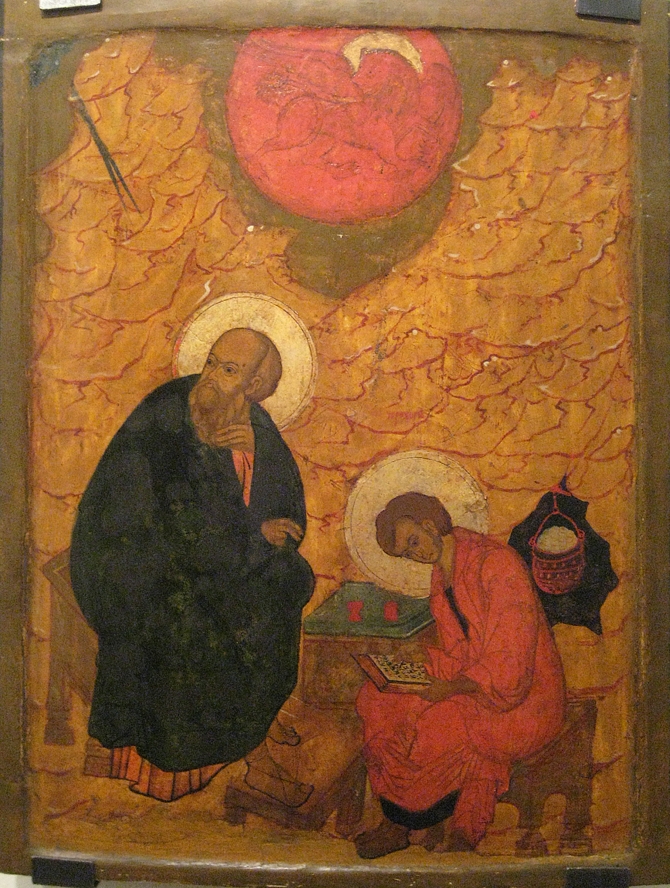
Prochorus was one of the seven deacons ordained by the Apostles in the earliest days of the Jerusalem church (Acts 6:1–6) and is numbered among the Seventy Apostles. The tradition makes him a companion first of the Apostle Peter, who set him over the church of Nicomedia in Bithynia, and afterwards of John the Theologian, whose disciple and amanuensis he became: it is Prochorus whom the whole Byzantine iconographic tradition shows seated at John's feet in the cave of Patmos, taking down at his dictation the words of the Apocalypse. Returning at length to his see, he went out preaching and is held to have finished his course as a martyr at Antioch. He is kept on July 28 with his fellow deacons Nicanor, Timon and Parmenas.

Among the seven deacons
Prochorus enters the record in the sixth chapter of the Acts of the Apostles. When the Greek-speaking believers of Jerusalem complained that their widows were passed over in the daily distribution, the Twelve — unwilling to leave the preaching of the word in order to serve tables — directed the community to choose out seven men of good repute, full of the Spirit and of wisdom, for that ministry. The seven set before the Apostles, who prayed and laid hands on them, were Stephen, Philip, Prochorus, Nicanor, Timon, Parmenas, and Nicholas the proselyte of Antioch (Acts 6:5–6). These seven the Church honours as her first deacons, and Prochorus is counted also among the Seventy whom the Lord had sent out two by two before his face (Luke 10:1) — hence the double style of the calendars, "Apostle and Deacon."
Bishop of Nicomedia
Beyond Acts the record is entirely traditional, and it is transmitted with unusual consistency. Prochorus is said to have attached himself to the Apostle Peter, and by Peter to have been ordained bishop of Nicomedia, the great city of Bithynia on the Propontis that would in the next age become an imperial capital and, under Diocletian, the scene of the fiercest of the persecutions. That a first-generation apostolic man should be placed at Nicomedia is entirely of a piece with the missionary geography of 1 Peter 1:1, which addresses the sojourners of Pontus, Galatia, Cappadocia, Asia and Bithynia.
With John the Theologian on Patmos
The most famous strand of the tradition attaches Prochorus not to Peter but to John the Theologian. He is remembered as John's companion and disciple in Asia, and as sharing his exile on Patmos under Domitian; and there, in the cave above the harbour of Skala, he wrote at John's dictation the Revelation — "he wrote down the book of the Apocalypse concerning the last things of the world," as the synaxarion notice has it. From this one sentence has come one of the most reproduced images in all Christian art: the aged Evangelist turning his head to the voice, and the young beardless scribe at his knee with pen and codex. The same tradition attributes to Prochorus a set of apocryphal Acts of John — the so-called Acts of John by Prochorus, a fifth-century Greek composition surviving in a great many manuscripts — which is the immediate literary source of most of the medieval Patmos legends. The attribution is pseudepigraphic and has never been received as history by careful writers; but the book's popularity is the chief reason the pairing of John and Prochorus became so fixed in the memory of the Church.
Martyrdom at Antioch
The received account brings Prochorus back from Patmos to his own church at Nicomedia, which he governed with zeal, and thence out again on missionary journeys. He is said to have preached at Antioch — the great see of the East, the city where the disciples were first called Christians — and there to have been put to death for the Gospel, so completing his ministry as a hieromartyr. Neither the year nor the manner of his death is transmitted; the synaxaria say only that he was perfected in martyrdom at Antioch. His memory is accordingly of particular interest in the Antiochian tradition, which counts among the martyrs of its own city one of the seven first deacons of the Church.
Feast and commemoration
July 28 (church date; Old Calendar civil August 10), kept as the joint synaxis of the four deacons Prochorus, Nicanor, Timon and Parmenas, of whom Prochorus is named first. The four died at different times and in different places — Nicanor at Jerusalem in the persecution that broke out at Stephen's stoning, Prochorus at Antioch, Timon at Bostra, Parmenas in Macedonia — and the July feast gathers them not by a common martyrdom but by their common ordination in Acts 6. Nicanor is kept in addition on December 28, in the train of the Protomartyr Stephen's feast; Philip the Deacon has his own day on October 11, and Stephen on December 27 with the translation of his relics on August 2. All seven are further commemorated in the Synaxis of the Seventy Apostles on January 4. The day falls in the open season between the Apostles' Fast and the Dormition Fast, so that only the ordinary Wednesday and Friday rule applies. Universal usage.
Hymns
Troparion — Tone 3 (common of the holy apostles)
O holy Apostles, intercede with the merciful God, that he may grant to our souls the forgiveness of our sins.
Original translation from the Greek
Iconography
Prochorus is almost never shown alone. His image in the tradition is the Patmos dictation — one of the settled compositions of Byzantine and Russian art, and the standard frontispiece of Gospel and Apocalypse manuscripts: the cave of the revelation, the rock cleft above, the aged John the Theologian seated or half-turned with his hand to his ear, listening to the voice out of heaven, and at his feet or at a low desk the young, beardless, haloed Prochorus, pen in hand, writing in an open codex. The image stored here is a seventeenth-century Russian panel from Nizhny Novgorod: John in a dark mantle on the left, the mountain of Patmos rising in gold and red behind, and Prochorus in a red himation bent over the book, the inkwell and pen-case hanging on the rock beside him. Where Prochorus is shown in his own right — in the ranks of the Seventy, or in the deacons' row of a sanctuary programme — he wears the deacon's sticharion and orarion and carries a censer or a small casket, in the type established for the seven deacons by Stephen.
Disputed questions
- Not to be confused with Prochorus of the Kiev Caves (†1107, February 10), the Russian ascetic called "the Goosefoot-eater," nor with the fourteenth-century Byzantine theologian Prochorus Cydones, brother of Demetrius Cydones, who is no saint of the Church at all but a Thomist condemned by the synod of 1368.
- Peter's disciple or John's? The two strands of the tradition — ordination by Peter to Nicomedia, and discipleship with John in Asia and on Patmos — are not incompatible, and the synaxaria simply lay them end to end. Critical hagiography treats the Patmos material as a fifth-century literary elaboration built on the bare Acts notice, and the Nicomedian episcopate as an early see-list attribution of the kind attached to nearly all of the Seventy. What is historically secure is the single verse of Acts 6.
- The Acts of John by Prochorus is universally recognised as pseudonymous. Nothing in it can be used as evidence for the historical Prochorus, and the Orthodox tradition receives it as edifying narrative and not as scripture or as history.