
Timon the Deacon
The Holy Apostle Timon the Deacon, of the Seventy, Bishop of Bostra
Apostle · Apostle of the Seventy · Deacon · Bishop · Hieromartyr · d. 1st century, at Bostra in Arabia
Commemorated 4 January — Synaxis of the Seventy Apostles, 28 July — Synaxis of the deacons Prochorus, Nicanor, Timon and Parmenas
Timon was one of the seven deacons ordained by the Apostles at Jerusalem in the first days of the Church (Acts 6:1–6) and is numbered among the Seventy Apostles. The tradition sends him out from Jerusalem to Bostra, the caravan city of the province of Arabia, as its first bishop, and remembers him for a deliverance out of a furnace: cast into the fire by Jews and Greeks together, he is said to have walked out of it unharmed. Of his end the sources differ — some say he was crucified, others that he died in peace after his preaching — and the calendars accordingly style him now hieromartyr, now simply apostle. He is kept on July 28 with his fellow deacons Prochorus, Nicanor and Parmenas. As bishop of a see of the Arabian province, historically within the orbit of the patriarchate of Antioch, he belongs to the earliest layer of the Antiochian tradition's own memory.

One of the seven
The single certain fact about Timon stands in Acts 6. The Hellenist believers of Jerusalem complained that their widows were being neglected in the daily ministration; the Twelve bade the community choose seven men "of good report, full of the Holy Spirit and wisdom," and set them over that service, that the Apostles themselves might give themselves to prayer and the ministry of the word. The seven were Stephen, Philip, Prochorus, Nicanor, Timon, Parmenas and Nicholas the proselyte of Antioch; the Apostles prayed and laid their hands upon them. From this ordination the diaconate of the Church takes its origin, and Timon is honoured with his six colleagues as one of its first bearers. The tradition further reckons him among the Seventy sent out by the Lord (Luke 10:1).
Bishop of Bostra in Arabia
The apostolic see-lists — the catalogues transmitted under the names of Hippolytus and of Dorotheus of Tyre, which assign each of the Seventy a city — make Timon bishop of Bostra (Βόστρα, the modern Bosra in southern Syria). The city was the chief place of the Nabataean kingdom and, after Trajan's annexation in 106, the metropolis of the Roman province of Arabia, a great crossroads of the caravan trade between Damascus and the Red Sea. Ecclesiastically Bostra was to become the metropolitan see of Arabia within the patriarchate of Antioch — the see of Beryllus, whom Origen brought back from error, and later of Titus of Bostra, the fourth-century opponent of the Manichees. That the tradition placed one of the seven deacons at its head is a claim to the apostolicity of a see that mattered greatly to the Antiochian church.
The furnace
The one narrative episode transmitted of Timon is his deliverance from the fire. His preaching, the notice says, provoked both the Jews of the city and its pagan Greeks, and they made common cause against him; he was seized and thrown into a burning furnace, and came out of it unhurt, preserved by the power of God — the deacon's passion cast in the mould of the Three Children in the furnace of Babylon (Daniel 3), a pattern the hagiographers used often for the confessors of the apostolic age. The episode is the reason his iconographic notices sometimes place a flame beside him.
Repose or crucifixion
The end of Timon is the point on which the sources part company. One line of the tradition, followed by the Slavonic synaxaria and by the Orthodox Church in America's notice, records that he was finally crucified, and so is honoured as a hieromartyr. Another, older and barer, says only that he preached, wrought his deliverance from the fire, and reposed in peace at Bostra. The Greek Menaion's own notice for July 28 does not resolve it; and since neither line can be checked against anything earlier than the medieval synaxaria, this collection records both and prefers neither. The types of this entry follow the majority usage of the calendars, which style him hieromartyr.
Feast and commemoration
July 28 (church date; Old Calendar civil August 10), in the joint synaxis of the four deacons Prochorus, Nicanor, Timon and Parmenas. The four are gathered by their common ordination in Acts 6 and not by a common death: the tradition places Nicanor's martyrdom at Jerusalem in the persecution at Stephen's stoning, Prochorus's at Antioch, Timon's at Bostra and Parmenas's in Macedonia. Timon is commemorated again with all his brethren in the Synaxis of the Seventy Apostles on January 4. The Roman Martyrology keeps him on April 19. Universal usage.
Hymns
Troparion — Tone 3 (common of the holy apostles)
O holy Apostles, intercede with the merciful God, that he may grant to our souls the forgiveness of our sins.
Original translation from the Greek
Iconography
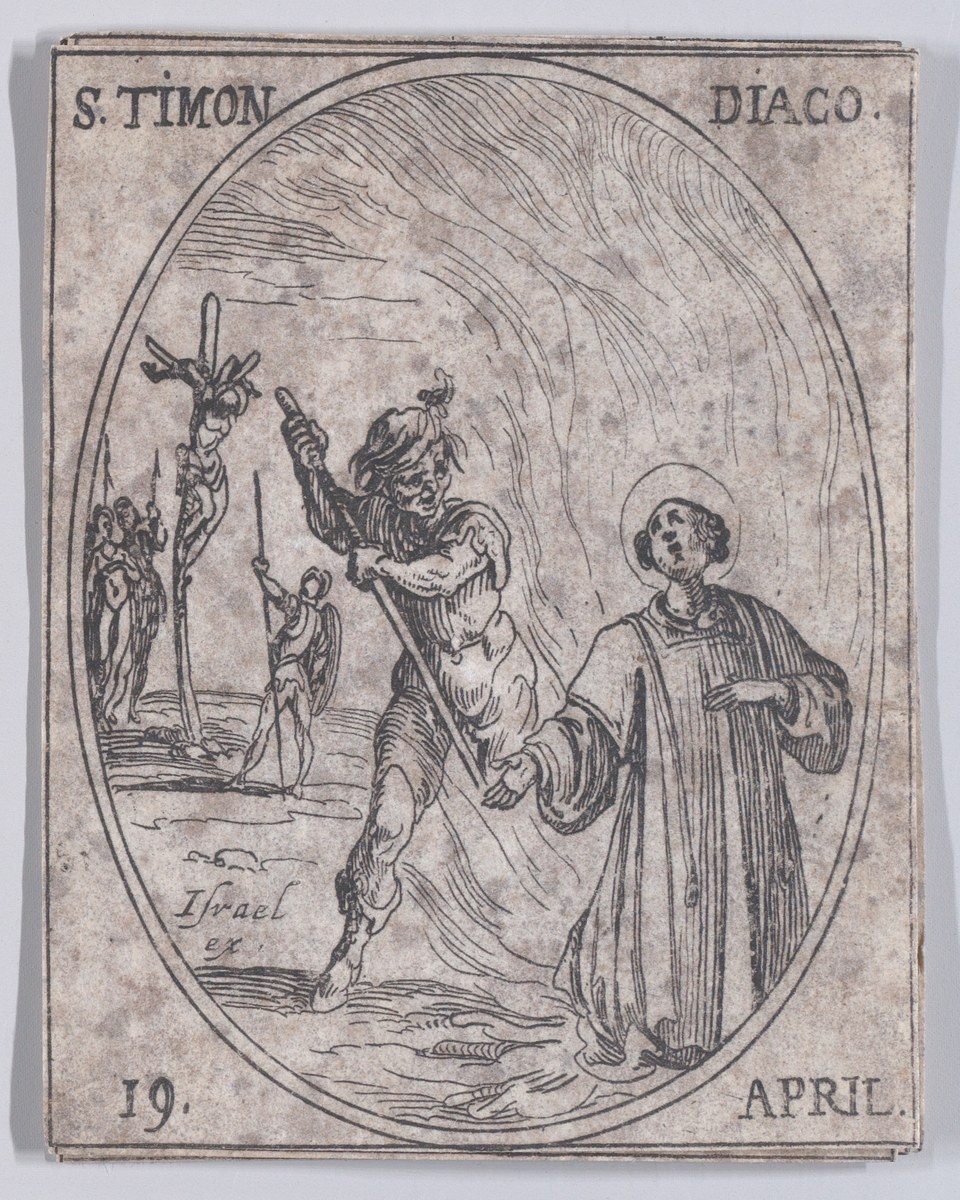
Timon is shown, like the rest of the seven, as a deacon of the apostolic generation: young or middle-aged and dark-haired, sometimes lightly bearded, in the white or pale sticharion with the orarion over the left shoulder, holding a censer in one hand and a small liturgical casket in the other — the type set by Stephen and repeated in the deacons' register at the foot of sanctuary and prothesis walls throughout the Byzantine world. Where he is distinguished, it is by the flames of the furnace at his feet or by the bishop's omophorion worn over the deacon's dress, an iconographic compromise for a man remembered in both orders. He appears among the ranked figures of the Synaxis of the Seventy Apostles. The stored image is a Western work per §34: Callot's etching from Les Images de tous les saincts (1636, Metropolitan Museum), captioned S. Timon Diaco. — the deacon in the sticharion turning from the raised club of his executioner toward the cross of his end. An Eastern image remains wanted and is listed among the upgrade-wanted icons; the July date rules out the Menologion of Basil II, which covers only September to February.
Disputed questions
- The name is otherwise almost unknown in Christian antiquity, which has occasionally led to speculation that "Timon" is a shortened form of Timotheus. There is no evidence for this, and the four transmitted lists of the Seventy all keep the two names apart: Timothy, the disciple of Paul and bishop of Ephesus (January 22), is a distinct person with a wholly distinct dossier.
- Bostra or elsewhere? A minority of the see-lists give Timon no city at all, and the Bostra attribution belongs to the same class of late apostolic geography as the rest of the catalogue. It is nonetheless the universal reading of the Byzantine calendars.
- Crucifixion or peaceful repose — see above. The calendars that print him as hieromartyr and those that print him simply as apostle are both defensible on the transmitted evidence.