
Sabbas of Krypetsk
Our Venerable Father Sabbas, Abbot and Wonderworker of Krypetsk
Venerable · Wonderworker · b. c. 1425, in the Serbian lands (uncertain) — d. 28 August 1495, at the Krypetsk monastery near Pskov
Commemorated 28 August — Repose at Krypetsk (1495)
Sabbas of Krypetsk (†1495) was an Athonite monk who came north into the Russian lands, spent some years in the crowded monasteries of the Pskov country, and then went out alone into an all but impassable bog fifteen versts from the nearest house to find the solitude he wanted. Disciples found him anyway; a monastery of St John the Theologian grew up on the island of firm ground in the marsh, and he refused to be its abbot, appointing the monk Cassian in his place and keeping for himself the last place in the choir. He was famous in Pskov for two things during his life — the causeway he built with his own hands across the swamp, so that people could reach the church, and his flat refusal to let any woman inside the enclosure, which cost the wife of the city's own governor a healing at the gate rather than at the tomb. He reposed on August 28, 1495; his relics were revealed some fifty years later, his Life was written by the Pskov priest Basil in 1555, and his feast was established at the same time.

Origins and the road north
Almost nothing certain is known of his birth. The Life written for his canonisation states only that he came from the Serbian lands and that he received the monastic habit on Mount Athos, and later Russian tradition has generally taken him for a Serb; the Life is sixty years after his death and the detail cannot be checked. What is not in doubt is the Athonite tonsure, and the particular stamp it left: the hesychastic pattern of solitary prayer with a small community around it, which had come north in these generations with the disciples of Gregory of Sinai and had already remade Russian monasticism once.
He came to the Pskov country in the middle of the fifteenth century. He tried first the monastery on Snetnaya Gora, the Snetogorsk house above the Velikaya, and found it too full and too near the city; then he went to the community on the river Tolva — the Eleazar (Spaso-Eleazarov) monastery, then under the great Pskov ascetic Euphrosynus — and stayed some years. But he had not come north to live in a large monastery, and the abbot at last blessed him to go.
The bog
He went out about fifteen versts from the Tolva into the Krypetsk wilderness: a tract of forest and standing water where the only dry ground was a low island in the middle of a bog, with a small lake beside it. There he built a cell and lived alone, on what the forest gave, for a number of years — the Life says he ate only bread and water, and that in the beginning he had no companion but the wild beasts of the place, which did him no harm.
Solitude of that quality is not kept secret in a Russian province. Men came out across the marsh to see him, and stayed, and after some years asked him to make them a monastery and to build a church in honour of the Apostle and Evangelist John the Theologian. He agreed to the monastery and refused the headship of it: he named the monk Cassian abbot, and himself took the lowest place, obeying the man he had appointed. It is the same self-effacement the desert fathers practised and the Russian north repeated: he governed by not governing.
The practical problem of the site he solved himself. The monastery could be reached only by wading, and the Life records that Sabbas went out with the brethren and built a causeway — a timber road laid over the bog — so that pilgrims and the poor could come dry-shod to the church. He is said to have worked on it with his own hands like the youngest of them.
The prince, the princess, and the gate
The monastery had no title to its land, which in the Pskov republic was a dangerous condition. In 1487 the governor of Pskov, Prince Yaroslav Vasilievich Obolensky, obtained for it from the city a deed to its ground and its waters, and the charter survives as the firmest date in Sabbas' life.
The reason for the prince's favour is the best-known story about the saint. The prince's wife was gravely ill — paralysed, in the usual telling — and he brought her out through the forest to the holy man. Sabbas would not admit a woman inside the enclosure, and said so, and did not bend when it was the governor of Pskov who asked. He came out to the gate instead, prayed over her there, and she was healed at the gate; and the prince, warned by the saint against the custom he had been about to break, went home and gave the monastery its charter. Later generations kept a stone cross at the place, and the prohibition itself as a rule of the house.
Repose, relics, and later cultus
He reposed on August 28, 1495, having spent, by the Life's reckoning, some forty years in the Krypetsk wilderness. He was buried in the monastery he had refused to govern.
The tradition of his intercession begins at once. The most-repeated miracle is posthumous: a band of robbers came by night to plunder the monastery treasury and were met in the yard by a venerable elder with a staff, of great authority, who rebuked them and told them to repent; they fled, and afterwards recognised him from the icon, and came back to confess. The story is told in the Life as the reason for his title of wonderworker.
In the middle of the sixteenth century the saint appeared, according to the same source, to the monk Isaiah of the monastery and showed him where his body lay; the relics were uncovered incorrupt, and were kept thereafter in the church of St John the Theologian. In 1555 the Pskov priest Basil — the hagiographer also known as Vasily-Varlaam, who wrote the lives of several of the Pskov and Novgorod saints in these years — compiled the Life of Sabbas of Krypetsk, and his commemoration was established on the day of his repose.
The Krypetsk monastery of St John the Theologian remained one of the principal houses of the Pskov land. It was closed under the Soviet power and its buildings ruined; it was returned to the Church in 1990 and the relics of its founder, which had been hidden, were recovered and restored to the monastery in 1997. Sabbas is numbered among the Synaxis of the Saints of Pskov.
Feast and commemoration
August 28 (church date; New Calendar civil August 28; Old Calendar civil September 10), the day of his repose, kept in the Russian Church and by the OCA; the Greek and Antiochian calendars do not keep him. He is commemorated also with the Synaxis of the Saints of Pskov, and locally at Krypetsk on the day of the uncovering and of the 1997 return of his relics. The day is the eve of the strict fast of the Beheading of the Forerunner, and he shares it with Moses the Ethiopian, the Synaxis of the Fathers of the Kiev Far Caves, and the uncovering of the relics of Job of Pochaev.
Not to be confused with Sabbas of Storozhevsk (December 3), Sabbas of Moscow, or Sabbatius of Solovki.
Hymns
Troparion — Tone 8
In thee, O Father, was preserved unimpaired that which is according to the image; for taking up the cross thou didst follow after Christ, and by thy deeds thou hast taught us to overlook the flesh, for it passeth away, but to care for the soul, a thing immortal. Wherefore, O venerable Sabbas, thy spirit rejoiceth with the angels.
Original translation from the Slavonic
Kontakion — Tone 8
Fleeing the noise of the world thou didst hide thyself in the marshes, and God made thy hiding-place a lamp to the land of Pskov; thou wouldst not be called abbot, and art called a wonderworker; wherefore we cry to thee: rejoice, O venerable Sabbas, boast of the Krypetsk wilderness.
Original translation from the Slavonic
Iconography
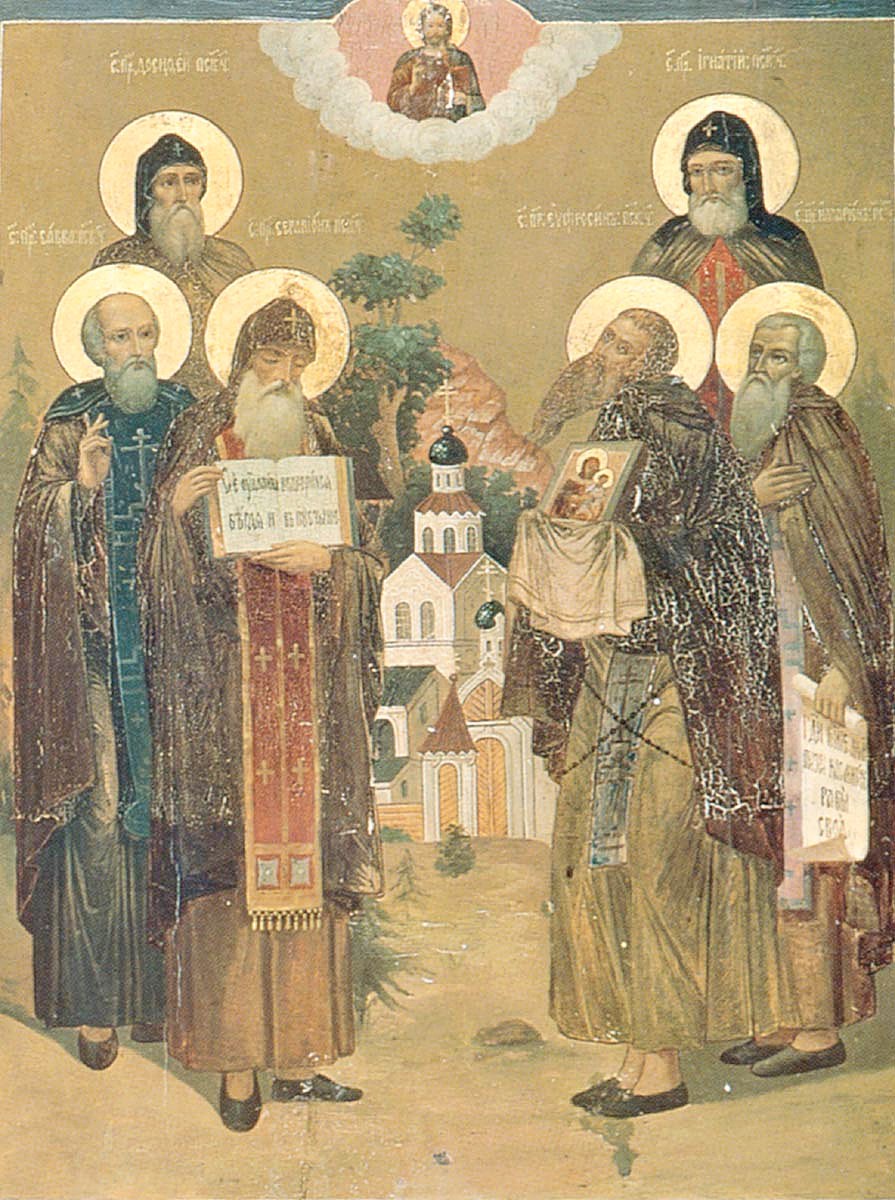
Sabbas is painted as an old monk of the Russian northern type: long, narrow, grey-brown beard, the mandyas over the rason, the koukoulion thrown back or worn, holding a scroll and often a staff — the staff being iconographically significant, since the robbers who fled the monastery knew him afterwards by it. The developed hagiographic icon of the Pskov workshops sets him full-length in the centre with the monastery of St John the Theologian in his hand or at his feet, the lake and the timber causeway indicated below, and scenes of his life in the border: the tonsure on Athos, the coming to the bog, the healing of the princess at the gate, the building of the causeway, the repose, and the routing of the robbers. He appears also among the ranks of the Synaxis of the Saints of Pskov, beside Euphrosynus of Pskov, Nicander of the Desert, and Cornelius of the Pskov Caves.
No pre-1900 icon of Sabbas of Krypetsk in a verifiable public-domain reproduction has been located for storage in this collection.
The stored image is a 19th-century icon of the Pskov venerables, each named by inscription, Sabbas of Krypetsk among them at their head.
Disputed questions
Serbian or Russian? The Life's statement that he came "from the Serbian lands" is the only evidence, and some historians have preferred to read it as meaning only that he came by way of the Serbian monastery on Athos, or have doubted it altogether. His name in religion is that of the great Serbian hierarch Sabbas of Serbia, which may be a trace of his origin or may simply be a common monastic name.
Dates. Only 1487 (the charter) and 1495 (the repose) are documentary. His birth about 1425, his arrival in the Pskov country, and the forty years in the wilderness are all inferences from the Life, which was written sixty years after his death; the Wikidata entry's birth-year of c. 1250 is an error with no basis in the sources.