
Sabbas Stratelates
The Holy Martyr Sabbas Stratelates, the General, and the Seventy Soldiers with him
Martyr · Wonderworker · d. 272, drowned in a river at Rome
Commemorated 24 April — Martyrdom by drowning at Rome with the seventy soldiers
Sabbas the Stratelates — "the General" — was a Goth by birth who rose by his courage to high command in the Roman army under the emperor Aurelian (270–275). A Christian from his youth, he spent his pay on the poor and his liberty on visiting confessors in prison, and received from God the gift of healing the sick and driving out demons. Denounced to the emperor, he unbuckled and threw down the soldier's belt that was the badge of his rank rather than deny Christ; and when torture — the scourge, the lighted torches, the cauldron of pitch — left him unharmed, seventy soldiers of his own command confessed Christ and were beheaded where they stood. Comforted in prison by a vision of Christ, Sabbas was tortured again the next morning and then drowned in a river, about the year 272.

A Goth in the service of Rome
The synaxaria are unanimous that Sabbas was of the Gothic nation — one of the many Germanic foederati and recruits who by the third century filled the ranks and even the higher commands of the Roman army. Nothing is transmitted of his homeland or his family. His rank is given as στρατηλάτης, stratelates: in the Byzantine hagiographical vocabulary the word covers any senior field commander, and it is the same title borne by the great-martyrs Theodore Stratelates of Heraclea and Andrew Stratelates. He served under Aurelian, the soldier-emperor who reunited the divided empire between 270 and 275 and whose reign the Church remembers for a short but severe harassment of Christians in its closing years.
What the tradition emphasises is not his campaigns but the manner of his life inside a pagan army. He had been a Christian from his youth and did not conceal it in private practice: he gave to the destitute, ransomed and relieved prisoners, and went into the gaols to visit Christians held there for the faith — a work of mercy that in a persecuting reign was itself a species of confession. The account adds that for the purity of this life God gave him a charism of healing: he cured the sick and cast out unclean spirits by naming Christ, so that he was known among the soldiers as a wonderworker before he was known as a martyr.
The belt thrown down
Sabbas's Christianity was reported to the emperor. Aurelian, who valued him as an officer, required only the ordinary formality: let him sacrifice, or at least deny. Sabbas answered by unbuckling his military belt — the cingulum militiae, the visible sign of rank and of the oath that bound a Roman soldier to his emperor — and casting it down before the tribunal. The gesture is the hinge of his passion, and the hymnography seizes on it: he laid aside the belt and honours of an earthly rank in order to keep the service of the heavenly King. Having surrendered his commission he was no longer an officer to be disciplined but a Christian to be broken.
He was beaten; he was scorched with lighted torches or tapers; and he was thrown into a cauldron of pitch. The passion relates that he came out of each of these untouched, the pitch not harming his flesh. Whether these details are read as literal history or as the settled idiom in which the martyrological tradition confesses the powerlessness of torture against grace, the narrative function is the same, and the next event depends on it.
The seventy soldiers
The spectators of a soldier's execution were soldiers. Watching a man they had served with stand unhurt in the middle of his torments, seventy of them declared themselves Christians on the spot. There was no trial and no interval: they were beheaded with the sword immediately, and the Church keeps their memory with Sabbas's own on this day, the Greek synaxarion noting simply that they believed through him and were cut down. They are among the clearest instances in the martyrologies of the pattern the ancient Church observed again and again — that the persuasive power of the martyr's endurance worked first and most often on the men detailed to inflict it.
The vision in prison and the drowning
Sabbas was returned to prison. There, at midnight, as he stood at prayer, Christ appeared to him and shone upon him with the light of His glory, bidding him not to fear but to take courage, for his contest was nearly finished. Strengthened by the vision, he endured a further round of torments in the morning; and when these too failed to move him, the sentence was changed to drowning. He was taken to a river and thrown in, and so died, about the year 272.
The Greek verses of the day turn the manner of his death into its own paradox: drowned in water, he was the one who drowned the demons of delusion. It is the same figure of speech that the tradition applies to Sabbas the Goth a century later — a coincidence which, as noted below, has cost the two saints a good deal of confusion.
Veneration and later cultus
Sabbas is a saint of the universal Byzantine calendar, entered in the Synaxarion of Constantinople and carried in the Greek Menaion for April 24 with proper verses. He has a proper troparion and kontakion in the Slavonic books, which is a mark of more than minimal cultus: the Russian tradition kept him with some warmth, and it is from Russia that the surviving icon-panels of him come. In the Greek usage his commemoration stands in the shadow of the venerable Elizabeth, whose canon occupies the day's office, and of George the Great Martyr the day before; his soldiers' company is remembered with him.
Feast and commemoration
April 24 (church date; New Calendar civil April 24, Old Calendar civil May 7). The feast is universal. On the New Calendar reckoning followed by the Antiochian Archdiocese the day usually falls in the Paschal season or the last days of Great Lent, depending on the year; the Old Calendar Churches — Russian, Ukrainian, Serbian, Georgian — keep it on civil May 7, which is why Russian sources habitually cite that date. Sabbas is commemorated together with the seventy soldiers converted by his endurance, who have no separate feast. In the Greek Menaion the day's proper office belongs to the venerable Elizabeth; Sabbas and his soldiers are commemorated in the synaxarion notice and in stichera, a common arrangement when two saints of unequal hymnographic provision fall together.
Hymns
Troparion — Tone 5
Leaving behind the belt and the honours of earthly rank, O sufferer, thou didst confess before the tyrant, the deceitful emperor, that Christ is truly God; and for His sake thou didst endure many torments, O glorious one. Therefore wast thou wreathed with the surpassing crown of victory by the King of all who reign, and wast made radiant among the heavenly hosts. Standing now before Him, O Sabbas, pray that our souls may be saved.
Original translation from the Greek
Kontakion — Tone 4
Shown forth unconquerable, O commander, thou didst overthrow the cunning of the barbarians; and contending most steadfastly, O glorious one, thou didst put to flight a multitude of invisible foes, and so didst weave for thyself the crown of victory. Pray thou to Christ for us who honour thee with faith, O all-blessed Sabbas.
Original translation from the Greek
Iconography
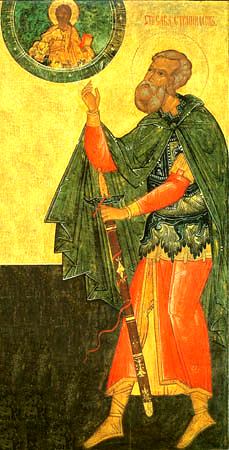
Sabbas Stratelates is painted as a military saint, but of the older and quieter type rather than the armoured warrior: middle-aged, with a full dark beard going to grey, in the long red tunic of the soldier under a green campaign cloak fastened at the shoulder, standing on the gold ground. He holds a spear or a long staff-cross — the instrument of a commander converted into the sign of his contest — and often the martyr's cross in the other hand. The distinguishing feature of the developed Russian type is the blessing hand of Christ, or Christ in a medallion, appearing in the upper corner of the panel: the martyr looks up and raises his hand toward the vision, which is the iconographic notation of the appearance of Christ to him at midnight in the prison. He may also be shown with the discarded belt at his feet, and in narrative cycles with the cauldron of pitch, the beheading of the seventy soldiers, or his own drowning.
The stored image is a pre-1900 Russian panel inscribed in Church Slavonic С(ВЯ)ТЫЙ САВВА СТРАТИЛАТЪ — "Holy Sabbas Stratelates" — showing exactly this type: the bearded general in the green mantle over a red tunic, staff in hand, gazing up at Christ enthroned within a green-and-gold medallion at the upper left, whom he salutes with his raised right hand.
Disputed questions
- Not to be confused with Sabbas the Goth (commemorated April 12, †372) — the confusion most likely to occur, and the one worth stating plainly, because the two saints share four distinctive features: the name Sabbas, Gothic origin, martyrdom by drowning in a river, and feast days twelve days apart in the same month. They are nevertheless certainly distinct men, a century apart and in different worlds. Sabbas the Goth was a layman, a reader and psalm-singer of a Christian village beyond the Danube, drowned in the river Mousaios (Buzău) in 372 in the persecution of the Gothic king Athanaric, and his passion survives in a contemporary letter sent from the Gothic church to Cappadocia. Sabbas Stratelates was a Roman general of Gothic stock serving inside the empire, martyred under a Roman emperor, Aurelian, about 272. Popular Russian icon-captioning has occasionally gone so far as to call the two "twins," which is a description of the resemblance, not a claim of identity.
- Not to be confused, further, with the monastic Sabbases of the calendar: Sabbas the Sanctified (December 5), the founder of the Great Lavra in Palestine; Sabbas of Serbia (January 14), the first archbishop of the Serbs; Sabbas of Storozhevsk (December 3); and — on this very day — Sabbas (Savva) the Recluse of the Kiev Far Caves (13th century) and Sabbas Brancovici, Metropolitan of Ardeal (†1683), both of whom share April 24 with the Stratelates in the Slavonic and Romanian calendars. The epithet Stratelates is proper to this Sabbas alone.
- The place and the river. The Byzantine title "of Rome" and the Latin-Western reading of the passion put the martyrdom at Rome, and Aurelian's presence there in the early 270s is consistent with it; the river is then, naturally, identified as the Tiber, as several modern reference works do. But the ancient notice names no river, and the identification is an inference rather than a datum. It should be reported as such.
- The date 272. The year is a conventional one, derived from placing the martyrdom early in Aurelian's reign rather than from any dated source; some accounts simply give "under Aurelian, 270–275."
- The number seventy. Round numbers of companions (seventy, forty, a thousand) are a known feature of the martyrologies, and the seventy soldiers may well be a traditional figure rather than a count. The Church commemorates them as she received them.