
Simeon the Myrrh-gusher of Serbia
Our Venerable and God-bearing Father Simeon the Myrrh-gusher, Grand Župan of Serbia
Venerable · Wonderworker · Prince · b. c. 1113, at Ribnica in Zeta (near modern Podgorica), as Stefan Nemanja — d. 13 February 1199, at the monastery of Hilandar on Mount Athos
Commemorated 13 February — Repose at Hilandar as the monk Simeon; the myrrh-streaming of his relics
Simeon the Myrrh-gusher (c. 1113 – 1199), born Stefan Nemanja, was the Grand Župan (grand prince) who gathered the scattered Serbian lands into a single state, won their independence from Byzantium, rooted out the Bogomil heresy, and founded the Nemanjić dynasty that ruled Serbia for two centuries and gave it a line of saints. A great builder of churches — Đurđevi Stupovi, and above all his burial-church of Studenica — he abdicated his throne in 1196 in favour of his son Stefan, was tonsured a monk under the name Simeon, and went to end his days on Mount Athos beside his youngest son, the monk Sava. There father and son together refounded the ruined monastery of Hilandar as the great Serbian house of the Holy Mountain. Simeon reposed at Hilandar on 13 February 1199; from his relics there flowed a fragrant, healing myrrh, and when Sava translated them home to Studenica they streamed myrrh again and reconciled his warring sons. He is the first-glorified saint of the Nemanjić house — the root of the "holy vine" of Serbian sovereign-saints — and is kept on February 13.

Origins and the winning of a Serbian state
Stefan Nemanja was born about the year 1113 at Ribnica, in the maritime Serbian land of Zeta (near modern Podgorica), the youngest son of a Serbian prince of the house of the župani of Raška. Because Zeta lay within the jurisdiction of the Latin Church, the infant was first baptised in the Latin rite; brought back to the interior, he was re-baptised into the Orthodox Church by the bishop of Ras, in the church of Saints Peter and Paul — an event the tradition dwells on, for it made the founder of Christian Serbia twice-born into the faith of the East. He grew up in a Serbia divided among quarrelling princes and pressed between the great powers of the age — the Byzantine Empire to the south and east, the kingdom of Hungary to the north, the maritime cities and the Latin west along the Adriatic.
Rising to rule about 1166, Nemanja made himself Grand Župan — the senior prince — and over thirty years of war and statecraft welded the Serbian principalities into one realm. He threw off, warred against, submitted to, and at last outlasted the overlordship of the Byzantine emperor Manuel I Komnenos; after Manuel's death in 1180, with the empire falling into disorder, he secured a Serbia effectively independent, extending its borders, taking the towns of the Morava valley and the coast, and giving the Serbian state the shape and the centre — the land of Raška — from which it would grow into the medieval Serbian kingdom and empire. He is thus honoured as the founder of the Serbian state in its lasting form, and the father of the Nemanjić dynasty, which through his sons and their descendants ruled Serbia until 1371 and produced, in an unbroken succession, its greatest kings and several of its saints.
The defender of Orthodoxy and builder of churches
Nemanja understood the unity of his realm as inseparable from the unity of its faith. The most dangerous solvent of both was the Bogomil heresy — the dualist, world-denying movement, kin to the Cathars of the West, that had struck deep root in the Balkans. About 1176 he summoned a great council (sabor) of his land, and there condemned the Bogomils, driving their teachers out, burning their books, and confiscating the goods of the obstinate — a stern campaign by which, the Serbian tradition holds, he cleansed his country of the heresy and set Orthodoxy as the foundation of the state. To Orthodoxy he gave not only law but stone: he was among the greatest church-builders of the medieval Balkans, founding and endowing monasteries that became the cradles of Serbian art and letters — Đurđevi Stupovi ("the Towers of Saint George," c. 1171) near Ras, the church of the Holy Virgin at Toplica, and, greatest of all, about 1190, the monastery of the Dormition at Studenica, which he built as his own foundation and his intended tomb — its marble church the masterpiece of the "Raška school" and the mother-house of Serbian monasticism. Studenica would receive his relics and become the shrine of the founder-saint.
Wife, sons, and the holy family of the Nemanjići
Nemanja married Ana (Anastasia), a noblewoman, and their marriage became the root of a whole dynasty of saints. Their sons were Vukan, prince of Zeta; Stefan, the middle son and heir, who would be crowned "the First-Crowned" king of Serbia; and the youngest, Rastko, who fled the world for Mount Athos and became Sava, the first Archbishop and enlightener of the Serbs. When Nemanja himself took the monastic path, his wife Ana was likewise tonsured, as the nun Anastasia, and is venerated among the Serbian saints; so that the Serbian Church keeps father, mother, and son — Simeon, Anastasia, and Sava — as a holy household, and speaks of the "holy vine" or holy lineage (sveta loza) of the Nemanjići, the sovereign house from whose stock so many saints sprang. Sava, the son who had first drawn his father toward the monastic life, would in time write his Life — the first work of original Serbian biography — and enrol the founder of the dynasty among the saints.
Abdication and monastic tonsure
At the height of his power, and full of years, Nemanja resolved to lay down the world. In the spring of 1196, at a solemn assembly of the Serbian land at Ras, he abdicated the throne — passing the grand-princely rule not to his eldest son Vukan but to the middle son Stefan, whom he judged the fitter heir — and on the same day, in his own foundation of Studenica, received the monastic tonsure and the name Simeon. His wife Ana was tonsured with him, as the nun Anastasia. For a time the aged monk-prince remained at Studenica in prayer and penitence; but his heart was drawn to the Holy Mountain, where his son Sava had gone before him, and about 1197–1198 he left Serbia to end his days as a simple monk of Mount Athos.
Symeon and Sava: the founding of Hilandar
On Athos the old founder-prince became a novice again under the guidance of the child he had begotten. Simeon joined Sava first at the Greek monastery of Vatopedi, where he had entered; and there, father and son, they conceived the work that would crown both their lives. They obtained from the Byzantine emperor Alexios III Angelos — to whom Simeon was bound by marriage-alliance — and from the Protaton of the Holy Mountain the grant of the ruined and abandoned monastery of Hilandar, and rebuilt and endowed it (by the imperial chrysobull of 1198) as an autonomous Serbian monastery on Athos, held of the Serbian crown. Hilandar became — and to this day remains — the great Serbian house of the Holy Mountain, the cradle of Serbian literacy, translation, hymnody, and monastic culture, and the spiritual heart of the Serbian Church beyond its borders. That the first work of the abdicated Grand Župan and his monk-son should be a monastery is the seal of the whole Nemanjić ideal: the Christian state crowned and completed by the monastic life.
Repose and the myrrh
Simeon did not long survive the founding. Worn with age and ascetic labour, he reposed at Hilandar on 13 February 1199, tended to the last by his son Sava, who received his father's soul and buried him in the monastery he had raised. Almost at once the tomb bore witness: from the relics of the monk-prince there began to flow a fragrant, healing myrrh (miro), a sweet oil that streamed from his body and worked wonders on the sick who anointed themselves with it — the sign by which the Church knew him for a saint and gave him the name he bears, the Myrrh-gusher (Serbian Mirotočivi, Greek Myroblytes, "the myrrh-flowing"). He was the first canonised saint of the Nemanjić dynasty, glorified by the son who had made him a monk.
Translation to Studenica, and the reconciliation of the sons
After his father's death Serbia fell into civil war between the brothers Stefan and Vukan, who contended for the throne. Sava, still a monk of Athos, was besought to come home and heal the realm; and about 1207 he returned, bearing his father's relics back to Serbia, and laid them in the church of Studenica, the monastery Simeon had built for his tomb. There, at the shrine of the founder-saint, Sava gathered his warring brothers, and over the myrrh-streaming body of their father reconciled them — the incorrupt and fragrant relics of the Myrrh-gusher becoming the very instrument of the peace of the kingdom. From Studenica, as its hegumen, Sava then set about the reform of the whole Serbian Church, which would lead in 1219 to its autocephaly and his own consecration as its first archbishop. Thus the founder-saint, dead, went on founding: the myrrh of Simeon watered the peace of Serbia and the birth of its independent Church.
Miracles and the myrrh-streaming
The relics of Simeon streamed myrrh not only at his Athonite tomb and at Studenica but, the tradition holds, on the appointed days of his memory and at times of the nation's need; a vine (loza) that sprang, the legend says, from the empty tomb at Hilandar where his body had first lain became itself a source of wonders — its dried grapes given to the childless, whom the saint's intercession was believed to make fruitful, so that the "vine of Saint Simeon" is venerated at Hilandar to this day and joins in name and in fact the image of the holy vine of his saintly progeny. Through his relics and his myrrh the Serbian people have honoured him for eight centuries as the healer, protector, and father of the nation, the founder who continued after death to gather and to bless the realm he had made.
Feast and commemoration
Simeon is commemorated on February 13 (church date; New Calendar civil February 13, Old Calendar civil February 26), the day of his repose at Hilandar. He is one of the foremost saints of the Serbian Orthodox Church, kept throughout Serbia and the Serbian diaspora — where his day (observed on the Old Calendar, so civil February 26) is honoured with especial solemnity at Studenica, which guards his relics, and at Hilandar on Athos, his tomb and his foundation. His veneration is universal in the Byzantine churches; the OCA and the Slavic calendars keep him on February 13, several styling him "King of Serbia." The Serbian tradition remembers him together with his son Sava (Jan 14) and his wife the nun Anastasia, the holy household from which the Nemanjić "holy vine" of saints sprang; father and son, the two founders — of the state and of the Church — are the twin pillars of Serbian sanctity, and are constantly named and depicted together.
Hymns
Troparion — Tone 3
Enlightened from on high by the grace of God, O our venerable father Simeon, thou didst forsake an earthly rule and its passing glory, and taking up the yoke of Christ in the monastic life didst shine yet more brightly than before; where- fore, after thy repose, thou pourest forth a sweet-smelling myrrh of healing upon all who draw near with faith to thy holy shrine. Glory to him that gave thee strength; glory to him that crowned thee; glory to him that worketh through thee healings for all.
Original translation from the Slavonic
Kontakion — Tone 6
Having embraced the angelic life upon the earth, and put away the cares and sweetness of the world, thou didst follow after Christ in fasting and in prayer, O God-bearing Simeon, and didst guide thy people into the knowledge of God; wherefore Christ hath glorified thee with the gift of myrrh, that we who honour thee may cry: Rejoice, O founder and father of thy land.
Original translation from the Slavonic
Iconography
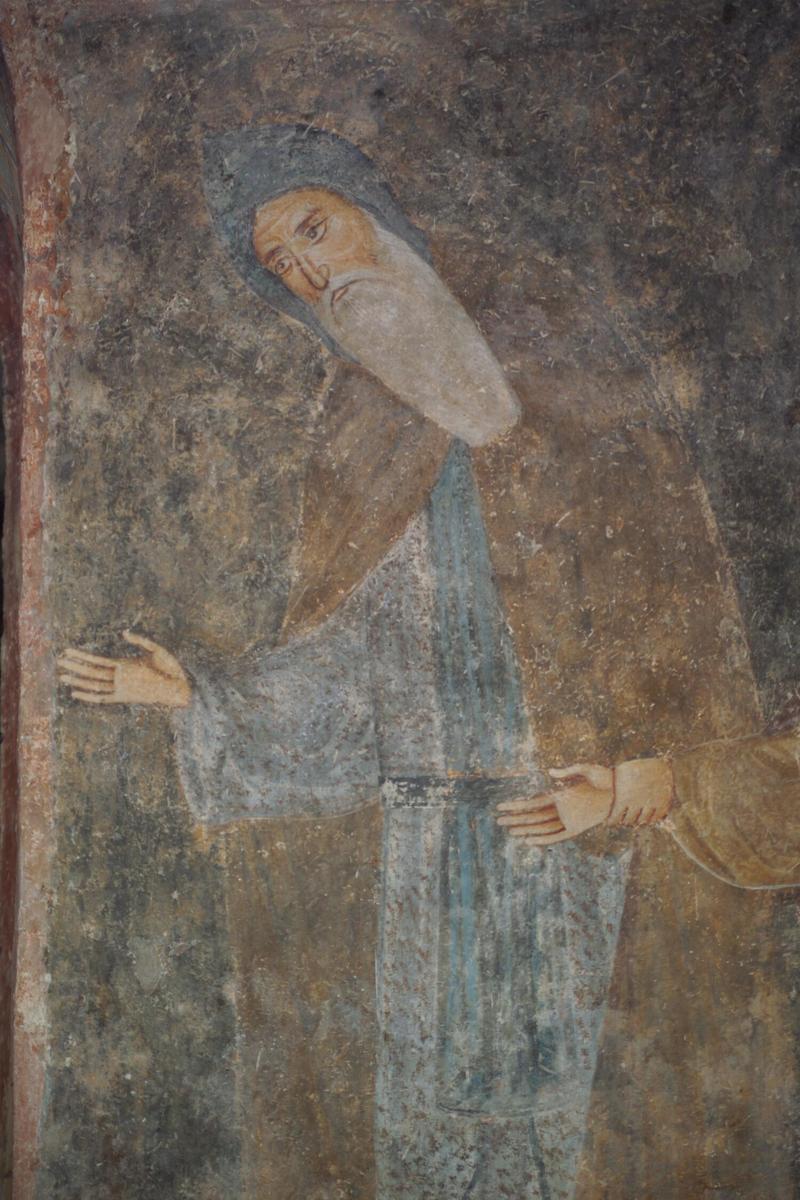
Simeon is depicted as an aged monk — white-bearded, in the dark monastic habit and often the great schema, sometimes crowned or set beside the emblems of the rule he laid down — for his image holds together the two states of his life, the sovereign who became a monk. He is very frequently shown paired with his son Sava, the two founder-saints of the Nemanjić house standing together, Simeon the monk and Sava the archbishop; and he appears throughout the great fresco cycles of the medieval Serbian monasteries he and his descendants raised — Studenica (his tomb), Sopoćani, Mileševa, Gračanica, Dečani, the Peć patriarchate — both in portrait and in the narrative scenes of his Life: his tonsure, the founding of Hilandar, his repose tended by Sava, and the myrrh-streaming of his relics. He figures too in the dynastic composition of the "holy vine of the Nemanjići" (loza Nemanjića) — the Serbian version of the Tree of Jesse, in which the saintly kings and archbishops of the house spring as branches from the reclining figure of Simeon, its root.
The stored image is one of the most venerable of his portraits: a thirteenth-century fresco of Saint Simeon (Stefan Nemanja) from the Sopoćani monastery, a foundation of his great-grandson King Uroš I and one of the summits of medieval Serbian painting — the founder haloed and vested as a monk in the grave, luminous manner of the Sopoćani masters.
Disputed questions
- The year of birth. The sources do not fix it; c. 1113–1114 is the commonly received date, reckoned back from his career, with some variation.
- The regnal dates. Nemanja's rise to the grand-župan's throne is variously dated in the 1160s (commonly 1166); the chronology of his long contest with Byzantium is reconstructed from Greek and Serbian sources and is not everywhere certain. His abdication (1196) and repose (13 February 1199) are firmly fixed.
- "King" or "Grand Župan." Nemanja never bore the royal title; he ruled as Grand Župan (veliki župan), grand prince. The royal crown came to his house only with his son Stefan the First-Crowned (crowned king in 1217). Several notices — including the OCA — nonetheless style Simeon "King of Serbia," honouring him as founder of the royal dynasty; the entry keeps the historically exact title (Grand Župan) and records the honorific usage. His royal rank in the types is given as prince accordingly (the sovereign founder), per the taxonomy's royal-office set.
- Not to be confused with the several other saints named Simeon/Symeon: not with Symeon the God-receiver (the Elder of the Meeting, Feb 3); nor with Symeon the Stylite of the Pillar; nor with Symeon the New Theologian; nor with Symeon the Ancient of Syria; nor with the Russian Simeon of Verkhoturye; and — a near-collision of epithet — not with Simon the Myrrh-gusher, the Athonite founder of Simonopetra (Dec 28), a wholly distinct saint whose by-name is likewise "the Myrrh-gusher." "Simeon the Myrrh-gusher of Serbia," the monk-prince Stefan Nemanja, is this saint alone.