
Cyril of Gortyna
The Holy Hieromartyr Cyril, Bishop of Gortyna in Crete
Hieromartyr · Bishop · b. c. 206 — d. c. 299, at a place called Raxos in Crete
Commemorated 14 June — Martyrdom by beheading (the day of the received Greek Menaion), 9 July — The day kept in the Russian and OCA calendars
Cyril was bishop of Gortyna, the metropolis of Roman Crete and the see founded by the Apostle Titus, and he was martyred there as a very old man in the persecution of Diocletian and Maximian. The synaxarion gives his story with unusual and memorable particularity: he had lived austerely as an ascetic, was consecrated bishop in his sixty-eighth year, governed his flock twenty-five years, and was then brought before the governor Agrianus; condemned to the fire, he stood unhurt while his bonds burned away and the pyre fell to ashes, and was let go. When he went on converting the pagans he was sentenced again — a bridle put in his mouth, and, being ninety-three and unable to walk, set on an ox-cart to be carried to execution. At a place called Raxos the oxen halted of their own accord, and there he was beheaded. The Greek Menaion keeps him on June 14; the Russian and American calendars on July 9.

The see of Gortyna
Gortyna on the Mesara plain was the capital of Crete under Rome, and its church claimed the Apostle Titus (August 25), whom Saint Paul left in the island "to set in order the things that are wanting, and to ordain elders in every city" (Titus 1:5), as its first bishop. Its bishops therefore ranked as archbishops or metropolitans of Crete, and Cyril is inscribed on the frescoes beside Titus with that title. His own life before the episcopate is described in the synaxarion in the language reserved for ascetics: he passed his years in holiness and austerity, and he was already old — in his sixty-eighth year — when he was consecrated bishop. He then governed the Cretan church for twenty-five years, into the reign of Diocletian and the persecution that began in 303.
The fire that would not burn
Cyril was arrested and brought before a governor whom the Greek synaxarion names Agrianus (Ἀγριανός). He confessed Christ with an old man's fearlessness — the synaxarion's distich turns precisely on this: though Cyril of Gortyna was an old man, he had a heart still young toward the sword — and was condemned to be burned alive. He was bound and thrown into the fire; and the account relates that the cords fell away burnt from his limbs, the wood of the pyre was reduced entirely to ashes, and the bishop stood in the middle of it wholly unharmed. The governor, whatever he made of it, set him free.
The ox-cart and Raxos
Freedom was not retirement. Cyril went back to his preaching, and the number of pagans he brought to the faith made the sentence inevitable a second time. This time there was no trial by fire. He was gagged — a bridle was put in his mouth, the humiliation reserved for the incorrigibly outspoken — and because he was now ninety-three years old and could not walk to the place of execution, he was loaded onto an ox-wagon and driven out of the city. When the wagon reached a place called Raxos, the oxen stopped of themselves and would go no further; and there the old bishop was beheaded, and received the martyr's crown. The detail of the halting oxen is the kind of thing that only a local memory transmits, and it is preserved in the received synaxarion without embellishment.
Feast and commemoration
June 14 on the church calendar (Old Calendar civil June 27) in the received Greek books, where he is the third name of the day after the Prophet Elisha and Methodius of Constantinople, commemorated in the synaxarion with a distich but with no proper office of his own; the office of the day is the prophet's and the hierarch's. The Russian and American calendars commemorate him instead on July 9. On Crete he is honoured with the other saints of Gortyna and Arkadia in the local synaxis, and beside the Apostle Titus, whose successor in that see he is.
Hymns
Troparion — Tone 4 (common of a hieromartyr)
As a sharer in the ways and a successor to the thrones of the Apostles, thou didst find in the practice of virtue the means to ascend to divine heights, O divinely-inspired one; rightly dividing the word of truth, thou didst contend for the faith even unto blood, O hieromartyr Cyril: intercede with Christ God that our souls may be saved.
Original translation from the Greek
Synaxarion
Though Cyril of Gortyna was an old man, he had a heart still young toward the sword.
Iconography
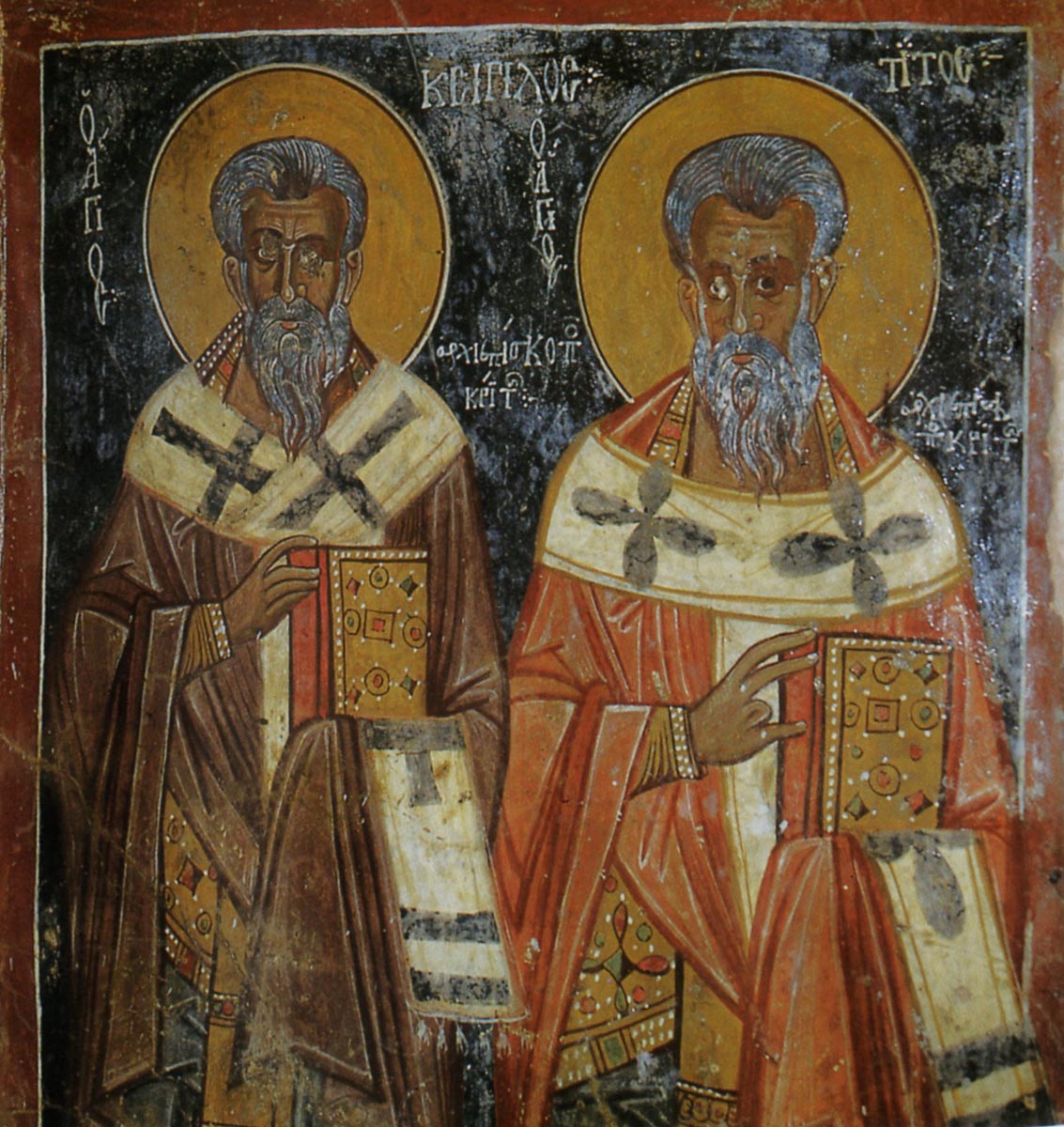
Cyril is painted as a very aged hierarch — white-haired and white-bearded, in phelonion and crossed omophorion, holding the jewelled Gospel — and his fixed companion in Cretan painting is the Apostle Titus, his predecessor in the see, the two standing side by side and both inscribed archbishop of Crete. Narrative depictions show his two condemnations: the pyre from which he stepped out unburnt, and the ox-cart with the bridle in his mouth, which is his own unmistakable attribute where it appears. A miniature of his martyrdom is found in the illustrated chronicle tradition.
The stored image is a Cretan fresco of the thirteenth to fifteenth century of the two archbishops of Crete, inscribed Ὁ ἅγιος Κύριλλος ἀρχιεπίσκοπος Κρήτης over the left figure and Ὁ ἅγιος Τίτος over the right: Cyril in a brown-purple phelonion with the dark-crossed omophorion and a long white beard, holding the Gospel in a veiled hand.
Disputed questions
- The date of the feast: June 14 or July 9. The received Greek Menaion and the Synaxaristes of Nikodemos the Hagiorite commemorate him on June 14, with the distich given below, and that is the day followed here. The Russian calendars and the Orthodox Church in America keep a "Hieromartyr Cyril, Bishop of Gortyna" on July 9. The two are the same saint; both dates are recorded in this entry's feasts, and the disagreement is not resolved.
- The year and the emperor. June 14 sources give the year 299 under Diocletian and Maximian; the July 9 tradition says he suffered "either under Decius (249–251), or according to other sources under Maximian (284–305)." Since the persecution in the provinces belongs to 303–304, and since the synaxarion's own arithmetic (consecrated at 68, bishop 25 years, martyred at 93) is internally consistent, a death about the turn of the fourth century is the best reading; a Decian date would require a different and much earlier man.
- The length of the episcopate. Twenty-five years in the Greek account; fifty years in the OCA life. The governor is Agrianus in the Greek and Lucius in the Russian. These are the clearest signs that two branches of one tradition are at work, and that the July 9 and June 14 notices were transmitted separately for a long time.
- A second Cyril of Gortyna. Dositheos of Jerusalem, in the Dodekabiblos, records another hieromartyr Cyril of Gortyna who was killed by the Saracens in 780 for refusing to deny Christ, and from whose wounds myrrh is said to have flowed instead of blood. Whether this is a genuinely distinct saint or a displaced doublet of the older bishop is unsettled; the possibility is recorded here so that images and notices of "Cyril of Gortyna" are not assumed to belong to one man.
- Not to be confused with Cyril of Alexandria, Cyril of Jerusalem, or the Slavonic Cyril the Philosopher.
The same see of Gortyna was held four centuries later by Andrew of Crete (†c. 740, July 4), the hymnographer of the Great Canon, whose homily on Saint Titus is one of the witnesses to the early history of the Cretan church.